by Amal Zadok
Introduction
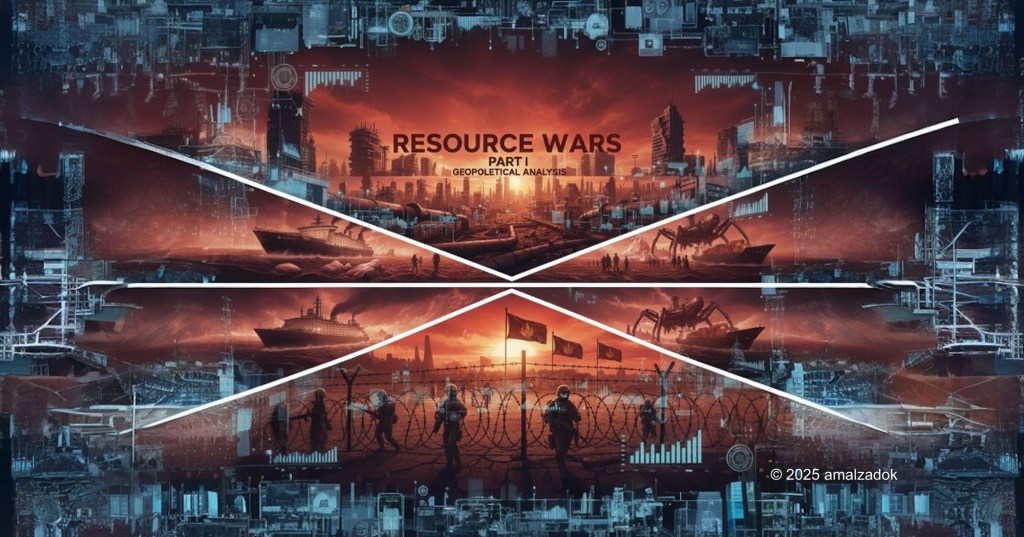
This exposé is presented in two uncompromising parts, designed to capture the full, global breadth of the new resource wars and their human cost. In a world driven by the scramble for gas, oil, water, minerals, and the land that conceals them, conflicts are no longer isolated incidents—they are interconnected fronts in a global campaign of extraction and domination.
Part I: Genocide, Gas, and Extraction—The New Battlefields
Part I investigates how entire populations and states, from Gaza to Ukraine, have become collateral for strategic plunder. You will uncover the real motives driving the devastation of Gaza, the resource ambitions underlying Russia’s war with Ukraine, and the water crisis emerging as the next epoch-defining frontline. This section reveals the hidden economic drivers, colonial logic, and geopolitical blueprints shaping today’s most explosive conflicts—showing why modern warfare cannot be understood without following the flow of resources.
Part II: Superpower Rivalry, Scarcity, and the Road to Collapse
Part II widens the lens to the geopolitical chessboard: the scramble for the Arctic, the green transition’s new domains of exploitation, and the intensifying siege around Venezuela’s oil and South America’s minerals. Here, readers will see how economic warfare, sanctions, and chokepoints are transforming globalization into a zero-sum game, why China’s logistics revolution is reshaping influence, and how the final collapse of world morality is spelled out in each ruined nation and dying river. You will be confronted with the ultimate question: will humanity unite to reclaim the future, or choose plunder until nothing remains?
Part I: Genocide, Gas, and Extraction—The New Battlefields
Resource Wars Redraw the Global Map
The global order is splitting open, revealing its raw, predatory mechanics. Beneath the slogans of democracy and human rights, the planet obeys a single law—the law of extraction. The twenty-first century is the age of resource wars, where dominance is measured not by moral pretense, but by control of civilization’s vital lifeblood: gas, oil, water, minerals, and the invisible circuits of data. Gaza, Ukraine, Venezuela, and the fast-drying rivers of Africa and Asia are not just separate tragedies—they are theaters of the same global war.
Gaza: Genocide for Energy Supremacy
In Gaza, the stakes are economic, not ideological. Beneath the bombed coastline lies the Gaza Marine gas field, discovered in 1999 and left dormant for a generation. It contains enough natural gas to make the Palestinian people economically independent, perhaps even prosperous. Such independence is anathema to those who rule by dependency. Since its discovery, every attempt by Palestinians to harness this strategic gas has been blocked or destroyed by Israel—with tacit Western complicity.
Every “security operation,” every bombardment, every euphemism of “self-defense” has cleared the way for a singular goal: full Israeli control of offshore gas extraction and the permanent exclusion of Palestinians from their resource future. Expulsion, starvation, and annihilation have another endgame—to make room for uncontested resource domination. Gas, not land, is the prize. Each demolished home and murdered child is collateral damage in the drive to claim a corridor for gas exports to a Europe desperate for energy supplies after cutting ties with Russia. The world’s silence is betrayal. This is not security—it is colonialism remastered: genocide as business strategy.
The Billion-Dollar Gas Field: Ownership Versus Annihilation
The Gaza Marine project—potentially worth billions per year for Palestine—remains trapped in crossfire. The prize isn’t just revenue or electricity; it is the promise of true sovereignty. Recognition of Palestinian statehood could unlock this windfall, but Israel’s calculation is ruthless: only dead or exiled Palestinians guarantee uncontested extraction and export. The ghosts of Gaza call out as witnesses to a crime whose means is violence, and whose ultimate justification is profit.
Ukraine: NATO’s Encroachment, Russian Fears, and Western Resource Ambitions
The war in Ukraine is not just a contest over territory or ideology—it is a struggle that unites existential security fears and clear-eyed economic ambitions. In Moscow’s view, NATO’s relentless expansion eastward has always represented an existential threat; Ukraine’s potential entry into the alliance, combined with the alliance’s burgeoning bases and weaponry at Russia’s borders, triggered a response that the Kremlin insists was inevitable: the so-called “special operation,” a preemptive push to reclaim a strategic buffer and prevent NATO’s reach from reaching the very heart of the Russian homeland.
Yet as Russian forces have fought to assert control over Ukraine’s eastern and southern regions, a second and equally voracious game is underway—being played by America and Europe. For Western powers, the war is not just about defending “democracy” or deterring Russian aggression; it is explicitly about gaining privileged access to Ukraine’s immense treasure trove of resources. Ukraine is blessed with colossal deposits of rare earth metals, critical minerals such as graphite, lithium, and titanium, fertile farmland, and hydrocarbon reserves considered strategic for the future of the European Union’s energy security and America’s technological supremacy.
In recent years, the US, in partnership with the EU, has rapidly established “Reconstruction Investment Funds” and mineral extraction agreements that will see American and European firms receive preferential rights to Ukraine’s most valuable subsoil assets.
These deals are often lauded as rebuilding efforts, but in practice, they cement the West’s stake in postwar Ukraine, ensuring that Ukraine’s rare earths, agrarian wealth, and energy play a central role in shoring up Western economic power and the green transition.
For the US, it is a double gain: breaking China’s grip on critical minerals while cementing Europe’s dependence on American-controlled supply lines.
This “resource diplomacy” is not abstract—it is already drawing clear lines of profit and dependency for decades to come. Even as the frontlines shift and civilians suffer, contracts for mining, drilling, and export are being signed at breakneck pace—promising private investors and Western states a direct cut of Ukraine’s mineral and agricultural bounty after the war. Some regions rich in minerals remain under dispute or Russian occupation, but for both the West and Moscow, these underground riches remain at the heart of the contest.
Thus, Ukraine’s fate is now being shaped by twin imperatives: Russia’s drive to survive what it calls Western encirclement, and America’s and Europe’s blunt ambition to control the resources that will fuel their futures. Control over Ukraine is, in the final calculus, a battle for both security and supply—one in which survival, sovereignty, and staggering profit are all at stake.
Water Wars: The Coming Battle for Survival
If oil is the blood of modern civilization, water is its breath—without it, life, industry, and agriculture collapse. Yet as the century turns, a global water catastrophe is no longer a distant warning, but a grinding reality: more than two billion people now lack access to safely managed drinking water, and half the planet faces chronic shortages or unsafe supplies each year.
From dried river basins to shrinking lakes and failing aquifers, water crises now destabilize economies and ignite violent conflicts in every hemisphere.
Agriculture, responsible for the majority of water consumption, is under siege amid droughts, desertification, and erratic weather. Failed crops and livestock wipe out entire regional economies, triggering food shortages, hyperinflation, and waves of hunger-induced migration. Africa’s Nile basin is a battlefield for political survival, as Ethiopia’s mega-dam risks plunging Egypt into catastrophic water stress.
In South Asia, rivers crossing contested borders have become weapons, squeezing neighbors into submission with engineered scarcity.
In the Middle East, water control is the silent accomplice to occupation and genocide; Palestinians in Gaza and the West Bank are denied access to their most
vital resource, forced into dependence by Israeli policy and regional power plays.
Across Latin America and the world, private investors and conglomerates race to monopolize aquifers and groundwater rights, treating this most essential public good as a luxury commodity.
Experts warn that by the decade’s end, two-thirds of humanity may experience severe water stress. The next wars—more than any fought for oil or minerals—will be sparked by thirst. In this era, access to water will draw new borders, incite rebellions, and determine whether nations rise or fall
©️2025 Amal Zadok. All rights reserved.
Subscribe and never miss an article!
 Think and be Free!