by Amal Zadok
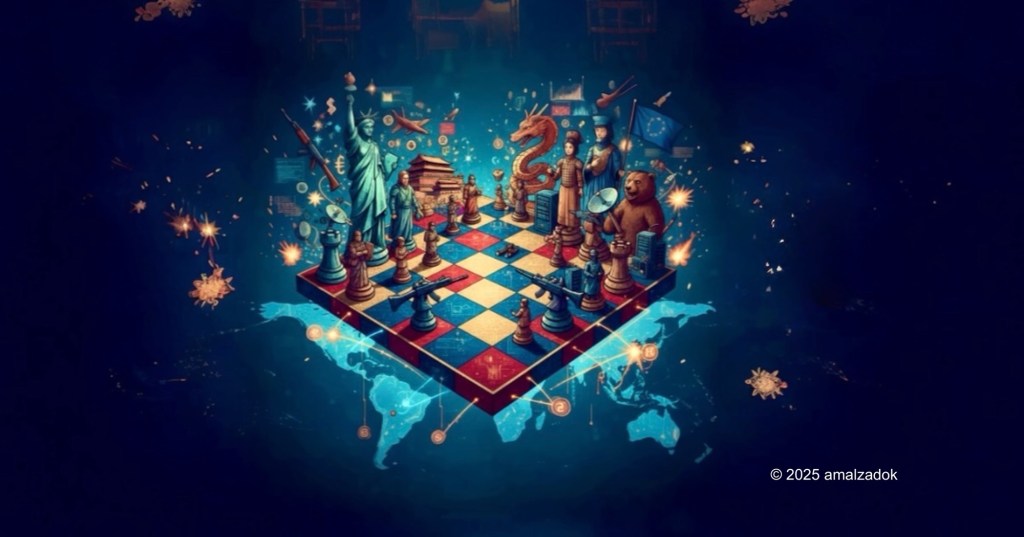
In the mid-2020s, inside the third decade of the 21st century (2021–2030), the architecture of international relations has become chaotically multipolar. No longer does “leverage” reside in the hands of a single power, nor can military force alone impose diplomatic solutions. The collapse of hallmark negotiations—most notably the 2022 Istanbul process aiming to end the war in Ukraine—exposed the Western bloc’s inability to enforce compromise, shut the doors on genuine negotiation, and set the stage for a new era of relentless, multidimensional conflict (Moscow Times, 2025; Intellinews, 2024; Responsible Statecraft, 2025). On the contemporary chessboard, financial warfare, technological embargoes, proxy confrontations, and psychological operations intertwine—heralding what some analysts perceive as an asymmetric Third World War (Defensa, 2025; Ogutcu, 2024; CSIS, 2025).
The Death of Leverage: U.S. and the European Landmass
American influence in Europe has ebbed as the ground realities of Ukraine’s war and Europe’s security needs have shifted. Once, U.S. leverage meant dictating both terms and outcomes, but by 2025, the capacity to project power—militarily or diplomatically—has faded.
The withdrawal from Ukraine as a “primary guarantor of European security” and reluctance to back unconditional NATO expansion for Ukraine, coupled with a rising European sentiment for autonomy, have eroded Washington’s legacy leverage (Cato Institute, 2025; Council on Foreign Relations, 2025; RFE/RL, 2025).
According to retired General Keith Kellogg, U.S. strategists are struggling to define what credible deterrence and leverage mean in a fragmented world where compromise is inevitable and military guarantees are no longer reliable (Fox News, 2025; Council on Foreign Relations, 2025).
The fragmentation of leverage was laid bare in the failure to secure a peace deal during the 2022 negotiations in Istanbul. The draft proposed Ukrainian neutrality and security guarantees, yet disagreements over territorial integrity and future Western obligations led to a breakdown.
The discovery of mass atrocities in Bucha hardened Ukrainian and Western postures against compromise, and Western powers—particularly the U.S. and UK—began to reject negotiation in favor of continued military pressure (Moscow Times, 2025; Intellinews, 2024). In retrospect, this marked a point of no return, confining the U.S. to a path of escalation without a credible offramp to peace.
Asymmetric War: The Real “World War III”
What is now termed “the Third World War” defies the template of conflicts past. This war is not defined by clear front lines but by economic sanctions, technological embargoes, currency wars, and information operations. The battlefields are as likely to be global financial networks as Donbas trenches or the Taiwan Strait (Defensa, 2025; Ogutcu, 2024; CSIS, 2025).
The concept of “reverse asymmetry,” as argued by defense theorists, describes an environment where classic military advantages mean less than the ability to manipulate supply chains, public opinion, or cyber infrastructure (Defensa, 2025). Territorial gains are no longer paramount; instead, the competition is for influence, legitimacy, and “hearts and minds.”
This multidimensional battlefield blurs public and private, civil and military, foreign and domestic. Actors operate through proxies, mercenaries, and covert cyber units, amplifying the chaos and unpredictability of the strategic environment (CSIS, 2025). Not only Russia and the West, but also China, Iran, Turkey, and other rising powers exploit financial leverage, information dominance, and asymmetric tactics in pursuit of their interests (Russia Matters, 2025; Ogutcu, 2024; CSIS, 2025).
The China Factor: Watching, Waiting, Leveraging
China’s approach exemplifies the asymmetric mindset. Rather than overt military intervention, Beijing leverages its dominance in rare earth minerals, microchip production, and global supply chains to extract concessions and punish transgressors (The Atlantic, 2025; CBC, 2025; CNN, 2025).
The recent U.S.-China trade standoff underscores how economic and technological dependencies are now the principal vectors of coercion, overshadowing even traditional military might (The Atlantic, 2025; CBC, 2025; CNN, 2025).
Chinese leaders, closely observing the unraveling of diplomatic pathways in Ukraine and the West’s turn toward coercive measures, have adapted their grand strategy. The threat of restricting key exports—and the real option to reroute global trade on Beijing’s terms—now serves as “leverage” every bit as real as nuclear deterrence was during the Cold War era (CBC, 2025; CNN, 2025). This shift reflects a broader global trend: power is measured not just in hardware or alliances, but in the ability to disrupt, destabilize, or dominate the economic connective tissue of the world.
America’s Strategic Dilemma
The United States finds itself at an inflection point. Having chosen escalation over negotiation, it now finds its tools—military aid, sanctions, and rhetoric—met by equally potent asymmetric responses (Cato Institute, 2025; Council on Foreign Relations, 2025; RFE/RL, 2025).
According to observers, the lack of interest in revisiting the Istanbul frameworks, or negotiating on terms acceptable to Russian or even Ukrainian sensibilities, is not so much a show of strength but a symptom of strategic confusion (Moscow Times, 2025; Intellinews, 2024; Responsible Statecraft, 2025).
Rather than a liberator, America is now cast as a reactive power struggling to maintain relevance in a world where every crisis is interconnected and every action begets unpredictable consequences.
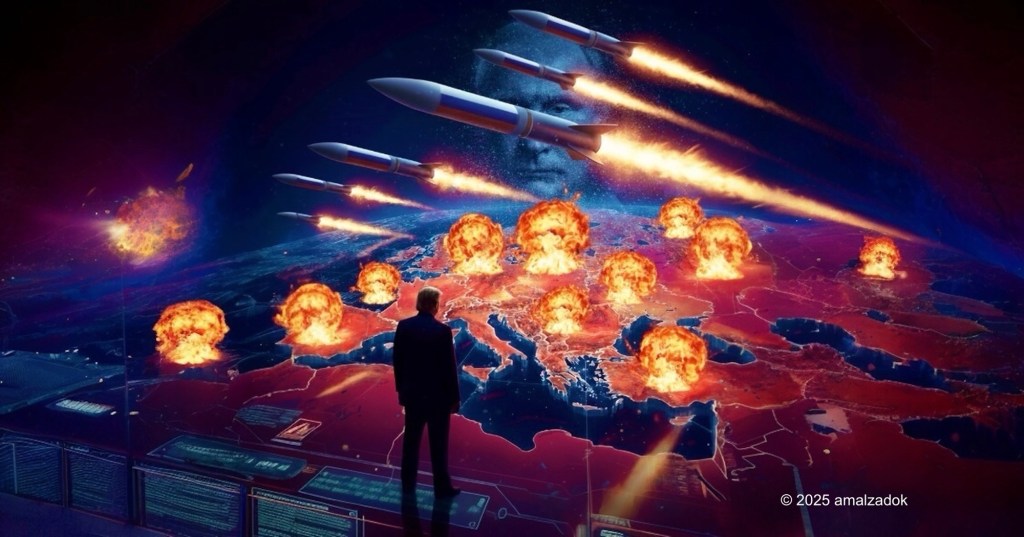
The expansionary nature of this new asymmetric conflict ensures that escalation continues even in the absence of formal declarations of war. Financial sanctions, tech restrictions, clandestine sabotage, and diplomatic brinksmanship proliferate—with less and less clarity about objectives or outcomes (Defensa, 2025; Nitishastra, 2025; CSIS, 2025).
Conclusion
Everything is, indeed, connected: the collapse of Istanbul, the evaporation of American leverage, the rise of asymmetric, globalized warfare, and the watchful presence of China mark an epochal transformation in world order.
The refusal to negotiate, the strategic shortsightedness of all sides, and the embrace of maximalist, winner-takes-all postures have birthed a war without borders and without clear end (Moscow Times, 2025; Ogutcu, 2024; CSIS, 2025). The world now sits inside an asymmetric conflict whose only certainty is uncertainty, whose battles are fought across currencies, code, commodities, and minds.
History will remember this era not as a sequence of isolated crises, but as a time when the largest powers gambled away the prospects of stability in pursuit of intangible victories. The post-Istanbul world has proven that negotiation is not dead, but merely starved by hubris, inertia, and the seduction of zero-sum tactics.
In this new order, asymmetric conflict favors patience, subtlety, and creative leverage: states able to outmaneuver others beyond military bravado will shape tomorrow’s global architecture.
The lesson for our time is brutal and unforgettable—the price of dismissing compromise is perpetual war, and the cost of arrogance is irrelevance (Defensa, 2025; Moscow Times, 2025; The Atlantic, 2025).
References
Cato Institute. (2025, February 24). Trump Should Cut Off Europe’s Defense Welfare Queens. https://www.cato.org/commentary/trump-should-cut-europes-defense-welfare-queens
CBC. (2025, October 28). Trade deal or no trade deal, China still holds crucial leverage. https://www.cbc.ca/news/world/trump-xi-us-china-apec-meeting-9.6955385
CNN. (2025, October 27). If you think Trump’s China deal is the end of the story. https://www.cnn.com/2025/10/27/economy/rare-earth-minerals-china-us-trade-deal
Council on Foreign Relations. (2025, February 9). Securing Ukraine’s Future. https://www.cfr.org/event/securing-ukraines-future
CSIS. (2025, September 15). The Evolution of Irregular Warfare. https://www.csis.org/analysis/chapter-12-irregular-warfare
Defensa. (2025, October 27). A new dimension of asymmetry in armed conflict. https://www.defensa.gob.es/documents/2073105/2320887/una_nueva_dimension_del_conflicto_2025_dieeeo86_eng.pdf
Fox News. (2025, May 1). Retired Army Lieutenant Gen. Keith Kellogg provides analysis of America’s attempted Ukraine strategy. https://www.facebook.com/FoxNews/posts/retired-army-lieutenant-gen-keith-kellogg-provides-analysis-of-americas-attempte/1076216994368162/
Intellinews. (2024, April 16). Fresh evidence suggests that the April 2022 Istanbul peace deal to end the war in Ukraine was stillborn. https://www.intellinews.com/fresh-evidence-suggests-that-the-april-2022-istanbul-peace-deal-to-end-the-war-in-ukraine-was-stillborn-321468/
Moscow Times. (2025, May 11). What Prospects Are There for Russia-Ukraine Peace Talks in Istanbul. https://www.themoscowtimes.com/2025/05/12/what-prospects-are-there-for-russia-ukraine-peace-talks-in-istanbul-a89051
Nitishastra. (2025, October 27). China’s Overreach, America’s Leverage & India’s Strategic Equilibrium. https://nitishastra.substack.com/p/chinas-overreach-americas-leverage
Ogutcu, M. (2024, November 19). Who Will Prevail in the Third World War? https://www.globalpanorama.org/en/2024/09/who-will-prevail-in-the-third-world-war-mehmet-ogutcu/
Responsible Statecraft. (2025, May 18). Istanbul 2.0: Know when to hold ’em, know when to fold ’em. https://responsiblestatecraft.org/ukraine-russia-istanbul-talks/
RFE/RL. (2025, February 1). Trump Able To End Ukraine War In ’Months, Not Years. https://www.rferl.org/a/trump-strategy-end-ukraine-war-months-kellogg/33299246.html
Russia Matters. (2025, January 30). Keith Kellogg on Russia and Ukraine. https://www.russiamatters.org/analysis/keith-kellogg-russia-and-ukraine
The Atlantic. (2025, October 23). China Gets Tough on Trump. https://www.theatlantic.com/international/archive/2025/10/xi-trump-trade-war-escalation-china-power/684658
©️2025 Amal Zadok. All rights reserved.
Subscribe and never miss an article!
 Think and be Free!