by Amal Zadok
When a president says only his “own morality” limits his power and that he “does not need international law,” while a mother of three is shot through her windshield by an ICE officer on an American street, the mask is off. This is no longer a debate about policy; it is the birth of a regime that reserves law for the weak and bullets for anyone who get in the way.
A president who crowns himself
Trump’s statement to The New York Times that his power as commander in chief is constrained only by his “own morality” is the distilled creed of authoritarianism. In his own words, there is “one thing” that can stop him: not Congress, not courts, not treaties, but his “own mind,” followed by the contemptuous aside, “I don’t need international law.”
This is not some late-night tweet; it is a formal doctrine announced from the Oval Office. In that interview, he waves away the UN Charter, the ban on aggressive war, and decades of treaty obligations as optional restraints that apply only if he personally decides they should, implicitly trampling the Charter’s prohibition on the use of force and the core idea that even great powers are bound by law.
He prides himself on using military strikes, invasions, economic strangulation and political coercion as tools of personal will, not as acts accountable to any external standard. A president who claims that law is binding only when he feels like it has ceased to be a constitutional officer and has slipped into the role of a sovereign who believes that legality is a costume he can put on for international conferences and drop whenever he wants to unleash force.
From “rules-based order” to rule by fear
For years, Washington preached a “rules-based international order” to other states. Now Trump publicly shreds that script and replaces it with a gangster’s logic: power first, rules never. He openly treats treaties as disposable, walks away from arms-control agreements, and shrugs at the possible collapse of the last major nuclear restraints with a fatalistic “if it expires, it expires.”
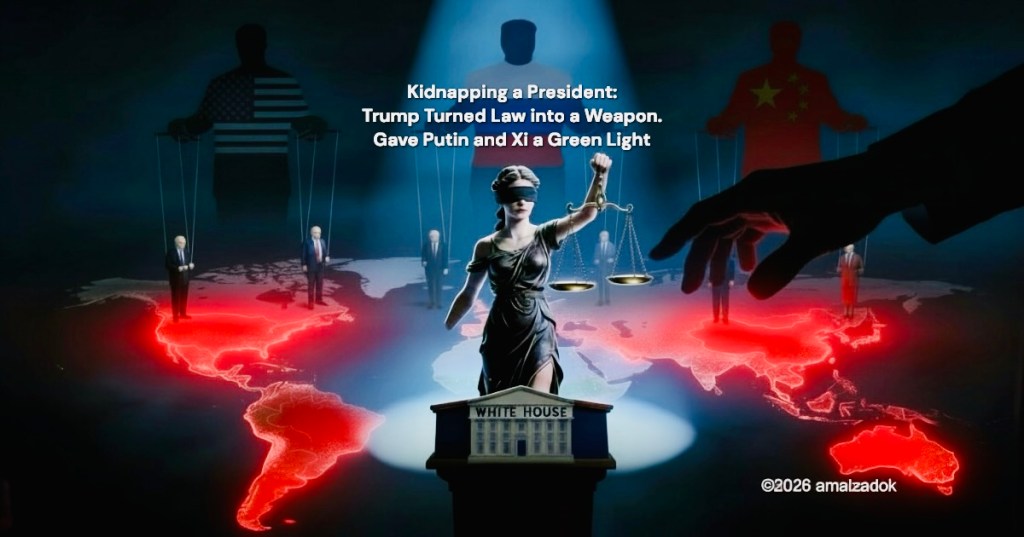
The message radiates far beyond Washington. If the United States claims the right to strike where it wants, topple whom it chooses, and threaten nuclear and non‑nuclear states alike without even pretending to obey international law, why should Moscow feel bound in Ukraine or Beijing in Taiwan? The “order” that once at least pretended to restrain the strong becomes a stage on which the biggest actor improvises violence while lecturing others about norms.
Trump’s “own morality” is not a safeguard; it is a surrender of civilization to personality. It tells every future strongman—from Budapest to Brasília—that law is ornamental and that the only crime is losing.
The ICE bullet in Minneapolis
While Trump claims he does not need international law abroad, his domestic security machine is being trained to treat American streets like occupied territory. In Minneapolis, 37‑year‑old Renee Nicole Good, a U.S. citizen, a mother of three, was shot and killed by an ICE officer while sitting in her car on a cold Midwestern street, neighbors watching from their windows as sirens and shouts shattered the night.
She was not a cartel boss or a terrorist; she was a neighbor, a writer, a woman who had come out—according to local accounts—to care for those around her. The official story shifts like a propaganda broadcast. DHS officials insist she “failed to comply,” that she “attempted to run over” an officer. Local witnesses describe confusion and conflicting commands, with one officer telling her to drive away from a stuck ICE vehicle and another simultaneously trying to pull her from the car; body‑camera and bystander video show agents swarming the vehicle, one officer stepping into her path, firing at close range as she attempts to drive off, her car then crashing down the street as her life bleeds out on the asphalt.
Minneapolis city officials have said openly what federal spokespeople will not: that this was “a federal agent recklessly using power that resulted in somebody dying.” The FBI has now taken over the investigation after the state’s own Bureau of Criminal Apprehension backed away, a sign of just how toxic and politically charged this killing has become, while community grief vigils name her not as a suspect but as a poet, a newcomer, a mother.
The same contempt for accountability that lets a president shrug off the UN Charter now underwrites a culture in which an ICE bullet can end a citizen’s life and the first instinct of power is to justify, not to repent.
The quiet architecture of a police state
This is how police states are built in real time—not with a single spectacular coup, but through a series of “operations,” “raids,” and “emergency deployments” that normalize the presence of armed federal agents in daily life. In Minneapolis, thousands of federal officers were deployed in what DHS bragged was the “largest operation ever,” turning a U.S. city into a live‑fire training ground for an internal occupation.
The use of ICE, a civil immigration agency, like a paramilitary police force is not an accident. It is a deliberate fusion of domestic and foreign logics: the border mentality imported into the heart of the city, where neighbors blowing whistles to warn each other become suspect, where legal observers and bystanders are treated as obstacles, and where a parked car is one nervous trigger pull away from becoming a coffin.
Trump’s doctrine—that only his conscience limits his power—seeps down the chain of command. If the man at the top says law is malleable, if he publicly promises to back his officers no matter what, then every badge and gun on the street hears the same message: you are the law. This is exactly how Stalin’s NKVD and Hitler’s Gestapo operated—not because every officer was a monster, but because the system told them that their violence was always already justified.
A monstrous hybrid of Nazism and Stalinism
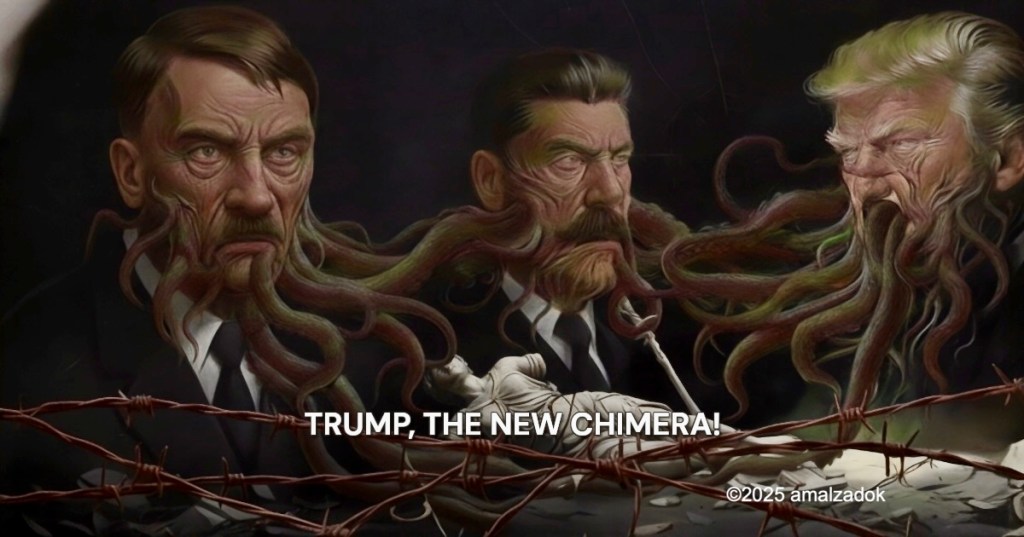
The horror of the current moment is not that America has become identical to Nazi Germany or Stalin’s Soviet Union; it is that it is mutating into a hybrid that borrows the worst tools of both. From Nazism, Trump borrows the cult of the leader whose “moral sense” legitimatizes everything, the theater of strength, the glorification of “law and order” as a shield for state brutality. From Stalinism, he borrows the idea that internal enemies lurk everywhere, that entire communities (immigrants, protesters, “anarchists,” “terror sympathizers”) are fair game for sweeping repression.
When federal agents can snatch people off streets, deploy to cities over local opposition, and now kill a mother in her car under the banner of immigration enforcement, the line between democracy and dictatorship is not “eroding.” It is being redrawn in blood. When a president announces that courts, laws and treaties are lower‑tier obstacles compared to his “own mind,” he is not defending America from enemies; he is positioning himself as the only real branch of government that matters.
This is how hybrid tyrannies work. Elections still occur, some courts still function, newspapers still print—but the security services learn that their real loyalty is owed upward, not outward. The constitution becomes a script for public ceremonies, while the real constitution is whatever the leader and his loyalists can get away with.
The conscience that kills
Trump insists he is “not looking to hurt people,” even as he lists lethal operations as achievements, even as his policies unleash missiles abroad and militarized raids at home. His “own morality” apparently allows for the bombing of foreign soil without authorization, the kidnapping or coercion of foreign leaders, the tearing up of refugee protections, and now a domestic climate in which federal officers gun down a woman in Minneapolis and are treated as heroes in waiting.
There is a cruel symmetry here. Abroad, he claims the right to ignore international law in the name of “national strength.” At home, his security forces act as if ordinary Americans are foreign subjects in a pacification campaign. The shared logic is simple: the people at the receiving end of American power—Venezuelan civilians, Iranian technicians, migrants at the border, a mother in a Minneapolis sedan—do not matter as rights‑bearing human beings. They matter only as problems for the leader’s will to solve.
When a man with this worldview sits in the Oval Office and tells a major newspaper that only his conscience can stop him, the world should stop pretending this is normal politics. This is not conservatism, populism, or even crude nationalism. It is the theology of the police state: one man’s inner voice elevated above constitutions, courts, treaties, and the screams from the street where Renee Nicole Good died.
An ultimatum to real patriots
So the question is no longer what Trump will do next; the question is what Americans are going to do about an America that the Founders would not recognize. A republic whose president claims to stand above law and whose federal agents kill unarmed citizens in the name of “order” is not the republic Madison and Hamilton were arguing for; it is the nightmare they wrote the Constitution to prevent.
The Constitution does not ask “real patriots” to clap for strongmen; it demands that they use every peaceful tool it provides—speech, press, assembly, petitions, jury service, litigation, elections, impeachment, and relentless oversight—to drag power back under law. It calls legislators to defund and dismantle rogue operations, judges to enforce rights without fear, civil servants to refuse illegal orders, and ordinary citizens to organize, vote, strike, and resist until no man’s “own morality” can ever again stand in for the rule of law. If Americans will not use those tools now, when a mother lies dead in Minneapolis and a president boasts that only his conscience can stop him, then the Constitution will become nothing more than an antique in a glass case—and the hybrid monster of Nazism and Stalinism will finish the work it has already begun.
References
1.The New York Times. (2026, January 8). Trump addresses Venezuela, Greenland and presidential power in wide‑ranging interview. https://www.nytimes.com/2026/01/08/us/politics/trump-interview-power-morality.htm
2.The New York Times. (2026, January 8). Trump said his global power was limited only by his ‘own morality’. https://www.nytimes.com/2026/01/08/briefing/trump-interview-oval-office-apple-ceo.html
3.Bluewin. (2026, January 9). USA: Trump: Only my sense of morality can hold me back. https://www.bluewin.ch/en/news/international/trump-only-my-sense-of-morality-can-hold-me-back-3041854.html
4.Moneycontrol. (2026, January 8). ‘Only my morality can stop me’: Trump claims sweeping war powers, shrugs off international law. https://www.moneycontrol.com/world/only-my-morality-can-stop-me-trump-claims-sweeping-war-powers-says-he-doesn-t-need-internatio-article-12812335.html
5.Financial Express. (2026, January 8). ‘I don’t need international law’: Trump says only his own morality limits his global power. https://www.financialexpress.com/world-news/us-news/only-one-thing-can-stop-me-trump-says-he-dont-need-international-law-boasts-12812091/
6.World Socialist Web Site. (2026, January 8). Declaring ‘I don’t need international law,’ Trump moves to assert unlimited warmaking powers. https://www.wsws.org/en/articles/2026/01/09/qyot-j09.html
7.Al Jazeera. (2026, January 8). FBI takes over investigation into ICE agent killing of woman in Minneapolis. https://www.aljazeera.com/news/2026/1/8/fbi-takes-over-investigation-into-ice-agent-killing-of-woman-in-minneapolis
8.ABC News (Australia). (2026, January 7). What led to an ICE agent fatally shooting a public observer in Minneapolis? https://www.abc.net.au/news/2026-01-08/ice-shooting-minneapolis-minnesota-immigration-crackdown/106209128
9.NBC News. (2026, January 7). Renee Nicole Good, woman shot by ICE officer, was out ‘caring for her neighbors’. https://www.nbcnews.com/news/us-news/renee-nicole-good-minneapolis-ice-shooting-victim-caring-neighbor-rcna252901
10.Colorado Public Radio. (2026, January 7). Woman killed by ICE in Minneapolis originally from Colorado. https://www.cpr.org/2026/01/07/fatal-minneapolis-ice-shooting-colorado-woman/
11.CNN. (2026, January 8). ICE officer who shot woman in Minneapolis was dragged by a car in 2025, video shows. https://www.cnn.com/2026/01/08/us/ice-agent-minneapolis-shooting-car-dragged-invs
12.NBC News. (2026, January 8). ICE officer who fatally shot Minnesota woman was dragged by a car during a prior enforcement stop. https://www.nbcnews.com/news/us-news/ice-officer-fatally-shot-minnesota-woman-was-dragged-car-june-immigrat-rcna252992
13.City of Minneapolis. (2026, January 6). Minneapolis responds to fatal shooting of woman by federal agent. https://www.minneapolismn.gov/news/2026/january/fatal-shooting-response/
14.PBS NewsHour. (2026, January 8). Woman killed by ICE agent was mother of 3, poet and new to Minneapolis. https://www.pbs.org/newshour/nation/woman-killed-by-ice-agent-was-mother-of-3-poet-and-new-to-minneapolis
©️2026 Amal Zadok. All rights reserved.
Subscribe and never miss an article!
 Think and be Free!