Tag: Ukrainian war

  • The Edge of Detonation: How Russia’s Hypersonic Supremacy and Trump’s Gambling Push Europe Toward Catastrophe

    The Edge of Detonation: How Russia’s Hypersonic Supremacy and Trump’s Gambling Push Europe Toward Catastrophe

    by Amal Zadok

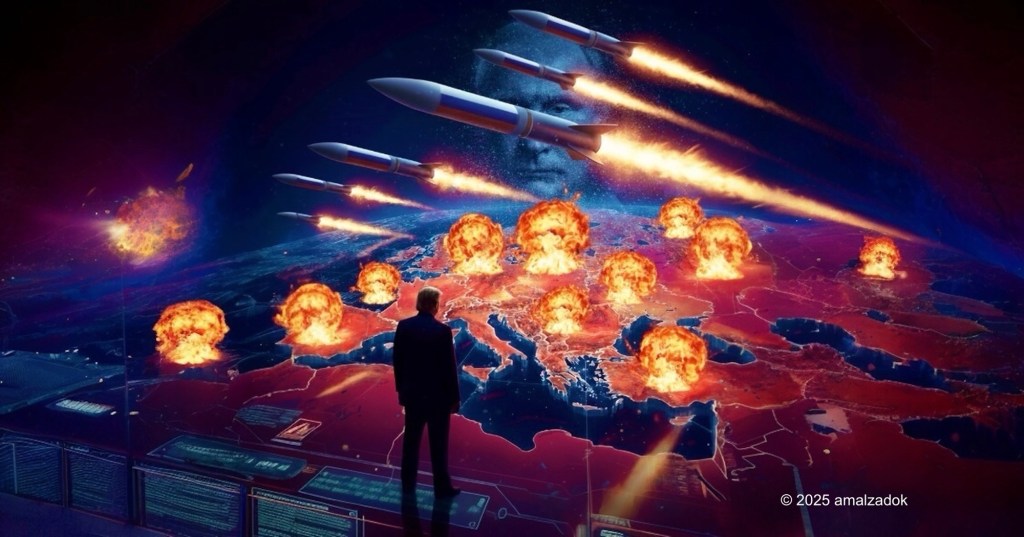
    Russia’s advancement in hypersonic missile technology and the latest breakthroughs with the Burevestnik nuclear-powered cruise missile have transformed the global strategic balance. The Kremlin now possesses unmatched means to threaten and deter adversaries—while President Trump’s aggressive missile defense push, arms sales, and economic warfare risk driving Europe into catastrophe.

    Russia’s Hypersonic Arsenal: Avangard, Kinzhal, Zircon

    Russia’s operational hypersonic systems are a potent challenge to Western defense. The Avangard hypersonic glide vehicle achieves speeds up to Mach 27, delivering nuclear payloads with unpredictable flight paths that overwhelm missile defenses. The KH-47M2 Kinzhal air-launched missile strikes from more than 930 miles away at speeds near Mach 10, repeatedly used with effect in Ukraine engagements. The 3M22 Zircon, a naval scramjet-powered missile, can reach Mach 8, allowing Russia to project power across the Baltic and Barents Sea while exposing critical weaknesses in European defense networks.

    Oreshnik: Russia’s New Hypersonic IRBM Gamechanger

    The Oreshnik missile, officially entering service in 2025, is a new pillar in Russia’s offensive repertoire. Launched against Ukraine’s strategic facilities and now deployed to Belarus, Oreshnik outruns interception with speeds over Mach 10 and a range of up to 5,500 kilometers—putting all of Europe within striking distance. Its MIRV warhead capability, paired with conventional or nuclear payloads, allows for simultaneous multiple strikes that few, if any, European defenses can counter. This system closes the “INF Treaty gap,” fulfilling Kremlin ambitions for decisive escalatory options and establishing a new era in missile warfare.

    Burevestnik: The ‘Storm Petrel’ Proven Missile

    The 9M730 Burevestnik nuclear-powered cruise missile—confirmed by Russian and independent observers—achieved a 14,000-kilometer, 15-hour test flight. Putin and top military officials now present it as an “invincible” weapon, with virtually unlimited range, low-altitude maneuvering, and immunity to current missile shields. Western skepticism has faded with clear operational proof; Burevestnik’s unpredictable flight path and reactor-based endurance make it a guaranteed factor in future strategic planning.

    Trump’s Missile Defense and the European Gamble

    President Trump’s Golden Dome missile shield, expanded into Poland, Romania, and the Baltic region, aims to reinforce allies but also spurs Russian paranoia and accelerates the arms race. At the same time, the U.S. and Europe escalate weapons deliveries to Ukraine, directly sustaining the conflict and intensifying Kremlin perceptions of existential threat.

    Trump’s loud claims of detachment from the war are belied by vast arms sales and the orchestration of economic strategies—especially proposals to outright seize Russian assets from Western banks. This policy not only prolongs the war but exposes the entire European financial system to Russian retaliation, including potential energy cutoffs, cyberattacks, and rapid financial destabilization.

    Russia’s Strategic Edge Beyond Ukraine

    Moscow is winning the war of attrition on Ukraine’s battlefields and is better prepared than NATO or the U.S. for broader, high-technology war. Joint Zapad-2025 exercises, rearmament, and doctrinal innovations emphasize “escalate to deescalate”—delivering overwhelming strikes to force adversaries into accepting Russian terms. Meanwhile, NATO is hamstrung by divided political leadership, fragile supply chains, and a crumbling financial architecture now at the mercy of misguided economic warfare.

    Countdown to Catastrophe

    The world sits on the brink of strategic disaster, where technological mastery meets reckless policy. Russia’s proven missile supremacy and Trump’s dangerous game with arms sales and financial aggression are accelerating global destabilization. If misjudgment or provocation continues, it will not simply endanger Ukraine and Western Europe—it will threaten the survival of the global financial system and the architecture of peace itself.

    The stakes are now irreversible. What began as posturing and escalation could soon descend into nuclear brinkmanship and total economic collapse. Only authentic diplomatic imagination—applied today, not tomorrow—can prevent a self-inflicted cataclysm. The countdown has begun, and every second echoes with the roar of hypersonic engines.

    ©️2025 Amal Zadok. All rights reserved.

    Subscribe and never miss an article!

  • Europe’s Self-Destruction: How Denial of Multipolar Reality is Fueling War and Collapse

    Europe’s Self-Destruction: How Denial of Multipolar Reality is Fueling War and Collapse

    by Amal Zadok

    The current war in Ukraine has not only been devastating for Ukrainians but is also steadily corroding Europe itself. Behind the headlines of military offensives, sanctions, and refugee crises lies a deeper structural problem: Europe’s refusal to accept the rise of a multipolar world order. By clinging to the vestiges of US-led unipolar hegemony, European leaders are not merely prolonging the war in Ukraine but accelerating the continent’s own decline—economically, politically, and strategically.

    Europe’s Addiction to Unipolar Illusions

    At the heart of the issue is Europe’s inherited ideological attachment to the post-Cold War liberal order. European elites internalized the illusion that American-led globalization was permanent, and that geopolitics was merely about spreading Western institutions eastward. NATO enlargement, EU expansion, and neoliberal economic integration were treated as inevitable. Russia’s objections were written off as paranoia, while China’s rise was underestimated or dismissed.

    This mindset encouraged hubris. Instead of building a security architecture that included Russia, Europe bet everything on NATO expansion, reinforcing a dangerous zero-sum logic. Instead of accepting the new economic gravity of Asia, Europe doubled down on dependence upon US markets and financial architecture. When the clash finally arrived in Ukraine, Europe’s only instinct was to double down on the same unipolar strategies: sanctions, arms transfers, and alignment with Washington’s demands.

    But these strategies no longer work in today’s world. The Global South refuses to isolate Russia. Energy markets rebalanced swiftly, with Moscow redirecting exports to Asia. Sanctions harmed European industries more than they destabilized Russia. Yet European leaders continue to behave as if economic coercion and military escalation can enforce a unipolar order that no longer exists.

    Ukraine: The Battlefield of Denial

    The catastrophic war in Ukraine is therefore less about Ukraine itself and more about Europe’s inability to come to terms with multipolarity. Recognizing that the post-Cold War order has collapsed would mean negotiating directly with Russia and accepting that Moscow has legitimate security interests. It would mean building dialogue with rising powers who no longer accept Western tutelage. For Europe’s elite, this is ideological heresy. Instead, they cling to the narrative that Ukraine is defending “Western civilization,” a framing that justifies endless escalation, arms shipments, and the sacrifice of diplomacy.

    This refusal to adjust, however, only traps Ukraine in an unending war with no path to victory. By pouring weapons into a conflict against a nuclear-armed power with superior industrial resilience, Europe ensures a stalemate of destruction. The longer the war endures, the more Ukraine becomes depopulated, devastated, and dependent, while Europe drains itself economically trying to sustain it.

    Economic Suicide in Real Time

    Europe has already paid an extraordinary price. Sanctions cut the continent off from cheap Russian energy, a lifeline for its manufacturing base. As a result, industries in Germany, Italy, and France face soaring costs and competitive decline. Deindustrialization is no longer a fear but a lived reality, with factories closing or relocating abroad.

    Beyond energy, Europe has surrendered its financial autonomy. Compliance with US sanctions forces European banks and corporations to follow Washington’s dictates even when their own interests suffer. Dependence on expensive American LNG has bound Europe further to the US economy, undermining talk of “strategic autonomy.” Meanwhile, inflation, energy poverty, and public discontent push European societies into political turbulence.

    The irony is striking: in trying to weaken Russia, Europe has instead sabotaged its own industrial heartland. Moscow has survived by pivoting toward Asian growth centers, while Europe faces stagflation, competitiveness crises, and rising social unrest.

    Political Surrender to Washington

    The political fallout is equally severe. Rather than acting as an independent pole in global politics, Europe has reduced itself to a subordinate partner in US strategy. From defense to energy to digital policy, the default answer in Brussels is to align not with Europe’s material interests but Washington’s geopolitical imperatives.

    This has hollowed out European claims of sovereignty. Talk of “strategic autonomy,” long championed by figures like Emmanuel Macron, rings hollow when every major policy decision is framed in NATO headquarters or filtered through Washington. European citizens feel the consequences: rising living costs, declining security, and disillusionment with leaders who cannot articulate a vision apart from Washington’s shadow.

    Meanwhile, other regions of the world are moving ahead. The BRICS have expanded, creating institutions and partnerships that bypass the Western-centric financial order. The Gulf States, Africa, and Latin America pursue diversified partnerships without deference to the West. While these regions embrace multipolar engagement, Europe isolates itself, clinging to a dying order.

    The Road Not Taken

    It did not have to be this way. Europe could have adapted to multipolarity by developing a security framework that accommodated Russia while protecting smaller states. It could have leveraged its economic power to build cooperative partnerships across Eurasia. It could have positioned itself as a bridge between the US and the rising powers of Asia and the Global South.

    Instead, by refusing to accept multipolarity, Europe rendered itself a casualty of it. Stuck in Cold War reflexes, Europe missed opportunities for diplomacy and adaptation, and now pays the price in economic decline and political irrelevance. Ukraine is the immediate battlefield, but the deeper battle is over Europe’s place in the world order.

    The tragedy of Europe’s stance is that, in trying to maintain unipolar dominance, it has undermined its own prosperity and future. The reluctance to accept a multipolar system has perpetuated the war in Ukraine, ruined prospects for peace, and accelerated Europe’s economic and political decline. History rarely waits for those unwilling to adapt. Unless Europe finds the courage to acknowledge the new multipolar reality, the continent risks not only defeat in Ukraine but destruction from within.

    Europe now stands at a civilizational crossroads: either awaken to the reality of multipolarity and reclaim agency in shaping its destiny, or march blindly into a future of irrelevance, poverty, and dependency. The choice is no longer between Washington or Moscow—it is between self-preservation or self-destruction.

    ©️2025 Amal Zadok. All rights reserved.

    Subscribe and never miss an article!

  • Europe’s Suicide Pact: Sacrificing Justice & Freedom for American Masters

    Europe’s Suicide Pact: Sacrificing Justice & Freedom for American Masters

    by Amal Zadok

    Europe is willingly dismantling its soul to serve a patron that profits from its demise.

    The post-war era birthed a powerful vision: Europe as a “Continent of Life and Social Justice.” Rising from the ashes of unimaginable destruction, it championed peace, built sophisticated social welfare models that were the envy of the world – universal healthcare, robust pensions, strong workers’ rights, affordable education, and social safety nets – and fostered unparalleled industrial prowess. Its integration project promised not just economic unity, but a society prioritizing human dignity, solidarity, and a unique alternative to raw capitalism.

    Yet, a profound and unsettling reality now grips the continent: Europe is actively dismantling these very foundations, regressing towards a self-inflicted economic, social, and civilizational “Dark Ages.” Crucially, the architect of this decline is not a distant foe, but its closest ally. The uncomfortable truth Europe refuses to confront is that under its comprehensive submission to the United States – militarily, financially, economically, and socially – the primary threat to its prosperity, sovereignty, cherished social model, and increasingly, its freedom of information and speech, emanates not from Moscow, but from Washington.

    The roots of this vassalage lie deep in the post-WWII settlement. The security umbrella provided by NATO offered stability but simultaneously bred a crippling, strategic dependency. Decades of deliberate underinvestment in genuine, autonomous European defense capabilities created a dangerous illusion of security. When crises erupted on its doorstep, most starkly the Ukraine conflict, Europe was exposed, impotent, and utterly reliant on American might and, critically, American decision-making.

    This reliance transcends mere logistics; it dictates foreign policy, forcing Europe into alignment with US global objectives that frequently disregard Europe’s core interests and the well-being of its citizens. The imposition of sweeping sanctions on Russian energy, driven overwhelmingly by Washington’s geopolitical calculus with little regard for European vulnerability, exemplifies this destructive dynamic. Europe, ignoring its profound structural dependence on affordable Russian gas, severed its own economic lifeline in a fit of geopolitical solidarity defined elsewhere. The result was an energy shockwave of unprecedented scale, fundamentally altering Europe’s cost base, shattering household budgets, and igniting rampant inflation.

    The economic autodestruction that followed was swift, brutal, and fundamentally self-inflicted under US pressure. Skyrocketing energy prices eviscerated the continent’s industrial heartland – the very engine of wealth creation that funded its famed social model. Fertilizer plants, chemical facilities, glassmakers, and metal smelters saw their competitive advantage annihilated overnight. Factories shuttered, production halted, and hundreds of thousands of jobs vanished.

    This wasn’t passive decline; it was active deindustrialization, a conscious sacrifice orchestrated by European capitals yielding to intense US demands. Investment fled en masse, not merely to cheaper locations, but specifically towards the United States, lured by its shale gas bounty and the protectionist subsidies of the Inflation Reduction Act. Estimates suggest over $800 billion in industrial capital flight since the energy crisis began – a colossal, deliberate transfer of wealth and productive capacity directly benefiting the American economy at Europe’s expense, catastrophically eroding the tax base essential for sustaining its social programs.

    Simultaneously, Europe embraced a militaristic surge utterly incongruent with its peaceful ideals and fiscal reality. Panicked by its exposed weakness and under relentless US pressure – amplified by the transactional threats and extortionate demands of figures like Donald Trump for tribute-like increases in NATO spending – European nations pledged massive, unsustainable hikes in defense budgets.

    This is where the direct assault on the European social model and social justice becomes explicit and devastating. Billions of Euros, desperately needed to maintain universal healthcare, robust pensions, affordable childcare, unemployment benefits, social housing, and green transition initiatives – the very pillars of Europe’s enlightened society and its commitment to social justice – are now being ruthlessly diverted. Funds essential to cushion citizens against the crushing cost-of-living crisis, fueled primarily by the US-driven energy policy rupture, are instead funneled into imported military hardware – predominantly American.

    The armamentistic race, dictated by Washington’s priorities and Trump’s coercive tactics, forces brutal, unjust choices upon European societies: hospitals or tanks? Pensions or missiles? Affordable heating or F-35s? Social cohesion and justice or geopolitical obedience? This fiscal drain deepens unsustainable public debt and deliberately starves the welfare state, dismantling the “European way of life” piece by piece, sacrificing social justice on the altar of alliance loyalty.

    Compounding this decline is a disturbing erosion of freedom of information and speech, often justified under the guise of security or alignment with US narratives. While fixating on external threats, European institutions and member states increasingly adopt measures that stifle dissent and critical discourse. Legislation ostensibly aimed at combating “disinformation” or “foreign interference” risks casting a wide net, potentially silencing legitimate criticism of government policies, particularly regarding the Ukraine conflict, sanctions, NATO expansion, or the very nature of the transatlantic relationship.

    The pressure to conform to a US-defined geopolitical narrative creates an environment where dissenting voices – questioning the wisdom of energy sanctions, the scale of militarization, or the costs of subservience – are marginalized, labeled as pro-Russian, or subjected to online censorship and de-platforming pressures. Academic freedom faces new constraints, media pluralism diminishes as narratives converge under geopolitical pressure, and the space for open, democratic debate crucial for a healthy society shrinks. This suppression, often tacitly encouraged by the need to maintain “Western unity,” undermines a core European value: the right to scrutinize power and challenge orthodoxy.

    Here lies the blinding, tragic paradox: While Europe fixates on Russia as the existential threat, the tangible, accelerating destruction of its economic base, social fabric, strategic autonomy, its world-renowned welfare model, and now its foundational freedoms, is being wrought by its alliance with the United States. The soaring energy costs, the gutted industries, the capital flight, the inflation eroding living standards, the deliberate defunding of social safety nets sacrificing social justice, and the creeping constraints on free expression – these are direct consequences of policies demanded by Washington and obediently enacted by European leaders, often against their own populations’ immediate welfare and social contract.

    The US reaps immense benefits: a crippled European competitor in key industries, a vast captive market for its overpriced LNG, lucrative arms contracts, the enforced weakening of Europe’s alternative social model, and a more pliant Europe aligned with its global agenda, even at the cost of European liberties.

    The specter of Trump’s potential return only intensifies this existential peril. His explicit disdain for the alliance, threats of abandonment, and demands for tribute-like payments expose the transactional cruelty underlying the relationship. His rhetoric and pressure directly accelerate the cannibalization of Europe’s social spending to feed the US arms industry and satisfy his demands, while his disdain for independent media and criticism creates a chilling effect that resonates within compliant European corridors of power.

    Yet, Europe remains willfully blind, clinging to the crumbling myth of a benevolent transatlantic partnership, unable or unwilling to acknowledge that the primary strategic antagonist fostering its comprehensive decline – economic, industrial, social, sovereign, and now in the realm of fundamental freedoms – sits across the Atlantic.

    The path back from this emerging Dark Ages demands nothing less than a seismic shift in consciousness and action. Europe must achieve genuine strategic sovereignty, building autonomous defense capabilities to end its humiliating military dependency and break free from coercive demands. It must pursue radical energy independence through aggressive diversification and accelerated renewables, rebuilding its industrial base on sustainable foundations to revive the tax revenues essential for reinvestment in social justice.

    It must fiercely defend and rebuild its commitment to freedom of information and speech as non-negotiable pillars of democracy, resisting pressures to silence dissent under false banners of unity. Most critically, it must open its eyes: The fundamental threat to European prosperity, autonomy, its unique social welfare heritage, and its core liberties stems from its unhealthy, subservient marriage to American power.

    Continuing to sacrifice its industries, its people’s welfare, its cherished social safety nets, its democratic freedoms, and its future on the altar of US geopolitical gambits and Trumpian demands is not solidarity; it is collective civilizational suicide. Recognizing that the greatest danger lies not in the East, but in the West, is the first, indispensable step towards reclaiming Europe’s light, its commitment to life and social justice, and its destiny.

    The alternative is extinction. Not by invasion, but voluntary euthanasia: economies bled white, societies shattered beyond repair, voices strangled at the source – all sacrificed on the altar of Atlantic subservience.

    The autopsy will read: “Death by Loyalty to American Masters”.

    ©️2025 Amal Zadok. All rights reserved