by Amal Zadok
Kornelia Kirchweger: ‘The EU must disappear. Over the years, through treaties and crises, the EU has acquired an occupying power over Europe and, in my opinion, it occupies this continent in a brutal and authoritarian way, suffocating cultures, freedom, freedom of expression and leading this continent precisely to the place from which the EU claimed it would rescue it: out from under the rubble of war – and precisely back there is where the EU is dragging Europe once again. And this EU must disappear. The EU must disappear. The EU has entrenched itself over the years, through treaties and crises.’”
Kornelia Kirchweger says out loud what millions of Europeans only dare to mutter at their kitchen tables: the European Union does not “unite” Europe; it occupies it. The smiling blue flag with its neat golden stars has become the banner of a new empire that does not need tanks or barbed wire to crush nations, because it rules instead through debt, digital surveillance, and an ideology that brands dissent as heresy. Her demand that “the EU must disappear” is not a theatrical provocation; it is a necessary act of European self‑defence.
The EU was sold as a guarantee of “never again”—never again war, never again authoritarianism, never again the trampling of peoples by distant, unaccountable power. Yet what exists in Brussels now is precisely a distant, unaccountable power that blackmails elected governments, dictates economic policy, and polices speech under the holy trinity of “security, safety, and stability.” The continent that once produced revolutions against divine‑right kings now applauds as faceless commissioners and central bankers issue decrees that bind hundreds of millions who never voted for them. This is not cooperation; it is vassalage dressed as progress—the “occupying power” over Europe that Kornelia names with surgical precision.
Kornelia identifies the method: treaties and crises. Each crisis—financial, health, geopolitical—has been seized as a pretext to centralise more control in Brussels and Frankfurt, tying national budgets and laws to institutions that answer to no electorate. Treaties once presented as tools of peace have hardened into chains. Opt‑outs vanish, “temporary” emergency measures become permanent, and referenda that deliver the “wrong” answer are ignored or re‑run until obedience is achieved. Consent, the heart of any genuine democracy, has been replaced by weary resignation. When Kornelia says the EU has “entrenched itself,” she is simply describing how the coup by paperwork has already taken place.
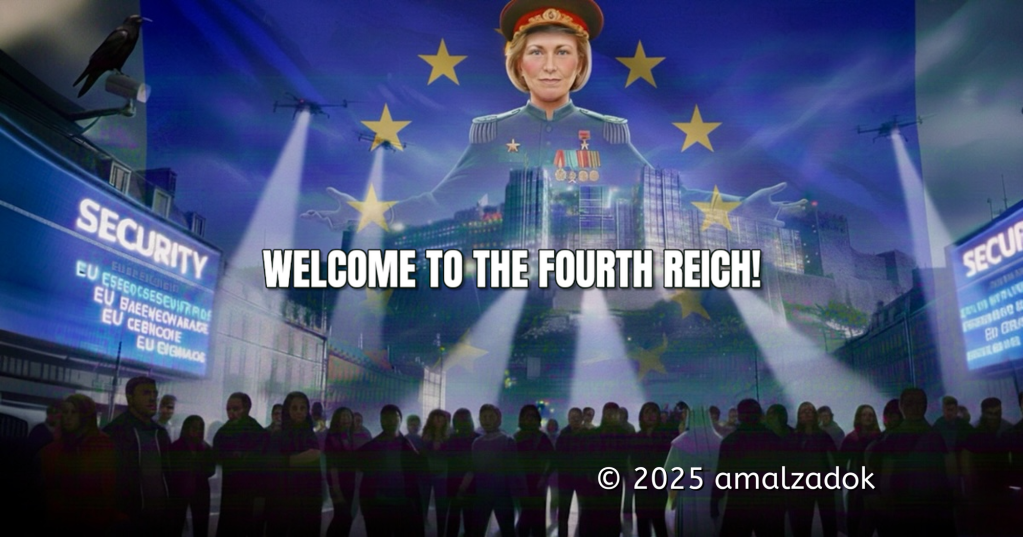
At the centre of this drift stands Ursula von der Leyen, the unelected queen of an empire that pretends not to be one. She has mastered the art of ruling by permanent emergency, using the pandemic, the Ukraine war, and now “information warfare” as pretexts to bypass member states, concentrate power in the Commission, and present herself as indispensable commander of Europe’s “permacrisis.” Her Commission has become a quasi‑dictatorial sovereign, a machine that treats national parliaments as rubber stamps and voters as an obstacle to be managed. If the EU is the occupying force over Europe, von der Leyen is its soft‑Stalinist party secretary: unelected, unremovable, and convinced that history runs through her desk.
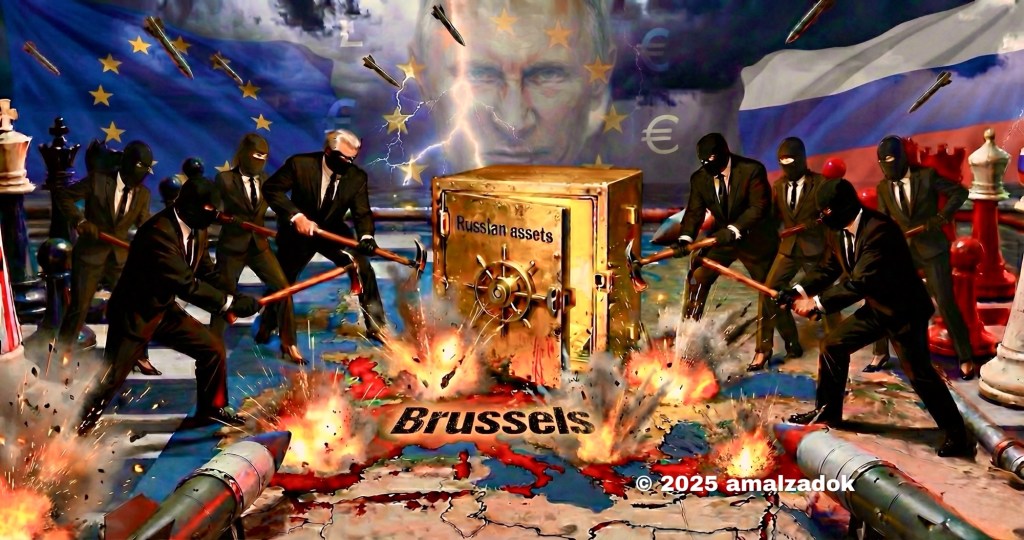
What makes von der Leyen’s rule particularly dangerous is the fusion of moralism and soft Stalinism. She divides politics into loyal comrades of “European values” and enemies labelled “Russian puppets,” “extremists,” or “threats to democracy,” echoing the old tactic of branding opponents as agents of foreign powers. Sanctions lists are drafted behind closed doors, freezing assets and destroying reputations without meaningful due process, while she lectures the continent about the rule of law. This is not justice; it is a bureaucratic blacklist system worthy of Stalin’s clerks, updated with IBAN numbers and SWIFT codes. Kornelia’s phrase “brutal and authoritarian occupation” finds a face and a signature here.
The regime’s poison lies in its moral camouflage. Brussels speaks the language of human rights while cutting off oxygen to any culture that resists its dogmas. National identities are tolerated as folkloric decoration, provided they never obstruct the homogenous “European way of life” defined by unelected ideologues. The EU preaches diversity but practises uniformity: uniform currency, uniform rules, uniform narratives. A Polish farmer, an Italian nurse, a Greek dock worker are treated not as citizens of concrete communities, but as variables in a spreadsheet to be adjusted for “convergence.”
This is the suffocation of cultures that Kornelia denounces—accomplished not with bayonets, but with compliance reports.
Her accusation that the EU asphyxiates freedom of expression cuts to the bone. In the name of fighting “disinformation,” Brussels under von der Leyen has constructed a censorship architecture more efficient than anything the old dictatorships could dream of. The Digital Services Act and its siblings give Eurocrats leverage to pressure platforms into shadow‑banning, de‑monetising, or deleting voices that question official narratives on war, migration, public health, or the sanctity of EU institutions. No show trials are needed when a single email can erase a journalist, scholar, or priest from public visibility at the speed of an algorithmic tweak.
This is soft totalitarianism: no gulags, but social death; no midnight knocks, but destroyed careers; no banned books, but invisible search results. The dissident of the 21st century is not dragged before a court; he is rendered unemployable, unbanked, and unseeable. Because all of this is done “to protect democracy,” the average citizen is shamed into applauding his own gagging. Kornelia’s refusal to applaud exposes the regime’s deepest fear: that Europeans might rediscover the courage to speak like she does—and realise how many already secretly agree.
The same contempt for peoples that drives censorship also shapes policy on war and peace. The EU that boasts of a Nobel Peace Prize now behaves like a bloodless war‑management office. Under von der Leyen, the Ukraine war has been instrumentalised not only to rearm the continent but to cement Commission control over foreign and security policy, powers never explicitly granted by the treaties. Endless escalation—sanctions that wreck European industry, arms spending that drains public coffers—is not driven by popular will, but by a fanatical Atlanticist class that sees ordinary Europeans as expendable collateral in its geopolitical fantasies.
Brussels and its faithful capitals treat the war as a moral pageant in which they can pose as defenders of civilisation while families pay in energy bills, inflation, and lost futures. War fever has become a convenient instrument of internal control. Question sanctions and you are a Putinist; oppose pumping more weapons into a meat grinder and you “undermine European security”; call for ceasefire and negotiation and you become suspect, perhaps criminal. A foreign conflict is transformed into a loyalty test for EU citizens, justifying new surveillance powers, tighter protest restrictions, and elastic “extremism” laws that can stretch to cover anyone who still dares to shout no. It is the road back to rubble that Kornelia fears—this time moral and institutional rubble, prepared in peacetime.
A civilisation collapses long before its buildings fall. It collapses when truth becomes a risk, when fear hums constantly in the background, when parents quietly prepare their children to emigrate because they no longer believe their homeland has a future. Across Europe, that collapse is visible: brain drain, demographic winter, emptied villages, cities where locals cannot afford to live, parliaments that resemble branch offices of an imperial centre more than houses of a sovereign people. In such a landscape, Kornelia’s cry that “the EU must disappear” is not nihilism; it is an act of hope against managed decay.
Defenders of the Union insist that without Brussels, Europe would sink into nationalism, conflict, and chaos. Yet it is under von der Leyen’s Brussels that Europe is again flirting with catastrophe: fuelling wars it cannot win, provoking powers it cannot defeat, and crushing precisely the democratic vitality that could renew it. The choice is not between this Union and a new Dark Age; it is between this Union and the possibility of a Europe that is genuinely plural, genuinely democratic, and genuinely peaceful. Kornelia forces the real question: is the current EU architecture compatible with freedom at all, or has it become structurally hostile to it?
To reach that better Europe, the EU in its current form must indeed disappear. Not be gently “reformed,” not be slightly “rebalanced,” but dismantled as a structure of domination. Powers must be repatriated to national and local levels, treaties scrapped or radically rewritten under real popular scrutiny, censorship mechanisms abolished, and the permanent war footing decisively rejected. Cooperation between European peoples is desirable; a Brussels‑centred oligarchy commanded by an unaccountable Commission president is not. Kornelia’s radical clarity destroys the comforting illusion that cosmetic tinkering will ever suffice.
Her sentence, “The EU must disappear,” is therefore a line of liberation, not despair. It tells a tired and frightened continent: you are allowed to fire your jailers. You are allowed to say no to the empire that acts in your name while looting your savings, your freedoms, and your sons. You are allowed to imagine—and then build—a Europe after Brussels: a Europe of peoples instead of commissars, cultures instead of codes, conscience instead of slogans.
Either Europe listens to voices like Kornelia’s and dismantles its gilded prison from within, or it will learn again that empires built on fear and lies always fall—but they often drag their subjects into the rubble with them.
©️2025 Amal Zadok. All rights reserved.
Subscribe and never miss an article!

 Think and be Free!