Tag: ukraine

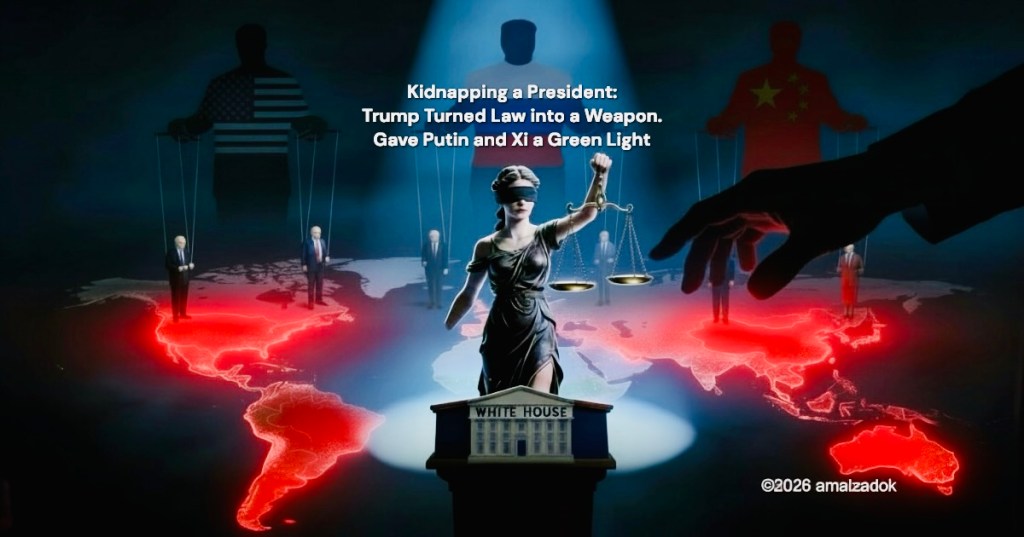
  • Kidnapping a President: How Trump Turned Law into a Weapon and Gave Putin and Xi a Green Light

    Kidnapping a President: How Trump Turned Law into a Weapon and Gave Putin and Xi a Green Light

    by Amal Zadok

    Trump’s armed kidnapping of Nicolás Maduro is not just another reckless intervention; it is the moment the United States openly abandons the legal order it uses to judge its enemies. One operation in Caracas manages to break core rules of international law, trample the Constitution’s allocation of war powers, and weaponize domestic criminal statutes into a pretext for cross‑border regime decapitation. This is not mere hypocrisy; it is a structural shift toward a world where armed force wears the thin mask of law while tearing out the law’s foundations.​

    Start with the international plane. Article 2(4) of the UN Charter prohibits the threat or use of force against the territorial integrity or political independence of any state, except in self‑defence against an armed attack or with Security Council authorization. None of those conditions existed: Venezuela had not attacked the United States, there was no imminent armed assault, and the Security Council had authorized nothing. Airstrikes around Caracas and the insertion of US forces to seize a sitting head of state are the paradigmatic use of armed force that the Charter was written to forbid, regardless of how loudly Washington chants “narco‑terrorism” or “democracy.”​

    The raid also violates the principles of sovereign equality and non‑intervention in Articles 2(1) and 2(7) and in customary international law. Forcibly removing a president and floating the idea that the US might effectively “run” Venezuela is not influence; it is a direct assault on the political independence of a UN member. That is why UN officials and governments well beyond Maduro’s circle have called the action illegal aggression and a “dangerous precedent” for the global order.​

    Head‑of‑state immunity is the next pillar smashed. Customary international law grants sitting heads of state full personal immunity—immunity ratione personae—from foreign criminal jurisdiction and enforcement measures while they are in office. This shield does not endorse any leader’s morality; it prevents foreign courts and special forces from becoming tools of regime change. By abducting Maduro and hauling him before a New York judge, the United States has effectively claimed that its recognition policy decides who is a head of state and who can be treated as a common fugitive.​

    The extraterritorial kidnapping itself is a further violation. Even advocates of muscular US power concede that seizing a foreign leader from his own soil without consent is a “flagrant violation” of sovereignty and an unlawful abduction under general international law. Several experts argue that the scale and character of the raid reach the level of an “armed attack,” meaning Venezuela would, in principle, enjoy a right of self‑defence against the United States. In one stroke, Washington transforms the law it invokes into a weapon, while shredding the central norm designed to keep interstate violence in check since 1945.​

    Inside the United States, the pattern is equally stark. The Constitution gives Congress the power to declare war, and the War Powers Resolution requires prior consultation “in every possible instance” and prompt notification when American forces enter hostilities. Trump’s own officials had previously acknowledged that ground operations in Venezuela would require congressional authorization—and that they did not have it. Yet the raid went ahead as a fait accompli, with Congress informed after the fact and forced to choose between retroactive acquiescence or a politically suicidal confrontation with an emboldened executive.​

    The UN Charter is also a ratified US treaty and, under Article VI of the Constitution, part of the “supreme Law of the Land.” When a president orders a military operation that plainly contradicts Article 2(4)’s ban on the use of force, he is not just flirting with illegality abroad; he is directing the state to act against a binding treaty that sits at the top of the domestic legal hierarchy. Some constitutional scholars therefore describe the raid as a dual illegality: a violation of international law that simultaneously undercuts the treaty‑supremacy structure of US law itself.​

    The criminal‑law angle exposes the tyrannical core. Extradition treaties, mutual legal assistance and due‑process guarantees are supposed to govern cross‑border arrests; they do not authorize special forces to “pick up” a foreign head of state at gunpoint because US prosecutors filed an indictment. By leaning on the old Ker–Frisbie doctrine—that illegal abduction does not by itself bar a trial—Trump turns a controversial judicial rule into an executive license for kidnapping. What would obviously be kidnapping, conspiracy and unlawful violence for any private actor is rebranded as “policy” when ordered from the Oval Office.​

    At that point, “tyranny” stops being rhetorical and becomes descriptive. A leader who can unilaterally launch cross‑border raids, ignore Congress’s war role, violate binding treaties and twist criminal procedure into a shield for his own extralegal violence is not meaningfully bound by law. He is constrained only by raw power and political calculation. That is exactly the model Russia and China have been waiting for Washington to normalize—and Trump has just handed them the script.​

    Trump has not just broken rules; he has opened a doctrinal Pandora’s box. Moscow can now point to the Maduro operation when it justifies the seizure or assassination of Ukrainian officials as “counter‑terrorism” or enforcement of Russian criminal law. Beijing can frame a lightning move on Taipei as a domestic law‑enforcement action against “secessionist criminals,” citing the American precedent that great powers’ indictments and security narratives override borders, immunity and the UN Charter. The United States spent decades preaching a “rules‑based international order”; in Caracas, it demonstrated that, when the stakes are high enough, what really rules is force wrapped in legal costume.​

    If this stands, the world slides from an imperfect legal order—full of double standards and selective enforcement—into something harsher and more honest: open season, where each great power hunts in its sphere and cites the others’ crimes as precedent. The kidnapping of Maduro is more than a scandal; it is a template that Russia, China and others will eagerly adapt, armed not only with missiles and special forces, but with the very legal arguments Trump has ripped from their cage—a ready‑made script for twenty‑first‑century tyranny dressed up as law.​

    References

    1. ABC News. (2026). Were the US actions in Venezuela legal under international law?
    2. Le Monde. (2026). US attack on Venezuela: What does international law say?
    3. The Conversation. (2026). Were the US actions in Venezuela legal under international law? An expert explains.
    4. Chatham House. (2026). The US capture of President Nicolás Maduro – and attacks on Venezuela – have no justification.
    5. Global Affairs. (2026). International Law and Venezuela’s Maduro.
    6. Opinio Juris. (2026). The United States’ Attack Against Venezuela: Might Does Not Make Right.
    7. UN News. (2026). US actions in Venezuela “constitute a dangerous precedent”.
    8. Justice in Conflict. (2026). Maduro’s Indictment, Head‑of‑State Immunity, and the United States.
    9. Huquq. (2026). The Maduro Case and the Fractured Foundations of Immunity.
    10. Brookings. (2026). Making Sense of the US Military Operation in Venezuela.
    11. CNN. (2026). Trump’s Legal Authority in Venezuela, Explained.
    12. Bloomberg. (2026). Did Maduro’s Seizure Violate US and International Law?
    13. PBS. (2026). Fact‑Checking Trump’s Claims After U.S. Strike on Venezuela and Capture of Maduro.
    14. The New Yorker. (2026). The Brazen Illegality of Trump’s Venezuela Operation.
    15. BBC News. (2026). US Sharply Criticised by Foes and Friends Over Maduro Seizure.
    16. SBS. (2026). From Russia to Iran, Venezuela’s Allies React to the Capture of Maduro.
    17. Time. (2026). How the World Is Reacting to the U.S. Capture of Nicolás Maduro.
    18. CNN. (2026). Maduro’s Capture Is a Blow to China. But on Chinese Social Media …
    19. CBS News. (2026). How Could Trump’s Move Against Venezuela Impact China, Russia, Iran, Cuba?
    20. Völkerrechtsblog. (2026). The U.S. Strikes Against Venezuela and the Credibility of the Anti‑Aggression Norm.
    21. ABC (Australia). (2026). The Venezuela Strike Sets a New Low for the World Order.
    22. CSIS. (2026). The Maduro Raid: A Military Victory with No Viable Endgame.
    23. The New York Times. (2026). Is It Legal for U.S. to “Run” Venezuela After Maduro’s Capture?
    24. The Conversation. (2026). Trump’s Intervention in Venezuela: The 3 Warnings for the World.
    25. The New York Times. (2026). Global Ripples From Venezuela.
    26. Empire Unchained Blog. (2026). Empire Unchained: How the US Capture of Maduro Shattered the Post‑War International Order.

    Appendix: Summary of Laws Broken Internally and Externally by Trump in the Kidnapping of Maduro

    • UN Charter Article 2(4): Prohibits the threat or use of force against the territorial integrity or political independence of any state; breached by airstrikes and the cross‑border raid without self‑defence or Security Council authorization.​
    • UN Charter Articles 2(1) and 2(7) & customary non‑intervention: Require sovereign equality and non‑interference; violated by forcibly removing a sitting president and floating effective US control over Venezuela’s politics.​
    • Customary head‑of‑state immunity (immunity ratione personae): Grants sitting heads of state full personal immunity from foreign criminal jurisdiction and enforcement; ignored by abducting Maduro to stand trial in a US court.​
    • Customary prohibition of extraterritorial abduction: Forbids kidnapping persons, especially senior officials, from another state’s territory without consent; violated by the armed seizure in Caracas.​
    • US constitutional allocation of war powers: Congress’s power to declare war and War Powers Resolution consultation and notification requirements were sidestepped by launching the raid without prior authorization or transparent notification.​
    • Treaty‑supremacy structure (Article VI of the US Constitution): The UN Charter is binding US law; ordering action that breaches Article 2(4) undermines the supremacy of ratified treaties in the domestic legal hierarchy.​
    • Extradition and criminal‑procedure norms: Established mechanisms (extradition treaties, mutual legal assistance, due process) were bypassed in favour of a unilateral military kidnapping justified by a domestic indictment.​
    • Functional domestic criminal norms (kidnapping, conspiracy, unlawful violence): Conduct that would clearly constitute serious crimes for private actors is insulated by presidential power, effectively placing the executive above the law it imposes on others.​

    ©️2026 Amal Zadok. All rights reserved.

    Subscribe and never miss an article!

  • Silent Europe: The Political Clica That Traded Bread and Liberty for War

    Silent Europe: The Political Clica That Traded Bread and Liberty for War

    by Amal Zadok

    Europe finds itself plunged into its darkest democratic and social hour since the end of World War II. At the helm stands a political clica—an organized, exclusive minority determined to protect its own interests above those of the citizenry.

    The European Union has bartered away social well-being and fundamental freedoms for the fiction of perpetual war and manufactured security (Wikipedia, 2025). This clica is embodied by Volodymyr Zelensky, Emmanuel Macron, Sir Keir Starmer, Friedrich Merz, Giorgia Meloni, Ursula von der Leyen, Christine Lagarde, and Kaja Kallas: a closed, opaque network that determines Europe’s fate by bypassing the popular will, human rights, and participatory justice (Eurofound, 2025; Le Grand Continent, 2025).

    The Clica and the Apocalypse of Welfare

    Since the outbreak of war in Ukraine, the European clica has siphoned off more than 138 billion euros in public resources and social sacrifices to sustain the conflict and secure its own power (Le Grand Continent, 2025). The people pay the price: shuttered hospitals, educational collapse, energy poverty, unemployment, inflation, and the disintegration of social programs that once defined the European project (Eurofound, 2025; Human Rights Watch, 2025; Euronews, 2025).

    Every euro directed by the clica toward war is a euro denied to the elderly, youth, migrants, those dependent on social services, and working families. Daily life erodes, while the official narrative insists on “solidarity” and “sacrifice for Ukraine” as if they were ultimate objectives (Euronews, 2025).

    Exclusion and Pillage: The Mechanism of the Clica

    European aid to Ukraine, managed by the clica, already exceeds that from the United States by 20% (Le Grand Continent, 2025). National and community priorities are subjugated to the dogma of war. Teachers, healthcare workers, scientists, and social workers watch their resources and rights evaporate under the moral blackmail imposed by the clica’s leaders: dissent is silenced, criminalized, or banned from public debate (Human Rights Watch, 2025).

    The outcome is the structural and ethical collapse of social Europe: ruined families, children with no future in education, the elderly without health care, impoverished neighborhoods, and widespread fear of losing one’s dignity due to decisions made far from any democratic process (Eurofound, 2025).

    Repression and Despotism: Europe Against Its Own People

    Worse than material destitution is the systematic demolition of basic human rights and free expression. The clica has pushed through regulations like the Digital Services Act, empowering authorities to preemptively delete critical content, shut down accounts, and implement digital surveillance—all in the name of “democratic health” and “combating misinformation” (RSF, 2025; Amnesty International, 2025).

    By 2025, Europe recorded the highest number of attacks and restrictions on journalists, media, and critical citizens in decades: over 340 incidents documented in just the first half of the year (RSF, 2025). Protesting the war-driven plundering means risking fines, prosecution, job loss, and media censorship, especially in England, Finland, France, and Germany (Infobae, 2025). Self-censorship is driven by institutionalized fear and legal persecution—dissent is equated with subversion, and alternative thinking is forced out of serious debate (Euronews, 2025).

    The New USSR: Europe In the Shadow of Stalin

    Drawing direct parallels to the Stalinist Soviet Union is no longer mere rhetorical exaggeration but a grim observation. The clica exerts the same suffocating and punitive control over citizenship that characterized Stalin’s regime: all discourse must fit the official narrative, all deviation is a form of treason, and all critical thought is met with merciless retribution.

    Just like in the USSR, fear becomes a collective tool of control; self-censorship and denunciation, driven by mistrust, become tools for navigating an environment of institutional suspicion (RSF, 2025; Infobae, 2025). Information is managed, hierarchized, and, when necessary, erased.

    Citizens, much like those in Soviet Moscow, sense an invisible line separating “legitimate” public opinion from “political crime”—a line the clica redraws at will.

    It’s not just the structure—it’s the core. The “cult” of war echoes Stalinism’s dogmatism: repression, hunger, and technological stagnation were justified by the banner of national emergency.

    Today, the clica wields the supposed Russian threat to centralize power, gut constitutional rights, and crush any real democratic avenue. The strategic use of an external enemy, collective hysteria, systematic slander of dissent, and budgetary opacity reproduce, point for point, the logic that underpinned Soviet totalitarianism.

    The Clica and the Digital Police State

    The police state built by the European clica stretches from digital algorithms to physical surveillance: banning peaceful demonstrations, obscuring public spending, and promoting institutional silencing of any voice challenging the war narrative (RSF, 2025; XNet-X, 2025). Social and political pluralism is replaced by the top-down imposition of private interests and entrenchment by the ruling elite.

    The newly invented doctrine of “continental unity” is, in fact, the clica’s main purpose: to legitimize economic and democratic disaster and to maintain total control over vital resources and collective decisions (Le Grand Continent, 2025; Human Rights Watch, 2025).

    The Clica as the New Totalitarian Oligarchy

    Zelensky is the useful face, the visible beneficiary of resource transfer and fear strategy. Macron, Starmer, Merz, Meloni, Von der Leyen, Lagarde, and Kallas coordinate the institutional entrenchment and budgetary plundering.

    Together, they form a “power clica” that has broken the social contract, using war as endless fiction to dodge accountability, expand extraordinary powers, and safeguard their permanence (Eurofound, 2025; Amnesty International, 2025).

    The Stolen Future: The Price of the Clica

    The data is undeniable: poverty, inequality, emigration, and precarity have hit historic highs, while debate on Europe’s path is forcibly closed. Participatory democracy is now only cosmetic. No one asks the people what their priorities are; no one reveals the true human cost of plunder.

    Every decision is made by the clica—always invoking fear or urgent war—and criticism is punished as treason or so-called “disinformation” (Eurofound, 2025; Human Rights Watch, 2025).

    The Resistance: Restoring Bread and the Word

    In this context, resistance is more than a political option: it is now the last line of defense against a visible, continent-wide authoritarian slide.

    Citizens must reclaim the right to decide their own collective fate, restore control over public spending, demand transparency, and guarantee full rights for freedom of association and expression. The battle for bread, dignity, and speech has become a historic imperative (XNet-X, 2025; Amnesty International, 2025).

    European memory demands courage: silence in the face of the clica—in all its historical forms—enabled the greatest crimes of totalitarianism. Today the risk is to repeat that history, only rebranded and dressed in modern language.

    Europe will never be free or just as long as the clica rules alone, robbing its people of the future, welfare, and truth. The only horizon is a radical return to democracy, participation, and plurality—expelling the clica and returning bread, hope, and liberty of speech to the millions it now threatens.

    And you, European—what will you do?

    History, when it repeats itself, does so at even greater cost. Europe stands at the edge of an abyss: you will either rise up to throw off the yoke of the clica and reclaim the democratic, critical, and solidaristic spirit that once pushed back every tyranny—or you will resign yourself to a new Soviet Union, trapped in digital Stalinism, where vigilance, submission, and fear replace reason, plurality, and civic courage. There is no middle ground: neutrality today is the oxygen that fuels tomorrow’s totalitarianism.

    To abstain from resisting is to surrender—without a fight—the future, dignity, and speech of millions to a minor, authoritarian elite.

    Europe’s destiny is now at stake as never before. Each citizen must answer the essential question: will you allow, through silence or indifference, the clica to erase centuries of struggles for freedom and human rights? Or will you join a new generation of resistance who, as so many times before, choose the light and freedom over voluntary servitude?

    The choice is yours, and the time is now. Europe will face its last great night of reason… or will be reborn in the democratic light the world always hoped for.

    References

    Amnesty International. (2025, February 26). Agresión de Rusia en Ucrania. https://www.amnesty.org/es/projects/russias-aggression-in-ukraine/

    Euronews. (2025, March 10). Los expertos advierten que el recorte de la ayuda exterior de Europa podría provocar “un colapso”. https://es.euronews.com/salud/2025/03/11/totalmente-devastador-los-paises-europeos-recortan-la-ayuda-exterior-y-los-grupos-sanitari

    Eurofound. (2025). Support for Ukraine still high among EU citizens but some fall off apparent among certain groups. https://www.eurofound.europa.eu/en/publications/all/support-ukraine-still-high-among-eu-citizens-some-fall-apparent-among

    Human Rights Watch. (2025, January 29). Informe Mundial 2025. https://www.hrw.org/es/world-report/2025

    Infobae. (2025, May 21). Los europeos son cada vez menos libres para decir lo que piensan. https://www.infobae.com/america/mundo/2025/05/21/los-europeos-son-cada-vez-menos-libres-para-decir-lo-que-piensan/

    Le Grand Continent. (2025, April 14). La ayuda europea a Ucrania es un 20% mayor que la ayuda estadounidense. https://legrandcontinent.eu/es/2025/04/15/la-ayuda-europea-a-ucrania-es-un-20-mayor-que-la-ayuda-estadounidense/

    RSF – Reporters Without Borders. (2025, May 27). World Press Freedom Index RSF 2025. https://rsf-es.org/clasificacion-mundial-de-la-libertad-de-prensa-rsf-2025-el-debilitamiento-economico-de-los-medios-constituye-una-de-las-principales-amenazas-para-la-libertad-de-prensa/

    Wikipedia. (2025, April 17). Clica. https://es.wikipedia.org/wiki/Clica

    XNet-X. (2025, March 16). Our Report on the Rule of Law in the EU 2025. https://xnet-x.net/es/estado-de-derecho-rolreport2025/

    ©️2025 Amal Zadok. All rights reserved.

    Subscribe and never miss an article!
  • Battlefields and Banknotes: How Macron and the Rothschild Dynasty Turn War Into Wealth

    Battlefields and Banknotes: How Macron and the Rothschild Dynasty Turn War Into Wealth

    by Amal Zadok

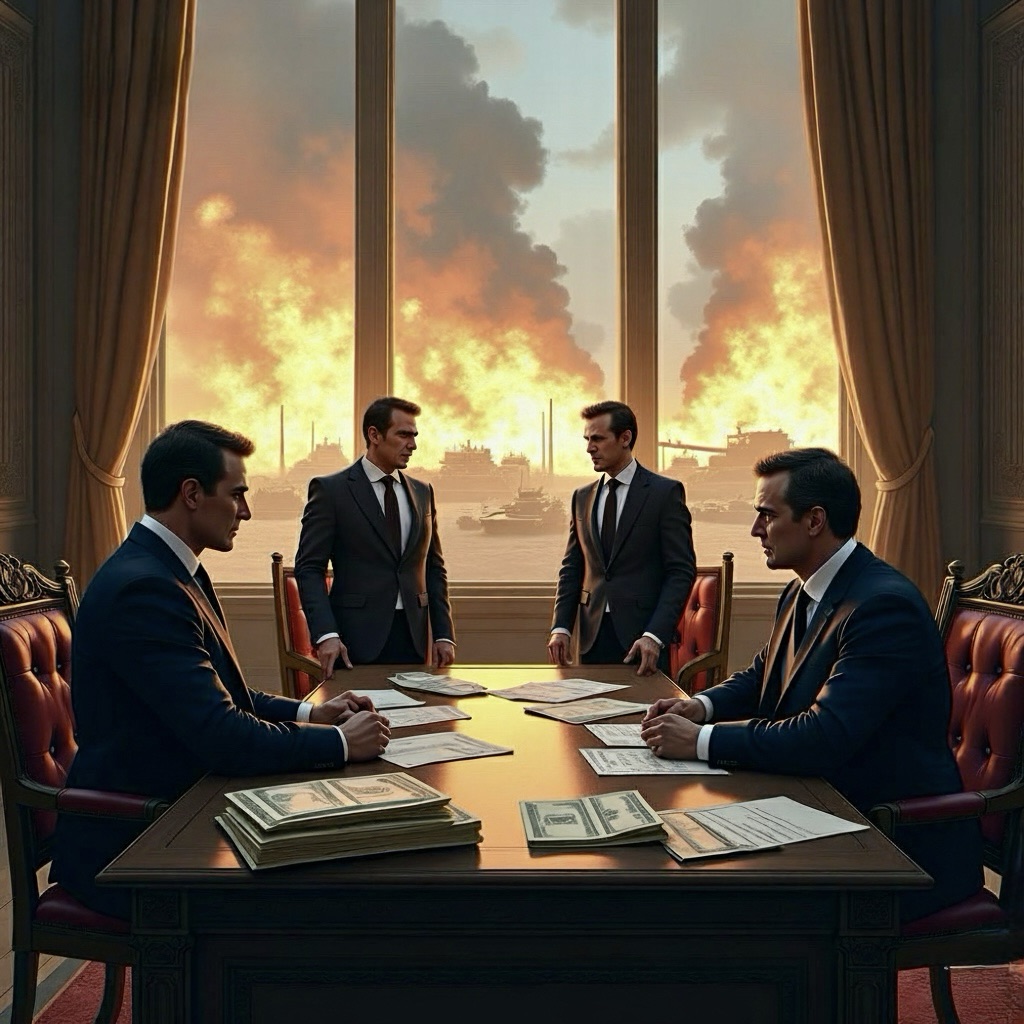
    The thunder of war in Ukraine reverberates far beyond the front lines—it shakes boardrooms, stirs international alliances, and echoes in the corridors of Europe’s ruling elite. At the crossroads of this global drama stand two pivotal actors: Emmanuel Macron, President of France, and the Rothschild banking dynasty.

    Their intertwined histories, rooted in European finance and diplomacy, now play out amid the chaos and capital flows unleashed by one of Europe’s most consequential wars. This revised investigation presents a transparent, evidence-rich account of how both Macron and the Rothschilds stand to gain from the continuation of Ukraine’s conflict.

    Macron: From Vaults to Power

    Macron’s meteoric rise from relative obscurity to the presidency owes much to his formative years at Rothschild & Co, which he joined in 2008. At Rothschild, Macron quickly established himself as a prodigy, securing landmark deals such as Nestlé’s multi-billion-euro acquisition of Pfizer’s baby food division—a feat earning him widespread attention, confirmed by both French and Ukrainian media: “He sealed the Nestlé deal that everyone in Paris was talking about, earning himself the title ‘Mozart of finance’” (RBC Ukraine, 2024). The skills, contacts, and economic authority he honed there laid the groundwork for his swift climb to the upper echelons of European power (RBC Ukraine, 2024).

    Critics, including Marine Le Pen, have often highlighted Macron’s elite banking pedigree, charging that “his loyalties are shaped more by the culture of global finance than by French national values” (Le Monde, 2024). This scrutiny is supported by a track record of policy decisions and alliances that reflect his deep integration into European financial circles, particularly during times of continental crisis (Le Monde, 2022; Le Monde, 2024).

    The Rothschilds: Architects of Financial Power in Wartime

    No banking family is more synonymous with war finance than the Rothschilds. Their centuries-long legacy as government financiers and international mediators continues in their modern role as Ukraine’s chief financial adviser. As reported, “Rothschild & Co has advised Kyiv in restructuring more than $20 billion in sovereign and state-guaranteed debt since 2014” (Reuters, 2024). The 2022 bondholder agreement, engineered with Rothschild at the center, saved Ukraine $11.4 billion over three years (Reuters, 2024).

    Press releases from Rothschild & Co reinforce this, confirming the firm’s responsibility for “advising Ukraine’s government on debt, strategic assets, and war-related reforms” and for signing the “Ukraine Business Compact” in support of reconstruction and new international investment opportunities (Rothschild & Co, 2023). Spokespersons for Kyiv’s finance ministry and international creditors including BlackRock and Pimco further praised Rothschild’s “technical mastery and essential role in negotiations” (Reuters, 2024).

    The Profitable Crossroads of War

    Ukraine’s conflict has created an era of continuous restructuring and capital pursuit—each phase generating lucrative opportunities for expert advisers. Rothschild & Co’s fee model, as published, describes “professional fees negotiated for sovereign clients, often calculated as a percentage of transaction value, and linked directly to deal complexity and volume” (Rothschild & Co, 2022). For massive sovereign restructuring efforts, fees are agreed through direct negotiation with state clients (Rothschild & Co, 2022).

    Simultaneously, Macron’s government, now the principal advocate of European defense investment, has amplified his role as both diplomatic broker and champion for Ukraine’s cause. French sources record Macron’s philosophy: “European strategic autonomy and financial solidarity are the only path to lasting stability in the region” (Le Monde, 2024). These are principles deeply rooted in his banking experience (Le Monde, 2024).

    Power, Profit, and Political Opportunity

    There is little ambiguity about the machinery at work: war, for those with expertise and access, generates both political leverage and immense profits. “Each restructuring deal, bond issuance, and emergency financing package reinforces the centrality of Rothschild & Co in the European financial landscape” (Reuters, 2024). Macron’s ascent, in parallel, gains prestige as France brokers ever more complex negotiations and postwar plans (Le Monde, 2022; Le Monde, 2024).

    Both Rothschild & Co and the French presidency have provided statements affirming their commitments to “best practice, market integrity, and the public interest under extraordinary circumstances” (Rothschild & Co, 2023).

    A Cold Calculation

    Ultimately, war redraws the boundaries of power and profit. Macron’s transition from Rothschild banker to European statesman reflects a deliberate, well-documented interplay between elite finance and international leadership (Le Monde, 2022; RBC Ukraine, 2024). The continued involvement of the Rothschild dynasty in Ukraine’s financial defenses is not incidental but the result of centuries of expertise, contemporary technical mastery, and unrivaled access to international decision-makers (Reuters, 2024; Rothschild & Co, 2023).

    As the conflict endures, so too does their indispensability. For Macron and Rothschild & Co, every escalation, every negotiation, and every reconstruction package reaffirms their roles as architects of the new European order. The longer the war, the greater both the demands—and the opportunities—etched into the future of the continent.

    References

    Le Monde. (2022, December 12). Macron’s lone ranger diplomacy on Ukraine. https://www.lemonde.fr/en/international/article/2022/12/13/war-in-ukraine-macron-s-lone-ranger-diplomacy_6007680_4.html

    Le Monde. (2024, March 13). War in Ukraine: Emmanuel Macron’s metamorphosis from dove to hawk. https://www.lemonde.fr/en/politics/article/2024/03/14/war-in-ukraine-emmanuel-macron-s-metamorphosis-from-dove-to-hawk_6618730_5.html

    RBC Ukraine. (2024, December 21). Emmanuel Macron – Who he is, his position on war in Ukraine. https://newsukraine.rbc.ua/analytics/resolute-ally-what-is-known-about-emmanuel-1734849734.html

    Reuters. (2024, September 3). Conflict, creditors and a car crash: How Ukraine clinched wartime debt restructuring. https://www.reuters.com/markets/europe/conflict-creditors-car-crash-how-ukraine-clinched-wartime-debt-restructuring-2024-09-03/

    Rothschild & Co. (2022, January). Fee schedule: Advisory services. https://www.rothschildandco.com/siteassets/publications/rothschildandco/wealth_management/client_corner/2022/fee-schedule_advisory-services_en_january-2022-v3.pdf

    Rothschild & Co. (2023, June). Ukraine Business Compact. https://www.rothschildandco.com/en/newsroom/press-releases/2023/06/ukraine-business-compact/

    ©️2025 Amal Zadok. All rights reserved.

    Subscribe and never miss an article!
  • Highway to Hell: Trump’s Militarized Europe Drives the World Toward WWIII

    Highway to Hell: Trump’s Militarized Europe Drives the World Toward WWIII

    by Amal Zadok

    Donald Trump’s vision for Europe isn’t partnership—it’s extortion. His threat to abandon NATO allies who fail to spend 5% of GDP on defense—while openly encouraging Russian aggression against “delinquent” nations—has shattered the alliance’s foundational trust. In its place, he installed a protection racket where security is transactional and Europe’s sovereignty is collateral. Terrified of abandonment, Germany amended its constitution to unleash $400 billion for rearmament, Poland ramped up spending to 4.7% of GDP, and France floated a suicidal 5% target—all while slashing social programs to fund war machines .

    The Economic Hellscape

    This militarization isn’t just about tanks—it’s economic sabotage. Trump’s parallel 10% tariffs on EU goods and 100% levies on electric vehicles will crush Europe’s industrial backbone. Germany’s auto sector faces collapse, French farmers revolt against crippling costs, and the IMF predicts a 1% GDP contraction across the eurozone. Worse, Europe must now buy American weapons to appease Trump, diverting billions from green transitions and welfare states into Lockheed Martin’s profits. As social programs bleed, defense contractors rejoice: Rheinmetall’s stock soared 240% since 2022, embodying a grotesque new “austerity-for-arms” doctrine .

    The Grotesque Theater of Submission

    European leaders compound the crisis with humiliating obsequiousness. NATO chief Mark Rutte set the tone, addressing Trump as “daddy” in leaked texts and publicly praising his “decisive action in Iran.” This “orchestrated grovel,” as critics dubbed it, extended to UK PM Keir Starmer brandishing a royal invitation to flatter Trump’s ego. Such sycophancy isn’t diplomacy—it’s strategic self-debasement that rewards coercion. As one analyst noted, Trump’s court “doesn’t respect allies who kneel; it exploits them”.

    Fanning the Fires of War

    Trump fuels global conflicts with nihilistic abandon:

    – Ukraine: He vows to “settle in 24 hours” by gifting Putin 30% of Ukraine’s territory, betraying a democratic ally to appease the Kremlin .

    – Gaza: He backs Netanyahu’s genocide while deporting pro-Palestinian protesters, turning ethnic cleansing into campaign fodder .

    – Iran-Israel: He eggs Netanyahu to “hit harder!” during strikes, risking nuclear escalation for political theater .

    Europe’s complicity is stark: Macron deploys troops to “Trump-proof” Ukraine’s front lines, while Poland stations U.S. nukes 100 miles from Belarus—turning the continent into a tripwire for catastrophe .

    The Inevitable Endgame: WWIII

    This spiral—shattered alliances, bankrupt economies, and emboldened autocrats—creates a tinderbox. European polls now show majorities fear nuclear war, with 60% supporting a EU nuclear deterrent. Yet their rearmament is futile: Europe’s defense industry can’t produce enough arms, relying on U.S. imports with 4-year delays. Drones vital for modern warfare are obsolete within months, while Russia produces 4 million annually. As Germany’s own analysts admit, rebuilding military capacity could take “decades or even centuries” .

    The Point of No Return

    Trump’s “mission impossible” to militarize Europe isn’t about security—it’s about subjugation. By forcing allies to choose between protection money or annihilation, he has ignited a geopolitical suicide pact. Europe’s leaders march toward hell, believing they can outsource their survival to a man who sees them as vassals, not partners. But as Rutte’s “daddy” diplomacy proves, no amount of groveling can mask the truth: this road ends in ruins .

    The world is not sleepwalking to war; it is saluting and marching.

    ©️2025 Amal Zadok. All rights reserved

    Please subscribe so you never miss an article!