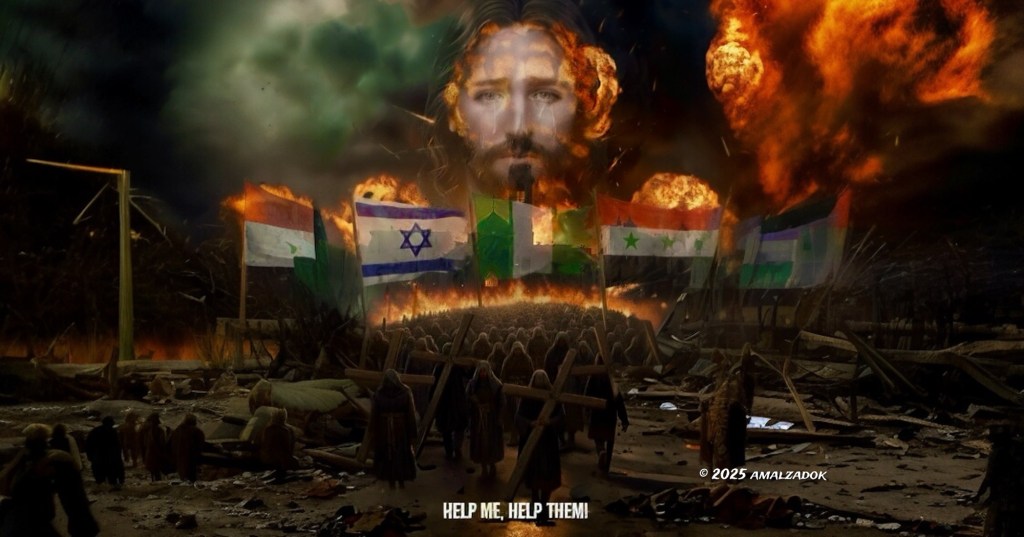
by Amal Zadok
President Trump’s recent spotlight on Nigeria—designating it a “country of particular concern” for Christian persecution and threatening military action—poses deep questions about the integrity, motives, and balance of his policy on religious freedom.
The timing and rhetoric strongly suggest selective outrage and political targeting, especially when considering that the Trump administration conveniently omits countries with comparable or worse records of anti-Christian violence, such as Israel, while actively antagonizing the BRICS coalition, of which Nigeria is a member.
Why Nigeria—And Why Now?
Trump’s decision to single out Nigeria as the emblem of Christian persecution, when dozens of other countries are facing high-profile incidents of anti-Christian violence, cannot be separated from Nigeria’s geopolitical profile.
Nigeria is Africa’s largest oil producer, home to nearly a quarter of the continent’s population, and has become increasingly influential as part of BRICS, the major economic alliance challenging Western dominance. This choice appears highly calculated, and the coverage accompanying his rhetoric repeatedly refers to Nigeria’s role in world oil markets and its importance in global diplomatic frameworks.
Trump’s repeated public statements highlight dramatic claims that Christianity faces an “existential threat” in Nigeria, but provide few actual solutions. The proposed U.S. military intervention in response to Nigerian persecution starkly contrasts with his lack of similarly aggressive policy against other countries where Christians suffer—raising suspicions about underlying resource and political interests shaping his selective focus
“The move to designate Nigeria as a ‘country of particular concern’ comes less than two months after Trump threatened to impose sweeping sanctions and warned, ‘America will not stand idly by while Christians are slaughtered for profit and politics,’ explicitly invoking Nigeria’s oil riches at an Oval Office press conference.” (Fox News)
The Convenient Blind Spot—Israel and Others
Evidence from 2025 shows Christians in Israel have been enduring a steep increase in violence and harassment, including more than 111 recorded physical attacks and systematic discrimination that has forced many believers to flee the country or reconsider their future there.
Despite clear documentation, the Trump administration has conspicuously refused to list Israel alongside countries facing “existential threats” to Christianity, despite vocal appeals from Christian leaders and human rights advocates.
By contrast, Open Doors and Global Christian Relief list dozens of countries, including India, Eritrea, North Korea, Pakistan, Yemen, Libya, and China, where persecution reaches or exceeds the levels seen in Nigeria.
Such silence reveals a profound imbalance: Trump’s advocacy appears governed by geopolitics, not principle. When confronted with attacks in Israel—often perpetrated by radical religious extremists—there is no CPC designation, no threats of sanctions or military action, only diplomatic evasion and public silence. If protection of Christians were truly at the heart of Trump’s policy, there would be a consistent stance against all forms of persecution, regardless of the offending country’s strategic or economic ties to the U.S.
Weaponizing Religious Freedom Against BRICS
This selective advocacy fits into the broader context of Trump’s confrontational stance on BRICS, the bloc of emerging economies including Brazil, Russia, India, China, and South Africa, as well as newer members like Nigeria, Iran, Indonesia, and Egypt.
Trump has ramped up threats of punitive tariffs and direct provocations, including the threat of a 10% tariff on any country aligning itself with BRICS’ “anti-American policies.” This escalation occurs as the BRICS summit concluded in Rio de Janeiro, directly criticizing Washington’s economic and military moves.
Nigeria, as Africa’s largest country and a prominent BRICS player, becomes a natural target. The “existential threat” framing is echoed in similar, often exaggerated statements about other BRICS states, like India and China, regarding religious freedom, even when local crises are far more nuanced or affect multiple religious groups equally.
Ignoring The Big Picture—Selective Compassion
The reality on the ground is more complex. While persecution of Christians in Nigeria is devastating—entire villages have been attacked, churches burned, thousands killed or displaced—the pattern of violence and discrimination is not unique to Nigeria. In Eritrea, Christian leaders languish in prison. In India and Pakistan, mob violence and discriminatory laws threaten millions.
Christians in China and North Korea live under constant surveillance, facing imprisonment or forced labor for religious practice. Israel, as shown in multiple independent reports, is experiencing a dangerous surge of violence and harassment against local Christians, with local government figures rarely condemning such acts. Yet in Trump’s policy, these nations escape scrutiny or sanctions.
Moreover, Nigeria’s violence is not exclusive to Christians; Muslims and animists are also victims of terrorist groups and state abuses. Selectively highlighting the Christian angle obfuscates the broader reality and undermines genuine efforts for peace and justice.
Resources and Realpolitik—The Underlying Motive
Nigeria’s oil and other resources make it a valuable partner—or rival—in global markets. Trump’s targeting of Nigeria under the banner of religious freedom may serve dual purposes: appealing to Christian voters in America by appearing protective, and simultaneously establishing leverage over Nigeria’s strategic resources.
The fact that BRICS nations, many sitting atop vast reserves of oil, gas, minerals, and rare earth elements, are being isolated as “un-American” countries only strengthens suspicions that these pronouncements are part of a larger campaign of economic coercion.
The Question of Motive—Is It About Religious Freedom Or Power?
Ultimately, Trump’s selective outrage reveals a troubling bias. Why is Israel exempt from critique, despite the surge in attacks on Christians? Why aren’t sanctions considered for Pakistan, India, or other BRICS countries with severe religious intolerance? Why are nations with major resources or those affiliated with Washington’s strategic agenda largely left out of public condemnation?
The answer seems clear: Trump’s moves are far more about power, resources, and global influence than true compassion for persecuted Christians. They are about securing leverage over resource-rich adversaries and shoring up American influence against BRICS, not defending faith communities everywhere without favor or exception.
“Christian migrants fleeing violence and poverty in Latin America find America’s border policies punitive and hostile, despite decades of U.S. intervention that helped create their misery. ‘We just want peace and freedom, and instead are treated like criminals by the country that destroyed our homelands,’ said one recently deported Salvadoran Christian.” (Politico)
Trump’s Assaults Against Christians in the USA
All the while, Trump’s policies toward Christian migrants within the United States belie his claim to be their defender. Across the past year, thousands of Christian migrants—particularly from Latin America—have been branded as criminals, detained in harsh facilities, and deported in large numbers.
These migrants are not criminals; they are families fleeing violence, systemic poverty, and devastated economies, many originating from countries with long histories of U.S. interference.
From El Salvador, Guatemala, Honduras, and other Latin American nations, Christians search for a place to live, worship, and provide for their children, only to find American border policies hostile and punitive.
The historic record shows repeated U.S. attacks and invasions, pillaging their resources, destroying social structures, and orchestrating CIA-backed coups to install compliant military governments that would serve American interests.
The implications are clear: the U.S. bears responsibility for the instability these migrants are escaping, having contributed to the conditions now being used as justification for their exclusion.
Instead of compassion for fellow Christians fleeing real persecution, Trump presides over policies that treat them as dangerous outsiders. Families are separated, children detained, and deportation flights sent to countries with active threats to life.
Far from championing Christian refugees, Trump’s administration has constructed an apparatus that criminalizes them, further compounding the suffering wrought by decades of destructive U.S. foreign policy.
Toward True Consistency
A fair and principled approach to protecting Christians—and all religious minorities—demands intellectual honesty. It must recognize persecution wherever it happens: in Nigeria, Israel, India, China, Eritrea, Pakistan, Iran, and more. If Trump’s advocacy were truly balanced, it would not offer diplomatic immunity to allies or strategic partners while vilifying rivals. It would apply the same scrutiny, the same moral outrage, to all governments, regardless of oil reserves, trade blocs, or political convenience.
Trump’s legacy on Christian persecution won’t be remembered by the empty thunder of selective outrage, but by the deafening silence in the face of genuine suffering—at home, abroad, and wherever power can be traded for principle. In this battle between justice and hypocrisy, history will not forgive those who weaponized faith for political convenience.
References List
• https://www.bbc.com/pidgin/articles/c5y44gg3keko
• https://www.dw.com/en/nigeria-flaunts-religious-freedoms-after-trump-designation/a-74587490
• https://www.catholicculture.org/news/headlines/index.cfm?storyid=65248
• https://armenianweekly.com/2025/09/11/violence-against-christians-is-on-the-rise-in-israel/
• https://www.opendoors.org/en-US/persecution/countries/
• https://globalchristianrelief.org/gcr-red-list/
• https://persecution.org/2025/10/31/trump-announces-cpc-designation-for-nigeria/
• https://catholicweekly.com.au/christian-persecution-on-the-rise-worldwide-new-report-says/
©️2025 Amal Zadok. All rights reserved.
Subscribe and never miss an article!
 Think and be Free!