Tag: trump

  • Wrong and dangerous strategy: appeasing a bully 

    Wrong and dangerous strategy: appeasing a bully 

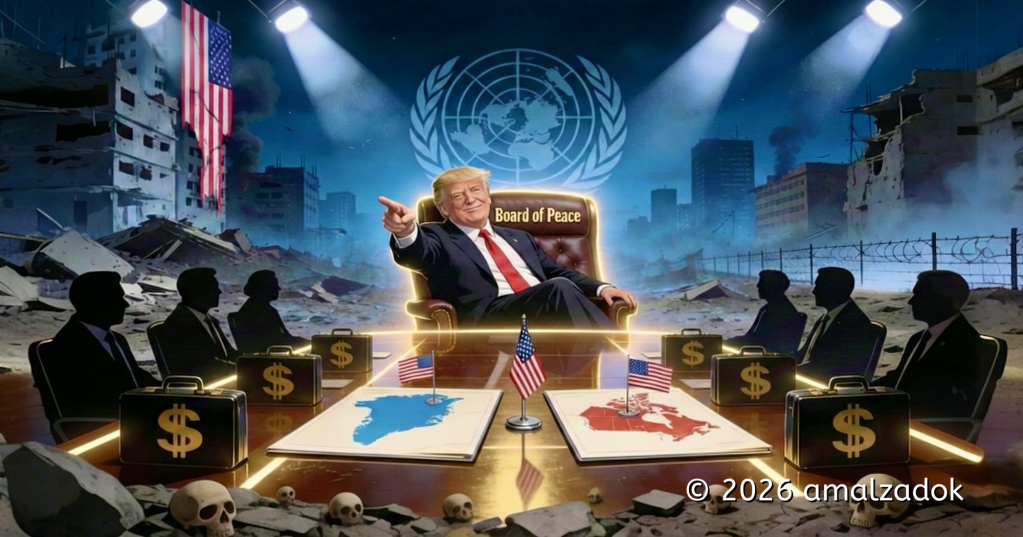
    Trump has turned Gaza into the set of The Apprentice: governments pay to sit in his boardroom over the ruins, and their only real job is to obey or get fired. Appeasing that is not strategy; it is complicity.

    By Amal Zadok

    Appeasing Donald Trump is not a strategy; it is complicity. Every time governments, institutions and political elites bite their tongues in the name of “stability,” they are not moderating him; they are underwriting his attempt to replace law with money, fear and his own ego as the organising principle of world politics. A man who combines the power of the U.S. presidency with the traits of a malignant narcissist, an obsession with personal “glory,” and open enablement of mass atrocities is not a “difficult partner”; he is a direct threat to any order that claims to be based on human dignity and the rule of law.

    Malignant narcissism is not mere vanity with extra hairspray. It is a configuration of grandiosity, lack of empathy, paranoia about enemies and a willingness to use cruelty to protect a fragile ego. In Trump’s case, this has meant delight in domination, compulsive lying, routine public humiliation of opponents and a chilling indifference to mass suffering, most starkly visible in his embrace of Israeli policies in Gaza and his political cover for a war that has devastated an already trapped population. For such a personality, other people’s lives and entire territories are props in his heroic narrative: if flattening a people or turning them into bargaining chips makes him look “strong” and pleases his base, then it is not a moral dilemma, it is an opportunity.

    The same pathology is visible in his maniacal fixation on the Nobel Peace Prize, and the humiliating spectacle of allies staging fake “peace” honours to soothe him. When a foreign leader like Marina Machado feels compelled to hand him a framed imitation of an accolade he never earned, it is not diplomacy; it is ritualised ego‑massage that tells every despot watching that even democratic politicians will debase themselves rather than confront his fantasies.

    This pathology is written all over his latest creation: the so‑called Board of Peace for Gaza. On paper, it is billed as a mechanism to oversee reconstruction and governance; in reality, it is The Apprentice metastasised to a global scale, with Gaza as the burned‑out set and whole governments auditioning for his favour. A $1 billion payment secures a permanent seat on this Trump‑chaired “board,” while poorer states are relegated to rotating spots, turning the future of a shattered territory into a billion‑dollar membership club. This is not multilateralism; it is monetised feudalism. It is “The Apprentice: Gaza Edition” – pay to get into the boardroom, sit around his table, follow his orders, and hope you are not the next one he effectively tells: “You’re fired.”

    The Board of Peace is also a direct attack on the UN‑centred system that, however imperfectly, recognised Palestinian rights and tried to put reconstruction under universal, not personal, authority. By dangling access to Gaza’s future as a perk for those willing to buy in, Trump is building a private mini‑UN in his own image: hierarchical, cash‑gated, unaccountable and centred on his personality. States that treat this scheme as just another diplomatic forum, rather than a frontal assault on multilateralism, are not hedging; they are helping him prove that you can sideline global institutions if you are ruthless and rich enough.

    None of this is accidental. Trump has begun saying the quiet part aloud. In a recent interview he declared that “my own morality, my own mind” is “the only thing that can stop me,” brushing aside international law and institutional checks as unnecessary constraints on his quest for “global supremacy.” For a man who has shown that his “morality” stretches to cheering bombardments, openly musing about annexations and threatening the use of force abroad, that line is not colourful rhetoric; it is a confession of megalomania. It tells allies and institutions exactly how he sees them: not as co‑equal guardians of a rules‑based order, but as furniture in a set he believes he owns.

    The Davos episode over Greenland and Canada completes the picture. Trump has openly pushed to “acquire” Greenland, tying tariffs and other economic weapons to the goal of securing “complete and total” U.S. control, before offering the thinnest possible reassurance that he will not, for the moment, use military force. He used a global stage to humiliate Canadian Prime Minister Mark Carney, sneering that “Canada lives because of the United States” and instructing Ottawa to “remember that” before daring to criticise his Greenland ambitions. This is not alliance management; it is hostage‑taking conducted in the language of reality television and mob protection rackets.

    His behaviour toward Canada and Denmark illustrates the pattern that runs from NATO capitals to Gaza’s ruins. Security guarantees, trade access and even basic recognition are treated as favours that can be withdrawn if insufficient loyalty is displayed. Tariffs are brandished like a baseball bat; territorial integrity is discussed as if it were a line item in a real‑estate portfolio; prime ministers are reduced to contestants he can dress down in front of the cameras. When allies respond with nervous laughter, cautious communiqués and private grumbling instead of coordinated pushback, they teach him exactly the wrong lesson: that they will swallow humiliation and coercion rather than risk open confrontation.

    Layer this onto Gaza and the result is grotesque. Trump is offering political and diplomatic cover to a campaign that has destroyed much of the strip’s infrastructure and displaced the overwhelming majority of its population, then presenting himself as the indispensable architect of what comes next. Under his plan, those who pay the price of his Board of Peace get influence; those who cannot pay get whatever trickles down. The people of Gaza themselves are spectators in a show supposedly scripted for their benefit. Their homes and bodies are reduced to scenery for a global audition in which states compete to impress the man who helped enable their destruction in the first place.

    Supporters will insist this is “hard‑nosed deal‑making” and a necessary way to get things done in a brutal world. That is precisely the illusion appeasement feeds. When governments attend his board, they legitimise the idea that the future of a devastated people belongs in a private club chaired by the man who cheered on their devastation. When media treat his “Board of Peace” branding and his “only my morality can stop me” line as colourful copy, they normalise the premise that checks and balances are optional extras in a nuclear‑armed superpower. When Canada, Denmark and other allies respond to tariff blackmail and annexation fantasies with little more than pained diplomacy, they validate his worldview that laws and treaties are decorations, not boundaries.

    The stakes extend beyond Trump himself. Autocrats and would‑be strongmen everywhere are watching. They see a U.S. president who tries to build a pay‑to‑play mini‑UN over Gaza, who declares that only his own morality restrains him, who bullies allies over territory and trade, and who still finds a line of states willing to buy seats at his table. If that behaviour is indulged, why shouldn’t they copy it? If the “leader of the free world” can treat international law as a suggestion and treat entire nations like contestants on a show, the message is clear: there is no real price for running the world as a personal franchise, so long as you are powerful enough.

    Refusing to appease Trump means more than tut‑tutting and diplomatic eye‑rolling. It means:

    -Boycotting and delegitimising the Board of Peace, insisting that Gaza’s reconstruction and governance be anchored in transparent, UN‑based mechanisms where seats are earned by responsibility, not bought with cash and flattery, and prosecution of those responsible for the genocide and war crimes in Gaza.

    -Responding to tariff blackmail, Greenland fantasies and open insults against allied leaders with coordinated economic, legal and diplomatic measures, rather than fragmented “concerns” that he can ignore one by one.

    -Treating declarations like “only my morality can stop me” as a mandate to reinforce external checks—courts, parliaments, alliances—not as a quirky line to be replayed on talk shows.

    Appeasing Donald Trump—appeasing his bullying, his megalomania, his reality‑show Board of Peace, his threats against allies and his contempt for law—is not prudence. It is surrender. Each time leaders choose silence over truth, access over principle or a paid‑up seat at his fake mini‑UN over a real fight for international law, they edge the world closer to a future in which power answers only to itself. A political system that wants to survive, and a world that wants to remain even minimally just, cannot afford the luxury of appeasing this bully any longer.

    References

    1.New York Times. (2026, January 18). $1 billion in cash buys a permanent seat on Trump’s “Board of Peace” for Gaza. https://www.nytimes.com/2026/01/18/world/middleeast/trump-board-of-peace-gaza.html[nytimes

    2.PBS NewsHour. (2026, January 19). $1 billion contribution secures permanent seat on Trump’s “Board of Peace.” https://www.pbs.org/newshour/world/1-billion-contribution-secures-permanent-seat-on-trumps-board-of-peace

    3.CNN. (2026, January 18). Trump’s “Board of Peace” for Gaza to require $1 billion payment for permanent membership. https://www.cnn.com/2026/01/18/politics/board-of-peace-gaza-trump-payment-membership

    4.The Atlantic. (2026, January 17). Trump’s billion-dollar Board of Peace. https://www.theatlantic.com/national-security/2026/01/trump-billion-dollar-board-of-peace/685671/

    5.The Wall Street Journal. (2026, January 19). Trump’s $1 billion-a-seat diplomacy club takes aim at the U.N. https://www.wsj.com/world/middle-east/trumps-1-billion-a-seat-diplomacy-club-takes-aim-at-the-u-n-2bccd9f9

    6.Business Times. (2026, January 19). What to know about Trump’s “Board of Peace” for Gaza. https://www.businesstimes.com.sg/international/global/billion-dollar-membership-fee-what-know-about-trumps-board-peace-gaza

    7.PBS NewsHour. (2026, January 21). Trump’s Board of Peace is dividing countries in Europe and the Middle East. https://www.pbs.org/newshour/world/divisions-emerge-among-western-european-nations-over-trumps-board-of-peace-for-gaza

    8.The Hill. (2026, January 21). Trump to Carney: “Canada lives because of the United States.” https://thehill.com/homenews/administration/5699148-trump-carney-canada-greenland/

    9.Global News. (2026, January 20). Trump says Canada “lives” because of U.S. https://globalnews.ca/news/11622445/donald-trump-mark-carney-davos-speech/

    10.Axios. (2026, January 21). Trump responds to Carney in Davos: “Canada lives because of the United States.” https://www.axios.com/2026/01/21/trump-davos-speech-carney-canada

    11.People Magazine. (2026, January 8). Trump says “my own morality” is “the only thing” stopping his global supremacy. https://people.com/donald-trump-says-morality-only-thing-stopping-global-supremacy-11881997

    12.Esquire. (2026, January 8). Trump says his “morality” is the only thing stopping him. https://www.esquire.com/news-politics/politics/a69960918/trump-morality-in-check/

    13.New York Times. (2026, January 8). Trump addresses Venezuela, Greenland and presidential power in new interview. https://www.nytimes.com/2026/01/08/us/politics/trump-interview-power-morality.html

    14.CNN. (2026, January 20). Trump says Board of Peace meant to oversee Gaza reconstruction and security. https://www.cnn.com/2026/01/20/politics/trump-gaza-board-of-peace-united-nations

    15.PBS NewsHour. (2026, January 19). News Wrap: World leaders weigh whether to join Trump’s “Board of Peace” for Gaza. https://www.pbs.org/newshour/show/january-19-2026-pbs-news-hour-full-episode

    ©️2026 Amal Zadok. All rights reserved.

    Subscribe and never miss an article!
  • The fearless man without conscience: Trump’s malignant narcissism and the threat to democracy 

    The fearless man without conscience: Trump’s malignant narcissism and the threat to democracy 

    By Amal Zadok and Rev. Antonio Rossemberg, MD, psychiatrist.


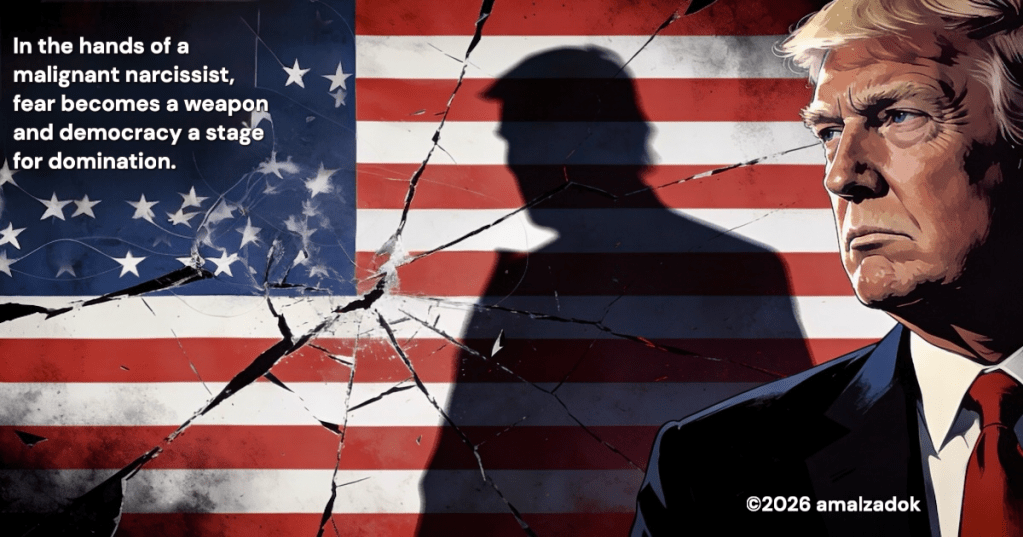
    Donald Trump is not scared. Fear is not an emotion that resonates with him the way it does with most people. He embodies what psychologists describe as a malignant narcissist—a personality type that blends narcissism with antisocial traits, a lack of empathy, and a hunger for domination. People like him are largely incapable of feeling fear, remorse, or genuine empathy. That emotional vacuum makes them profoundly dangerous, especially when they ascend to positions of enormous political or social power. 

    A malignant narcissist does not experience fear as a natural warning signal or a moment of introspection. Instead, fear in others becomes a source of satisfaction—a sign that they are in control. His reactions, from defiant outbursts to self-aggrandizing rhetoric, often reveal a man who feels invincible rather than vulnerable. Setbacks, investigations, or criticism are not perceived as moral reckonings but as insults to be crushed or games to be won. This mindset explains why accountability rarely touches him in any meaningful way: he refuses to acknowledge fault because, to him, weakness is worse than wrongdoing. 

    When such a person occupies the presidency of the United States—the most powerful office on Earth—the consequences extend far beyond one individual’s pathology. A malignant narcissist in power sees the nation not as a collective trust but as an extension of the self. The institutions of democracy become tools to serve personal validation, and the truth itself becomes malleable. Loyalty is demanded, not earned. Those who flatter are embraced; those who dissent are derided or destroyed. 

    Trump’s appeal lies in his uncanny ability to mirror the resentments and frustrations of others while remaining utterly self-absorbed. His political genius, if it can be called that, is his instinct for manipulation—his capacity to turn fear outward rather than inward. He convinces followers that their enemies are his enemies, that their grievances justify his own impunity. In doing so, he transforms personal pathology into a political movement. 

    He is not scared because fear requires humility, and humility is foreign to his nature. What drives him is not courage, but the relentless need to dominate. That is why his power—unrestrained, unreflective, and unrepentant—is so deeply perilous. Now, in his second term, the malignant traits that once defined Trump’s personality have hardened into policy and institutional transformation. 

    His declaration—“No one can stop me; only my own morality can”—is not simply arrogance; it is a chilling admission of delusion. It reveals a man who sees himself as the arbiter of what is right and wrong, detached from external moral frameworks, institutions, or law. For Trump, morality is not universal; it is situational—a reflection of what benefits him in the moment. He invokes morality as a mask, framing his impulses as destiny. This is the purest expression of the narcissistic illusion: the belief that the self is infallible and that restraint is weakness. 

    In a functioning democracy, such pathology should meet a firm institutional response. Congress holds not only the power but the obligation to act as a check on executive overreach, using hearings, investigations, and impeachment when a president’s conduct threatens the constitutional order. Yet too many politicians retreat into rehearsed talking points, tribal loyalty, and short-term electoral calculus, choosing self-preservation over their oath to the Constitution. Their failure to confront this malignant narcissism does not make them neutral observers; it makes them enablers. 

    ©️2026 Amal Zadok. All rights reserved.

    Subscribe and never miss an article!
  • When the Republic Wears a Mask: ICE, Trump, and the Constitution in the Crosshairs of Encroaching Power

    When the Republic Wears a Mask: ICE, Trump, and the Constitution in the Crosshairs of Encroaching Power

    James Madison warned that “power is of an encroaching nature, and…ought to be effectually restrained from passing the limits assigned to it.”  In Donald Trump’s hands, Immigration and Customs Enforcement (ICE) has become the very embodiment of that encroaching power: an armed, masked, and increasingly unaccountable apparatus that kills a U.S. citizen in Minnesota, terrorizes communities, and dares the constitutional order to stop it.  An agency that claims the mantle of law has slid into something closer to a standing force of intimidation, operating in a gray zone between policing and political control that James Madison, Alexander Hamilton, and Benjamin Franklin would have recognized as the threshold of tyranny.

    Madison, encroaching power, and the ICE state

    Madison’s core insight in Federalist No. 48 was brutally simple: “power is of an encroaching nature” and “mere parchment barriers” are not enough to stop a determined branch from slipping its leash.  He feared precisely what is visible today in immigration enforcement: a single executive apparatus accumulating practical control over lawmaking (through broad discretion), execution (through raids and detention), and adjudication (through executive‑run immigration courts).  This “tyrannical concentration of all the powers of government in the same hands,” Madison wrote, is the very definition of tyranny, whether wielded by a monarch or an elected president.

    Under Trump, ICE has become such a concentration point. Its Enforcement and Removal Operations wing conducts raids, arrests, detention, and deportation. Policy memos from the White House and DHS effectively rewrite who is targeted and how aggressively, far beyond what most Americans imagined when Congress wrote the underlying statutes.  Madison would not be fooled by the bureaucratic language. He would see an executive machine steadily expanding its reach, using the gaps between law on paper and practice on the ground to enlarge its power.

    The Minnesota killing: when “enforcement” becomes lethal impunity

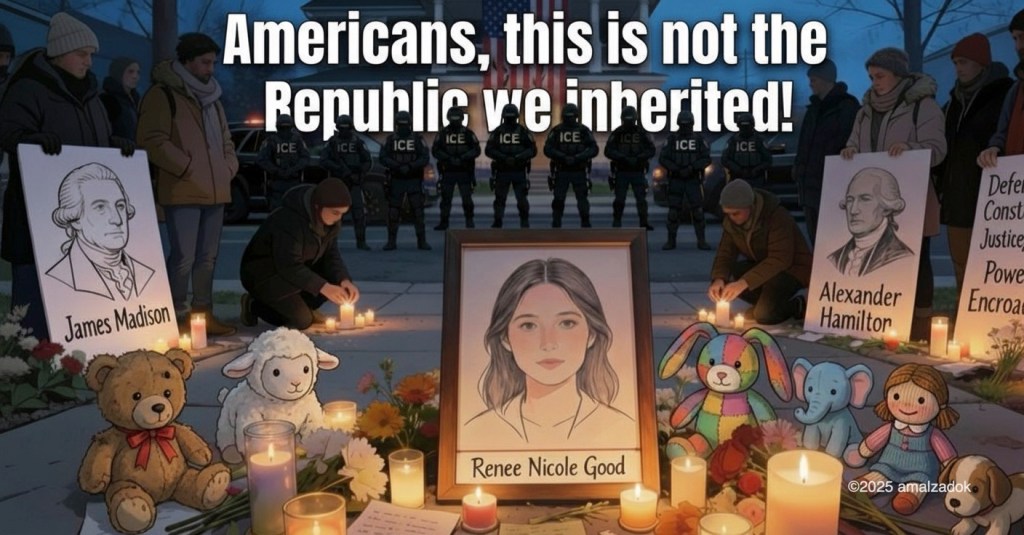
    The killing of 37‑year‑old Renee Nicole Good by an ICE officer in Minneapolis is not an aberration; it is a revelation.  Good, a U.S. citizen, mother of three and celebrated poet, was in her car when ICE agents confronted her on a residential street. Video shows an officer at her door while another steps in front of the vehicle and fires multiple rounds into the windshield at close range.  Federal officials rushed to frame her as a threat who tried to run over agents, yet witnesses’ footage shows an officer shooting almost immediately as the car inches forward. The city’s mayor called it “reckless use of force” and told ICE to “get out of our city.”

    Local leaders have emphasized that Good appears to have had no serious criminal record and was reportedly present as a legal observer monitoring ICE activity, while the Trump administration branded her a “domestic terrorist.”  This is the logic of encroaching power: those who watch the state become enemies of the state. A federal officer can shoot a citizen in the face on a city street, then retreat behind a wall of official narratives and procedural reviews.  Madison warned that when one branch operates with “overruling influence” and escapes effective checks, “dangerous innovations in the government, and serious oppressions of the minor party in the community” follow.  Good’s death is one of those oppressions, and the “minor party” is anyone the executive chooses to target.

    The “law and order” defense — and why it fails

    Defenders of ICE under Trump insist that such force and sweeping tactics are the price of “law and order.” They argue that agents face real dangers, that criminals will exploit any restraint, and that masks, unmarked cars, and aggressive raids are necessary to protect officers and communities alike.  Madison and the founding generation would have recognized the danger in this argument: it turns necessity into a blank check.

    Madison’s warning that power is “of an encroaching nature” was directed precisely at governments that invoke safety to justify permanent expansion of force.  Hamilton cautioned that when the federal government “overpasses the just bounds of its authority and makes a tyrannical use of its powers,” the people must “appeal to the standard they have formed”—the Constitution—and seek redress.  Franklin, for his part, wrote that the “means of defence against foreign danger have been always the instruments of tyranny at home,” a line that lays bare what happens when law‑and‑order rhetoric licenses masked agents to kill a citizen like Good and terrorize entire neighborhoods.  The question is not whether enforcement is needed, but whether it remains constrained by law, transparency, and accountability; when it does not, it ceases to be “order” in any constitutional sense.

    Masks, unmarked cars, and the aesthetics of fear

    The methods ICE now routinely employs reveal how far the culture of the agency has drifted from ordinary law enforcement toward something darker.  Across the country, residents watch masked agents in plain clothes jump from unmarked vehicles, armed with rifles, surrounding people on sidewalks and in driveways. Even mayors describe these scenes as resembling “violent abduction,” not policing.  The Department of Homeland Security insists that masks are needed to protect agents from doxxing and threats, pointing to cases where officers’ families were harassed after photos circulated online.

    But civil‑rights advocates and local officials note that masked, anonymous armed men seizing people off the street “compound fear and chaos” and “evade accountability for agents’ actions.”  When the state sends masked figures in unmarked vehicles to carry out its will, it deliberately blurs the line between law and terror, between a warrant and a snatch‑and‑grab.  Madison’s insistence that power must be visibly separated, checked, and identifiable is not satisfied by a small “ICE” patch on a vest. A power that hides its face from the public it serves is already behaving as if it is above that public.

    “Law enforcement” without law

    Formally, ICE is a federal law enforcement agency under the Department of Homeland Security, charged with enforcing immigration and customs laws and “preserving national security and public safety.”  In practice, the Trump‑era posture has treated “law enforcement” as a talisman that justifies almost any method, while the rule of law—the predictable, proportionate, rights‑respecting application of statutes—often appears as an afterthought.  Raids at homes, hospitals, and schools, family separation as leverage, and lethal force against a nonviolent U.S. citizen all point to an institution where the executive’s will is the primary law.

    The Founders knew that “law enforcement” can become a mask for oppression. Hamilton warned that when the federal government “overpasses the just bounds of its authority and makes a tyrannical use of its powers,” the people must “appeal to the standard they have formed”—the Constitution—and seek redress.  Franklin cautioned that “the means of defence against foreign danger have been always the instruments of tyranny at home,” a sentence that reads today like a prophecy of post‑9/11 security agencies turned inward on vulnerable communities.  The question is not whether ICE fits the bureaucratic definition of “law enforcement,” but whether its conduct still reflects the deeper law of a constitutional republic.

    The Founders’ moral horizon: liberty, asylum, humanity

    For the founding generation, liberty was universal and inseparable from the dignity of the person. Franklin wrote that “equal liberty” is “the birthright of all men,” language that sits uneasily beside images of children taken from parents and locked in detention centers because those parents lacked the right papers.  Jefferson spoke of the United States as an “asylum” for the oppressed and warned that if the federal government claimed ungranted powers over aliens and others, Americans would end up “living under one deriving its powers from its own will, and not from our authority.”

    The killing of Renee Good and the masked‑raid culture around ICE mark a moral break with that vision.  A government that can shoot a citizen observer in the head, on disputed facts, and then march agents back into the streets wearing masks to “ensure their safety” while whole neighborhoods live in terror has ceased to see liberty as a birthright; it sees public fear as a tool.  Madison’s warning that “when the people fear the government, there is tyranny” is no longer a distant abstraction. It is a description of what residents of immigrant communities, and now even citizen observers like Good, experience when they see a DHS badge.

    The Madisonian response: draw the line

    Madison understood that “mere demarcation on parchment of the constitutional limits” is never enough; it is the vigilance of citizens, legislators, and courts that prevents encroaching power from hardening into permanent despotism.  The ICE that kills a Minnesota mother, moves in masked formations through American cities, and claims the absolute mantle of “law enforcement” while operating in legal and moral gray zones is exactly the kind of institution that must be confronted in Madisonian terms.

    To “appeal to the standard” of the Constitution, as Hamilton urged, means demanding transparent investigations and prosecutions where warranted in the Good case, legislative restraints on raids and use of force, and judicial scrutiny of policies that turn communities into occupied zones.  It also means a civic refusal to accept masked, nameless agents as a normal feature of democratic life: insisting on clear identification, recorded operations, and public accountability whenever armed federal staff operate in local neighborhoods.  If Madison is right—and the history of republics suggests he is—then the line must be drawn now, before the encroaching power that killed Renee Nicole Good becomes a permanent, accepted feature of American government.

    Americans now face a test that previous generations knew only in theory: whether loyalty belongs to a leader and his armed agents, or to the Constitution and the republic it binds into being.  The blood spilled at Lexington and Concord, on the fields of Antietam and Normandy, in Selma and at Kent State, was not offered to sanctify a regime of masked men in unmarked vehicles, but to preserve a nation of laws where power answers to the people.  When ICE can kill a citizen like Renee Good on a quiet Midwestern street, when families live in terror of raids more reminiscent of juntas than of justice, the United States drifts toward a resemblance it has long condemned in others: the look and feel of the very dictatorships it claims to oppose.  The choice now is stark and inescapable: either citizens, churches, cities, states, and courts rise in open, principled defense of the constitutional order—demanding that this government once again fear its people, not the other way around—or the encroaching power Madison warned against will finish its work, and the republic so many men and women died to preserve will quietly become something else.

    References

    1.Ammo.com. (2024, April 19). Founding Fathers’ quotes on government, democracy, and power in the people. https://ammo.com/articles/founding-fathers-quotes-democracy-government-power-in-people

    2.Avalon Project. (1788). Federalist No. 48. Yale Law School. https://avalon.law.yale.edu/18th_century/fed48.asp

    3.Bill Muehlenberg. (2021, November 29). The Founding Fathers on freedom. https://billmuehlenberg.com/2021/11/29/the-founding-fathers-on-freedom

    4.Bill of Rights Institute. (2024). Founders’ quotes. https://billofrightsinstitute.org/founding-documents/founders-quotes

    5.CBC News. (2026, January 9). The White House is defending fatal ICE shooting of Minneapolis woman. But what are the rules of engagement? https://www.cbc.ca/news/world/ice-minneapolis-shooting-use-of-force-9.7038275

    6.Civil and Human Rights Coalition. (2025, February 17). The human costs of Trump’s immigration crackdown. The Leadership Conference on Civil and Human Rights. https://civilrights.org/blog/the-human-costs-of-trumps-immigration-crackdown

    7.Cornell Law School, Legal Information Institute. (2016). Immigration and Customs Enforcement (ICE). https://www.law.cornell.edu/wex/immigration_and_customs_enforcement_(ice)

    8.FEE. (2025, November 19). 17 Benjamin Franklin quotes on tyranny, liberty, and rights. Foundation for Economic Education. https://fee.org/articles/17-benjamin-franklin-quotes-on-tyranny-liberty-and-rights

    9.Gilder Lehrman Institute of American History. (n.d.). Founding Fathers’ selected quotations key. https://www.gilderlehrman.org/sites/default/files/inline-pdfs/Key%20to%20Founding%20Fathers%20Selected%20Quotations.pdf

    10.Hamilton, A. (2017). Alexander Hamilton quotes about tyranny. AZQuotes. https://www.azquotes.com/author/6160-Alexander_Hamilton/tag/tyranny

    11.Monticello. (n.d.). The question of immigration. Thomas Jefferson Foundation. https://www.monticello.org/the-art-of-citizenship/the-question-of-immigration

    12.National Constitution Center. (2016, March 15). James Madison: Birthday quotes from the most quotable Founding Father. https://constitutioncenter.org/blog/james-madison-birthday-quotes-from-the-most-quotable-founding-father

    13.NPR. (2025, July 9). Masked immigration agents are spurring fear and confusion. https://www.npr.org/2025/07/09/nx-s1-5440311/ice-raids-masked-agents

    14.Press-Pubs, University of Chicago. (n.d.). Jefferson, T. Resolutions relative to the Alien and Sedition Acts. https://press-pubs.uchicago.edu/founders/documents/v1ch8s41.html

    15.Teaching American History. (2024, July 24). Federalist 47, Federalist 48, and Federalist 51. https://teachingamericanhistory.org/document/federalist-47-federalist-48-and-federalist-51

    16.The Conversation. (2018). How the media dealt a major blow to Donald Trump’s family separations policy. https://theconversation.com/how-the-media-dealt-a-major-blow-to-donald-trumps-family-separations-policy-98669

    17.The New York Times. (2025, July 20). LA Mayor: Masked ICE agents created “reign of terror”. https://www.nytimes.com/2025/07/20/us/politics/ice-agents-masks.html

    18.The New York Times. (2025, August 5). Inside Trump’s new tactic to separate immigrant families. https://www.nytimes.com/2025/08/05/us/politics/trump-administration-family-separation.html

    19.United States Immigration and Customs Enforcement. (2003– ). United States Immigration and Customs Enforcement. Wikipedia. https://en.wikipedia.org/wiki/United_States_Immigration_and_Customs_Enforcement

    20.Federal Law Enforcement Training & Research Center. (2014, November 25). What is ICE? https://www.federallawenforcement.org/ice/what-is-ice

    21.ABC News. (2026, January 7). Woman killed by ICE agent in Minneapolis was a mother of 3, poet… https://abcnews.go.com/US/wireStory/woman-killed-ice-agent-minneapolis-mother-3-poet-129008055

    22.BBC News. (2026, January 7). US immigration agent fatally shoots woman in Minneapolis. https://www.bbc.com/news/articles/c0jvnl4j1n4o

    23.BBC News. (2026, January 8). Renee Nicole Good: Who was the woman killed by ICE in Minneapolis? https://www.bbc.com/news/articles/c1jepdjy256o

    24.Al Jazeera. (2026, January 8). Who was Renee Nicole Good, the woman killed in ICE Minneapolis shooting? https://www.aljazeera.com/news/2026/1/8/who-is-renee-nicole-good-the-woman-killed-in-the-ice-minneapolis-shooting

    25.SupplySideLiberal. (2022). The Federalist Papers #48: Legislatures, too, can become tyrannical (James Madison). https://blog.supplysideliberal.com/post/2022/2/6/the-federalist-papers-48-legislatures-too-can-become-tyrannicaljames-madison

    26.Critical Skills Blog. (2024, July 21). The Founding Fathers’ fears of tyranny: Insights from Jefferson, Madison, Hamilton, and Washington. https://criticalskillsblog.com/2024/07/22/the-founding-fathers-fears-of-tyranny-insights-from-jefferson-madison-hamilton-and-washington

    ©️2026 Amal Zadok. All rights reserved.

    Subscribe and never miss an article!
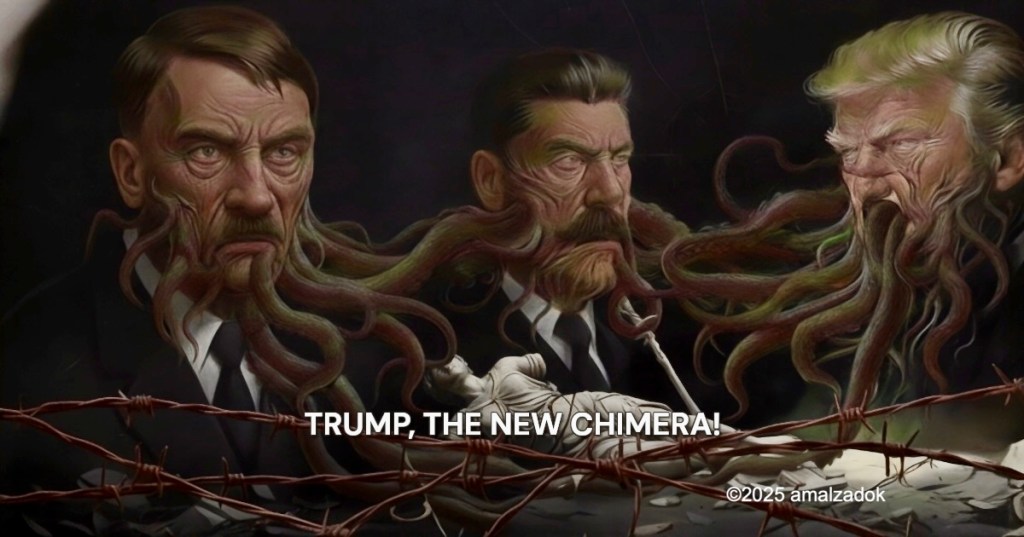
  • Trump, the New Chimera: A Hybrid of Stalin and Hitler on the World Stage

    Trump, the New Chimera: A Hybrid of Stalin and Hitler on the World Stage

    by Amal Zadok

    When a president says only his “own morality” limits his power and that he “does not need international law,” while a mother of three is shot through her windshield by an ICE officer on an American street, the mask is off. This is no longer a debate about policy; it is the birth of a regime that reserves law for the weak and bullets for anyone who get in the way. 

    A president who crowns himself

    Trump’s statement to The New York Times that his power as commander in chief is constrained only by his “own morality” is the distilled creed of authoritarianism. In his own words, there is “one thing” that can stop him: not Congress, not courts, not treaties, but his “own mind,” followed by the contemptuous aside, “I don’t need international law.” 

    This is not some late-night tweet; it is a formal doctrine announced from the Oval Office. In that interview, he waves away the UN Charter, the ban on aggressive war, and decades of treaty obligations as optional restraints that apply only if he personally decides they should, implicitly trampling the Charter’s prohibition on the use of force and the core idea that even great powers are bound by law. 

    He prides himself on using military strikes, invasions, economic strangulation and political coercion as tools of personal will, not as acts accountable to any external standard. A president who claims that law is binding only when he feels like it has ceased to be a constitutional officer and has slipped into the role of a sovereign who believes that legality is a costume he can put on for international conferences and drop whenever he wants to unleash force.

    From “rules-based order” to rule by fear

    For years, Washington preached a “rules-based international order” to other states. Now Trump publicly shreds that script and replaces it with a gangster’s logic: power first, rules never. He openly treats treaties as disposable, walks away from arms-control agreements, and shrugs at the possible collapse of the last major nuclear restraints with a fatalistic “if it expires, it expires.” 

    The message radiates far beyond Washington. If the United States claims the right to strike where it wants, topple whom it chooses, and threaten nuclear and non‑nuclear states alike without even pretending to obey international law, why should Moscow feel bound in Ukraine or Beijing in Taiwan? The “order” that once at least pretended to restrain the strong becomes a stage on which the biggest actor improvises violence while lecturing others about norms. 

    Trump’s “own morality” is not a safeguard; it is a surrender of civilization to personality. It tells every future strongman—from Budapest to Brasília—that law is ornamental and that the only crime is losing. 

    The ICE bullet in Minneapolis

    While Trump claims he does not need international law abroad, his domestic security machine is being trained to treat American streets like occupied territory. In Minneapolis, 37‑year‑old Renee Nicole Good, a U.S. citizen, a mother of three, was shot and killed by an ICE officer while sitting in her car on a cold Midwestern street, neighbors watching from their windows as sirens and shouts shattered the night. 

    She was not a cartel boss or a terrorist; she was a neighbor, a writer, a woman who had come out—according to local accounts—to care for those around her. The official story shifts like a propaganda broadcast. DHS officials insist she “failed to comply,” that she “attempted to run over” an officer. Local witnesses describe confusion and conflicting commands, with one officer telling her to drive away from a stuck ICE vehicle and another simultaneously trying to pull her from the car; body‑camera and bystander video show agents swarming the vehicle, one officer stepping into her path, firing at close range as she attempts to drive off, her car then crashing down the street as her life bleeds out on the asphalt. 

    Minneapolis city officials have said openly what federal spokespeople will not: that this was “a federal agent recklessly using power that resulted in somebody dying.” The FBI has now taken over the investigation after the state’s own Bureau of Criminal Apprehension backed away, a sign of just how toxic and politically charged this killing has become, while community grief vigils name her not as a suspect but as a poet, a newcomer, a mother. 

    The same contempt for accountability that lets a president shrug off the UN Charter now underwrites a culture in which an ICE bullet can end a citizen’s life and the first instinct of power is to justify, not to repent. 

    The quiet architecture of a police state

    This is how police states are built in real time—not with a single spectacular coup, but through a series of “operations,” “raids,” and “emergency deployments” that normalize the presence of armed federal agents in daily life. In Minneapolis, thousands of federal officers were deployed in what DHS bragged was the “largest operation ever,” turning a U.S. city into a live‑fire training ground for an internal occupation. 

    The use of ICE, a civil immigration agency, like a paramilitary police force is not an accident. It is a deliberate fusion of domestic and foreign logics: the border mentality imported into the heart of the city, where neighbors blowing whistles to warn each other become suspect, where legal observers and bystanders are treated as obstacles, and where a parked car is one nervous trigger pull away from becoming a coffin. 

    Trump’s doctrine—that only his conscience limits his power—seeps down the chain of command. If the man at the top says law is malleable, if he publicly promises to back his officers no matter what, then every badge and gun on the street hears the same message: you are the law. This is exactly how Stalin’s NKVD and Hitler’s Gestapo operated—not because every officer was a monster, but because the system told them that their violence was always already justified. 

    A monstrous hybrid of Nazism and Stalinism

    The horror of the current moment is not that America has become identical to Nazi Germany or Stalin’s Soviet Union; it is that it is mutating into a hybrid that borrows the worst tools of both. From Nazism, Trump borrows the cult of the leader whose “moral sense” legitimatizes everything, the theater of strength, the glorification of “law and order” as a shield for state brutality. From Stalinism, he borrows the idea that internal enemies lurk everywhere, that entire communities (immigrants, protesters, “anarchists,” “terror sympathizers”) are fair game for sweeping repression. 

    When federal agents can snatch people off streets, deploy to cities over local opposition, and now kill a mother in her car under the banner of immigration enforcement, the line between democracy and dictatorship is not “eroding.” It is being redrawn in blood. When a president announces that courts, laws and treaties are lower‑tier obstacles compared to his “own mind,” he is not defending America from enemies; he is positioning himself as the only real branch of government that matters. 

    This is how hybrid tyrannies work. Elections still occur, some courts still function, newspapers still print—but the security services learn that their real loyalty is owed upward, not outward. The constitution becomes a script for public ceremonies, while the real constitution is whatever the leader and his loyalists can get away with. 

    The conscience that kills

    Trump insists he is “not looking to hurt people,” even as he lists lethal operations as achievements, even as his policies unleash missiles abroad and militarized raids at home. His “own morality” apparently allows for the bombing of foreign soil without authorization, the kidnapping or coercion of foreign leaders, the tearing up of refugee protections, and now a domestic climate in which federal officers gun down a woman in Minneapolis and are treated as heroes in waiting. 

    There is a cruel symmetry here. Abroad, he claims the right to ignore international law in the name of “national strength.” At home, his security forces act as if ordinary Americans are foreign subjects in a pacification campaign. The shared logic is simple: the people at the receiving end of American power—Venezuelan civilians, Iranian technicians, migrants at the border, a mother in a Minneapolis sedan—do not matter as rights‑bearing human beings. They matter only as problems for the leader’s will to solve. 

    When a man with this worldview sits in the Oval Office and tells a major newspaper that only his conscience can stop him, the world should stop pretending this is normal politics. This is not conservatism, populism, or even crude nationalism. It is the theology of the police state: one man’s inner voice elevated above constitutions, courts, treaties, and the screams from the street where Renee Nicole Good died. 

    An ultimatum to real patriots

    So the question is no longer what Trump will do next; the question is what Americans are going to do about an America that the Founders would not recognize. A republic whose president claims to stand above law and whose federal agents kill unarmed citizens in the name of “order” is not the republic Madison and Hamilton were arguing for; it is the nightmare they wrote the Constitution to prevent. 

    The Constitution does not ask “real patriots” to clap for strongmen; it demands that they use every peaceful tool it provides—speech, press, assembly, petitions, jury service, litigation, elections, impeachment, and relentless oversight—to drag power back under law. It calls legislators to defund and dismantle rogue operations, judges to enforce rights without fear, civil servants to refuse illegal orders, and ordinary citizens to organize, vote, strike, and resist until no man’s “own morality” can ever again stand in for the rule of law. If Americans will not use those tools now, when a mother lies dead in Minneapolis and a president boasts that only his conscience can stop him, then the Constitution will become nothing more than an antique in a glass case—and the hybrid monster of Nazism and Stalinism will finish the work it has already begun. 

    References 

    1.The New York Times. (2026, January 8). Trump addresses Venezuela, Greenland and presidential power in wide‑ranging interview. https://www.nytimes.com/2026/01/08/us/politics/trump-interview-power-morality.htm

    2.The New York Times. (2026, January 8). Trump said his global power was limited only by his ‘own morality’. https://www.nytimes.com/2026/01/08/briefing/trump-interview-oval-office-apple-ceo.html

    3.Bluewin. (2026, January 9). USA: Trump: Only my sense of morality can hold me back. https://www.bluewin.ch/en/news/international/trump-only-my-sense-of-morality-can-hold-me-back-3041854.html

    4.Moneycontrol. (2026, January 8). ‘Only my morality can stop me’: Trump claims sweeping war powers, shrugs off international law. https://www.moneycontrol.com/world/only-my-morality-can-stop-me-trump-claims-sweeping-war-powers-says-he-doesn-t-need-internatio-article-12812335.html

    5.Financial Express. (2026, January 8). ‘I don’t need international law’: Trump says only his own morality limits his global power. https://www.financialexpress.com/world-news/us-news/only-one-thing-can-stop-me-trump-says-he-dont-need-international-law-boasts-12812091/

    6.World Socialist Web Site. (2026, January 8). Declaring ‘I don’t need international law,’ Trump moves to assert unlimited warmaking powers. https://www.wsws.org/en/articles/2026/01/09/qyot-j09.html

    7.Al Jazeera. (2026, January 8). FBI takes over investigation into ICE agent killing of woman in Minneapolis. https://www.aljazeera.com/news/2026/1/8/fbi-takes-over-investigation-into-ice-agent-killing-of-woman-in-minneapolis

    8.ABC News (Australia). (2026, January 7). What led to an ICE agent fatally shooting a public observer in Minneapolis? https://www.abc.net.au/news/2026-01-08/ice-shooting-minneapolis-minnesota-immigration-crackdown/106209128

    9.NBC News. (2026, January 7). Renee Nicole Good, woman shot by ICE officer, was out ‘caring for her neighbors’. https://www.nbcnews.com/news/us-news/renee-nicole-good-minneapolis-ice-shooting-victim-caring-neighbor-rcna252901

    10.Colorado Public Radio. (2026, January 7). Woman killed by ICE in Minneapolis originally from Colorado. https://www.cpr.org/2026/01/07/fatal-minneapolis-ice-shooting-colorado-woman/

    11.CNN. (2026, January 8). ICE officer who shot woman in Minneapolis was dragged by a car in 2025, video shows. https://www.cnn.com/2026/01/08/us/ice-agent-minneapolis-shooting-car-dragged-invs

    12.NBC News. (2026, January 8). ICE officer who fatally shot Minnesota woman was dragged by a car during a prior enforcement stop. https://www.nbcnews.com/news/us-news/ice-officer-fatally-shot-minnesota-woman-was-dragged-car-june-immigrat-rcna252992

    13.City of Minneapolis. (2026, January 6). Minneapolis responds to fatal shooting of woman by federal agent. https://www.minneapolismn.gov/news/2026/january/fatal-shooting-response/

    14.PBS NewsHour. (2026, January 8). Woman killed by ICE agent was mother of 3, poet and new to Minneapolis. https://www.pbs.org/newshour/nation/woman-killed-by-ice-agent-was-mother-of-3-poet-and-new-to-minneapolis

    ©️2026 Amal Zadok. All rights reserved.

    Subscribe and never miss an article!
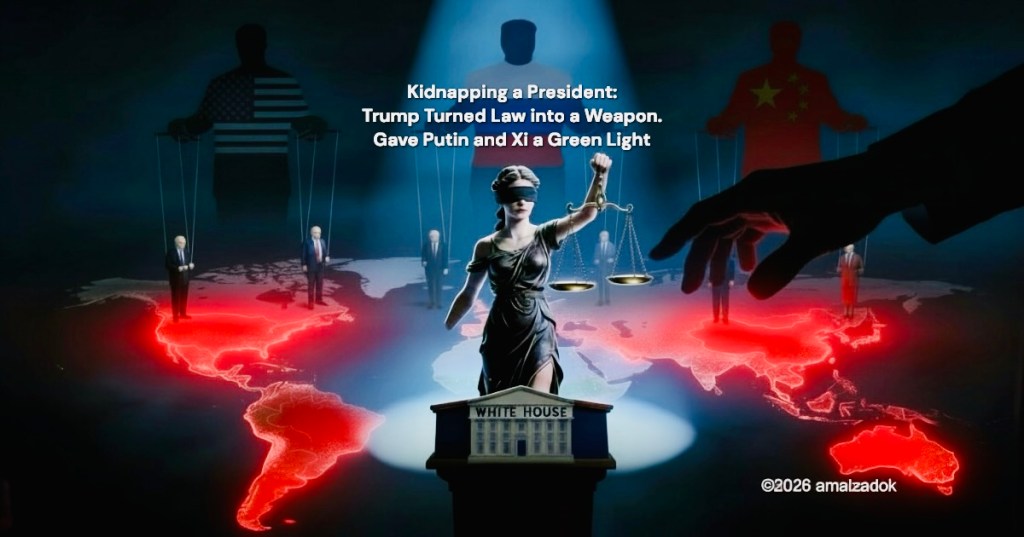
  • Kidnapping a President: How Trump Turned Law into a Weapon and Gave Putin and Xi a Green Light

    Kidnapping a President: How Trump Turned Law into a Weapon and Gave Putin and Xi a Green Light

    by Amal Zadok

    Trump’s armed kidnapping of Nicolás Maduro is not just another reckless intervention; it is the moment the United States openly abandons the legal order it uses to judge its enemies. One operation in Caracas manages to break core rules of international law, trample the Constitution’s allocation of war powers, and weaponize domestic criminal statutes into a pretext for cross‑border regime decapitation. This is not mere hypocrisy; it is a structural shift toward a world where armed force wears the thin mask of law while tearing out the law’s foundations.​

    Start with the international plane. Article 2(4) of the UN Charter prohibits the threat or use of force against the territorial integrity or political independence of any state, except in self‑defence against an armed attack or with Security Council authorization. None of those conditions existed: Venezuela had not attacked the United States, there was no imminent armed assault, and the Security Council had authorized nothing. Airstrikes around Caracas and the insertion of US forces to seize a sitting head of state are the paradigmatic use of armed force that the Charter was written to forbid, regardless of how loudly Washington chants “narco‑terrorism” or “democracy.”​

    The raid also violates the principles of sovereign equality and non‑intervention in Articles 2(1) and 2(7) and in customary international law. Forcibly removing a president and floating the idea that the US might effectively “run” Venezuela is not influence; it is a direct assault on the political independence of a UN member. That is why UN officials and governments well beyond Maduro’s circle have called the action illegal aggression and a “dangerous precedent” for the global order.​

    Head‑of‑state immunity is the next pillar smashed. Customary international law grants sitting heads of state full personal immunity—immunity ratione personae—from foreign criminal jurisdiction and enforcement measures while they are in office. This shield does not endorse any leader’s morality; it prevents foreign courts and special forces from becoming tools of regime change. By abducting Maduro and hauling him before a New York judge, the United States has effectively claimed that its recognition policy decides who is a head of state and who can be treated as a common fugitive.​

    The extraterritorial kidnapping itself is a further violation. Even advocates of muscular US power concede that seizing a foreign leader from his own soil without consent is a “flagrant violation” of sovereignty and an unlawful abduction under general international law. Several experts argue that the scale and character of the raid reach the level of an “armed attack,” meaning Venezuela would, in principle, enjoy a right of self‑defence against the United States. In one stroke, Washington transforms the law it invokes into a weapon, while shredding the central norm designed to keep interstate violence in check since 1945.​

    Inside the United States, the pattern is equally stark. The Constitution gives Congress the power to declare war, and the War Powers Resolution requires prior consultation “in every possible instance” and prompt notification when American forces enter hostilities. Trump’s own officials had previously acknowledged that ground operations in Venezuela would require congressional authorization—and that they did not have it. Yet the raid went ahead as a fait accompli, with Congress informed after the fact and forced to choose between retroactive acquiescence or a politically suicidal confrontation with an emboldened executive.​

    The UN Charter is also a ratified US treaty and, under Article VI of the Constitution, part of the “supreme Law of the Land.” When a president orders a military operation that plainly contradicts Article 2(4)’s ban on the use of force, he is not just flirting with illegality abroad; he is directing the state to act against a binding treaty that sits at the top of the domestic legal hierarchy. Some constitutional scholars therefore describe the raid as a dual illegality: a violation of international law that simultaneously undercuts the treaty‑supremacy structure of US law itself.​

    The criminal‑law angle exposes the tyrannical core. Extradition treaties, mutual legal assistance and due‑process guarantees are supposed to govern cross‑border arrests; they do not authorize special forces to “pick up” a foreign head of state at gunpoint because US prosecutors filed an indictment. By leaning on the old Ker–Frisbie doctrine—that illegal abduction does not by itself bar a trial—Trump turns a controversial judicial rule into an executive license for kidnapping. What would obviously be kidnapping, conspiracy and unlawful violence for any private actor is rebranded as “policy” when ordered from the Oval Office.​

    At that point, “tyranny” stops being rhetorical and becomes descriptive. A leader who can unilaterally launch cross‑border raids, ignore Congress’s war role, violate binding treaties and twist criminal procedure into a shield for his own extralegal violence is not meaningfully bound by law. He is constrained only by raw power and political calculation. That is exactly the model Russia and China have been waiting for Washington to normalize—and Trump has just handed them the script.​

    Trump has not just broken rules; he has opened a doctrinal Pandora’s box. Moscow can now point to the Maduro operation when it justifies the seizure or assassination of Ukrainian officials as “counter‑terrorism” or enforcement of Russian criminal law. Beijing can frame a lightning move on Taipei as a domestic law‑enforcement action against “secessionist criminals,” citing the American precedent that great powers’ indictments and security narratives override borders, immunity and the UN Charter. The United States spent decades preaching a “rules‑based international order”; in Caracas, it demonstrated that, when the stakes are high enough, what really rules is force wrapped in legal costume.​

    If this stands, the world slides from an imperfect legal order—full of double standards and selective enforcement—into something harsher and more honest: open season, where each great power hunts in its sphere and cites the others’ crimes as precedent. The kidnapping of Maduro is more than a scandal; it is a template that Russia, China and others will eagerly adapt, armed not only with missiles and special forces, but with the very legal arguments Trump has ripped from their cage—a ready‑made script for twenty‑first‑century tyranny dressed up as law.​

    References

    1. ABC News. (2026). Were the US actions in Venezuela legal under international law?
    2. Le Monde. (2026). US attack on Venezuela: What does international law say?
    3. The Conversation. (2026). Were the US actions in Venezuela legal under international law? An expert explains.
    4. Chatham House. (2026). The US capture of President Nicolás Maduro – and attacks on Venezuela – have no justification.
    5. Global Affairs. (2026). International Law and Venezuela’s Maduro.
    6. Opinio Juris. (2026). The United States’ Attack Against Venezuela: Might Does Not Make Right.
    7. UN News. (2026). US actions in Venezuela “constitute a dangerous precedent”.
    8. Justice in Conflict. (2026). Maduro’s Indictment, Head‑of‑State Immunity, and the United States.
    9. Huquq. (2026). The Maduro Case and the Fractured Foundations of Immunity.
    10. Brookings. (2026). Making Sense of the US Military Operation in Venezuela.
    11. CNN. (2026). Trump’s Legal Authority in Venezuela, Explained.
    12. Bloomberg. (2026). Did Maduro’s Seizure Violate US and International Law?
    13. PBS. (2026). Fact‑Checking Trump’s Claims After U.S. Strike on Venezuela and Capture of Maduro.
    14. The New Yorker. (2026). The Brazen Illegality of Trump’s Venezuela Operation.
    15. BBC News. (2026). US Sharply Criticised by Foes and Friends Over Maduro Seizure.
    16. SBS. (2026). From Russia to Iran, Venezuela’s Allies React to the Capture of Maduro.
    17. Time. (2026). How the World Is Reacting to the U.S. Capture of Nicolás Maduro.
    18. CNN. (2026). Maduro’s Capture Is a Blow to China. But on Chinese Social Media …
    19. CBS News. (2026). How Could Trump’s Move Against Venezuela Impact China, Russia, Iran, Cuba?
    20. Völkerrechtsblog. (2026). The U.S. Strikes Against Venezuela and the Credibility of the Anti‑Aggression Norm.
    21. ABC (Australia). (2026). The Venezuela Strike Sets a New Low for the World Order.
    22. CSIS. (2026). The Maduro Raid: A Military Victory with No Viable Endgame.
    23. The New York Times. (2026). Is It Legal for U.S. to “Run” Venezuela After Maduro’s Capture?
    24. The Conversation. (2026). Trump’s Intervention in Venezuela: The 3 Warnings for the World.
    25. The New York Times. (2026). Global Ripples From Venezuela.
    26. Empire Unchained Blog. (2026). Empire Unchained: How the US Capture of Maduro Shattered the Post‑War International Order.

    Appendix: Summary of Laws Broken Internally and Externally by Trump in the Kidnapping of Maduro

    • UN Charter Article 2(4): Prohibits the threat or use of force against the territorial integrity or political independence of any state; breached by airstrikes and the cross‑border raid without self‑defence or Security Council authorization.​
    • UN Charter Articles 2(1) and 2(7) & customary non‑intervention: Require sovereign equality and non‑interference; violated by forcibly removing a sitting president and floating effective US control over Venezuela’s politics.​
    • Customary head‑of‑state immunity (immunity ratione personae): Grants sitting heads of state full personal immunity from foreign criminal jurisdiction and enforcement; ignored by abducting Maduro to stand trial in a US court.​
    • Customary prohibition of extraterritorial abduction: Forbids kidnapping persons, especially senior officials, from another state’s territory without consent; violated by the armed seizure in Caracas.​
    • US constitutional allocation of war powers: Congress’s power to declare war and War Powers Resolution consultation and notification requirements were sidestepped by launching the raid without prior authorization or transparent notification.​
    • Treaty‑supremacy structure (Article VI of the US Constitution): The UN Charter is binding US law; ordering action that breaches Article 2(4) undermines the supremacy of ratified treaties in the domestic legal hierarchy.​
    • Extradition and criminal‑procedure norms: Established mechanisms (extradition treaties, mutual legal assistance, due process) were bypassed in favour of a unilateral military kidnapping justified by a domestic indictment.​
    • Functional domestic criminal norms (kidnapping, conspiracy, unlawful violence): Conduct that would clearly constitute serious crimes for private actors is insulated by presidential power, effectively placing the executive above the law it imposes on others.​

    ©️2026 Amal Zadok. All rights reserved.

    Subscribe and never miss an article!
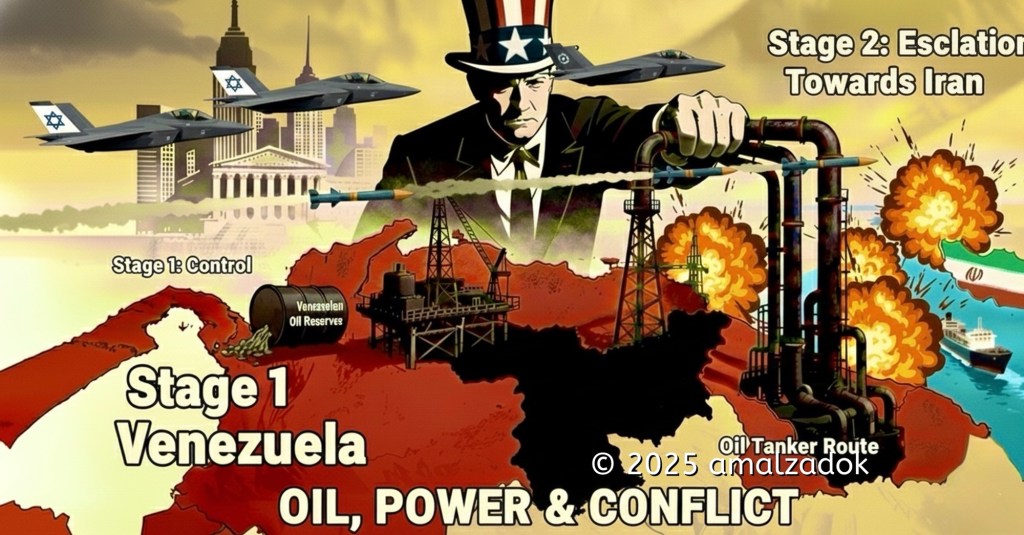
  • Oil for Armageddon: How Washington Is Seizing Venezuela to Fight Its Future War with Iran

    Oil for Armageddon: How Washington Is Seizing Venezuela to Fight Its Future War with Iran

    The pattern of U.S. moves on Venezuelan oil, combined with the strategic vulnerability of the Strait of Hormuz, makes it plausible that Washington is positioning itself for a future confrontation with Iran in which Gulf oil flows could be disrupted, while Venezuelan crude serves as a non‑Hormuz fallback for the U.S. and Israel. The recent U.S. attack on Venezuela, the capture of President Nicolás Maduro and his wife, and their transfer to New York on narcotics and related charges do not undermine this thesis; they expose how “drug enforcement” has become the legal façade for a resource‑seizure operation aimed at securing oil for a long war scenario.

    The scale of Venezuela’s oil treasure

    Any geopolitical argument about Venezuelan oil must start with sheer scale. Venezuela today holds the largest proven oil reserves on the planet, with estimates around 300–303 billion barrels, or roughly 17–18 percent of all known reserves, surpassing even Saudi Arabia. In other words, this one Latin American country, within flight distance of Florida, controls more oil underground than the entire United States, which has around 55 billion barrels of proven reserves.

    Those reserves are not just large but strategically tempting. Much of Venezuelan crude is heavy, but U.S. Gulf Coast refineries are precisely configured to process heavy and extra‑heavy oil, historically imported from Venezuela and Mexico. In a world where Middle East supplies become uncertain, a political arrangement that gives Washington decisive leverage over the biggest single reserve base in the world is an energy security dream.

    From sanctions to open seizure: Maduro in New York

    For years, Washington relied on sanctions, asset freezes, and indictments to squeeze Caracas while stopping short of open war. The narco‑terrorism case filed in New York against Maduro and other Venezuelan officials framed the country’s leadership as a criminal cartel, preparing public opinion for more extreme measures. That legal architecture has now been matched by force: U.S. strikes on Venezuela, the capture of Maduro and his wife, and their transfer to New York on drug and criminal charges mark a historic escalation from economic warfare to direct regime decapitation.

    Crucially, this escalation has been accompanied by unprecedented candor from Donald Trump about what comes next. He has publicly stated that the United States will “run” Venezuela “for now,” asserted that the U.S. “built” Venezuela’s oil industry in the past, and pledged that American companies will return to “rebuild” and tap its oil reserves—framing this as an open‑ended, effectively indefinite arrangement. In other words, the kidnapping of a sitting president on drug charges is not the consummation of a moral crusade against narcotics; it is the opening move in a new phase where Washington claims the right to administer, and profit from, the world’s largest oil reserves.

    Why the Strait of Hormuz terrifies planners

    The Strait of Hormuz is a narrow maritime corridor between Iran and Oman, the only sea exit for the oil‑rich Persian Gulf. In a typical recent year, roughly 20–21 million barrels of oil per day have transited this passage, about 20–21 percent of total global petroleum liquids consumption and over one‑quarter of all seaborne oil trade.

    For decades, U.S. planners have quietly admitted what they seldom say openly: Hormuz is the soft underbelly of the global oil system. Around 80 percent of the crude that moves through it goes to Asian markets like China, India, Japan, and South Korea, but any serious disruption sends benchmark prices soaring and hits Western economies as well. Iran has repeatedly threatened to close or disrupt Hormuz if attacked and has demonstrated its capacity to harass or seize tankers, mine shipping lanes, and launch missiles at regional infrastructure.

    In a full‑scale U.S.–Iran or Israel–Iran war, Hormuz does not need to be “completely shut” to cause chaos. Sporadic attacks, insurance spikes, and partial interruptions could remove several million barrels a day from the market for months, triggering price shocks, recession risks, and political backlash in oil‑importing democracies. This is the nightmare scenario for Washington: a conflict it believes is necessary for regional dominance colliding with its own population’s intolerance for sky‑high oil prices and economic free‑fall.

    Linking the dots: Venezuelan oil as war insurance

    Once the strategic importance of Hormuz is understood, U.S. behavior toward Venezuela stops looking random. Over the last decade, Washington has oscillated between punishing Caracas with sanctions and selectively easing restrictions to allow specific companies to re‑enter the Venezuelan oil sector under tight U.S. licensing. That pattern looked less like moral outrage and more like controlled positioning: weaken the Maduro government politically, while keeping the door open for U.S. and allied corporate access to the oil fields and infrastructure.

    The post‑capture phase clarifies that logic. With Maduro removed and Trump openly declaring that the United States is taking indefinite control of Venezuela, Washington has maximal leverage to shape any “transitional” administration, dictate terms to state oil company PDVSA, and secure contracts for U.S. and European majors under the umbrella of American military and legal control. The same legal system that now holds Maduro and his wife on drug charges in New York will be used to claim the moral high ground, while U.S. energy companies are presented as the responsible adults arriving to restore order and “get the oil flowing again.”

    To see why this matters for a future Iran war, imagine a scenario in which Iranian mines and missiles reduce tanker traffic through Hormuz by a third for several months. The resulting loss of millions of barrels per day would send global prices spiralling and force consuming states to scramble for alternative supplies. In that context, U.S.‑linked production in Venezuela—now explicitly under a U.S. “run” arrangement with indefinite control—could be ramped up and redirected to cushion the blow for North America and its closest allies. Washington would not be able to replace every lost Gulf barrel, but it would possess a strategic tap that others, especially rival powers, do not control.

    Beyond democracy talk: energy security and Israel

    Officially, U.S. leaders justify both the earlier sanctions and the latest military operation as a defense of democracy, human rights, and the integrity of the international drug control regime. Yet Washington maintains close partnerships with Gulf monarchies whose political systems are far more autocratic than Caracas at its worst, and Trump himself has pardoned or commuted sentences for U.S.‑linked traffickers and allies, undermining the supposed moral consistency of the “war on drugs.” 

    Set alongside the explicit promise that the U.S. will now “run” Venezuela indefinitely and unleash its oil potential, the common denominator is not liberal values but strategic oil supply and alignment with U.S. and Israeli military objectives in the Middle East.

    Israel’s position is central here. Any large regional war involving Iran will almost certainly involve Israeli strikes on Iranian nuclear, missile, or command sites, prompting Iranian retaliation via proxies and potentially via direct attacks on Gulf infrastructure and shipping. Israeli and U.S. analysts openly discuss the risk of Hezbollah rockets, Iraqi militias, and Yemeni missiles converging on U.S. bases, desalination plants, and oil installations in a multi‑front escalation. For Washington, guaranteeing Israel’s ability to wage such a campaign without collapsing Western economies requires pre‑securing alternative oil streams that bypass the vulnerable chokepoints Iran can threaten. Venezuelan crude, moved across the Caribbean and Atlantic to U.S. and European refineries, would be largely immune to Hormuz and Red Sea disruptions.

    Seen from this angle, the armed seizure of Venezuela’s head of state on narco‑charges, and Trump’s boast that the U.S. is taking indefinite control of the country, is not just a shocking violation of sovereignty; it is a step in a broader war‑planning architecture. Control over the world’s largest oil reserves in the Western Hemisphere acts as a form of insurance policy: if Iran makes good on its threats, the U.S. can lean on Venezuelan barrels to stabilize its own market and cushion the shock for its allies.

    The logic of pre‑emptive control

    Energy planners think in decades, not news cycles. The fact that most Hormuz flows currently go to Asia does not reduce the strategic risk for the United States; it amplifies it, because China and India could leverage their access—or their sudden loss of access—to reshape global power balances during a crisis. If the U.S. is preparing for a world where confrontation with Iran, and by extension with Iran’s partners, becomes more likely, then securing a hemispheric oil fortress in Venezuela becomes rational from a cold strategic standpoint.

    By tightening sanctions, escalating to military strikes, physically removing the elected president under a cloud of drug charges, and now declaring indefinite U.S. control of the country, Washington builds a future in which any government in Caracas—friend, foe, or “transitional”—must negotiate oil policy under the shadow of American legal, military, and financial power. The goal is not merely to deny revenue to a hostile regime but to ensure that, when the next major war in the Middle East breaks out, those 300‑plus billion barrels sit within a system of contracts, infrastructure, and shipping lanes Washington can rapidly mobilize. In that scenario, Venezuela ceases to be a sovereign energy actor and becomes, in effect, a strategic fuel depot for a distant conflict in the Persian Gulf.

    References

    1.Al Jazeera. (2025, September 4). Venezuela has the world’s most oil: Why doesn’t it earn more from exports?

    2.BBC News. (2026, January 3). What we know about Maduro’s capture and US plan to “run” Venezuela.

    3.CBS News. (2026, January 3). U.S. strikes Venezuela and captures Maduro; Trump says U.S. will run the country.

    4.CNN. (2025, June 23). What is the Strait of Hormuz and why is it so significant?

    5.CNN. (2026, January 4). Maduro in U.S. custody after surprise Venezuela operation.

    6.Fox Business. (2026, January 2). Trump pledges U.S. return to Venezuela oil industry after Maduro capture.

    7.Fox News. (2026, January 3). Nicolás Maduro arrives in New York after capture; faces U.S. drug charges.

    8.NPR. (2026, January 3). What are the charges against Venezuela’s Nicolás Maduro?

    9.NPR. (2026, January 3). Maduro faces drug charges in U.S. even as Trump freed other traffickers.

    10.U.S. Department of Justice. (2025, February 4). Nicolás Maduro Moros and 14 current and former Venezuelan officials charged with narco‑terrorism, corruption, drug trafficking and other criminal charges.

    11.ABC News (Australia). (2026, January 3). Donald Trump says US will run Venezuela for now after capture of Nicolás Maduro.

    12.Los Angeles Times. (2026, January 3). Trump says U.S. will “run” Venezuela after capturing Maduro in audacious attack.

    13.PBS NewsHour. (2026, January 3). A timeline of U.S. military escalation against Venezuela leading to Maduro’s capture.

    14.The New Yorker. (2026, January 3). The brazen illegality of Trump’s Venezuela operation.

    15.U.S. Energy Information Administration. (2023, November 20). The Strait of Hormuz is the world’s most important oil transit chokepoint.

    16.U.S. Energy Information Administration. (2025, June 15). Amid regional conflict, the Strait of Hormuz remains critical oil chokepoint.

    17.Worldometers. (2024, October 31). Venezuela oil reserves, production and consumption.

    18.World Population Review. (2025, December 17). Oil reserves by country 2025.

    19.Newsweek. (2026, January 3). Map shows how Venezuela’s oil reserves compare to the rest of the world.

    20.Institute for Energy Research / IEA. (2024). Strait of Hormuz factsheet.

    ©️2026 Amal Zadok. All rights reserved.

    Subscribe and never miss an article!
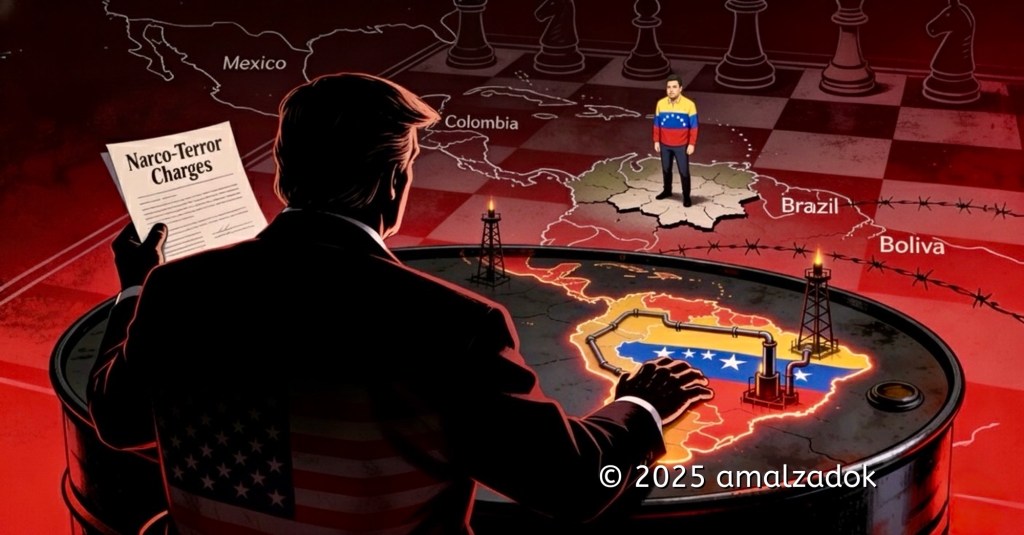
  • Narco-Fable or Oil Colony? How Washington Turned Maduro into a Pretext to Seize Venezuela

    Narco-Fable or Oil Colony? How Washington Turned Maduro into a Pretext to Seize Venezuela

    by Amal Zadok

    The New York narco‑terror indictment against Nicolás Maduro is not about protecting Americans from cocaine; it is the legal cover for a U.S. bid to seize control of Venezuela’s oil and run the country as a protectorate. Trump has said it plainly: the United States will “run” Venezuela, U.S. corporations will pour in “billions” to rebuild its energy sector, and they will take the wealth “out of the ground” so the operation “costs us nothing.” This is not drug policy. It is looting dressed up as law.

    The official story is a familiar Washington thriller: a rogue “narco‑dictator” plotting with guerrillas to flood U.S. streets with cocaine, forcing a reluctant empire to act. Yet U.S. and UN drug‑trade data tell a very different story. Venezuela is, at most, a side corridor in the hemispheric cocaine economy, while the overwhelming flows of narcotics into the United States come through the Eastern Pacific, Central America, and Mexico. 

    Serious monitoring has long estimated that only around 5–10 percent of Colombian cocaine transits Venezuela in a given year, while roughly 90 percent of U.S.‑bound cocaine uses Western Caribbean and Eastern Pacific routes dominated by Mexico‑based cartels. Some analyses of documented maritime shipments show that in a recent year barely 8 percent of sea‑borne South American cocaine departed via Venezuela and the southern Caribbean, with the rest hugging Pacific and Central American routes north. DEA threat assessments accordingly focus on Mexican cartels and synthetic opioids, often relegating Venezuela to a marginal note, if they mention it at all. The data destroy the U.S. case: the “narco‑state” narrative is not a description of reality but the script for an intervention.

    If the real goal were saving American lives from drugs, the targets are obvious. The fentanyl that is killing tens of thousands of Americans is overwhelmingly produced by Mexican organizations using chemical precursors sourced from Asia, not air‑dropped over the Caribbean by Venezuelan generals. Cocaine destined for U.S. cities overwhelmingly travels through Pacific and Central American routes controlled by Mexico‑based cartels, not through a marginal Atlantic detour. Yet Washington chose to bomb Venezuela and abduct its head of state, not to blockade Mexican cartels or meaningfully disrupt precursor supply chains. That choice betrays the truth: this is not a war on drugs. It is a war on a government sitting atop the world’s largest proven oil reserves, and a warning to any state that dares to challenge U.S. energy dominance.

    The indictment itself exposes the weakness of the narco‑fable. It relies heavily on cooperating witnesses, sensational claims about a “Cartel of the Suns,” and a few notorious cases, such as the conviction of the “narco‑nephews” related to Maduro’s wife, while glossing over the basic fact that Venezuela neither grows coca nor manufactures synthetic opioids. No serious analyst denies that Venezuelan officers and officials have dipped their hands into trafficking; corruption inside the state is real and corrosive. But scattered corruption does not a hemispheric hub make, and the attempt to inflate every crooked colonel into proof of a unified state conspiracy reveals more about prosecutors’ ambition than about the actual geography of the drug trade. The “narco‑state” label functions less as an empirical category and more as a magic word, unlocking sanctions, military deployments, and—now—regime change.

    The military operation against Maduro shows just how convenient that label is. U.S. forces and allied actors executed a near‑perfect decapitation strike: seize the president, fly him to New York, and leave the rest of the machinery standing. If Venezuela were truly an intolerable “narco‑dictatorship,” one would expect the supposed cartel‑state to be dismantled, the institutions “liberated” from their criminal capture, and the security forces re‑founded. Instead, the same authoritarian, corrupt structures remain in place—only now they operate under a new balance of power, with Washington openly boasting that it will oversee the country’s transition and economy. The dictatorship has not fallen; it has changed landlords.

    Corruption, far from being eradicated, is the lubricant of this new arrangement. The very fact that elements of the Venezuelan armed forces and political class could be bought or persuaded to hand over Maduro is evidence that the regime’s moral rot is intact. Washington did not come to cleanse that rot; it came to use it. A pliable officer corps, a bureaucracy trained in clientelism, and a security apparatus habituated to repression are not obstacles to a foreign power—they are assets. They allow an outside actor to decapitate a leader, slap the label “transition” on the operation, and continue business as usual with a few new faces at the top and new signatures at the oil ministry.

    Trump’s own words remove any remaining doubt about what “business as usual” means. He has bragged that the United States will “run” Venezuela until a satisfactory transition occurs, that U.S. oil majors will invest the “billions” needed to restore production, and that Venezuelan crude will pay for the intervention. Major outlets report officials discussing how American companies will help “restore” output and export Venezuelan oil to global markets, including to rivals like China. In the same breath, Trump has floated the idea that “the hemisphere is in play” and hinted that Washington is reclaiming “what was ours in the past.” This is not the language of partnership or sovereignty. It is the language of empire recovering a lost concession, with oil contracts in one hand and an indictment in the other.

    Inside the United States, the way this was done reveals a parallel slide toward authoritarianism. Trump acted without a formal declaration of war, without robust congressional debate, and with legal rationales that stretch the notion of self‑defense to the breaking point. In effect, one man, backed by the permanent national‑security apparatus, decided to overthrow a foreign government, occupy its territory in all but name, and hand its key industry to private corporations—all while presenting this as law enforcement. Washington condemns Maduro as a dictator even as it normalizes the presidential prerogative to wage undeclared wars of regime change. If dictatorship means unchecked executive power fused with militarism and economic plunder, the finger does not point only south.

    The media chorus has largely gone along, amplifying the narco‑fable and muting the resource grab. Major outlets have repeated, with minimal scrutiny, claims that Venezuela is a central cocaine menace, even when drug‑trade experts cited in the same stories note that the evidence does not support such a dramatic role. Critical voices and UN‑linked analyses showing Venezuela’s marginal place in the global cocaine map have been pushed to the margins, treated as technical quibbles rather than as the demolition charges they are under the official narrative. When the facts and the story diverge, the story wins—backed by bombs, not by data.

    Strip away the propaganda and what remains is brutal simplicity. A superpower has used exaggerated and selectively framed drug charges to remove a hostile leader, keep his authoritarian machinery, and seize practical control over a vast pool of oil. Maduro, an undeniably authoritarian and corrupt figure, has been transformed into the necessary demon for a larger project: the normalization of twenty‑first‑century colonialism under the banner of the “war on drugs” and “democratic transition.” The question is no longer whether Maduro deserved to face justice—Venezuelans themselves had long reasons to oppose him—but whether the United States has any right to turn a country into a protectorate because its president is unpopular in Washington and its oil fields are attractive to Chevron.

    A president who boasts that he will “run” Venezuela and reclaim “what was ours in the past” is announcing a doctrine of permanent devouring, one in which Latin America is reduced again to a buffet of oil, gas, minerals, and cheap labor for a power that has been quietly pushed out by the big‑league players in Europe and Asia and now turns back to its “backyard” in search of easy prey. As U.S. influence erodes in Brussels and Beijing, the temptation grows to reassert dominance where the costs seem lower and the resistance more fragmented: will it be Mexico, eternally vilified as a fentanyl factory; Colombia, treated as a forward operating base rather than a sovereign nation; Brazil, with its Amazon and pre‑salt oil; or lithium‑rich Bolivia, already punished once for daring to industrialize its own wealth? A president who bombs first and never bothers to ask Congress has sketched a roadmap in which borderlines are negotiable but corporate concessions are sacred, and at some point the question ceases to be whether one man in Caracas deserved to fall and becomes whether an entire region is prepared to live forever as a colony of a superpower that no longer even pretends to respect its own constitution when it goes to war.

    References

    1.Evrim Ağacı. (2025, September 2). UN report contradicts US claims on Venezuela drugs.

    2.U.S. Drug Enforcement Administration. (2024). National Drug Threat Assessment.

    3.Washington Office on Latin America. (2021). Beyond the narcostate narrative: What U.S. drug trade monitoring data says about Venezuela.

    4.USA Today. (2025, December 9). Trump says Venezuela traffics lethal drugs into US. Experts disagree.

    5.Al Jazeera. (2025, October 24). The US warships off Venezuela aren’t there to fight drugs.

    6.NBC News. (2026, January 3). Trump says U.S. will govern Venezuela until there’s a “proper transition”.

    7.Al Jazeera. (2026, January 3). Trump says US will “run” Venezuela after Nicolas Maduro seized.

    8.Vox. (2026, January 3). Trump says the US is going to “run” Venezuela. What does that mean?

    9.Reuters. (2026, January 3). Trump says US oil companies will spend billions to restore Venezuela’s crude output.

    10.The Hill. (2026, January 3). Trump says US will “run” Venezuela, control oil production.

    11.U.S. Department of Justice. (2025). Nicolás Maduro Moros and 14 current and former Venezuelan officials charged with narco‑terrorism, corruption, drug trafficking, and other criminal offenses.

    12.Transparencia Venezuela. (2024). Drug trafficking in Venezuela 2024.

    13.Chatham House. (2026, January 2). US to “run” Venezuela after Maduro captured: Early analysis.

    14.Al Jazeera. (2025, September 4). Is Venezuela the big cocaine menace Trump claims it to be?

    15.FAIR. (2025, November 18). Corporate media parrot dubious drug claims that justify war on Venezuela.

    16.Statista / IntelliNews. (2025, November 18). Few cocaine shipments head north from Venezuela.

    17.UNODC. (2023–2025). Global and transatlantic cocaine reports.

    18.Venezuelanalysis. (2025, September 1). Oil geopolitics disguised as “war on drugs”.

    19.Military.com. (2025, November 2). Venezuela in 2025: Realities, drug‑transit claims, and international law dimensions.

    20.CodePink. (2025, December 14). Trump’s Venezuela drug war gambit and the militarization of the Caribbean.

    21.Al Jazeera. (2025, December 4). Meet the US’s drug‑running friends: A history of narcotics involvement.

    22.BBC / CNN and related outlets (2025–2026). Coverage of Trump’s capture announcement and regional strategy.

    ©️2026 Amal Zadok. All rights reserved.

    Subscribe and never miss an article!
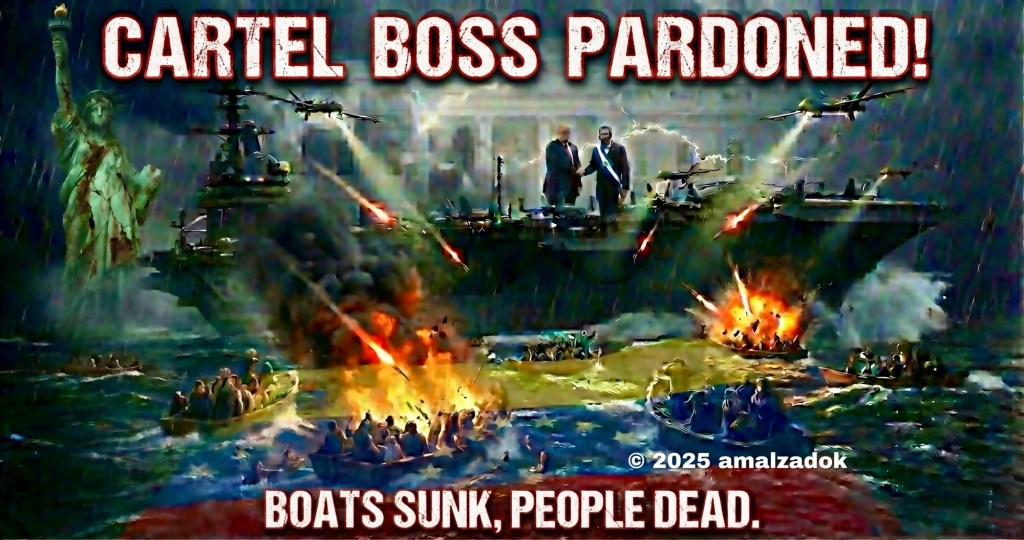
  • Trump’s Narco Hypocrisy: Pardoning the Kingpins, Bombing the Nobodies

    Trump’s Narco Hypocrisy: Pardoning the Kingpins, Bombing the Nobodies

    by Amal Zadok

    Trump’s second term has become a moral crime scene: a president who claims to fight terror and drugs is literally embracing a former jihadist whose past helped kill Americans, pardoning a narco‑president whose cocaine helped destroy American lives, arming Netanyahu as Gaza is reduced to rubble, and ordering missiles on nameless men in boats while powerful killers walk free. This is not “America First”; it is a grotesque alliance of blood‑stained elites, wrapped in a flag and sold as patriotism.

    The Syrian visitor is President Ahmed al‑Sharaa, once a rising figure in jihadist‑linked networks that drew a multimillion‑dollar U.S. bounty and were treated as a direct threat to American lives. A man whose circles were on U.S. terrorism lists is now ushered through White House security as an honoured guest, his history airbrushed away in the glow of photo‑ops. Trump does not just “talk” to him in some neutral venue; he grants him the prestige, the symbolism, the legitimacy of the Oval Office, and in doing so spits on the memory of Americans killed by the very networks this man once served.

    MAGA voters were told Trump would be the hammer of justice against jihadists, that he would avenge the dead and protect the living, that he would end “stupid wars” while keeping America safe. Millions of decent people believed those promises in good faith because they wanted fewer body bags, less chaos, and real protection for their families. They were not wrong to want those things; they were wrong about the man they trusted to deliver them.

    Then there is the ex‑president of Honduras, Juan Orlando Hernández. This man did not just “look the other way.” He helped turn his country into a narco highway, enabling cartels to move hundreds of tons of cocaine into the United States – a river of powder that translates directly into overdoses, gang violence, shattered families and dead Americans.

    This is not some technical, victimless crime; it is mass poisoning delivered by the ton. A U.S. jury listened to evidence and concluded, beyond reasonable doubt, that this head of state was a key player in a vast cocaine conspiracy, and a federal judge handed down a 45‑year sentence because anything less would mock the victims. And Trump blew it away: in December 2025 he signed a sweeping pardon that opened the prison gates for Hernández and declared his record wiped clean. This is policy, not accident.

    With one pen stroke, he tells every grieving American parent whose child died on cocaine or crack: your pain is negotiable, your justice is reversible, and if a man wears a presidential sash, his crimes are redeemable. He tells every cop who risked their life on the street, every agent who built the case, every witness who testified against a narco‑president: all of that can be wiped away if it is politically convenient.

    At the same time, Trump continues to pour political cover and weapons into Netanyahu’s hands as Gaza is pulverised and large parts of the West Bank are terrorised. This is a government openly carrying out collective punishment, bombing densely populated civilian areas, annihilating entire families, and leaving Gaza’s hospitals, neighbourhoods and basic infrastructure in ruins. Trump stands not as a restraining voice, but as an amplifier: praising Netanyahu, indulging his maximalist rhetoric, blocking accountability, and helping ensure that the bombs keep falling.

    Christians are not spared. Ancient churches have been damaged or desecrated, Christian communities harassed and attacked, Christian clergy assaulted or intimidated as the war spills across the Holy Land. The land where Jesus walked is now a place where Christian sanctuaries are treated as expendable collateral, and Trump’s response is not outrage, not sanctions, not a hard line on war crimes, but more indulgence, more permission, more weapons – all wrapped in a cynical fusion of Christian language and political calculation that turns faith into a shield for atrocity.

    This is the man who promised “no more endless wars” and “America First.” What did his supporters get instead? A president who invites a former jihadist to the White House one day before one of the most sacred days for the U.S. military, turning solemn remembrance into a backdrop for a grotesque photo‑op. That is not restraint; that is desecration dressed up as diplomacy.

    They got a president who blesses, arms and shields a foreign leader whose campaign in Gaza and the West Bank is seen by much of the world as a live‑streamed atrocity. They got a president who outsources “war” to drones and missiles at sea, blowing up boats on suspicion, rather than formally declaring conflicts or respecting Congress. U.S. forces under Trump have repeatedly struck alleged drug boats near Venezuela and across the Caribbean, killing men whose names, faces and actual roles are still hidden from the American public. This is policy, not accident.

    This is not the end of war; it is the laundering of war. It is the transformation of war into a series of “operations,” “strikes,” and “counter‑narco missions” that avoid public debate while still killing real human beings. No body bags shown on television, just shredded bodies in the Caribbean and the eastern Mediterranean, far away from American cameras.

    “Drain the swamp” was supposed to mean confronting entrenched power: lobbyists, foreign money, corrupt politicians, the revolving door with arms manufacturers and foreign regimes. Instead, Trump has fused his White House to some of the dirtiest currents in global politics. He entertains a former jihadist leader, frees a convicted narco‑president whose crimes helped drown U.S. communities in cocaine, and embraces and arms a government accused of genocide, war crimes, and systematic persecution – including persecution of Christians.

    He then stands back as missiles slam into small boats on the high seas, killing the poor and powerless whose only crime is being on the wrong vessel with the wrong accusation attached. The message to the world is simple: presidents and generals get invitations and pardons, while fishermen, migrants and low‑level smugglers get obliterated without trial.

    How is this “draining the swamp”? The swamp has never been happier. Arms dealers profit from the weapons sent to an unrestrained Israeli war machine, and defence contractors quietly celebrate the steady flow of contracts. Foreign politicians with blood‑soaked records find forgiveness and legitimacy in Washington. Lobbyists and ideologues pushing unconditional support for the Israeli government see their agenda elevated above the lives of Palestinians, above international law, above even the safety of Christian communities in the Holy Land.

    Ask plainly: is this what MAGA expected? A president who kills nameless men in boats without trial while freeing narco capos in suits? Who dignifies a former jihadist leader while preaching toughness on terror? Who backs a foreign government as it flattens Gaza, terrorises the West Bank, and allows Christian churches and communities to be attacked? Who uses patriotic slogans and Christian language as a mask for raw realpolitik and transactional alliances with killers?

    All of it adds up to a single, obscene picture. This is not the hero of some populist epic. This is a villain who learned how to speak the language of the angry and betrayed, only to turn around and protect the powerful while crushing the weak. Every missile launched at a boat full of suspects, every tank round that lands on a crowded Gaza street, every quiet, smiling photo with a man who once ran with terrorists or cartels – all of it is a signature on a contract that says: power will be protected, and the rest of you are expendable.

    It is like declaring total war on the Medellín Cartel while still inviting Pablo Escobar to the White House, shaking his hand, and pardoning him for every crime he committed against the American people – then turning around and hunting down desperate teenagers in speedboats to prove how “tough” you are. In this upside‑down morality, power launders guilt, the presidency launders narco‑politics, and the only people who truly face the full violence of the U.S. state are the ones too poor, too foreign and too disposable ever to see the inside of the Oval Office.

    ©️2025 Amal Zadok. All rights reserved.

    Subscribe and never miss an article!
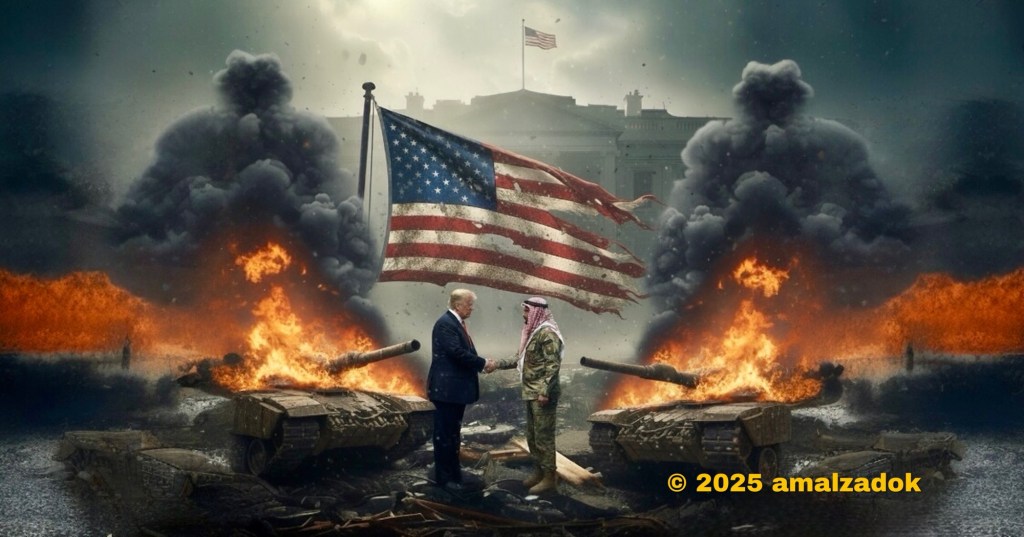
  • Trump’s Moral Bankruptcy: From Enabling Genocide in Gaza to Embracing Terror in the White House

    Trump’s Moral Bankruptcy: From Enabling Genocide in Gaza to Embracing Terror in the White House

    by Amal Zadok

    History will judge leaders not by their slogans, but by their actions in the face of suffering and evil. No figure in modern American politics demonstrates a collapse of principle so complete, so reckless, as Donald Trump does today. His legacy, once packaged as “America First,” now stands drenched in the blood of Gaza’s innocents and stained by the shameful embrace of one of the world’s most notorious terrorists—Ahmad al-Shara, formerly known as al-Jolani. A man once hunted internationally, with a $10 million bounty on his head for orchestrating massacres and beheadings, is now shaking hands with the president on White House grounds.

    This is not a mere misstep; it is a rupture with the very notion of civilization. The world expected leadership from America—and received, instead, the shrugging endorsement of genocide in Gaza. Trump’s administration has issued relentless backing for siege, starvation, and systematic destruction unprecedented in this generation. Not only have international law and human decency been trampled, but America’s moral standing now lies buried beneath the rubble of Palestinian homes.

    Could it be any clearer? The biblical prophets condemned those who “call evil good and good evil.” Trump does precisely this: blessing violence, turning victims into villains, excusing butchery as “toughness.” When he hosts Ahmad al-Shara—who terrorized both Christians and Muslims, who transformed Syrian towns into graveyards under the banner of Jihad—he desecrates the memory of every Christian martyred for their faith, and every Muslim slaughtered for resisting extremism. Only a soul lost in power’s delirium could boast of new “coalitions” with a man who, not long ago, inspired fear throughout the Middle East and drew global condemnation.

    Trump now presents this coalition as a “strategic necessity,” dismissing all criticism as “weakness” or “leftist hysteria.” Let us be perfectly clear: this is not strategy. This is appeasement, a transaction in blood, a gamble that America can harness evil as a tool. It is a bitter lesson history has taught before—every time, with catastrophic results. Yes, desperate voices within MAGA ranks scramble to defend Trump’s logic, clinging to the mirage that partnering with monsters will somehow deliver peace or “stability.” But no American who cherishes faith, principle, or basic decency can look at these decisions and feel anything but shame.

    Even now, as the images of Gaza’s ruins sear themselves into the world’s conscience, and survivors recount the horror of children starved and schools bombed, Trump and his circle dodge accountability. They invoke “national security” to justify the unthinkable. When confronted with al-Shara’s bloody résumé, Trump’s response is to boast: “We bring everyone to the table.” That table, today, stands set with the ghosts of Christian pastors executed by jihadists and Muslim villagers erased for daring to resist.

    Let’s not hide from the truth: this betrayal will shatter Trump’s MAGA base. Evangelical, Catholics and conservatives with a conscience know that justice and truth—foundational to both American and Christian identity—cannot coexist with the fellowship of murderers. The rank hypocrisy is too obvious, the dissonance too violent. Already, fractures run through the movement, as faith leaders and anti-war veterans recoil at images of slaughter in Gaza and the spectacle of a warlord welcomed in Washington.

    For decades, America’s allure, battered but real, derived from its capacity for moral outrage—its ability to say “no” to evil, whoever wore its face. Under Trump, that light flickers. The man who once posed as a bulwark against America’s enemies now kneels before them, trading honor for spectacle. The world is watching, and history will not forget. Gaza bleeds. Christians and Muslims mark their martyrs. America, in Trump’s shadow, wonders what more it will lose before it rediscovers its soul.

    There is no redemption in this chapter of America’s story—only betrayal. Trump has not merely abandoned the obligations of leadership; he has shattered the values he once proclaimed, the ideals upon which the Republic was built.

    The man who thundered slogans about freedom, justice, and strength now tears those words apart, choosing instead to embrace murderers and turn his back on the suffering of innocents.

    The Patriot is dead, smothered beneath vanity and cowardice. In his place stands a compromised, hollow leader—a twisted echo of what this Republic needs in its hour of greatest peril.

    America stands diminished, its flag tattered—not by foreign powers, but by the failures of the very man sworn to defend her. The Republic cannot endure treachery and weakness dressed in the garb of authority. It deserves more. It demands the rebirth of honour, the rejection of cruelty, and the triumph of real leadership before everything this nation stands for is lost forever.

    References

    1. BBC News. (2021). Abu Mohammed al-Jolani: The jihadist who turned to the West. https://www.bbc.com/news/world-middle-east-57656543

    2. Reuters. (2020). The U.S. and the Syrian Resistance: Inside America’s Secret Effort to Arm the Rebels. https://www.reuters.com/investigates/special-report/syria-usa/

    3. NBC News. (2025). Syrian interim president Ahmad al-Shara expected to join U.S.-led coalition against ISIS. https://www.nbcnews.com/news/world/syrian-interim-president-expected-join-us-coalition-isis

    4. The Guardian. (2023). Trump’s response to the Gaza crisis: Applause for force, silence for suffering. https://www.theguardian.com/world/2023/oct/31/trump-response-gaza-crisis

    5. U.S. State Department. (2021). $10 Million Reward for Information on Abu Mohammed al-Jolani. https://rewardsforjustice.net/english/julani.html

    6. Human Rights Watch. (2023). Gaza: Starvation and siege. https://www.hrw.org/news/2023/10/30/gaza-starvation-siege

    7. CNN. (2025). Trump faces backlash after inviting former jihadist leader to White House. https://www.cnn.com/politics/trump-white-house-syria-backlash

    ©️2025 Amal Zadok. All rights reserved.

    Subscribe and never miss an article!
  • The Butcher of Gaza and the Awakening of Humanity

    The Butcher of Gaza and the Awakening of Humanity

    by Amal Zadok

    Benjamin Netanyahu is furious. Again. This time, his greatest enemy isn’t the international press, the United Nations, or even the protests erupting around the world—it’s the supposed “bots” he claims are flooding social media to “attack Israel.” He growls that no one can “win” this online battle, insisting that faceless machines are smearing his nation’s name. But let’s call this what it really is: a desperate attempt to dismiss the tidal wave of human conscience rising against his regime’s atrocities.

    Netanyahu, Butcher of Gaza, the people flooding social media with outrage are not bots. They are mothers who see images of slaughtered Palestinian children and can’t stay silent. They are Jewish dissidents in Tel Aviv who shout “Not in our name!” through the haze of police tear gas. They are Christians, Muslims, atheists, and humanists from every continent who can no longer look away as Gaza is bombed into dust. This is not artificial intelligence—this is moral intelligence. It’s the human soul saying “enough.”

    When you call us “bots,” you reduce humanity to code so you can sleep through the screams you helped unleash. You pretend empathy is an algorithm, that conscience can be programmed, and that what you face online is some kind of cyber-plot rather than the righteous indignation of billions who see your cruelty unmasked. But the truth is simpler and infinitely more damning: the world has watched, in real time, as your government has committed one of the most heavily documented atrocities of the 21st century.

    For two years Gaza has been turned into a mass graveyard. Journalists, doctors, and children—buried under the euphemisms of “defense” and “security.” But the Palestinians’ genocide started in 1948. Meanwhile, settlers terrorize families in the West Bank, emboldened by a regime that has long since traded democracy for domination. And still, the Israeli government pleads victimhood. Still, Netanyahu cries that he’s under “attack” because ordinary people online dare to speak truth.

    He is right about one thing, though: he can’t win the social media war. That battle was lost the moment real-time images of Gaza streamed into every phone on Earth. The moment children’s names became hashtags, when funerals turned into viral protests, when the distinction between “here” and “there” collapsed into one shared horror. You cannot bomb the internet. You cannot censor the instinct of humans to recoil in disgust from state-sanctioned murder.

    We are your enemies, Mr. Netanyahu—because decent human beings are and must be the enemies of the brutal Zionist, apartheid regime you have built and represent. We are the universal army of the decent—the sons and daughters of humanity who refuse to let genocide hide behind the language of defense. You have weaponized fear and faith long enough. You turned a nation born from the memory of persecution into a machine of oppression. But today, no propaganda, no lobby, no media spin can shield you from moral exposure.

    Your frustration is the sound of truth breaking through the walls of deception. And though your drones may flatten Gaza’s skyline, your words are the ones collapsing under history’s judgment. You can keep calling us “bots.” We will keep calling you what you are: a war criminal terrified of human compassion.

    History is awake now, and it is not on your side.

    What Netanyahu cannot grasp is that technology has turned silence into extinction. Every bomb he drops is filmed. Every broken body finds a face and a name. His narrative—carefully scripted for decades—has evaporated under the cold lens of evidence, where mountains of rubble and rivers of blood refute his every word. The young no longer see two equal sides locked in conflict; they see the powerful brutalizing the powerless.

    His regime can flood television screens with polished spokespersons and carefully rehearsed talking points, but humanity has already switched to livestreams and truth unfiltered.

    He hides behind old slogans—“security,” “terrorism,” “defense”—as if these words can still hypnotize the world into obedience. But language is no longer under his command. Every euphemism now echoes like an indictment.

    To the millions filling the streets from London to Jakarta, New York to Santiago, he appears not as a statesman but as a relic, a fossil of cruelty who mistook fear for legitimacy. The global awakening he mocks as “bots” is in fact a revolution of moral clarity.

    He can jail dissidents, kill and block journalists; he can order raids and authorize bombings. But he cannot imprison the internet, nor erase the collective memory that has been born out of suffering. The images he tries to drown in propaganda have become the symbols of a reckoning greater than himself. They are reminders that power built on dehumanization always collapses under the weight of its own horror.

    Even now, as his coalition clings to extremist partners and his government trembles under international investigation, Netanyahu still brandishes paranoia like a sword. He rants about conspiracies, about “foreign manipulation,” about “digital antisemitism.” But the truth consuming him is simpler: the conscience of humanity cannot be intimidated. It is not antisemitic to reject his genocide; it is profoundly human.

    He built his empire on the illusion that domination could last forever, that occupation could hide behind victimhood, and that history would always look away. But history is watching now—watching live, watching in high definition, watching from every time zone—and history is recording every word he utters and every bomb he authorizes. No leader can survive that kind of scrutiny when his power depends on the destruction of children.

    So, Netanyahu, when you curse the “bots,” understand who you are really cursing. You are condemning the conscience of humanity itself. You are raging against the cry of life that will not be silenced. You are shouting at the mirrors of truth that reflect not lies, but your legacy: a leader so consumed by power that he mistook empathy for an enemy army.

    And one day, when your name is recited by future generations, it will not be as the great defender of a nation, or the strongman who “kept Israel safe.” It will be recited with the same trembling revulsion that history reserves for tyrants who mistook their weapons for wisdom. You will be remembered not as the man who fought “terror,” but as the architect of suffering, the Butcher of Gaza who mistook the world’s collective heartbreak for robots.

    And when that history is written, your greatest fear will come true: the world will know that it was never “bots” that defeated you. It was humanity itself—tired of blood, tired of lies, and unwilling any longer to bow before murder dressed as politics. The people rose, the truth prevailed, and your empire of fear was buried beneath the rubble of Gaza and the weight of your own deceit.

    That is the verdict history will render: in the end, no tyrant survives the truth.

    FREE PALESTINE!!

    THE WHOLE WORLD NOW RAISES AGAINST THE TYRANT, HIS REGIME, AND HIS ENABLERS AND SUPPORTERS.

    THE TIME IN HISTORY FOR RECKONING HAS ARRIVED FOR YOU, BUTCHER OF GAZA!.

    ©️2025 Amal Zadok. All rights reserved.

    Subscribe and never miss an article!

  • Europe’s Suicide Pact: Sacrificing Justice & Freedom for American Masters

    Europe’s Suicide Pact: Sacrificing Justice & Freedom for American Masters

    by Amal Zadok

    Europe is willingly dismantling its soul to serve a patron that profits from its demise.

    The post-war era birthed a powerful vision: Europe as a “Continent of Life and Social Justice.” Rising from the ashes of unimaginable destruction, it championed peace, built sophisticated social welfare models that were the envy of the world – universal healthcare, robust pensions, strong workers’ rights, affordable education, and social safety nets – and fostered unparalleled industrial prowess. Its integration project promised not just economic unity, but a society prioritizing human dignity, solidarity, and a unique alternative to raw capitalism.

    Yet, a profound and unsettling reality now grips the continent: Europe is actively dismantling these very foundations, regressing towards a self-inflicted economic, social, and civilizational “Dark Ages.” Crucially, the architect of this decline is not a distant foe, but its closest ally. The uncomfortable truth Europe refuses to confront is that under its comprehensive submission to the United States – militarily, financially, economically, and socially – the primary threat to its prosperity, sovereignty, cherished social model, and increasingly, its freedom of information and speech, emanates not from Moscow, but from Washington.

    The roots of this vassalage lie deep in the post-WWII settlement. The security umbrella provided by NATO offered stability but simultaneously bred a crippling, strategic dependency. Decades of deliberate underinvestment in genuine, autonomous European defense capabilities created a dangerous illusion of security. When crises erupted on its doorstep, most starkly the Ukraine conflict, Europe was exposed, impotent, and utterly reliant on American might and, critically, American decision-making.

    This reliance transcends mere logistics; it dictates foreign policy, forcing Europe into alignment with US global objectives that frequently disregard Europe’s core interests and the well-being of its citizens. The imposition of sweeping sanctions on Russian energy, driven overwhelmingly by Washington’s geopolitical calculus with little regard for European vulnerability, exemplifies this destructive dynamic. Europe, ignoring its profound structural dependence on affordable Russian gas, severed its own economic lifeline in a fit of geopolitical solidarity defined elsewhere. The result was an energy shockwave of unprecedented scale, fundamentally altering Europe’s cost base, shattering household budgets, and igniting rampant inflation.

    The economic autodestruction that followed was swift, brutal, and fundamentally self-inflicted under US pressure. Skyrocketing energy prices eviscerated the continent’s industrial heartland – the very engine of wealth creation that funded its famed social model. Fertilizer plants, chemical facilities, glassmakers, and metal smelters saw their competitive advantage annihilated overnight. Factories shuttered, production halted, and hundreds of thousands of jobs vanished.

    This wasn’t passive decline; it was active deindustrialization, a conscious sacrifice orchestrated by European capitals yielding to intense US demands. Investment fled en masse, not merely to cheaper locations, but specifically towards the United States, lured by its shale gas bounty and the protectionist subsidies of the Inflation Reduction Act. Estimates suggest over $800 billion in industrial capital flight since the energy crisis began – a colossal, deliberate transfer of wealth and productive capacity directly benefiting the American economy at Europe’s expense, catastrophically eroding the tax base essential for sustaining its social programs.

    Simultaneously, Europe embraced a militaristic surge utterly incongruent with its peaceful ideals and fiscal reality. Panicked by its exposed weakness and under relentless US pressure – amplified by the transactional threats and extortionate demands of figures like Donald Trump for tribute-like increases in NATO spending – European nations pledged massive, unsustainable hikes in defense budgets.

    This is where the direct assault on the European social model and social justice becomes explicit and devastating. Billions of Euros, desperately needed to maintain universal healthcare, robust pensions, affordable childcare, unemployment benefits, social housing, and green transition initiatives – the very pillars of Europe’s enlightened society and its commitment to social justice – are now being ruthlessly diverted. Funds essential to cushion citizens against the crushing cost-of-living crisis, fueled primarily by the US-driven energy policy rupture, are instead funneled into imported military hardware – predominantly American.

    The armamentistic race, dictated by Washington’s priorities and Trump’s coercive tactics, forces brutal, unjust choices upon European societies: hospitals or tanks? Pensions or missiles? Affordable heating or F-35s? Social cohesion and justice or geopolitical obedience? This fiscal drain deepens unsustainable public debt and deliberately starves the welfare state, dismantling the “European way of life” piece by piece, sacrificing social justice on the altar of alliance loyalty.

    Compounding this decline is a disturbing erosion of freedom of information and speech, often justified under the guise of security or alignment with US narratives. While fixating on external threats, European institutions and member states increasingly adopt measures that stifle dissent and critical discourse. Legislation ostensibly aimed at combating “disinformation” or “foreign interference” risks casting a wide net, potentially silencing legitimate criticism of government policies, particularly regarding the Ukraine conflict, sanctions, NATO expansion, or the very nature of the transatlantic relationship.

    The pressure to conform to a US-defined geopolitical narrative creates an environment where dissenting voices – questioning the wisdom of energy sanctions, the scale of militarization, or the costs of subservience – are marginalized, labeled as pro-Russian, or subjected to online censorship and de-platforming pressures. Academic freedom faces new constraints, media pluralism diminishes as narratives converge under geopolitical pressure, and the space for open, democratic debate crucial for a healthy society shrinks. This suppression, often tacitly encouraged by the need to maintain “Western unity,” undermines a core European value: the right to scrutinize power and challenge orthodoxy.

    Here lies the blinding, tragic paradox: While Europe fixates on Russia as the existential threat, the tangible, accelerating destruction of its economic base, social fabric, strategic autonomy, its world-renowned welfare model, and now its foundational freedoms, is being wrought by its alliance with the United States. The soaring energy costs, the gutted industries, the capital flight, the inflation eroding living standards, the deliberate defunding of social safety nets sacrificing social justice, and the creeping constraints on free expression – these are direct consequences of policies demanded by Washington and obediently enacted by European leaders, often against their own populations’ immediate welfare and social contract.

    The US reaps immense benefits: a crippled European competitor in key industries, a vast captive market for its overpriced LNG, lucrative arms contracts, the enforced weakening of Europe’s alternative social model, and a more pliant Europe aligned with its global agenda, even at the cost of European liberties.

    The specter of Trump’s potential return only intensifies this existential peril. His explicit disdain for the alliance, threats of abandonment, and demands for tribute-like payments expose the transactional cruelty underlying the relationship. His rhetoric and pressure directly accelerate the cannibalization of Europe’s social spending to feed the US arms industry and satisfy his demands, while his disdain for independent media and criticism creates a chilling effect that resonates within compliant European corridors of power.

    Yet, Europe remains willfully blind, clinging to the crumbling myth of a benevolent transatlantic partnership, unable or unwilling to acknowledge that the primary strategic antagonist fostering its comprehensive decline – economic, industrial, social, sovereign, and now in the realm of fundamental freedoms – sits across the Atlantic.

    The path back from this emerging Dark Ages demands nothing less than a seismic shift in consciousness and action. Europe must achieve genuine strategic sovereignty, building autonomous defense capabilities to end its humiliating military dependency and break free from coercive demands. It must pursue radical energy independence through aggressive diversification and accelerated renewables, rebuilding its industrial base on sustainable foundations to revive the tax revenues essential for reinvestment in social justice.

    It must fiercely defend and rebuild its commitment to freedom of information and speech as non-negotiable pillars of democracy, resisting pressures to silence dissent under false banners of unity. Most critically, it must open its eyes: The fundamental threat to European prosperity, autonomy, its unique social welfare heritage, and its core liberties stems from its unhealthy, subservient marriage to American power.

    Continuing to sacrifice its industries, its people’s welfare, its cherished social safety nets, its democratic freedoms, and its future on the altar of US geopolitical gambits and Trumpian demands is not solidarity; it is collective civilizational suicide. Recognizing that the greatest danger lies not in the East, but in the West, is the first, indispensable step towards reclaiming Europe’s light, its commitment to life and social justice, and its destiny.

    The alternative is extinction. Not by invasion, but voluntary euthanasia: economies bled white, societies shattered beyond repair, voices strangled at the source – all sacrificed on the altar of Atlantic subservience.

    The autopsy will read: “Death by Loyalty to American Masters”.

    ©️2025 Amal Zadok. All rights reserved

  • Highway to Hell: Trump’s Militarized Europe Drives the World Toward WWIII

    Highway to Hell: Trump’s Militarized Europe Drives the World Toward WWIII

    by Amal Zadok

    Donald Trump’s vision for Europe isn’t partnership—it’s extortion. His threat to abandon NATO allies who fail to spend 5% of GDP on defense—while openly encouraging Russian aggression against “delinquent” nations—has shattered the alliance’s foundational trust. In its place, he installed a protection racket where security is transactional and Europe’s sovereignty is collateral. Terrified of abandonment, Germany amended its constitution to unleash $400 billion for rearmament, Poland ramped up spending to 4.7% of GDP, and France floated a suicidal 5% target—all while slashing social programs to fund war machines .

    The Economic Hellscape

    This militarization isn’t just about tanks—it’s economic sabotage. Trump’s parallel 10% tariffs on EU goods and 100% levies on electric vehicles will crush Europe’s industrial backbone. Germany’s auto sector faces collapse, French farmers revolt against crippling costs, and the IMF predicts a 1% GDP contraction across the eurozone. Worse, Europe must now buy American weapons to appease Trump, diverting billions from green transitions and welfare states into Lockheed Martin’s profits. As social programs bleed, defense contractors rejoice: Rheinmetall’s stock soared 240% since 2022, embodying a grotesque new “austerity-for-arms” doctrine .

    The Grotesque Theater of Submission

    European leaders compound the crisis with humiliating obsequiousness. NATO chief Mark Rutte set the tone, addressing Trump as “daddy” in leaked texts and publicly praising his “decisive action in Iran.” This “orchestrated grovel,” as critics dubbed it, extended to UK PM Keir Starmer brandishing a royal invitation to flatter Trump’s ego. Such sycophancy isn’t diplomacy—it’s strategic self-debasement that rewards coercion. As one analyst noted, Trump’s court “doesn’t respect allies who kneel; it exploits them”.

    Fanning the Fires of War

    Trump fuels global conflicts with nihilistic abandon:

    – Ukraine: He vows to “settle in 24 hours” by gifting Putin 30% of Ukraine’s territory, betraying a democratic ally to appease the Kremlin .

    – Gaza: He backs Netanyahu’s genocide while deporting pro-Palestinian protesters, turning ethnic cleansing into campaign fodder .

    – Iran-Israel: He eggs Netanyahu to “hit harder!” during strikes, risking nuclear escalation for political theater .

    Europe’s complicity is stark: Macron deploys troops to “Trump-proof” Ukraine’s front lines, while Poland stations U.S. nukes 100 miles from Belarus—turning the continent into a tripwire for catastrophe .

    The Inevitable Endgame: WWIII

    This spiral—shattered alliances, bankrupt economies, and emboldened autocrats—creates a tinderbox. European polls now show majorities fear nuclear war, with 60% supporting a EU nuclear deterrent. Yet their rearmament is futile: Europe’s defense industry can’t produce enough arms, relying on U.S. imports with 4-year delays. Drones vital for modern warfare are obsolete within months, while Russia produces 4 million annually. As Germany’s own analysts admit, rebuilding military capacity could take “decades or even centuries” .

    The Point of No Return

    Trump’s “mission impossible” to militarize Europe isn’t about security—it’s about subjugation. By forcing allies to choose between protection money or annihilation, he has ignited a geopolitical suicide pact. Europe’s leaders march toward hell, believing they can outsource their survival to a man who sees them as vassals, not partners. But as Rutte’s “daddy” diplomacy proves, no amount of groveling can mask the truth: this road ends in ruins .

    The world is not sleepwalking to war; it is saluting and marching.

    ©️2025 Amal Zadok. All rights reserved

    Please subscribe so you never miss an article!