Tag: russia

  • Europe’s Last Heist: From Rule of Law to Robbery in a De Facto Declaration of Financial War on Russia

    Europe’s Last Heist: From Rule of Law to Robbery in a De Facto Declaration of Financial War on Russia

    by Amal Zadok

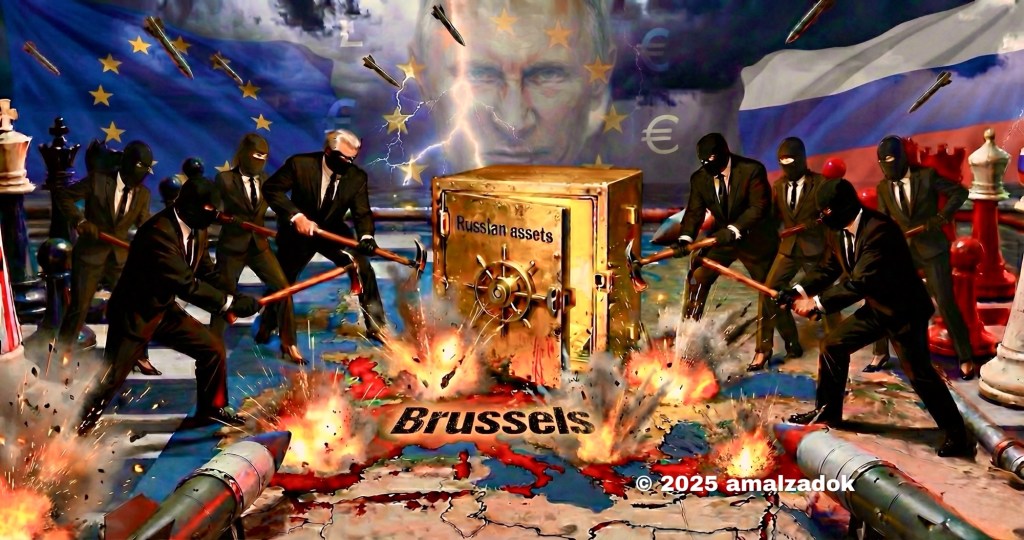
    Europe’s decision to seize and weaponise frozen Russian state assets marks a dangerous escalation: a last tantrum of a decadent elite that prefers to gamble with international law and Europe’s own future rather than accept strategic defeat and negotiate peace. Presenting this as “justice” or “reparations for Ukraine” hides a more prosaic reality: the European gangster wants those billions to plug fiscal holes, prop up a failing war effort, and delay the reckoning with its own political and economic suicide.

    The gangster move: stealing the frozen billions

    The plan to strip Russia of hundreds of billions in frozen reserves is the logical culmination of a policy that has already burned Europe’s cheap energy, industrial base, and social model on the altar of war. After sacrificing affordable Russian gas and triggering deindustrialisation and inflation, EU elites now eye Moscow’s confiscated assets as a new “magic fund” to sustain a war they cannot win and a fiscal model they can no longer finance from a shrinking tax base.

    This is framed as moral duty—“Russia must pay”—but the context betrays the real motive. Europe has already diverted enormous sums of public money to arm Kyiv while hospitals close, schools crumble, and poverty indices climb; the assets grab offers a way to extend this war spending without openly telling citizens they will lose even more welfare and rights. The political clica wants to swap domestic social anger for geopolitical banditry, trading bread and pensions for a one‑off financial heist.

    Belgium: pressure on the weak link

    Belgium sits at the centre of this scheme because Euroclear holds a massive chunk of the immobilised Russian reserves, turning Brussels into the vault the clica now wants to crack open. The same Europe that chants about “rule of law” is pressuring a small member state to accept a precedent that would have been unthinkable even at the height of the Cold War: openly confiscating another state’s reserves not as part of a peace settlement, but to keep shovelling weapons into an open‑ended proxy war.

    This pressure takes several forms.

    •Legal sophistry: relabelling seizure as “windfall profits,” “guarantees,” or “collateral,” while the substance is still the same—appropriating Russian wealth to fund war.

    •Political blackmail: warning Belgium that refusing the scheme would mean “abandoning Ukraine” or undermining European unity, turning a technical custody issue into a loyalty test.

    •Financial intimidation: hinting that Belgium’s role as a Euroclear hub could be questioned if it does not align with Washington and Brussels’ strategy.

    If Belgium capitulates, the message to the world is simple: deposits and reserves in Europe are safe only until the next geopolitical hysteria.

    Repercussions from Russia: from retaliation to systemic fracture

    For Russia, this move crosses a line between sanctions and outright theft. Moscow will not respond only with diplomatic protests; it has tools—economic, legal, and strategic—that will turn this European tantrum into a long‑term blowback.

    Likely responses include:

    •Legal counter‑claims and mirror seizures: Russia can expropriate European assets on its territory, nullify Western intellectual property, and seize physical infrastructure and investments as “compensation.”

    •Deepened de‑dollarisation and de‑euroisation: the signal to the Global South is devastating—Western currencies and jurisdictions are now weaponised, not neutral. This accelerates the creation of alternative payment systems, BRICS mechanisms, and commodity‑based settlement that permanently erode Europe’s financial relevance.

    •Strategic hardening: confiscation removes incentives for compromise. If Russia knows its reserves are gone for good, it has fewer reasons to agree to any settlement framed on Western terms, entrenching a cold war that Europe is far less equipped to sustain than Washington.

    In short, the “free money” Europe hopes to extract from Russian reserves will be repaid with isolation from emerging financial architectures, lost markets, and a Russia firmly anchored in a non‑Western bloc that no longer trusts European signatures or banks.

    Europe’s attempt to formalise this confiscation also carries the logic and symbolism of a declaration of war, even if it hides behind legal euphemisms and technocratic language. 

    Treating the central bank reserves of a nuclear‑armed state as spoils to be carved up for weapons and reconstruction funds signals that the EU no longer recognises Russia as a legitimate counterpart in the international system, but as a defeated enemy to be looted.

    In strategic terms, this is indistinguishable from economic total war, because it erases the boundary between temporary sanctions and permanent dispossession.

    Such a move hardens threat perceptions in Moscow to an unprecedented degree, reinforcing the narrative that the West seeks not negotiation or “behaviour change” but Russia’s strategic humiliation and eventual fragmentation. 

    If Russian leaders conclude that no future compromise can restore their assets, security, or status, they are incentivised to escalate horizontally—cyber, space, infrastructure, and asymmetric responses—rather than de‑escalate. 

    What Europe reads as financial cleverness, Russia reads as confirmation that the conflict is existential and must be met with long‑term, system‑level counter‑measures.

    By crossing this Rubicon, Europe not only undermines its own legal foundations but also normalises the idea that financial warfare can be escalated indefinitely without triggering wider conflict—a dangerous illusion. 

    Once the taboo on sovereign asset seizure is broken, every further crisis will tempt policymakers to “solve” political problems with new expropriations, pushing great‑power relations ever closer to open confrontation. 

    In this sense, the theft of Russian reserves is not just a tantrum; it is the codification of permanent economic war and, in substance, a de facto declaration of war against Russia, with all the risks of miscalculation, retaliation, and eventual military escalation that such a doctrine entails.

    The internal cost: Europe against its own citizens

    The gangster heist is not just an act against Russia; it is an act against Europeans themselves. By normalising confiscation of sovereign assets and emergency war financing, the same political clica also normalises permanent emergency at home—more censorship, less judicial independence, more police, and fewer social rights.

    The trajectory is already visible:

    •Sanctions and energy rupture triggered deindustrialisation, capital flight, and a collapse of the tax base that once funded Europe’s welfare states.

    •The Ukraine war became the justification to divert billions from schools, hospitals, and pensions into weapons, while dissenters were smeared as traitors or agents of Moscow.

    •Digital censorship regimes, “disinformation” laws, and emergency decrees hollowed out democratic debate and press freedom, recreating a digitalised version of Soviet‑style control.

    Using Russian money to keep this machinery going compounds the moral and legal rot. It signals that the war economy and repression must continue at any cost, because the elites have staked not just political capital but now the credibility of the entire European financial system on a conflict that has no realistic path to victory.

    Europe’s strategic suicide: from unipolar denial to open piracy

    Confiscating Russian reserves is also a symptom of a deeper pathology: Europe’s refusal to accept a multipolar world and its subservience to US strategic dictates. Instead of adapting to a reality where Russia, China, and the Global South cannot be coerced into obedience, Europe doubles down on unipolar fantasies—NATO expansion, economic warfare, ideological crusades—and then, when the costs become unbearable, resorts to financial piracy to prolong the illusion.

    The long‑term consequences are stark:

    •Trust collapse: states that watched Libya’s reserves frozen and now see Russia’s formally confiscated will regard Western custody as a trap, not a service.

    •Loss of strategic autonomy: as Europe burns bridges to Eurasia, it locks itself into dependency on American energy, arms, and financial architecture, becoming a semi‑sovereign periphery of Washington’s empire.

    •Civilisational hollowing: the moral language of “rule of law,” “human rights,” and “democracy” becomes empty when the EU behaves like a cartel seizing assets to fund a proxy war, censors opposition, and militarises public life.

    The irony is cruel: in the name of defending “European values” against Moscow, Europe is dismantling its welfare state, civil liberties, and credibility as a legal and financial safe haven.

    Beyond the tantrum: the fork in the road

    This last tantrum—the attempt to steal Russia’s frozen billions—is not a sign of strength but of exhaustion. It reveals elites trapped between a failed war strategy, a collapsing social contract, and a world that no longer tolerates Western impunity.

    Europe now stands at a precipice where one decision can still change its fate: either reclaim the primacy of bread over bombs, law over looting, and peace over permanent mobilisation, or accept its mutation into a garrisoned, obedient frontier of a fading empire. 

    If the frozen Russian billions are finally cracked open to feed the war machine, that act will not be a clever financial manoeuvre but the moment Europe openly chooses vassalage over sovereignty and plunder over principle. 

    On that day, historians will not write that Europe defended its values; they will record that, for the price of one last stolen jackpot, a civilisation signed away its soul and marked, in its own hand, the date of its final moral and strategic surrender.

    References

    1.European Parliamentary Research Service. (2025, November 27). EU sanctions and Russia’s frozen assets (Study EXPO_STU(2025)754487). European Parliament.

    2.European Parliamentary Research Service. (2025, September 7). Confiscation of immobilised Russian sovereign assets: State of play, arguments and scenarios (Briefing EPRS_BRI(2025)775908). European Parliament.

    3.European Parliamentary Research Service. (2025, June 30). Immobilised Russian central bank assets (At a glance EPRS_ATA(2025)769514). European Parliament.

    4.Reuters. (2025, December 2). EU proposes using frozen Russian assets or borrowing to raise €90 billion for Ukraine.

    5.Australian Broadcasting Corporation. (2025, December 3). EU proposes using frozen Russian assets as reparations loans for Ukraine.

    6.Verfassungsblog. (2025, April 3). Frozen Russian state assets. Verfassungsblog on Constitutional Matters.

    7.Council on Foreign Relations. (2025, November 19). How to use Russia’s frozen assets.

    8.Reuters. (2025, December 3). Russia mocks EU deliberations on frozen assets, says seizure will prompt “harshest response”.

    9.CNBC. (2025, December 4). Russia: Europe’s use of frozen assets could be justification for war.

    10.Investing.com. (2025, December 4). Russia warns EU of “harsh response” over potential asset freezes.

    11.Reuters. (2025, December 1). Top Russian banker says EU faces 50 years of litigation if it takes Russia’s frozen assets.

    12.Big Europe. (2025, November 12). The poisoned chalice of Russia’s frozen assets.

    13.Geopolitique.eu. (2023, February 22). Sanction. Confiscate. Compensate. How Russian money can be repurposed as reparations for Ukrainian victims.

    14.Al Jazeera. (2025, December 2). Europe should seize Russia’s frozen assets now.

    15.Reuters. (2025, October 2). How Europe wants to unlock Russia’s frozen cash for Ukraine.

    16.CEPR. (2025, March). Seizing central bank assets?

    ©️2025 Amal Zadok. All rights reserved.

    Subscribe and never miss an article!
  • Europe’s Self-Destruction: How Denial of Multipolar Reality is Fueling War and Collapse

    Europe’s Self-Destruction: How Denial of Multipolar Reality is Fueling War and Collapse

    by Amal Zadok

    The current war in Ukraine has not only been devastating for Ukrainians but is also steadily corroding Europe itself. Behind the headlines of military offensives, sanctions, and refugee crises lies a deeper structural problem: Europe’s refusal to accept the rise of a multipolar world order. By clinging to the vestiges of US-led unipolar hegemony, European leaders are not merely prolonging the war in Ukraine but accelerating the continent’s own decline—economically, politically, and strategically.

    Europe’s Addiction to Unipolar Illusions

    At the heart of the issue is Europe’s inherited ideological attachment to the post-Cold War liberal order. European elites internalized the illusion that American-led globalization was permanent, and that geopolitics was merely about spreading Western institutions eastward. NATO enlargement, EU expansion, and neoliberal economic integration were treated as inevitable. Russia’s objections were written off as paranoia, while China’s rise was underestimated or dismissed.

    This mindset encouraged hubris. Instead of building a security architecture that included Russia, Europe bet everything on NATO expansion, reinforcing a dangerous zero-sum logic. Instead of accepting the new economic gravity of Asia, Europe doubled down on dependence upon US markets and financial architecture. When the clash finally arrived in Ukraine, Europe’s only instinct was to double down on the same unipolar strategies: sanctions, arms transfers, and alignment with Washington’s demands.

    But these strategies no longer work in today’s world. The Global South refuses to isolate Russia. Energy markets rebalanced swiftly, with Moscow redirecting exports to Asia. Sanctions harmed European industries more than they destabilized Russia. Yet European leaders continue to behave as if economic coercion and military escalation can enforce a unipolar order that no longer exists.

    Ukraine: The Battlefield of Denial

    The catastrophic war in Ukraine is therefore less about Ukraine itself and more about Europe’s inability to come to terms with multipolarity. Recognizing that the post-Cold War order has collapsed would mean negotiating directly with Russia and accepting that Moscow has legitimate security interests. It would mean building dialogue with rising powers who no longer accept Western tutelage. For Europe’s elite, this is ideological heresy. Instead, they cling to the narrative that Ukraine is defending “Western civilization,” a framing that justifies endless escalation, arms shipments, and the sacrifice of diplomacy.

    This refusal to adjust, however, only traps Ukraine in an unending war with no path to victory. By pouring weapons into a conflict against a nuclear-armed power with superior industrial resilience, Europe ensures a stalemate of destruction. The longer the war endures, the more Ukraine becomes depopulated, devastated, and dependent, while Europe drains itself economically trying to sustain it.

    Economic Suicide in Real Time

    Europe has already paid an extraordinary price. Sanctions cut the continent off from cheap Russian energy, a lifeline for its manufacturing base. As a result, industries in Germany, Italy, and France face soaring costs and competitive decline. Deindustrialization is no longer a fear but a lived reality, with factories closing or relocating abroad.

    Beyond energy, Europe has surrendered its financial autonomy. Compliance with US sanctions forces European banks and corporations to follow Washington’s dictates even when their own interests suffer. Dependence on expensive American LNG has bound Europe further to the US economy, undermining talk of “strategic autonomy.” Meanwhile, inflation, energy poverty, and public discontent push European societies into political turbulence.

    The irony is striking: in trying to weaken Russia, Europe has instead sabotaged its own industrial heartland. Moscow has survived by pivoting toward Asian growth centers, while Europe faces stagflation, competitiveness crises, and rising social unrest.

    Political Surrender to Washington

    The political fallout is equally severe. Rather than acting as an independent pole in global politics, Europe has reduced itself to a subordinate partner in US strategy. From defense to energy to digital policy, the default answer in Brussels is to align not with Europe’s material interests but Washington’s geopolitical imperatives.

    This has hollowed out European claims of sovereignty. Talk of “strategic autonomy,” long championed by figures like Emmanuel Macron, rings hollow when every major policy decision is framed in NATO headquarters or filtered through Washington. European citizens feel the consequences: rising living costs, declining security, and disillusionment with leaders who cannot articulate a vision apart from Washington’s shadow.

    Meanwhile, other regions of the world are moving ahead. The BRICS have expanded, creating institutions and partnerships that bypass the Western-centric financial order. The Gulf States, Africa, and Latin America pursue diversified partnerships without deference to the West. While these regions embrace multipolar engagement, Europe isolates itself, clinging to a dying order.

    The Road Not Taken

    It did not have to be this way. Europe could have adapted to multipolarity by developing a security framework that accommodated Russia while protecting smaller states. It could have leveraged its economic power to build cooperative partnerships across Eurasia. It could have positioned itself as a bridge between the US and the rising powers of Asia and the Global South.

    Instead, by refusing to accept multipolarity, Europe rendered itself a casualty of it. Stuck in Cold War reflexes, Europe missed opportunities for diplomacy and adaptation, and now pays the price in economic decline and political irrelevance. Ukraine is the immediate battlefield, but the deeper battle is over Europe’s place in the world order.

    The tragedy of Europe’s stance is that, in trying to maintain unipolar dominance, it has undermined its own prosperity and future. The reluctance to accept a multipolar system has perpetuated the war in Ukraine, ruined prospects for peace, and accelerated Europe’s economic and political decline. History rarely waits for those unwilling to adapt. Unless Europe finds the courage to acknowledge the new multipolar reality, the continent risks not only defeat in Ukraine but destruction from within.

    Europe now stands at a civilizational crossroads: either awaken to the reality of multipolarity and reclaim agency in shaping its destiny, or march blindly into a future of irrelevance, poverty, and dependency. The choice is no longer between Washington or Moscow—it is between self-preservation or self-destruction.

    ©️2025 Amal Zadok. All rights reserved.

    Subscribe and never miss an article!

  • Highway to Hell: Trump’s Militarized Europe Drives the World Toward WWIII

    Highway to Hell: Trump’s Militarized Europe Drives the World Toward WWIII

    by Amal Zadok

    Donald Trump’s vision for Europe isn’t partnership—it’s extortion. His threat to abandon NATO allies who fail to spend 5% of GDP on defense—while openly encouraging Russian aggression against “delinquent” nations—has shattered the alliance’s foundational trust. In its place, he installed a protection racket where security is transactional and Europe’s sovereignty is collateral. Terrified of abandonment, Germany amended its constitution to unleash $400 billion for rearmament, Poland ramped up spending to 4.7% of GDP, and France floated a suicidal 5% target—all while slashing social programs to fund war machines .

    The Economic Hellscape

    This militarization isn’t just about tanks—it’s economic sabotage. Trump’s parallel 10% tariffs on EU goods and 100% levies on electric vehicles will crush Europe’s industrial backbone. Germany’s auto sector faces collapse, French farmers revolt against crippling costs, and the IMF predicts a 1% GDP contraction across the eurozone. Worse, Europe must now buy American weapons to appease Trump, diverting billions from green transitions and welfare states into Lockheed Martin’s profits. As social programs bleed, defense contractors rejoice: Rheinmetall’s stock soared 240% since 2022, embodying a grotesque new “austerity-for-arms” doctrine .

    The Grotesque Theater of Submission

    European leaders compound the crisis with humiliating obsequiousness. NATO chief Mark Rutte set the tone, addressing Trump as “daddy” in leaked texts and publicly praising his “decisive action in Iran.” This “orchestrated grovel,” as critics dubbed it, extended to UK PM Keir Starmer brandishing a royal invitation to flatter Trump’s ego. Such sycophancy isn’t diplomacy—it’s strategic self-debasement that rewards coercion. As one analyst noted, Trump’s court “doesn’t respect allies who kneel; it exploits them”.

    Fanning the Fires of War

    Trump fuels global conflicts with nihilistic abandon:

    – Ukraine: He vows to “settle in 24 hours” by gifting Putin 30% of Ukraine’s territory, betraying a democratic ally to appease the Kremlin .

    – Gaza: He backs Netanyahu’s genocide while deporting pro-Palestinian protesters, turning ethnic cleansing into campaign fodder .

    – Iran-Israel: He eggs Netanyahu to “hit harder!” during strikes, risking nuclear escalation for political theater .

    Europe’s complicity is stark: Macron deploys troops to “Trump-proof” Ukraine’s front lines, while Poland stations U.S. nukes 100 miles from Belarus—turning the continent into a tripwire for catastrophe .

    The Inevitable Endgame: WWIII

    This spiral—shattered alliances, bankrupt economies, and emboldened autocrats—creates a tinderbox. European polls now show majorities fear nuclear war, with 60% supporting a EU nuclear deterrent. Yet their rearmament is futile: Europe’s defense industry can’t produce enough arms, relying on U.S. imports with 4-year delays. Drones vital for modern warfare are obsolete within months, while Russia produces 4 million annually. As Germany’s own analysts admit, rebuilding military capacity could take “decades or even centuries” .

    The Point of No Return

    Trump’s “mission impossible” to militarize Europe isn’t about security—it’s about subjugation. By forcing allies to choose between protection money or annihilation, he has ignited a geopolitical suicide pact. Europe’s leaders march toward hell, believing they can outsource their survival to a man who sees them as vassals, not partners. But as Rutte’s “daddy” diplomacy proves, no amount of groveling can mask the truth: this road ends in ruins .

    The world is not sleepwalking to war; it is saluting and marching.

    ©️2025 Amal Zadok. All rights reserved

    Please subscribe so you never miss an article!