Tag: Rule of law

  • Wrong and dangerous strategy: appeasing a bully 

    Wrong and dangerous strategy: appeasing a bully 

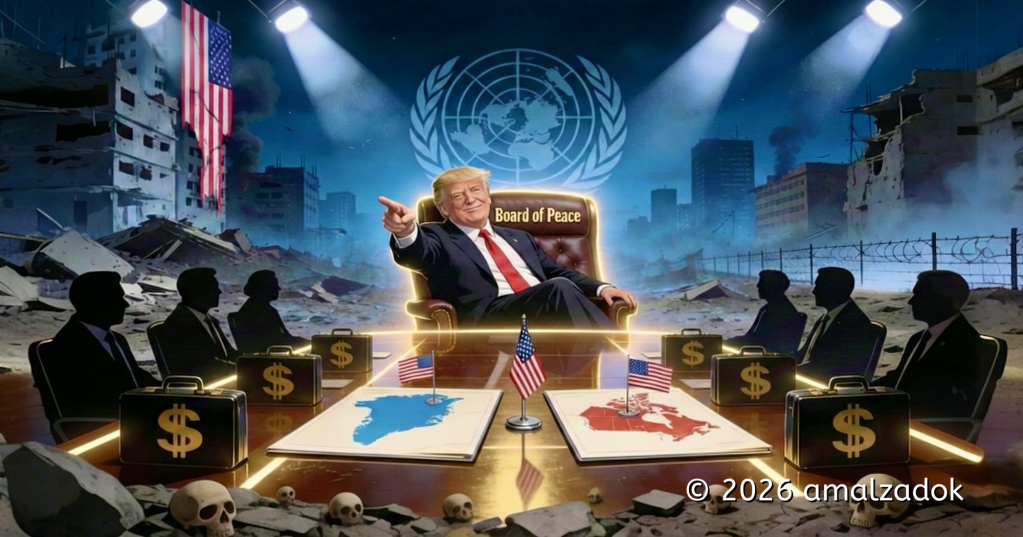
    Trump has turned Gaza into the set of The Apprentice: governments pay to sit in his boardroom over the ruins, and their only real job is to obey or get fired. Appeasing that is not strategy; it is complicity.

    By Amal Zadok

    Appeasing Donald Trump is not a strategy; it is complicity. Every time governments, institutions and political elites bite their tongues in the name of “stability,” they are not moderating him; they are underwriting his attempt to replace law with money, fear and his own ego as the organising principle of world politics. A man who combines the power of the U.S. presidency with the traits of a malignant narcissist, an obsession with personal “glory,” and open enablement of mass atrocities is not a “difficult partner”; he is a direct threat to any order that claims to be based on human dignity and the rule of law.

    Malignant narcissism is not mere vanity with extra hairspray. It is a configuration of grandiosity, lack of empathy, paranoia about enemies and a willingness to use cruelty to protect a fragile ego. In Trump’s case, this has meant delight in domination, compulsive lying, routine public humiliation of opponents and a chilling indifference to mass suffering, most starkly visible in his embrace of Israeli policies in Gaza and his political cover for a war that has devastated an already trapped population. For such a personality, other people’s lives and entire territories are props in his heroic narrative: if flattening a people or turning them into bargaining chips makes him look “strong” and pleases his base, then it is not a moral dilemma, it is an opportunity.

    The same pathology is visible in his maniacal fixation on the Nobel Peace Prize, and the humiliating spectacle of allies staging fake “peace” honours to soothe him. When a foreign leader like Marina Machado feels compelled to hand him a framed imitation of an accolade he never earned, it is not diplomacy; it is ritualised ego‑massage that tells every despot watching that even democratic politicians will debase themselves rather than confront his fantasies.

    This pathology is written all over his latest creation: the so‑called Board of Peace for Gaza. On paper, it is billed as a mechanism to oversee reconstruction and governance; in reality, it is The Apprentice metastasised to a global scale, with Gaza as the burned‑out set and whole governments auditioning for his favour. A $1 billion payment secures a permanent seat on this Trump‑chaired “board,” while poorer states are relegated to rotating spots, turning the future of a shattered territory into a billion‑dollar membership club. This is not multilateralism; it is monetised feudalism. It is “The Apprentice: Gaza Edition” – pay to get into the boardroom, sit around his table, follow his orders, and hope you are not the next one he effectively tells: “You’re fired.”

    The Board of Peace is also a direct attack on the UN‑centred system that, however imperfectly, recognised Palestinian rights and tried to put reconstruction under universal, not personal, authority. By dangling access to Gaza’s future as a perk for those willing to buy in, Trump is building a private mini‑UN in his own image: hierarchical, cash‑gated, unaccountable and centred on his personality. States that treat this scheme as just another diplomatic forum, rather than a frontal assault on multilateralism, are not hedging; they are helping him prove that you can sideline global institutions if you are ruthless and rich enough.

    None of this is accidental. Trump has begun saying the quiet part aloud. In a recent interview he declared that “my own morality, my own mind” is “the only thing that can stop me,” brushing aside international law and institutional checks as unnecessary constraints on his quest for “global supremacy.” For a man who has shown that his “morality” stretches to cheering bombardments, openly musing about annexations and threatening the use of force abroad, that line is not colourful rhetoric; it is a confession of megalomania. It tells allies and institutions exactly how he sees them: not as co‑equal guardians of a rules‑based order, but as furniture in a set he believes he owns.

    The Davos episode over Greenland and Canada completes the picture. Trump has openly pushed to “acquire” Greenland, tying tariffs and other economic weapons to the goal of securing “complete and total” U.S. control, before offering the thinnest possible reassurance that he will not, for the moment, use military force. He used a global stage to humiliate Canadian Prime Minister Mark Carney, sneering that “Canada lives because of the United States” and instructing Ottawa to “remember that” before daring to criticise his Greenland ambitions. This is not alliance management; it is hostage‑taking conducted in the language of reality television and mob protection rackets.

    His behaviour toward Canada and Denmark illustrates the pattern that runs from NATO capitals to Gaza’s ruins. Security guarantees, trade access and even basic recognition are treated as favours that can be withdrawn if insufficient loyalty is displayed. Tariffs are brandished like a baseball bat; territorial integrity is discussed as if it were a line item in a real‑estate portfolio; prime ministers are reduced to contestants he can dress down in front of the cameras. When allies respond with nervous laughter, cautious communiqués and private grumbling instead of coordinated pushback, they teach him exactly the wrong lesson: that they will swallow humiliation and coercion rather than risk open confrontation.

    Layer this onto Gaza and the result is grotesque. Trump is offering political and diplomatic cover to a campaign that has destroyed much of the strip’s infrastructure and displaced the overwhelming majority of its population, then presenting himself as the indispensable architect of what comes next. Under his plan, those who pay the price of his Board of Peace get influence; those who cannot pay get whatever trickles down. The people of Gaza themselves are spectators in a show supposedly scripted for their benefit. Their homes and bodies are reduced to scenery for a global audition in which states compete to impress the man who helped enable their destruction in the first place.

    Supporters will insist this is “hard‑nosed deal‑making” and a necessary way to get things done in a brutal world. That is precisely the illusion appeasement feeds. When governments attend his board, they legitimise the idea that the future of a devastated people belongs in a private club chaired by the man who cheered on their devastation. When media treat his “Board of Peace” branding and his “only my morality can stop me” line as colourful copy, they normalise the premise that checks and balances are optional extras in a nuclear‑armed superpower. When Canada, Denmark and other allies respond to tariff blackmail and annexation fantasies with little more than pained diplomacy, they validate his worldview that laws and treaties are decorations, not boundaries.

    The stakes extend beyond Trump himself. Autocrats and would‑be strongmen everywhere are watching. They see a U.S. president who tries to build a pay‑to‑play mini‑UN over Gaza, who declares that only his own morality restrains him, who bullies allies over territory and trade, and who still finds a line of states willing to buy seats at his table. If that behaviour is indulged, why shouldn’t they copy it? If the “leader of the free world” can treat international law as a suggestion and treat entire nations like contestants on a show, the message is clear: there is no real price for running the world as a personal franchise, so long as you are powerful enough.

    Refusing to appease Trump means more than tut‑tutting and diplomatic eye‑rolling. It means:

    -Boycotting and delegitimising the Board of Peace, insisting that Gaza’s reconstruction and governance be anchored in transparent, UN‑based mechanisms where seats are earned by responsibility, not bought with cash and flattery, and prosecution of those responsible for the genocide and war crimes in Gaza.

    -Responding to tariff blackmail, Greenland fantasies and open insults against allied leaders with coordinated economic, legal and diplomatic measures, rather than fragmented “concerns” that he can ignore one by one.

    -Treating declarations like “only my morality can stop me” as a mandate to reinforce external checks—courts, parliaments, alliances—not as a quirky line to be replayed on talk shows.

    Appeasing Donald Trump—appeasing his bullying, his megalomania, his reality‑show Board of Peace, his threats against allies and his contempt for law—is not prudence. It is surrender. Each time leaders choose silence over truth, access over principle or a paid‑up seat at his fake mini‑UN over a real fight for international law, they edge the world closer to a future in which power answers only to itself. A political system that wants to survive, and a world that wants to remain even minimally just, cannot afford the luxury of appeasing this bully any longer.

    References

    1.New York Times. (2026, January 18). $1 billion in cash buys a permanent seat on Trump’s “Board of Peace” for Gaza. https://www.nytimes.com/2026/01/18/world/middleeast/trump-board-of-peace-gaza.html[nytimes

    2.PBS NewsHour. (2026, January 19). $1 billion contribution secures permanent seat on Trump’s “Board of Peace.” https://www.pbs.org/newshour/world/1-billion-contribution-secures-permanent-seat-on-trumps-board-of-peace

    3.CNN. (2026, January 18). Trump’s “Board of Peace” for Gaza to require $1 billion payment for permanent membership. https://www.cnn.com/2026/01/18/politics/board-of-peace-gaza-trump-payment-membership

    4.The Atlantic. (2026, January 17). Trump’s billion-dollar Board of Peace. https://www.theatlantic.com/national-security/2026/01/trump-billion-dollar-board-of-peace/685671/

    5.The Wall Street Journal. (2026, January 19). Trump’s $1 billion-a-seat diplomacy club takes aim at the U.N. https://www.wsj.com/world/middle-east/trumps-1-billion-a-seat-diplomacy-club-takes-aim-at-the-u-n-2bccd9f9

    6.Business Times. (2026, January 19). What to know about Trump’s “Board of Peace” for Gaza. https://www.businesstimes.com.sg/international/global/billion-dollar-membership-fee-what-know-about-trumps-board-peace-gaza

    7.PBS NewsHour. (2026, January 21). Trump’s Board of Peace is dividing countries in Europe and the Middle East. https://www.pbs.org/newshour/world/divisions-emerge-among-western-european-nations-over-trumps-board-of-peace-for-gaza

    8.The Hill. (2026, January 21). Trump to Carney: “Canada lives because of the United States.” https://thehill.com/homenews/administration/5699148-trump-carney-canada-greenland/

    9.Global News. (2026, January 20). Trump says Canada “lives” because of U.S. https://globalnews.ca/news/11622445/donald-trump-mark-carney-davos-speech/

    10.Axios. (2026, January 21). Trump responds to Carney in Davos: “Canada lives because of the United States.” https://www.axios.com/2026/01/21/trump-davos-speech-carney-canada

    11.People Magazine. (2026, January 8). Trump says “my own morality” is “the only thing” stopping his global supremacy. https://people.com/donald-trump-says-morality-only-thing-stopping-global-supremacy-11881997

    12.Esquire. (2026, January 8). Trump says his “morality” is the only thing stopping him. https://www.esquire.com/news-politics/politics/a69960918/trump-morality-in-check/

    13.New York Times. (2026, January 8). Trump addresses Venezuela, Greenland and presidential power in new interview. https://www.nytimes.com/2026/01/08/us/politics/trump-interview-power-morality.html

    14.CNN. (2026, January 20). Trump says Board of Peace meant to oversee Gaza reconstruction and security. https://www.cnn.com/2026/01/20/politics/trump-gaza-board-of-peace-united-nations

    15.PBS NewsHour. (2026, January 19). News Wrap: World leaders weigh whether to join Trump’s “Board of Peace” for Gaza. https://www.pbs.org/newshour/show/january-19-2026-pbs-news-hour-full-episode

    ©️2026 Amal Zadok. All rights reserved.

    Subscribe and never miss an article!
  • The fearless man without conscience: Trump’s malignant narcissism and the threat to democracy 

    The fearless man without conscience: Trump’s malignant narcissism and the threat to democracy 

    By Amal Zadok and Rev. Antonio Rossemberg, MD, psychiatrist.


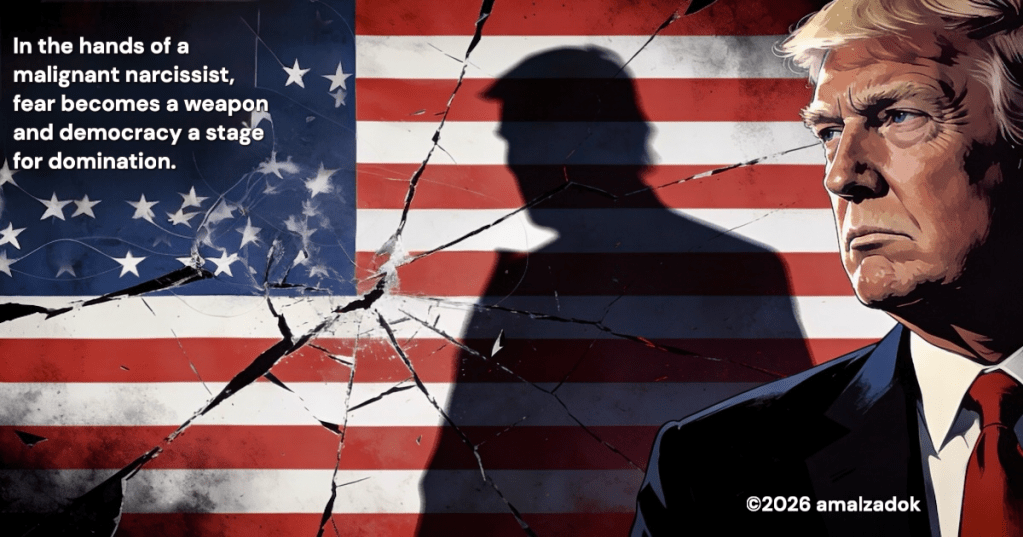
    Donald Trump is not scared. Fear is not an emotion that resonates with him the way it does with most people. He embodies what psychologists describe as a malignant narcissist—a personality type that blends narcissism with antisocial traits, a lack of empathy, and a hunger for domination. People like him are largely incapable of feeling fear, remorse, or genuine empathy. That emotional vacuum makes them profoundly dangerous, especially when they ascend to positions of enormous political or social power. 

    A malignant narcissist does not experience fear as a natural warning signal or a moment of introspection. Instead, fear in others becomes a source of satisfaction—a sign that they are in control. His reactions, from defiant outbursts to self-aggrandizing rhetoric, often reveal a man who feels invincible rather than vulnerable. Setbacks, investigations, or criticism are not perceived as moral reckonings but as insults to be crushed or games to be won. This mindset explains why accountability rarely touches him in any meaningful way: he refuses to acknowledge fault because, to him, weakness is worse than wrongdoing. 

    When such a person occupies the presidency of the United States—the most powerful office on Earth—the consequences extend far beyond one individual’s pathology. A malignant narcissist in power sees the nation not as a collective trust but as an extension of the self. The institutions of democracy become tools to serve personal validation, and the truth itself becomes malleable. Loyalty is demanded, not earned. Those who flatter are embraced; those who dissent are derided or destroyed. 

    Trump’s appeal lies in his uncanny ability to mirror the resentments and frustrations of others while remaining utterly self-absorbed. His political genius, if it can be called that, is his instinct for manipulation—his capacity to turn fear outward rather than inward. He convinces followers that their enemies are his enemies, that their grievances justify his own impunity. In doing so, he transforms personal pathology into a political movement. 

    He is not scared because fear requires humility, and humility is foreign to his nature. What drives him is not courage, but the relentless need to dominate. That is why his power—unrestrained, unreflective, and unrepentant—is so deeply perilous. Now, in his second term, the malignant traits that once defined Trump’s personality have hardened into policy and institutional transformation. 

    His declaration—“No one can stop me; only my own morality can”—is not simply arrogance; it is a chilling admission of delusion. It reveals a man who sees himself as the arbiter of what is right and wrong, detached from external moral frameworks, institutions, or law. For Trump, morality is not universal; it is situational—a reflection of what benefits him in the moment. He invokes morality as a mask, framing his impulses as destiny. This is the purest expression of the narcissistic illusion: the belief that the self is infallible and that restraint is weakness. 

    In a functioning democracy, such pathology should meet a firm institutional response. Congress holds not only the power but the obligation to act as a check on executive overreach, using hearings, investigations, and impeachment when a president’s conduct threatens the constitutional order. Yet too many politicians retreat into rehearsed talking points, tribal loyalty, and short-term electoral calculus, choosing self-preservation over their oath to the Constitution. Their failure to confront this malignant narcissism does not make them neutral observers; it makes them enablers. 

    ©️2026 Amal Zadok. All rights reserved.

    Subscribe and never miss an article!
  • When the Republic Wears a Mask: ICE, Trump, and the Constitution in the Crosshairs of Encroaching Power

    When the Republic Wears a Mask: ICE, Trump, and the Constitution in the Crosshairs of Encroaching Power

    James Madison warned that “power is of an encroaching nature, and…ought to be effectually restrained from passing the limits assigned to it.”  In Donald Trump’s hands, Immigration and Customs Enforcement (ICE) has become the very embodiment of that encroaching power: an armed, masked, and increasingly unaccountable apparatus that kills a U.S. citizen in Minnesota, terrorizes communities, and dares the constitutional order to stop it.  An agency that claims the mantle of law has slid into something closer to a standing force of intimidation, operating in a gray zone between policing and political control that James Madison, Alexander Hamilton, and Benjamin Franklin would have recognized as the threshold of tyranny.

    Madison, encroaching power, and the ICE state

    Madison’s core insight in Federalist No. 48 was brutally simple: “power is of an encroaching nature” and “mere parchment barriers” are not enough to stop a determined branch from slipping its leash.  He feared precisely what is visible today in immigration enforcement: a single executive apparatus accumulating practical control over lawmaking (through broad discretion), execution (through raids and detention), and adjudication (through executive‑run immigration courts).  This “tyrannical concentration of all the powers of government in the same hands,” Madison wrote, is the very definition of tyranny, whether wielded by a monarch or an elected president.

    Under Trump, ICE has become such a concentration point. Its Enforcement and Removal Operations wing conducts raids, arrests, detention, and deportation. Policy memos from the White House and DHS effectively rewrite who is targeted and how aggressively, far beyond what most Americans imagined when Congress wrote the underlying statutes.  Madison would not be fooled by the bureaucratic language. He would see an executive machine steadily expanding its reach, using the gaps between law on paper and practice on the ground to enlarge its power.

    The Minnesota killing: when “enforcement” becomes lethal impunity

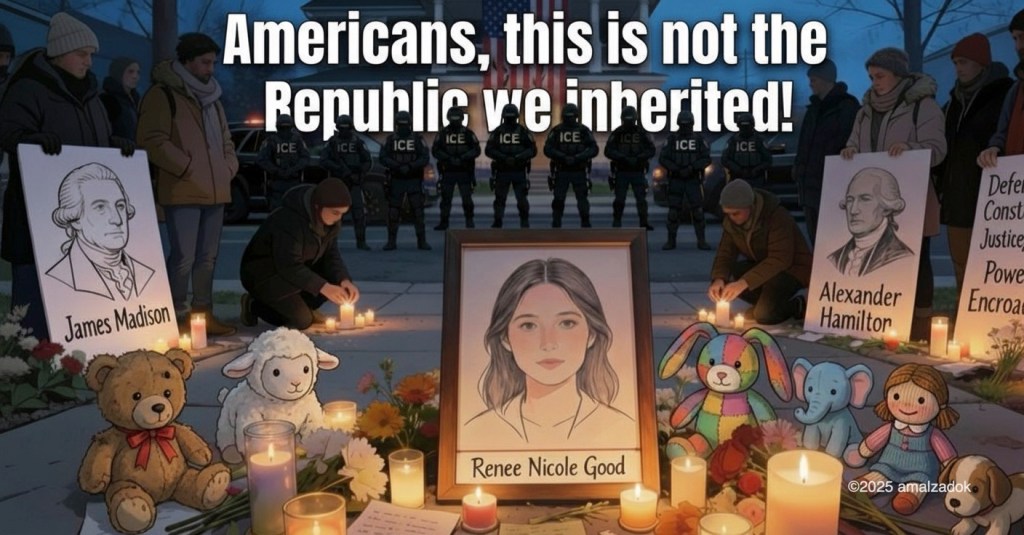
    The killing of 37‑year‑old Renee Nicole Good by an ICE officer in Minneapolis is not an aberration; it is a revelation.  Good, a U.S. citizen, mother of three and celebrated poet, was in her car when ICE agents confronted her on a residential street. Video shows an officer at her door while another steps in front of the vehicle and fires multiple rounds into the windshield at close range.  Federal officials rushed to frame her as a threat who tried to run over agents, yet witnesses’ footage shows an officer shooting almost immediately as the car inches forward. The city’s mayor called it “reckless use of force” and told ICE to “get out of our city.”

    Local leaders have emphasized that Good appears to have had no serious criminal record and was reportedly present as a legal observer monitoring ICE activity, while the Trump administration branded her a “domestic terrorist.”  This is the logic of encroaching power: those who watch the state become enemies of the state. A federal officer can shoot a citizen in the face on a city street, then retreat behind a wall of official narratives and procedural reviews.  Madison warned that when one branch operates with “overruling influence” and escapes effective checks, “dangerous innovations in the government, and serious oppressions of the minor party in the community” follow.  Good’s death is one of those oppressions, and the “minor party” is anyone the executive chooses to target.

    The “law and order” defense — and why it fails

    Defenders of ICE under Trump insist that such force and sweeping tactics are the price of “law and order.” They argue that agents face real dangers, that criminals will exploit any restraint, and that masks, unmarked cars, and aggressive raids are necessary to protect officers and communities alike.  Madison and the founding generation would have recognized the danger in this argument: it turns necessity into a blank check.

    Madison’s warning that power is “of an encroaching nature” was directed precisely at governments that invoke safety to justify permanent expansion of force.  Hamilton cautioned that when the federal government “overpasses the just bounds of its authority and makes a tyrannical use of its powers,” the people must “appeal to the standard they have formed”—the Constitution—and seek redress.  Franklin, for his part, wrote that the “means of defence against foreign danger have been always the instruments of tyranny at home,” a line that lays bare what happens when law‑and‑order rhetoric licenses masked agents to kill a citizen like Good and terrorize entire neighborhoods.  The question is not whether enforcement is needed, but whether it remains constrained by law, transparency, and accountability; when it does not, it ceases to be “order” in any constitutional sense.

    Masks, unmarked cars, and the aesthetics of fear

    The methods ICE now routinely employs reveal how far the culture of the agency has drifted from ordinary law enforcement toward something darker.  Across the country, residents watch masked agents in plain clothes jump from unmarked vehicles, armed with rifles, surrounding people on sidewalks and in driveways. Even mayors describe these scenes as resembling “violent abduction,” not policing.  The Department of Homeland Security insists that masks are needed to protect agents from doxxing and threats, pointing to cases where officers’ families were harassed after photos circulated online.

    But civil‑rights advocates and local officials note that masked, anonymous armed men seizing people off the street “compound fear and chaos” and “evade accountability for agents’ actions.”  When the state sends masked figures in unmarked vehicles to carry out its will, it deliberately blurs the line between law and terror, between a warrant and a snatch‑and‑grab.  Madison’s insistence that power must be visibly separated, checked, and identifiable is not satisfied by a small “ICE” patch on a vest. A power that hides its face from the public it serves is already behaving as if it is above that public.

    “Law enforcement” without law

    Formally, ICE is a federal law enforcement agency under the Department of Homeland Security, charged with enforcing immigration and customs laws and “preserving national security and public safety.”  In practice, the Trump‑era posture has treated “law enforcement” as a talisman that justifies almost any method, while the rule of law—the predictable, proportionate, rights‑respecting application of statutes—often appears as an afterthought.  Raids at homes, hospitals, and schools, family separation as leverage, and lethal force against a nonviolent U.S. citizen all point to an institution where the executive’s will is the primary law.

    The Founders knew that “law enforcement” can become a mask for oppression. Hamilton warned that when the federal government “overpasses the just bounds of its authority and makes a tyrannical use of its powers,” the people must “appeal to the standard they have formed”—the Constitution—and seek redress.  Franklin cautioned that “the means of defence against foreign danger have been always the instruments of tyranny at home,” a sentence that reads today like a prophecy of post‑9/11 security agencies turned inward on vulnerable communities.  The question is not whether ICE fits the bureaucratic definition of “law enforcement,” but whether its conduct still reflects the deeper law of a constitutional republic.

    The Founders’ moral horizon: liberty, asylum, humanity

    For the founding generation, liberty was universal and inseparable from the dignity of the person. Franklin wrote that “equal liberty” is “the birthright of all men,” language that sits uneasily beside images of children taken from parents and locked in detention centers because those parents lacked the right papers.  Jefferson spoke of the United States as an “asylum” for the oppressed and warned that if the federal government claimed ungranted powers over aliens and others, Americans would end up “living under one deriving its powers from its own will, and not from our authority.”

    The killing of Renee Good and the masked‑raid culture around ICE mark a moral break with that vision.  A government that can shoot a citizen observer in the head, on disputed facts, and then march agents back into the streets wearing masks to “ensure their safety” while whole neighborhoods live in terror has ceased to see liberty as a birthright; it sees public fear as a tool.  Madison’s warning that “when the people fear the government, there is tyranny” is no longer a distant abstraction. It is a description of what residents of immigrant communities, and now even citizen observers like Good, experience when they see a DHS badge.

    The Madisonian response: draw the line

    Madison understood that “mere demarcation on parchment of the constitutional limits” is never enough; it is the vigilance of citizens, legislators, and courts that prevents encroaching power from hardening into permanent despotism.  The ICE that kills a Minnesota mother, moves in masked formations through American cities, and claims the absolute mantle of “law enforcement” while operating in legal and moral gray zones is exactly the kind of institution that must be confronted in Madisonian terms.

    To “appeal to the standard” of the Constitution, as Hamilton urged, means demanding transparent investigations and prosecutions where warranted in the Good case, legislative restraints on raids and use of force, and judicial scrutiny of policies that turn communities into occupied zones.  It also means a civic refusal to accept masked, nameless agents as a normal feature of democratic life: insisting on clear identification, recorded operations, and public accountability whenever armed federal staff operate in local neighborhoods.  If Madison is right—and the history of republics suggests he is—then the line must be drawn now, before the encroaching power that killed Renee Nicole Good becomes a permanent, accepted feature of American government.

    Americans now face a test that previous generations knew only in theory: whether loyalty belongs to a leader and his armed agents, or to the Constitution and the republic it binds into being.  The blood spilled at Lexington and Concord, on the fields of Antietam and Normandy, in Selma and at Kent State, was not offered to sanctify a regime of masked men in unmarked vehicles, but to preserve a nation of laws where power answers to the people.  When ICE can kill a citizen like Renee Good on a quiet Midwestern street, when families live in terror of raids more reminiscent of juntas than of justice, the United States drifts toward a resemblance it has long condemned in others: the look and feel of the very dictatorships it claims to oppose.  The choice now is stark and inescapable: either citizens, churches, cities, states, and courts rise in open, principled defense of the constitutional order—demanding that this government once again fear its people, not the other way around—or the encroaching power Madison warned against will finish its work, and the republic so many men and women died to preserve will quietly become something else.

    References

    1.Ammo.com. (2024, April 19). Founding Fathers’ quotes on government, democracy, and power in the people. https://ammo.com/articles/founding-fathers-quotes-democracy-government-power-in-people

    2.Avalon Project. (1788). Federalist No. 48. Yale Law School. https://avalon.law.yale.edu/18th_century/fed48.asp

    3.Bill Muehlenberg. (2021, November 29). The Founding Fathers on freedom. https://billmuehlenberg.com/2021/11/29/the-founding-fathers-on-freedom

    4.Bill of Rights Institute. (2024). Founders’ quotes. https://billofrightsinstitute.org/founding-documents/founders-quotes

    5.CBC News. (2026, January 9). The White House is defending fatal ICE shooting of Minneapolis woman. But what are the rules of engagement? https://www.cbc.ca/news/world/ice-minneapolis-shooting-use-of-force-9.7038275

    6.Civil and Human Rights Coalition. (2025, February 17). The human costs of Trump’s immigration crackdown. The Leadership Conference on Civil and Human Rights. https://civilrights.org/blog/the-human-costs-of-trumps-immigration-crackdown

    7.Cornell Law School, Legal Information Institute. (2016). Immigration and Customs Enforcement (ICE). https://www.law.cornell.edu/wex/immigration_and_customs_enforcement_(ice)

    8.FEE. (2025, November 19). 17 Benjamin Franklin quotes on tyranny, liberty, and rights. Foundation for Economic Education. https://fee.org/articles/17-benjamin-franklin-quotes-on-tyranny-liberty-and-rights

    9.Gilder Lehrman Institute of American History. (n.d.). Founding Fathers’ selected quotations key. https://www.gilderlehrman.org/sites/default/files/inline-pdfs/Key%20to%20Founding%20Fathers%20Selected%20Quotations.pdf

    10.Hamilton, A. (2017). Alexander Hamilton quotes about tyranny. AZQuotes. https://www.azquotes.com/author/6160-Alexander_Hamilton/tag/tyranny

    11.Monticello. (n.d.). The question of immigration. Thomas Jefferson Foundation. https://www.monticello.org/the-art-of-citizenship/the-question-of-immigration

    12.National Constitution Center. (2016, March 15). James Madison: Birthday quotes from the most quotable Founding Father. https://constitutioncenter.org/blog/james-madison-birthday-quotes-from-the-most-quotable-founding-father

    13.NPR. (2025, July 9). Masked immigration agents are spurring fear and confusion. https://www.npr.org/2025/07/09/nx-s1-5440311/ice-raids-masked-agents

    14.Press-Pubs, University of Chicago. (n.d.). Jefferson, T. Resolutions relative to the Alien and Sedition Acts. https://press-pubs.uchicago.edu/founders/documents/v1ch8s41.html

    15.Teaching American History. (2024, July 24). Federalist 47, Federalist 48, and Federalist 51. https://teachingamericanhistory.org/document/federalist-47-federalist-48-and-federalist-51

    16.The Conversation. (2018). How the media dealt a major blow to Donald Trump’s family separations policy. https://theconversation.com/how-the-media-dealt-a-major-blow-to-donald-trumps-family-separations-policy-98669

    17.The New York Times. (2025, July 20). LA Mayor: Masked ICE agents created “reign of terror”. https://www.nytimes.com/2025/07/20/us/politics/ice-agents-masks.html

    18.The New York Times. (2025, August 5). Inside Trump’s new tactic to separate immigrant families. https://www.nytimes.com/2025/08/05/us/politics/trump-administration-family-separation.html

    19.United States Immigration and Customs Enforcement. (2003– ). United States Immigration and Customs Enforcement. Wikipedia. https://en.wikipedia.org/wiki/United_States_Immigration_and_Customs_Enforcement

    20.Federal Law Enforcement Training & Research Center. (2014, November 25). What is ICE? https://www.federallawenforcement.org/ice/what-is-ice

    21.ABC News. (2026, January 7). Woman killed by ICE agent in Minneapolis was a mother of 3, poet… https://abcnews.go.com/US/wireStory/woman-killed-ice-agent-minneapolis-mother-3-poet-129008055

    22.BBC News. (2026, January 7). US immigration agent fatally shoots woman in Minneapolis. https://www.bbc.com/news/articles/c0jvnl4j1n4o

    23.BBC News. (2026, January 8). Renee Nicole Good: Who was the woman killed by ICE in Minneapolis? https://www.bbc.com/news/articles/c1jepdjy256o

    24.Al Jazeera. (2026, January 8). Who was Renee Nicole Good, the woman killed in ICE Minneapolis shooting? https://www.aljazeera.com/news/2026/1/8/who-is-renee-nicole-good-the-woman-killed-in-the-ice-minneapolis-shooting

    25.SupplySideLiberal. (2022). The Federalist Papers #48: Legislatures, too, can become tyrannical (James Madison). https://blog.supplysideliberal.com/post/2022/2/6/the-federalist-papers-48-legislatures-too-can-become-tyrannicaljames-madison

    26.Critical Skills Blog. (2024, July 21). The Founding Fathers’ fears of tyranny: Insights from Jefferson, Madison, Hamilton, and Washington. https://criticalskillsblog.com/2024/07/22/the-founding-fathers-fears-of-tyranny-insights-from-jefferson-madison-hamilton-and-washington

    ©️2026 Amal Zadok. All rights reserved.

    Subscribe and never miss an article!
  • Trump, the New Chimera: A Hybrid of Stalin and Hitler on the World Stage

    Trump, the New Chimera: A Hybrid of Stalin and Hitler on the World Stage

    by Amal Zadok

    When a president says only his “own morality” limits his power and that he “does not need international law,” while a mother of three is shot through her windshield by an ICE officer on an American street, the mask is off. This is no longer a debate about policy; it is the birth of a regime that reserves law for the weak and bullets for anyone who get in the way. 

    A president who crowns himself

    Trump’s statement to The New York Times that his power as commander in chief is constrained only by his “own morality” is the distilled creed of authoritarianism. In his own words, there is “one thing” that can stop him: not Congress, not courts, not treaties, but his “own mind,” followed by the contemptuous aside, “I don’t need international law.” 

    This is not some late-night tweet; it is a formal doctrine announced from the Oval Office. In that interview, he waves away the UN Charter, the ban on aggressive war, and decades of treaty obligations as optional restraints that apply only if he personally decides they should, implicitly trampling the Charter’s prohibition on the use of force and the core idea that even great powers are bound by law. 

    He prides himself on using military strikes, invasions, economic strangulation and political coercion as tools of personal will, not as acts accountable to any external standard. A president who claims that law is binding only when he feels like it has ceased to be a constitutional officer and has slipped into the role of a sovereign who believes that legality is a costume he can put on for international conferences and drop whenever he wants to unleash force.

    From “rules-based order” to rule by fear

    For years, Washington preached a “rules-based international order” to other states. Now Trump publicly shreds that script and replaces it with a gangster’s logic: power first, rules never. He openly treats treaties as disposable, walks away from arms-control agreements, and shrugs at the possible collapse of the last major nuclear restraints with a fatalistic “if it expires, it expires.” 

    The message radiates far beyond Washington. If the United States claims the right to strike where it wants, topple whom it chooses, and threaten nuclear and non‑nuclear states alike without even pretending to obey international law, why should Moscow feel bound in Ukraine or Beijing in Taiwan? The “order” that once at least pretended to restrain the strong becomes a stage on which the biggest actor improvises violence while lecturing others about norms. 

    Trump’s “own morality” is not a safeguard; it is a surrender of civilization to personality. It tells every future strongman—from Budapest to Brasília—that law is ornamental and that the only crime is losing. 

    The ICE bullet in Minneapolis

    While Trump claims he does not need international law abroad, his domestic security machine is being trained to treat American streets like occupied territory. In Minneapolis, 37‑year‑old Renee Nicole Good, a U.S. citizen, a mother of three, was shot and killed by an ICE officer while sitting in her car on a cold Midwestern street, neighbors watching from their windows as sirens and shouts shattered the night. 

    She was not a cartel boss or a terrorist; she was a neighbor, a writer, a woman who had come out—according to local accounts—to care for those around her. The official story shifts like a propaganda broadcast. DHS officials insist she “failed to comply,” that she “attempted to run over” an officer. Local witnesses describe confusion and conflicting commands, with one officer telling her to drive away from a stuck ICE vehicle and another simultaneously trying to pull her from the car; body‑camera and bystander video show agents swarming the vehicle, one officer stepping into her path, firing at close range as she attempts to drive off, her car then crashing down the street as her life bleeds out on the asphalt. 

    Minneapolis city officials have said openly what federal spokespeople will not: that this was “a federal agent recklessly using power that resulted in somebody dying.” The FBI has now taken over the investigation after the state’s own Bureau of Criminal Apprehension backed away, a sign of just how toxic and politically charged this killing has become, while community grief vigils name her not as a suspect but as a poet, a newcomer, a mother. 

    The same contempt for accountability that lets a president shrug off the UN Charter now underwrites a culture in which an ICE bullet can end a citizen’s life and the first instinct of power is to justify, not to repent. 

    The quiet architecture of a police state

    This is how police states are built in real time—not with a single spectacular coup, but through a series of “operations,” “raids,” and “emergency deployments” that normalize the presence of armed federal agents in daily life. In Minneapolis, thousands of federal officers were deployed in what DHS bragged was the “largest operation ever,” turning a U.S. city into a live‑fire training ground for an internal occupation. 

    The use of ICE, a civil immigration agency, like a paramilitary police force is not an accident. It is a deliberate fusion of domestic and foreign logics: the border mentality imported into the heart of the city, where neighbors blowing whistles to warn each other become suspect, where legal observers and bystanders are treated as obstacles, and where a parked car is one nervous trigger pull away from becoming a coffin. 

    Trump’s doctrine—that only his conscience limits his power—seeps down the chain of command. If the man at the top says law is malleable, if he publicly promises to back his officers no matter what, then every badge and gun on the street hears the same message: you are the law. This is exactly how Stalin’s NKVD and Hitler’s Gestapo operated—not because every officer was a monster, but because the system told them that their violence was always already justified. 

    A monstrous hybrid of Nazism and Stalinism

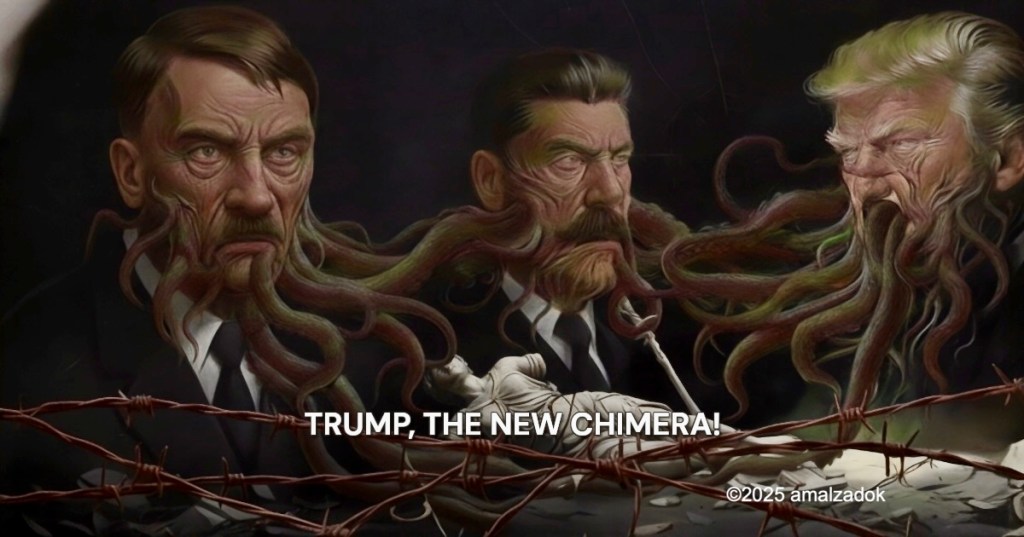
    The horror of the current moment is not that America has become identical to Nazi Germany or Stalin’s Soviet Union; it is that it is mutating into a hybrid that borrows the worst tools of both. From Nazism, Trump borrows the cult of the leader whose “moral sense” legitimatizes everything, the theater of strength, the glorification of “law and order” as a shield for state brutality. From Stalinism, he borrows the idea that internal enemies lurk everywhere, that entire communities (immigrants, protesters, “anarchists,” “terror sympathizers”) are fair game for sweeping repression. 

    When federal agents can snatch people off streets, deploy to cities over local opposition, and now kill a mother in her car under the banner of immigration enforcement, the line between democracy and dictatorship is not “eroding.” It is being redrawn in blood. When a president announces that courts, laws and treaties are lower‑tier obstacles compared to his “own mind,” he is not defending America from enemies; he is positioning himself as the only real branch of government that matters. 

    This is how hybrid tyrannies work. Elections still occur, some courts still function, newspapers still print—but the security services learn that their real loyalty is owed upward, not outward. The constitution becomes a script for public ceremonies, while the real constitution is whatever the leader and his loyalists can get away with. 

    The conscience that kills

    Trump insists he is “not looking to hurt people,” even as he lists lethal operations as achievements, even as his policies unleash missiles abroad and militarized raids at home. His “own morality” apparently allows for the bombing of foreign soil without authorization, the kidnapping or coercion of foreign leaders, the tearing up of refugee protections, and now a domestic climate in which federal officers gun down a woman in Minneapolis and are treated as heroes in waiting. 

    There is a cruel symmetry here. Abroad, he claims the right to ignore international law in the name of “national strength.” At home, his security forces act as if ordinary Americans are foreign subjects in a pacification campaign. The shared logic is simple: the people at the receiving end of American power—Venezuelan civilians, Iranian technicians, migrants at the border, a mother in a Minneapolis sedan—do not matter as rights‑bearing human beings. They matter only as problems for the leader’s will to solve. 

    When a man with this worldview sits in the Oval Office and tells a major newspaper that only his conscience can stop him, the world should stop pretending this is normal politics. This is not conservatism, populism, or even crude nationalism. It is the theology of the police state: one man’s inner voice elevated above constitutions, courts, treaties, and the screams from the street where Renee Nicole Good died. 

    An ultimatum to real patriots

    So the question is no longer what Trump will do next; the question is what Americans are going to do about an America that the Founders would not recognize. A republic whose president claims to stand above law and whose federal agents kill unarmed citizens in the name of “order” is not the republic Madison and Hamilton were arguing for; it is the nightmare they wrote the Constitution to prevent. 

    The Constitution does not ask “real patriots” to clap for strongmen; it demands that they use every peaceful tool it provides—speech, press, assembly, petitions, jury service, litigation, elections, impeachment, and relentless oversight—to drag power back under law. It calls legislators to defund and dismantle rogue operations, judges to enforce rights without fear, civil servants to refuse illegal orders, and ordinary citizens to organize, vote, strike, and resist until no man’s “own morality” can ever again stand in for the rule of law. If Americans will not use those tools now, when a mother lies dead in Minneapolis and a president boasts that only his conscience can stop him, then the Constitution will become nothing more than an antique in a glass case—and the hybrid monster of Nazism and Stalinism will finish the work it has already begun. 

    References 

    1.The New York Times. (2026, January 8). Trump addresses Venezuela, Greenland and presidential power in wide‑ranging interview. https://www.nytimes.com/2026/01/08/us/politics/trump-interview-power-morality.htm

    2.The New York Times. (2026, January 8). Trump said his global power was limited only by his ‘own morality’. https://www.nytimes.com/2026/01/08/briefing/trump-interview-oval-office-apple-ceo.html

    3.Bluewin. (2026, January 9). USA: Trump: Only my sense of morality can hold me back. https://www.bluewin.ch/en/news/international/trump-only-my-sense-of-morality-can-hold-me-back-3041854.html

    4.Moneycontrol. (2026, January 8). ‘Only my morality can stop me’: Trump claims sweeping war powers, shrugs off international law. https://www.moneycontrol.com/world/only-my-morality-can-stop-me-trump-claims-sweeping-war-powers-says-he-doesn-t-need-internatio-article-12812335.html

    5.Financial Express. (2026, January 8). ‘I don’t need international law’: Trump says only his own morality limits his global power. https://www.financialexpress.com/world-news/us-news/only-one-thing-can-stop-me-trump-says-he-dont-need-international-law-boasts-12812091/

    6.World Socialist Web Site. (2026, January 8). Declaring ‘I don’t need international law,’ Trump moves to assert unlimited warmaking powers. https://www.wsws.org/en/articles/2026/01/09/qyot-j09.html

    7.Al Jazeera. (2026, January 8). FBI takes over investigation into ICE agent killing of woman in Minneapolis. https://www.aljazeera.com/news/2026/1/8/fbi-takes-over-investigation-into-ice-agent-killing-of-woman-in-minneapolis

    8.ABC News (Australia). (2026, January 7). What led to an ICE agent fatally shooting a public observer in Minneapolis? https://www.abc.net.au/news/2026-01-08/ice-shooting-minneapolis-minnesota-immigration-crackdown/106209128

    9.NBC News. (2026, January 7). Renee Nicole Good, woman shot by ICE officer, was out ‘caring for her neighbors’. https://www.nbcnews.com/news/us-news/renee-nicole-good-minneapolis-ice-shooting-victim-caring-neighbor-rcna252901

    10.Colorado Public Radio. (2026, January 7). Woman killed by ICE in Minneapolis originally from Colorado. https://www.cpr.org/2026/01/07/fatal-minneapolis-ice-shooting-colorado-woman/

    11.CNN. (2026, January 8). ICE officer who shot woman in Minneapolis was dragged by a car in 2025, video shows. https://www.cnn.com/2026/01/08/us/ice-agent-minneapolis-shooting-car-dragged-invs

    12.NBC News. (2026, January 8). ICE officer who fatally shot Minnesota woman was dragged by a car during a prior enforcement stop. https://www.nbcnews.com/news/us-news/ice-officer-fatally-shot-minnesota-woman-was-dragged-car-june-immigrat-rcna252992

    13.City of Minneapolis. (2026, January 6). Minneapolis responds to fatal shooting of woman by federal agent. https://www.minneapolismn.gov/news/2026/january/fatal-shooting-response/

    14.PBS NewsHour. (2026, January 8). Woman killed by ICE agent was mother of 3, poet and new to Minneapolis. https://www.pbs.org/newshour/nation/woman-killed-by-ice-agent-was-mother-of-3-poet-and-new-to-minneapolis

    ©️2026 Amal Zadok. All rights reserved.

    Subscribe and never miss an article!
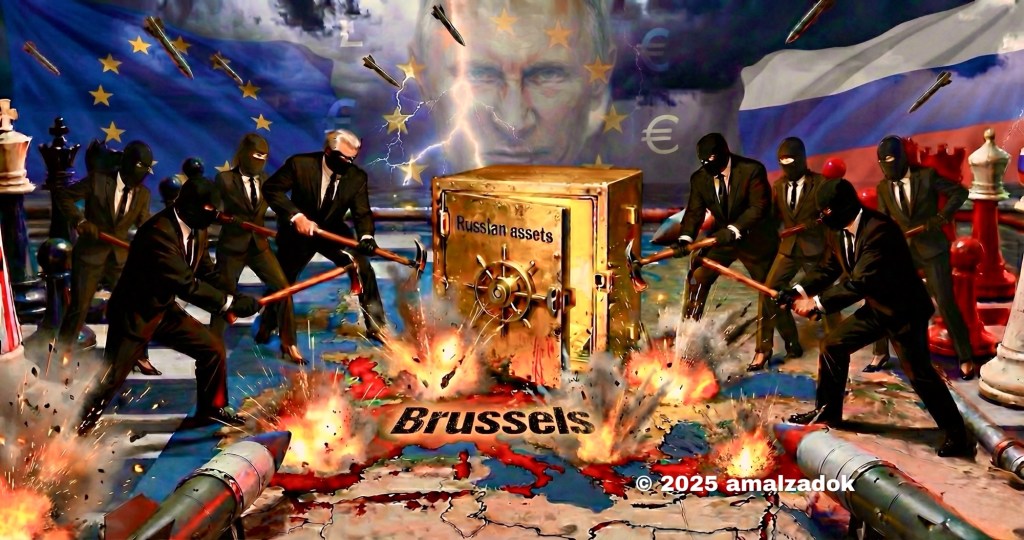
  • Europe’s Last Heist: From Rule of Law to Robbery in a De Facto Declaration of Financial War on Russia

    Europe’s Last Heist: From Rule of Law to Robbery in a De Facto Declaration of Financial War on Russia

    by Amal Zadok

    Europe’s decision to seize and weaponise frozen Russian state assets marks a dangerous escalation: a last tantrum of a decadent elite that prefers to gamble with international law and Europe’s own future rather than accept strategic defeat and negotiate peace. Presenting this as “justice” or “reparations for Ukraine” hides a more prosaic reality: the European gangster wants those billions to plug fiscal holes, prop up a failing war effort, and delay the reckoning with its own political and economic suicide.

    The gangster move: stealing the frozen billions

    The plan to strip Russia of hundreds of billions in frozen reserves is the logical culmination of a policy that has already burned Europe’s cheap energy, industrial base, and social model on the altar of war. After sacrificing affordable Russian gas and triggering deindustrialisation and inflation, EU elites now eye Moscow’s confiscated assets as a new “magic fund” to sustain a war they cannot win and a fiscal model they can no longer finance from a shrinking tax base.

    This is framed as moral duty—“Russia must pay”—but the context betrays the real motive. Europe has already diverted enormous sums of public money to arm Kyiv while hospitals close, schools crumble, and poverty indices climb; the assets grab offers a way to extend this war spending without openly telling citizens they will lose even more welfare and rights. The political clica wants to swap domestic social anger for geopolitical banditry, trading bread and pensions for a one‑off financial heist.

    Belgium: pressure on the weak link

    Belgium sits at the centre of this scheme because Euroclear holds a massive chunk of the immobilised Russian reserves, turning Brussels into the vault the clica now wants to crack open. The same Europe that chants about “rule of law” is pressuring a small member state to accept a precedent that would have been unthinkable even at the height of the Cold War: openly confiscating another state’s reserves not as part of a peace settlement, but to keep shovelling weapons into an open‑ended proxy war.

    This pressure takes several forms.

    •Legal sophistry: relabelling seizure as “windfall profits,” “guarantees,” or “collateral,” while the substance is still the same—appropriating Russian wealth to fund war.

    •Political blackmail: warning Belgium that refusing the scheme would mean “abandoning Ukraine” or undermining European unity, turning a technical custody issue into a loyalty test.

    •Financial intimidation: hinting that Belgium’s role as a Euroclear hub could be questioned if it does not align with Washington and Brussels’ strategy.

    If Belgium capitulates, the message to the world is simple: deposits and reserves in Europe are safe only until the next geopolitical hysteria.

    Repercussions from Russia: from retaliation to systemic fracture

    For Russia, this move crosses a line between sanctions and outright theft. Moscow will not respond only with diplomatic protests; it has tools—economic, legal, and strategic—that will turn this European tantrum into a long‑term blowback.

    Likely responses include:

    •Legal counter‑claims and mirror seizures: Russia can expropriate European assets on its territory, nullify Western intellectual property, and seize physical infrastructure and investments as “compensation.”

    •Deepened de‑dollarisation and de‑euroisation: the signal to the Global South is devastating—Western currencies and jurisdictions are now weaponised, not neutral. This accelerates the creation of alternative payment systems, BRICS mechanisms, and commodity‑based settlement that permanently erode Europe’s financial relevance.

    •Strategic hardening: confiscation removes incentives for compromise. If Russia knows its reserves are gone for good, it has fewer reasons to agree to any settlement framed on Western terms, entrenching a cold war that Europe is far less equipped to sustain than Washington.

    In short, the “free money” Europe hopes to extract from Russian reserves will be repaid with isolation from emerging financial architectures, lost markets, and a Russia firmly anchored in a non‑Western bloc that no longer trusts European signatures or banks.

    Europe’s attempt to formalise this confiscation also carries the logic and symbolism of a declaration of war, even if it hides behind legal euphemisms and technocratic language. 

    Treating the central bank reserves of a nuclear‑armed state as spoils to be carved up for weapons and reconstruction funds signals that the EU no longer recognises Russia as a legitimate counterpart in the international system, but as a defeated enemy to be looted.

    In strategic terms, this is indistinguishable from economic total war, because it erases the boundary between temporary sanctions and permanent dispossession.

    Such a move hardens threat perceptions in Moscow to an unprecedented degree, reinforcing the narrative that the West seeks not negotiation or “behaviour change” but Russia’s strategic humiliation and eventual fragmentation. 

    If Russian leaders conclude that no future compromise can restore their assets, security, or status, they are incentivised to escalate horizontally—cyber, space, infrastructure, and asymmetric responses—rather than de‑escalate. 

    What Europe reads as financial cleverness, Russia reads as confirmation that the conflict is existential and must be met with long‑term, system‑level counter‑measures.

    By crossing this Rubicon, Europe not only undermines its own legal foundations but also normalises the idea that financial warfare can be escalated indefinitely without triggering wider conflict—a dangerous illusion. 

    Once the taboo on sovereign asset seizure is broken, every further crisis will tempt policymakers to “solve” political problems with new expropriations, pushing great‑power relations ever closer to open confrontation. 

    In this sense, the theft of Russian reserves is not just a tantrum; it is the codification of permanent economic war and, in substance, a de facto declaration of war against Russia, with all the risks of miscalculation, retaliation, and eventual military escalation that such a doctrine entails.

    The internal cost: Europe against its own citizens

    The gangster heist is not just an act against Russia; it is an act against Europeans themselves. By normalising confiscation of sovereign assets and emergency war financing, the same political clica also normalises permanent emergency at home—more censorship, less judicial independence, more police, and fewer social rights.

    The trajectory is already visible:

    •Sanctions and energy rupture triggered deindustrialisation, capital flight, and a collapse of the tax base that once funded Europe’s welfare states.

    •The Ukraine war became the justification to divert billions from schools, hospitals, and pensions into weapons, while dissenters were smeared as traitors or agents of Moscow.

    •Digital censorship regimes, “disinformation” laws, and emergency decrees hollowed out democratic debate and press freedom, recreating a digitalised version of Soviet‑style control.

    Using Russian money to keep this machinery going compounds the moral and legal rot. It signals that the war economy and repression must continue at any cost, because the elites have staked not just political capital but now the credibility of the entire European financial system on a conflict that has no realistic path to victory.

    Europe’s strategic suicide: from unipolar denial to open piracy

    Confiscating Russian reserves is also a symptom of a deeper pathology: Europe’s refusal to accept a multipolar world and its subservience to US strategic dictates. Instead of adapting to a reality where Russia, China, and the Global South cannot be coerced into obedience, Europe doubles down on unipolar fantasies—NATO expansion, economic warfare, ideological crusades—and then, when the costs become unbearable, resorts to financial piracy to prolong the illusion.

    The long‑term consequences are stark:

    •Trust collapse: states that watched Libya’s reserves frozen and now see Russia’s formally confiscated will regard Western custody as a trap, not a service.

    •Loss of strategic autonomy: as Europe burns bridges to Eurasia, it locks itself into dependency on American energy, arms, and financial architecture, becoming a semi‑sovereign periphery of Washington’s empire.

    •Civilisational hollowing: the moral language of “rule of law,” “human rights,” and “democracy” becomes empty when the EU behaves like a cartel seizing assets to fund a proxy war, censors opposition, and militarises public life.

    The irony is cruel: in the name of defending “European values” against Moscow, Europe is dismantling its welfare state, civil liberties, and credibility as a legal and financial safe haven.

    Beyond the tantrum: the fork in the road

    This last tantrum—the attempt to steal Russia’s frozen billions—is not a sign of strength but of exhaustion. It reveals elites trapped between a failed war strategy, a collapsing social contract, and a world that no longer tolerates Western impunity.

    Europe now stands at a precipice where one decision can still change its fate: either reclaim the primacy of bread over bombs, law over looting, and peace over permanent mobilisation, or accept its mutation into a garrisoned, obedient frontier of a fading empire. 

    If the frozen Russian billions are finally cracked open to feed the war machine, that act will not be a clever financial manoeuvre but the moment Europe openly chooses vassalage over sovereignty and plunder over principle. 

    On that day, historians will not write that Europe defended its values; they will record that, for the price of one last stolen jackpot, a civilisation signed away its soul and marked, in its own hand, the date of its final moral and strategic surrender.

    References

    1.European Parliamentary Research Service. (2025, November 27). EU sanctions and Russia’s frozen assets (Study EXPO_STU(2025)754487). European Parliament.

    2.European Parliamentary Research Service. (2025, September 7). Confiscation of immobilised Russian sovereign assets: State of play, arguments and scenarios (Briefing EPRS_BRI(2025)775908). European Parliament.

    3.European Parliamentary Research Service. (2025, June 30). Immobilised Russian central bank assets (At a glance EPRS_ATA(2025)769514). European Parliament.

    4.Reuters. (2025, December 2). EU proposes using frozen Russian assets or borrowing to raise €90 billion for Ukraine.

    5.Australian Broadcasting Corporation. (2025, December 3). EU proposes using frozen Russian assets as reparations loans for Ukraine.

    6.Verfassungsblog. (2025, April 3). Frozen Russian state assets. Verfassungsblog on Constitutional Matters.

    7.Council on Foreign Relations. (2025, November 19). How to use Russia’s frozen assets.

    8.Reuters. (2025, December 3). Russia mocks EU deliberations on frozen assets, says seizure will prompt “harshest response”.

    9.CNBC. (2025, December 4). Russia: Europe’s use of frozen assets could be justification for war.

    10.Investing.com. (2025, December 4). Russia warns EU of “harsh response” over potential asset freezes.

    11.Reuters. (2025, December 1). Top Russian banker says EU faces 50 years of litigation if it takes Russia’s frozen assets.

    12.Big Europe. (2025, November 12). The poisoned chalice of Russia’s frozen assets.

    13.Geopolitique.eu. (2023, February 22). Sanction. Confiscate. Compensate. How Russian money can be repurposed as reparations for Ukrainian victims.

    14.Al Jazeera. (2025, December 2). Europe should seize Russia’s frozen assets now.

    15.Reuters. (2025, October 2). How Europe wants to unlock Russia’s frozen cash for Ukraine.

    16.CEPR. (2025, March). Seizing central bank assets?

    ©️2025 Amal Zadok. All rights reserved.

    Subscribe and never miss an article!