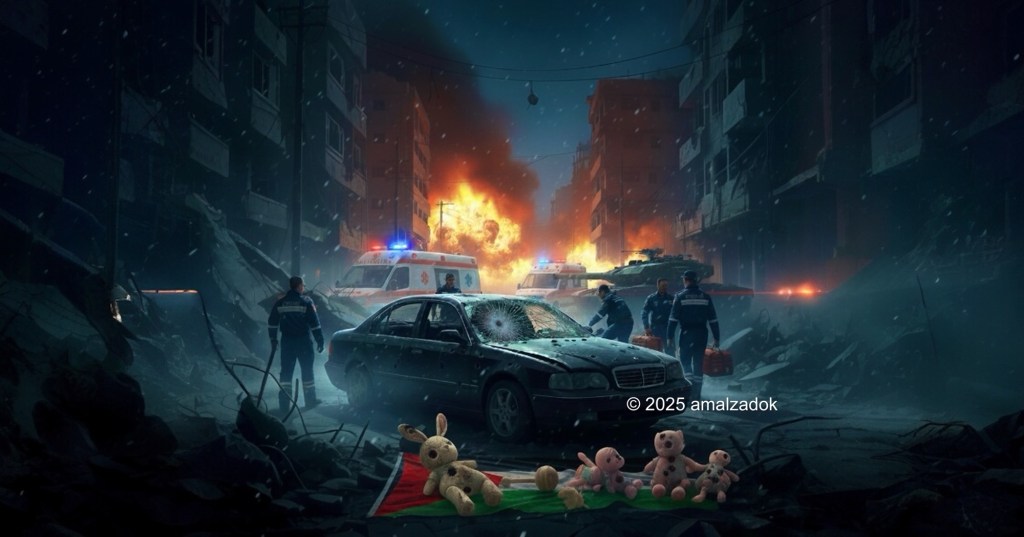
by Amal Zadok
On January 29, 2024, five-year-old Hind Rajab and six family members attempted to flee the Tel al-Hawa neighborhood in Gaza City after Israeli forces ordered residents to evacuate. Their route was blocked by the rubble of bombardment, forcing them to seek another way. Driving north, their black Kia was suddenly attacked by an Israeli tank at close range. Hind’s aunt, uncle, and cousins were killed instantly, and only Hind and her 15-year-old cousin, Layan Hamada, survived the first bursts of fire.
Layan managed to call the Palestine Red Crescent Society (PRCS) while the tank approached. Crying into the phone, she reported, “They are shooting at us. The tank is right next to me. We’re in the car, the tank is right next to us.” Machine-gun fire and Layan’s screams sounded as the call abruptly ended with her death. When the dispatchers called again, Hind answered, terrified, wounded, and alone amid the bodies of her family.
For three hours, she pleaded, “I’m so scared, please come. Please, will you come?” She waited while the tank remained nearby, and rescuers coordinated with the occupying military for permission to send help.
Despite the agony broadcast in her voice, official rescue permission was delayed. Eventually, two PRCS paramedics, Yusuf al-Zeino and Ahmed al-Madhoun, were dispatched in an ambulance and approached the scene. Their last communication reported seeing the car; then an explosion and gunfire ended their mission. They, too, were killed.
It took nearly two weeks before the Israeli withdrawal allowed families back into the area. Hind, her relatives, and both paramedics were found dead. The black Kia was riddled with 335 bullets, the ambulance destroyed a few meters away, and all the bodies showed signs of deliberate, close-range fire.
Forensic investigations, satellite imagery, and media analysis confirmed that Israeli tanks, only meters from the car, had a clear and unobstructed view of the children inside before firing. Nothing indicated confusion or “accident”—it was a direct, overwhelming attack.
The killing of Hind Rajab quickly became an emblem of unpunished brutality. The Israeli army denied responsibility and claimed no troops were present; but independent investigations—including those by The Washington Post, Sky News, and Forensic Architecture—proved that tanks were there, attacking both the car and the ambulance, and that those responsible could clearly see their victims were civilians, including children.
International bodies, human rights organizations, and experts declared the incident a war crime. Despite the evidence and the global outrage, no Israeli soldier or commander was held accountable, and the U.S. government—under President Donald Trump—continued military support, waiting for internal investigations that never condemned the killings.
Hind’s voice pleading for help and the horror of 335 bullets fired into a car full of children testify to the normalization of killing and the collapse of justice in Gaza. Her name became a rallying cry for those demanding an end to impunity and a reckoning for crimes against the innocent.
Hind Rajab’s tragedy poses a question to all in positions of power: When will you demand real justice for Hind and her family? How many more children must die before silence and complicity end? The cost of forgetting is complicity. The world cannot turn away.
©️2025 Amal Zadok. All rights reserved.
Subscribe and never miss an article!
 Think and be Free!