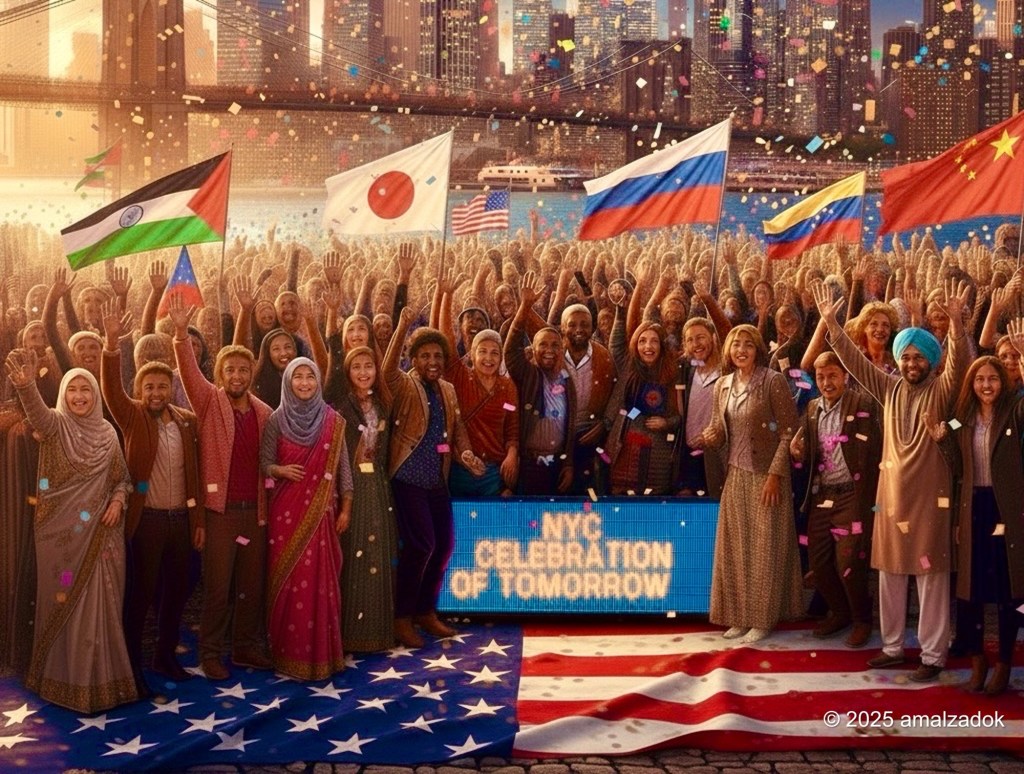
by Amal Zadok
A profound change is sweeping across the landscape of American politics—one that signals both the growing empowerment of Muslim candidates and a reckoning for the immense influence held by pro-Israel lobbying organizations, most notably the American Israel Public Affairs Committee (AIPAC).
In the embers of the Gaza crisis and amidst the cries for justice echoed on the streets from Detroit to Dallas, more U.S. voters are decisively steering away from politicians known for their unwavering fealty to the Zionist project. This rising wave of consciousness among the American electorate is shattering decades-old political dogmas, elevating new voices, and sending a stark message to those whose loyalty lies outside the boundaries of national interest and human decency.
The coming-of-age for Muslim candidates in the United States is not merely a statistical uptick on electoral rolls; it marks a tectonic shift in the public’s willingness to challenge the status quo. What began as scattered efforts in local elections has erupted into a potent movement for genuine representation—one that is unafraid to confront Washington’s hitherto unassailable orthodoxy on Israel.
In a year marred by the carnage in Gaza and punctuated by the chilling images of Palestinian suffering, the corrupt bargain that has so long bound U.S. politicians to pro-Israel interests is being aired and assailed in the public square like never before.
The magnitude of this shift became unmistakable with the election of Zohran Mamdani as New York’s first Muslim mayor. “New York will remain a city of immigrants, built by immigrants, powered by immigrants and, as of tonight, led by an immigrant,” proclaimed Mamdani to an electrified crowd of supporters on election night.
His ascent was not symbolic alone; it was built on tireless grassroots campaigning that brought together working-class, immigrant, and young voters, including first-time Muslim voters whose “story mirrors many of our own,” as voter Minata Lolo told The New York Times. “He is demonstrating we belong in every space, that our stories and values hold significance in shaping the future of the city.” At his campaign’s heart were concrete policies about affordability and equity—universal childcare, a rent freeze, and free public transit—echoing the lived realities of his diverse electorate and uniting communities who had once felt invisible or marginalized.
America’s youth, especially those galvanized by the Black Lives Matter movement and inspired by the cross-pollination of struggles from Ferguson to Sheikh Jarrah, are leading the charge.
This shift has also found momentum among dissatisfied MAGA voters who feel betrayed by Donald Trump’s handling of the Jeffrey Epstein case, frustrated by his administration’s choice to withhold key documents after early promises of transparency.
Large segments of Trump’s base, once fervently loyal, have erupted in outrage over the Justice Department’s memo absolving Epstein and over perceived cover-ups, demanding accountability and feeling let down by his lack of action on what became a central grassroots priority.
Alongside this, anger simmers over Trump’s failure to deliver on his pledge to withdraw U.S. military involvement from the Ukraine conflict, as well as sabre-rattling and belligerent rhetoric in foreign policy that has left many original MAGA supporters disillusioned.
These broken promises and political disappointments have fractured the president’s traditional coalition, fueling a wider rejection of establishment narratives and contributing powerfully to the tectonic shift now underway in the broader American electorate.
They are joined by faith leaders, union organizers, Jewish progressives fed up with “Israel right or wrong” apologetics, and a uniquely diverse coalition that has dramatically altered the terms of debate. For the first time in modern history, it is possible for candidates to run—and win—while loudly denouncing Israeli apartheid, the siege of Gaza, and the very machinery of repression AIPAC so zealously defends.
This change did not emerge in isolation. The carnage in Gaza, exacerbated by the relentless campaigns of Benjamin Netanyahu—rightly known by the majority of the world as the “Butcher of Gaza”—has served as a moral crucible for Americans of all backgrounds. With social media democratizing access to raw footage and unfiltered narratives from the streets of Khan Younis and Gaza City, the reality of Palestinian suffering could no longer be concealed by tired talking points or mainstream media euphemisms.
For the first time, a critical mass of American citizens now link the trillions spent by their government—and the political capital expended by their elected officials—to the lived horrors endured by innocent Palestinians under occupation.
Few institutions embody the establishment’s determination to maintain the status quo more than AIPAC. Boasting deep pockets, legendary organizational discipline, and a history of making or breaking congressional careers, AIPAC has been the architect of an era in which questioning U.S. support for Israel was treated as political suicide. Its infamous scorecards, aggressive primary challenges, and lavish campaign contributions have fostered a climate of fear and compliance among both seasoned incumbents and rising stars alike.
But the moment of reckoning has arrived. This year, multiple Muslim and progressive candidates posted historic victories in districts once considered safe havens for the “AIPAC class”—those whose rhetorical pirouettes often prioritized Tel Aviv’s priorities over their own constituents’ needs.
In Virginia, Ghazala Hashmi became the first Muslim woman elected to statewide office, running on a platform of fighting bigotry “and the ‘chaos’ of division,” which she credits to her community’s grassroots organizing. “Over the past 25 years, we have forged a strong coalition that includes our Jewish communities and encompasses Asian, Latino, and Black communities. We can assert that we are above this and will support one another,” said New York City Councilwoman Shahana Hanif, herself a re-elected Brooklyn Muslim progressive advocating strongly for Palestinian rights.
The desperation of Zionist stalwarts like Mark Levin, Senator Ted Cruz, and Congressman Randy Fine has become palpable—their performative outrage on cable news and social media now resembling the death throes of an ideology rapidly losing moral legitimacy.
Their attacks have grown ever more hysterical and unhinged, wielding the accusations of antisemitism with reckless abandon, and peddling conspiracy theories about “foreign agents” and “Islamic infiltration.” Yet, these tactics only underscore their impotence in the face of a public no longer cowed into silence.
Central to this transformation is the growing understanding that support for the Israeli government is not, and never has been, synonymous with support for the Jewish people—a distinction that is finally being made clear in the American mind.
A generation of young Jews—many horrified by the violence meted out in their name—have joined the chorus demanding accountability for Israel’s actions. Organizations like Jewish Voice for Peace and IfNotNow are shaping an alternative narrative, drawing lines between solidarity with Jews and complicity with apartheid, occupation, and ethnic cleansing. This development further isolates AIPAC, whose “pro-Israel” stance now appears brittle, archaic, and profoundly out of step with the moral arc of the country.
What makes the current political moment so volatile—and so pregnant with possibility—is that the electorate’s awakening is not confined to Muslim Americans or to progressives alone. A broad cross-section of voters, from war-weary veterans to suburban soccer moms, now recognize the cruel cost of Washington’s blank-check policy toward Israel.
They have come to see the billions in military aid—sent with no conditions, oversight, or accountability—not only as an affront to American values, but also as a betrayal of economic justice at home. In the wake of spiraling healthcare costs, crumbling infrastructure, and unmet social needs, the manufactured consensus around “shared values” with Israel rings increasingly hollow.
Poll after poll affirms what was once considered unthinkable: a strong plurality of Americans now support a ceasefire in Gaza and direct measures to curb U.S. military assistance to Israel. The panic gripping AIPAC and its congressional loyalists betrays a fundamental truth—once a mythic force capable of shaping elections with a single press release, their influence is now subject to the unpredictable, dynamic forces of genuine democracy.
The road ahead is uncharted and rife with challenges. Despite high-profile victories, the obstacles faced by Muslim and anti-AIPAC candidates are daunting—smear campaigns, relentless Islamophobia, and the far-reaching tentacles of the lobbying establishment are formidable foes.
Yet, for all the money funneled into negative ads and astroturfed outrage campaigns, it is stories—the real, lived experiences of Americans and Palestinians alike—that are turning the tide. Hanif, the Brooklyn Councilwoman, emphasized, “Islamophobic statements should be condemned across the political spectrum, highlighting the ongoing need to combat racism in the United States.” Her sentiment echoes throughout the grassroots.
The suffering in Gaza, beamed nightly into American living rooms, has pierced the veil of ignorance and indifference. The images of bombed-out hospitals and grieving mothers have rendered empty the old platitudes about “self-defense.” Young voters, in particular, view the complicity of elected officials not as distant geopolitics, but as a searing moral issue woven into the fabric of what it means to be American.
Their votes increasingly reflect a determination to break free from the grip of lobbies that would make them complicit in injustice abroad and neglect at home.
It is fitting, then, that this moment of American political reawakening is animated by Muslim candidates—many of whom bear the scars of war, displacement, and discrimination, yet who offer a vision of America reconciled with its own best ideals.
Their meteoric rise and forthright speech are elevating congressional debate, inspiring grassroots activism, and—perhaps most importantly—forcing a reckoning with uncomfortable truths.
Each victory declares that the era of uncritical, unconditional support for Israel is fading, and that the time for authentic, human-centered policy is at hand.
The struggle is hardly over. The forces that have so long dictated Middle East policy in Washington are not planning a quiet resignation.
If anything, their escalated rhetoric and heedless accusations signal open war on the future.
But the die is cast—a powerful new contingent in American politics stands ready, not merely to contest elections, but to reclaim the very soul of the nation.
In doing so, they are helping restore the power and dignity of the immigrant vote, renewing a broader sense of justice and inclusion, and forging unity across racial, ethnic, and cultural lines to halt the nation-breaking divisions that have threatened all American communities—including white Americans.
This movement points the way toward a future where the country draws strength from its diversity and recommits to true justice for every citizen.
References
1. AIPAC and Its Influence on Congress. (2025). The Center for Responsive Politics. https://www.opensecrets.org/news/reports/aipac-influence
2. “Muslim candidates post historic wins as voters demand change.” The Guardian. (2025). https://www.theguardian.com/us-news/2025/nov/01/muslim-candidates-election-wins-israel
3. Jewish Voice for Peace – “Change in American Jewish perspective on Israel.” (2025). https://www.jewishvoiceforpeace.org/resources/us-jewish-public-opinion/
4. Poll: Most Americans Support Ceasefire in Gaza. (2025). Pew Research Center. https://www.pewresearch.org/politics/2025/10/24/americans-support-gaza-ceasefire/
5. “Social Media and the Gaza Narrative Shift.” Middle East Eye. (2025). https://www.middleeasteye.net/news/us-public-opinion-shifts-israel-gaza
6. IfNotNow – On the changing role of American Jews. (2025). https://ifnotnowmovement.org/news/change-in-jewish-public-opinion-israel
7. Black Lives Matter and Palestinian Solidarity. (2025). Al Jazeera. https://www.aljazeera.com/features/2025/10/28/black-lives-matter-palestinian-solidarity
8. “AIPAC’s electoral strategies falter amid Israel controversy.” Politico. (2025). https://www.politico.com/news/2025/10/25/aipac-influence-midterms-israel-000000
9. New York Muslims Exult in Mamdani’s Victory. (2025). The New York Times. https://www.nytimes.com/2025/11/05/us/muslim-new-yorkers-mamdani.html
10. Mamdani makes history as New York City’s first Muslim mayor. (2025). DW News. https://www.dw.com/en/mamdani-makes-history-as-new-york-citys-first-muslim-mayor/video-74635514
11. Virginia makes history with first Muslim woman elected to statewide office. (2025). 19th News. https://19thnews.org/2025/11/virginia-ghazala-hashmi-muslim-woman-statewide-office/
12. Young, Muslim, Asian and Socialist: Zohran Mamdani’s New York Win. (2025). Asia News Network. https://asianews.network/young-muslim-asian-and-socialist-zohran-mamdanis-new-york-win-challenges-both-trump-and-democrats/
13. Mamdani supporters see an opening for more hopeful politics in his win. (2025). NPR. https://www.npr.org/2025/11/05/nx-s1-5578014/mamdani-supporters-see-an-opening-for-more-hopeful-politics-in-his-win
14. Muslim, South Asian Americans emerge as decisive force in U.S. elections. (2025). Muslim Network TV. https://www.muslimnetwork.tv/muslim-south-asian-americans-emerge-as-decisive-force-in-u-s-elections/
15. Mamdani’s New York victory sparks Islamophobic backlash in US. (2025). Al Jazeera. https://www.aljazeera.com/news/2025/6/30/mamdanis-new-york-victory-sparks-islamophobic-backlash-in-us
16. Trump faces backlash as 69% believe Epstein details concealed. (2025). Reuters. https://www.reuters.com/world/us/trump-faces-backlash-69-believe-epstein-details-concealed-reutersipsos-poll-2025-07-17/
17. Trump supporters angry over Justice Department’s Epstein memo. (2025). ABC News. https://abcnews.go.com/Politics/trump-supporters-angry-justice-departments-epstein-memo/story?id=123567461
©️2025 Amal Zadok. All rights reserved.
Subscribe and never miss an article!
 Think and be Free!