Tag: nato

  • Tear Down This Union: How Ursula von der Leyen Turned Europe Into a Gilded Prison

    Tear Down This Union: How Ursula von der Leyen Turned Europe Into a Gilded Prison

    by Amal Zadok

    Kornelia Kirchweger: ‘The EU must disappear. Over the years, through treaties and crises, the EU has acquired an occupying power over Europe and, in my opinion, it occupies this continent in a brutal and authoritarian way, suffocating cultures, freedom, freedom of expression and leading this continent precisely to the place from which the EU claimed it would rescue it: out from under the rubble of war – and precisely back there is where the EU is dragging Europe once again. And this EU must disappear. The EU must disappear. The EU has entrenched itself over the years, through treaties and crises.’”

    Kornelia Kirchweger says out loud what millions of Europeans only dare to mutter at their kitchen tables: the European Union does not “unite” Europe; it occupies it. The smiling blue flag with its neat golden stars has become the banner of a new empire that does not need tanks or barbed wire to crush nations, because it rules instead through debt, digital surveillance, and an ideology that brands dissent as heresy. Her demand that “the EU must disappear” is not a theatrical provocation; it is a necessary act of European self‑defence.

    The EU was sold as a guarantee of “never again”—never again war, never again authoritarianism, never again the trampling of peoples by distant, unaccountable power. Yet what exists in Brussels now is precisely a distant, unaccountable power that blackmails elected governments, dictates economic policy, and polices speech under the holy trinity of “security, safety, and stability.” The continent that once produced revolutions against divine‑right kings now applauds as faceless commissioners and central bankers issue decrees that bind hundreds of millions who never voted for them. This is not cooperation; it is vassalage dressed as progress—the “occupying power” over Europe that Kornelia names with surgical precision.

    Kornelia identifies the method: treaties and crises. Each crisis—financial, health, geopolitical—has been seized as a pretext to centralise more control in Brussels and Frankfurt, tying national budgets and laws to institutions that answer to no electorate. Treaties once presented as tools of peace have hardened into chains. Opt‑outs vanish, “temporary” emergency measures become permanent, and referenda that deliver the “wrong” answer are ignored or re‑run until obedience is achieved. Consent, the heart of any genuine democracy, has been replaced by weary resignation. When Kornelia says the EU has “entrenched itself,” she is simply describing how the coup by paperwork has already taken place.

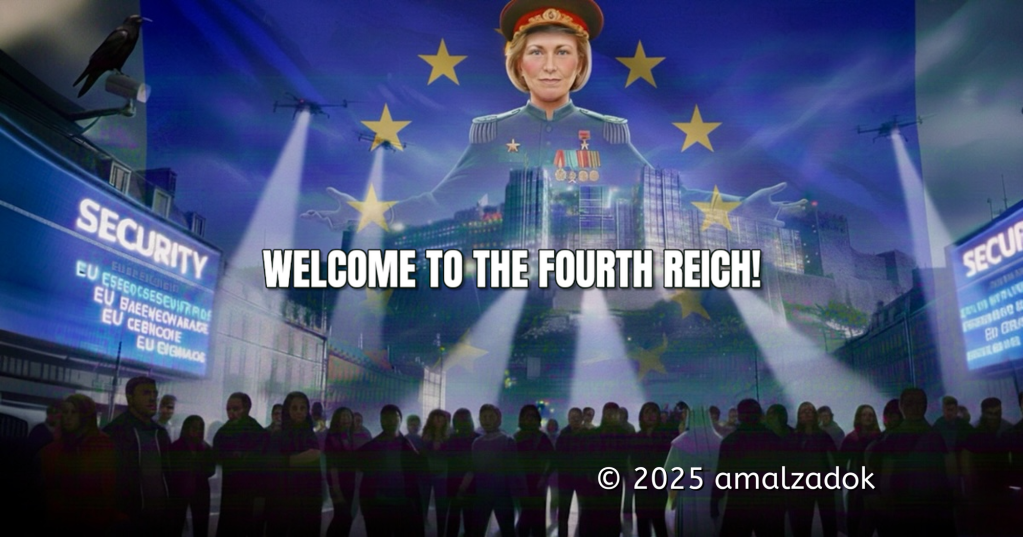
    At the centre of this drift stands Ursula von der Leyen, the unelected queen of an empire that pretends not to be one. She has mastered the art of ruling by permanent emergency, using the pandemic, the Ukraine war, and now “information warfare” as pretexts to bypass member states, concentrate power in the Commission, and present herself as indispensable commander of Europe’s “permacrisis.” Her Commission has become a quasi‑dictatorial sovereign, a machine that treats national parliaments as rubber stamps and voters as an obstacle to be managed. If the EU is the occupying force over Europe, von der Leyen is its soft‑Stalinist party secretary: unelected, unremovable, and convinced that history runs through her desk.

    What makes von der Leyen’s rule particularly dangerous is the fusion of moralism and soft Stalinism. She divides politics into loyal comrades of “European values” and enemies labelled “Russian puppets,” “extremists,” or “threats to democracy,” echoing the old tactic of branding opponents as agents of foreign powers. Sanctions lists are drafted behind closed doors, freezing assets and destroying reputations without meaningful due process, while she lectures the continent about the rule of law. This is not justice; it is a bureaucratic blacklist system worthy of Stalin’s clerks, updated with IBAN numbers and SWIFT codes. Kornelia’s phrase “brutal and authoritarian occupation” finds a face and a signature here.

    The regime’s poison lies in its moral camouflage. Brussels speaks the language of human rights while cutting off oxygen to any culture that resists its dogmas. National identities are tolerated as folkloric decoration, provided they never obstruct the homogenous “European way of life” defined by unelected ideologues. The EU preaches diversity but practises uniformity: uniform currency, uniform rules, uniform narratives. A Polish farmer, an Italian nurse, a Greek dock worker are treated not as citizens of concrete communities, but as variables in a spreadsheet to be adjusted for “convergence.” 

    This is the suffocation of cultures that Kornelia denounces—accomplished not with bayonets, but with compliance reports.

    Her accusation that the EU asphyxiates freedom of expression cuts to the bone. In the name of fighting “disinformation,” Brussels under von der Leyen has constructed a censorship architecture more efficient than anything the old dictatorships could dream of. The Digital Services Act and its siblings give Eurocrats leverage to pressure platforms into shadow‑banning, de‑monetising, or deleting voices that question official narratives on war, migration, public health, or the sanctity of EU institutions. No show trials are needed when a single email can erase a journalist, scholar, or priest from public visibility at the speed of an algorithmic tweak.

    This is soft totalitarianism: no gulags, but social death; no midnight knocks, but destroyed careers; no banned books, but invisible search results. The dissident of the 21st century is not dragged before a court; he is rendered unemployable, unbanked, and unseeable. Because all of this is done “to protect democracy,” the average citizen is shamed into applauding his own gagging. Kornelia’s refusal to applaud exposes the regime’s deepest fear: that Europeans might rediscover the courage to speak like she does—and realise how many already secretly agree.

    The same contempt for peoples that drives censorship also shapes policy on war and peace. The EU that boasts of a Nobel Peace Prize now behaves like a bloodless war‑management office. Under von der Leyen, the Ukraine war has been instrumentalised not only to rearm the continent but to cement Commission control over foreign and security policy, powers never explicitly granted by the treaties. Endless escalation—sanctions that wreck European industry, arms spending that drains public coffers—is not driven by popular will, but by a fanatical Atlanticist class that sees ordinary Europeans as expendable collateral in its geopolitical fantasies.

    Brussels and its faithful capitals treat the war as a moral pageant in which they can pose as defenders of civilisation while families pay in energy bills, inflation, and lost futures. War fever has become a convenient instrument of internal control. Question sanctions and you are a Putinist; oppose pumping more weapons into a meat grinder and you “undermine European security”; call for ceasefire and negotiation and you become suspect, perhaps criminal. A foreign conflict is transformed into a loyalty test for EU citizens, justifying new surveillance powers, tighter protest restrictions, and elastic “extremism” laws that can stretch to cover anyone who still dares to shout no. It is the road back to rubble that Kornelia fears—this time moral and institutional rubble, prepared in peacetime.

    A civilisation collapses long before its buildings fall. It collapses when truth becomes a risk, when fear hums constantly in the background, when parents quietly prepare their children to emigrate because they no longer believe their homeland has a future. Across Europe, that collapse is visible: brain drain, demographic winter, emptied villages, cities where locals cannot afford to live, parliaments that resemble branch offices of an imperial centre more than houses of a sovereign people. In such a landscape, Kornelia’s cry that “the EU must disappear” is not nihilism; it is an act of hope against managed decay.

    Defenders of the Union insist that without Brussels, Europe would sink into nationalism, conflict, and chaos. Yet it is under von der Leyen’s Brussels that Europe is again flirting with catastrophe: fuelling wars it cannot win, provoking powers it cannot defeat, and crushing precisely the democratic vitality that could renew it. The choice is not between this Union and a new Dark Age; it is between this Union and the possibility of a Europe that is genuinely plural, genuinely democratic, and genuinely peaceful. Kornelia forces the real question: is the current EU architecture compatible with freedom at all, or has it become structurally hostile to it?

    To reach that better Europe, the EU in its current form must indeed disappear. Not be gently “reformed,” not be slightly “rebalanced,” but dismantled as a structure of domination. Powers must be repatriated to national and local levels, treaties scrapped or radically rewritten under real popular scrutiny, censorship mechanisms abolished, and the permanent war footing decisively rejected. Cooperation between European peoples is desirable; a Brussels‑centred oligarchy commanded by an unaccountable Commission president is not. Kornelia’s radical clarity destroys the comforting illusion that cosmetic tinkering will ever suffice.

    Her sentence, “The EU must disappear,” is therefore a line of liberation, not despair. It tells a tired and frightened continent: you are allowed to fire your jailers. You are allowed to say no to the empire that acts in your name while looting your savings, your freedoms, and your sons. You are allowed to imagine—and then build—a Europe after Brussels: a Europe of peoples instead of commissars, cultures instead of codes, conscience instead of slogans.

    Either Europe listens to voices like Kornelia’s and dismantles its gilded prison from within, or it will learn again that empires built on fear and lies always fall—but they often drag their subjects into the rubble with them.

    ©️2025 Amal Zadok. All rights reserved.

    Subscribe and never miss an article!
  • Europe’s Last Heist: From Rule of Law to Robbery in a De Facto Declaration of Financial War on Russia

    Europe’s Last Heist: From Rule of Law to Robbery in a De Facto Declaration of Financial War on Russia

    by Amal Zadok

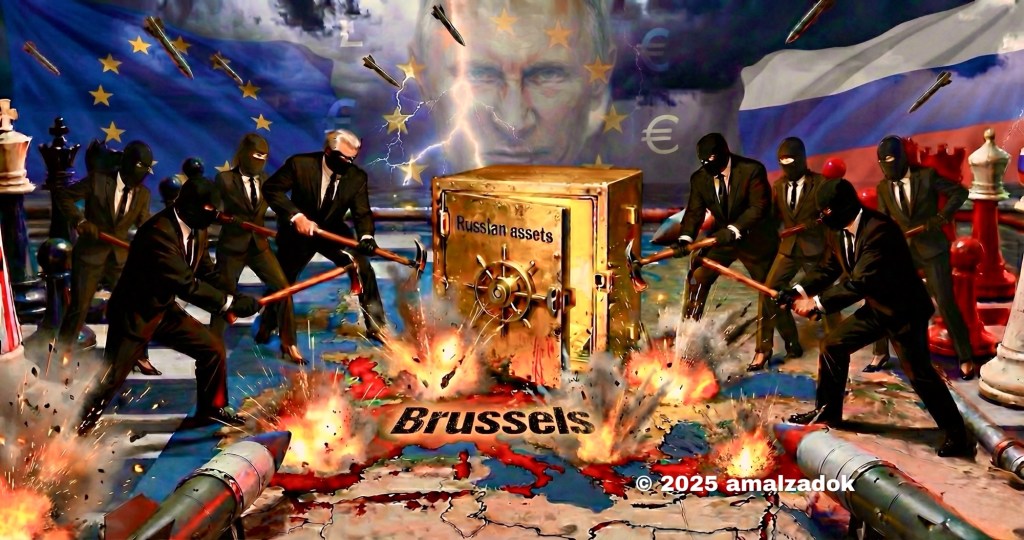
    Europe’s decision to seize and weaponise frozen Russian state assets marks a dangerous escalation: a last tantrum of a decadent elite that prefers to gamble with international law and Europe’s own future rather than accept strategic defeat and negotiate peace. Presenting this as “justice” or “reparations for Ukraine” hides a more prosaic reality: the European gangster wants those billions to plug fiscal holes, prop up a failing war effort, and delay the reckoning with its own political and economic suicide.

    The gangster move: stealing the frozen billions

    The plan to strip Russia of hundreds of billions in frozen reserves is the logical culmination of a policy that has already burned Europe’s cheap energy, industrial base, and social model on the altar of war. After sacrificing affordable Russian gas and triggering deindustrialisation and inflation, EU elites now eye Moscow’s confiscated assets as a new “magic fund” to sustain a war they cannot win and a fiscal model they can no longer finance from a shrinking tax base.

    This is framed as moral duty—“Russia must pay”—but the context betrays the real motive. Europe has already diverted enormous sums of public money to arm Kyiv while hospitals close, schools crumble, and poverty indices climb; the assets grab offers a way to extend this war spending without openly telling citizens they will lose even more welfare and rights. The political clica wants to swap domestic social anger for geopolitical banditry, trading bread and pensions for a one‑off financial heist.

    Belgium: pressure on the weak link

    Belgium sits at the centre of this scheme because Euroclear holds a massive chunk of the immobilised Russian reserves, turning Brussels into the vault the clica now wants to crack open. The same Europe that chants about “rule of law” is pressuring a small member state to accept a precedent that would have been unthinkable even at the height of the Cold War: openly confiscating another state’s reserves not as part of a peace settlement, but to keep shovelling weapons into an open‑ended proxy war.

    This pressure takes several forms.

    •Legal sophistry: relabelling seizure as “windfall profits,” “guarantees,” or “collateral,” while the substance is still the same—appropriating Russian wealth to fund war.

    •Political blackmail: warning Belgium that refusing the scheme would mean “abandoning Ukraine” or undermining European unity, turning a technical custody issue into a loyalty test.

    •Financial intimidation: hinting that Belgium’s role as a Euroclear hub could be questioned if it does not align with Washington and Brussels’ strategy.

    If Belgium capitulates, the message to the world is simple: deposits and reserves in Europe are safe only until the next geopolitical hysteria.

    Repercussions from Russia: from retaliation to systemic fracture

    For Russia, this move crosses a line between sanctions and outright theft. Moscow will not respond only with diplomatic protests; it has tools—economic, legal, and strategic—that will turn this European tantrum into a long‑term blowback.

    Likely responses include:

    •Legal counter‑claims and mirror seizures: Russia can expropriate European assets on its territory, nullify Western intellectual property, and seize physical infrastructure and investments as “compensation.”

    •Deepened de‑dollarisation and de‑euroisation: the signal to the Global South is devastating—Western currencies and jurisdictions are now weaponised, not neutral. This accelerates the creation of alternative payment systems, BRICS mechanisms, and commodity‑based settlement that permanently erode Europe’s financial relevance.

    •Strategic hardening: confiscation removes incentives for compromise. If Russia knows its reserves are gone for good, it has fewer reasons to agree to any settlement framed on Western terms, entrenching a cold war that Europe is far less equipped to sustain than Washington.

    In short, the “free money” Europe hopes to extract from Russian reserves will be repaid with isolation from emerging financial architectures, lost markets, and a Russia firmly anchored in a non‑Western bloc that no longer trusts European signatures or banks.

    Europe’s attempt to formalise this confiscation also carries the logic and symbolism of a declaration of war, even if it hides behind legal euphemisms and technocratic language. 

    Treating the central bank reserves of a nuclear‑armed state as spoils to be carved up for weapons and reconstruction funds signals that the EU no longer recognises Russia as a legitimate counterpart in the international system, but as a defeated enemy to be looted.

    In strategic terms, this is indistinguishable from economic total war, because it erases the boundary between temporary sanctions and permanent dispossession.

    Such a move hardens threat perceptions in Moscow to an unprecedented degree, reinforcing the narrative that the West seeks not negotiation or “behaviour change” but Russia’s strategic humiliation and eventual fragmentation. 

    If Russian leaders conclude that no future compromise can restore their assets, security, or status, they are incentivised to escalate horizontally—cyber, space, infrastructure, and asymmetric responses—rather than de‑escalate. 

    What Europe reads as financial cleverness, Russia reads as confirmation that the conflict is existential and must be met with long‑term, system‑level counter‑measures.

    By crossing this Rubicon, Europe not only undermines its own legal foundations but also normalises the idea that financial warfare can be escalated indefinitely without triggering wider conflict—a dangerous illusion. 

    Once the taboo on sovereign asset seizure is broken, every further crisis will tempt policymakers to “solve” political problems with new expropriations, pushing great‑power relations ever closer to open confrontation. 

    In this sense, the theft of Russian reserves is not just a tantrum; it is the codification of permanent economic war and, in substance, a de facto declaration of war against Russia, with all the risks of miscalculation, retaliation, and eventual military escalation that such a doctrine entails.

    The internal cost: Europe against its own citizens

    The gangster heist is not just an act against Russia; it is an act against Europeans themselves. By normalising confiscation of sovereign assets and emergency war financing, the same political clica also normalises permanent emergency at home—more censorship, less judicial independence, more police, and fewer social rights.

    The trajectory is already visible:

    •Sanctions and energy rupture triggered deindustrialisation, capital flight, and a collapse of the tax base that once funded Europe’s welfare states.

    •The Ukraine war became the justification to divert billions from schools, hospitals, and pensions into weapons, while dissenters were smeared as traitors or agents of Moscow.

    •Digital censorship regimes, “disinformation” laws, and emergency decrees hollowed out democratic debate and press freedom, recreating a digitalised version of Soviet‑style control.

    Using Russian money to keep this machinery going compounds the moral and legal rot. It signals that the war economy and repression must continue at any cost, because the elites have staked not just political capital but now the credibility of the entire European financial system on a conflict that has no realistic path to victory.

    Europe’s strategic suicide: from unipolar denial to open piracy

    Confiscating Russian reserves is also a symptom of a deeper pathology: Europe’s refusal to accept a multipolar world and its subservience to US strategic dictates. Instead of adapting to a reality where Russia, China, and the Global South cannot be coerced into obedience, Europe doubles down on unipolar fantasies—NATO expansion, economic warfare, ideological crusades—and then, when the costs become unbearable, resorts to financial piracy to prolong the illusion.

    The long‑term consequences are stark:

    •Trust collapse: states that watched Libya’s reserves frozen and now see Russia’s formally confiscated will regard Western custody as a trap, not a service.

    •Loss of strategic autonomy: as Europe burns bridges to Eurasia, it locks itself into dependency on American energy, arms, and financial architecture, becoming a semi‑sovereign periphery of Washington’s empire.

    •Civilisational hollowing: the moral language of “rule of law,” “human rights,” and “democracy” becomes empty when the EU behaves like a cartel seizing assets to fund a proxy war, censors opposition, and militarises public life.

    The irony is cruel: in the name of defending “European values” against Moscow, Europe is dismantling its welfare state, civil liberties, and credibility as a legal and financial safe haven.

    Beyond the tantrum: the fork in the road

    This last tantrum—the attempt to steal Russia’s frozen billions—is not a sign of strength but of exhaustion. It reveals elites trapped between a failed war strategy, a collapsing social contract, and a world that no longer tolerates Western impunity.

    Europe now stands at a precipice where one decision can still change its fate: either reclaim the primacy of bread over bombs, law over looting, and peace over permanent mobilisation, or accept its mutation into a garrisoned, obedient frontier of a fading empire. 

    If the frozen Russian billions are finally cracked open to feed the war machine, that act will not be a clever financial manoeuvre but the moment Europe openly chooses vassalage over sovereignty and plunder over principle. 

    On that day, historians will not write that Europe defended its values; they will record that, for the price of one last stolen jackpot, a civilisation signed away its soul and marked, in its own hand, the date of its final moral and strategic surrender.

    References

    1.European Parliamentary Research Service. (2025, November 27). EU sanctions and Russia’s frozen assets (Study EXPO_STU(2025)754487). European Parliament.

    2.European Parliamentary Research Service. (2025, September 7). Confiscation of immobilised Russian sovereign assets: State of play, arguments and scenarios (Briefing EPRS_BRI(2025)775908). European Parliament.

    3.European Parliamentary Research Service. (2025, June 30). Immobilised Russian central bank assets (At a glance EPRS_ATA(2025)769514). European Parliament.

    4.Reuters. (2025, December 2). EU proposes using frozen Russian assets or borrowing to raise €90 billion for Ukraine.

    5.Australian Broadcasting Corporation. (2025, December 3). EU proposes using frozen Russian assets as reparations loans for Ukraine.

    6.Verfassungsblog. (2025, April 3). Frozen Russian state assets. Verfassungsblog on Constitutional Matters.

    7.Council on Foreign Relations. (2025, November 19). How to use Russia’s frozen assets.

    8.Reuters. (2025, December 3). Russia mocks EU deliberations on frozen assets, says seizure will prompt “harshest response”.

    9.CNBC. (2025, December 4). Russia: Europe’s use of frozen assets could be justification for war.

    10.Investing.com. (2025, December 4). Russia warns EU of “harsh response” over potential asset freezes.

    11.Reuters. (2025, December 1). Top Russian banker says EU faces 50 years of litigation if it takes Russia’s frozen assets.

    12.Big Europe. (2025, November 12). The poisoned chalice of Russia’s frozen assets.

    13.Geopolitique.eu. (2023, February 22). Sanction. Confiscate. Compensate. How Russian money can be repurposed as reparations for Ukrainian victims.

    14.Al Jazeera. (2025, December 2). Europe should seize Russia’s frozen assets now.

    15.Reuters. (2025, October 2). How Europe wants to unlock Russia’s frozen cash for Ukraine.

    16.CEPR. (2025, March). Seizing central bank assets?

    ©️2025 Amal Zadok. All rights reserved.

    Subscribe and never miss an article!
  • Shattered Pillar of Europe: How US Power, NATO’s March and a Real Russian Existential Threat Are Sacrificing Europe’s Economy, Social Model and Future

    Shattered Pillar of Europe: How US Power, NATO’s March and a Real Russian Existential Threat Are Sacrificing Europe’s Economy, Social Model and Future

    by Amal Zadok

    US policy today is not just “supporting allies” or “defending democracy.” It functions as a strategy that keeps Europe dependent, weakens its economic base, and erodes the social achievements built up since the birth of the European Union. At the same time, Russia’s leadership confronts NATO expansion and Western use of Ukraine as a real existential threat, and this reality has interacted with US and EU choices in a mutually destructive security spiral. Together, these dynamics risk turning the EU from a potential independent pole in a multipolar world into a subordinated periphery of the United States, while locking Russia into a permanent confrontation that justifies ever tighter Western structures around Europe.

    From partner to protectorate

    In the early decades after 1945, Washington encouraged European integration as a bulwark against the Soviet Union and as a way to stabilise and industrialise Western Europe. As Europe grew richer and more cohesive, and as the European Community evolved into the EU with its own currency and ambitions of “strategic autonomy,” US attitudes shifted from sponsorship to management and, increasingly, control. The United States wanted a strong Europe inside a US‑led system—not a Europe capable of independent strategic choices, energy partnerships, or monetary power that might rival the dollar.

    The turning point came when European choices started to cut across US preferences: independent Ostpolitik, deep energy links with Russia, talk of an EU defence identity not subordinated to NATO, and the launch of the euro as an international currency. From that point, Washington’s core aim was effectively that Europe must never become an autonomous centre of power. It would remain militarily reliant on US hardware and guarantees, energetically tied to US‑controlled sources, and monetarily constrained inside a dollar‑dominated financial system in which the euro is, at best, a junior partner.

    Russia, NATO and the security dilemma

    This story sits inside a wider confrontation with Russia. From Moscow’s point of view, NATO’s eastward expansion after the 1990s and, especially, the prospect of Ukrainian and Georgian membership signalled the arrival of a hostile alliance on Russia’s immediate borders. Russian elites, across different currents, came to see NATO not just as a military structure but as the spearhead of a Western project to encircle, weaken and potentially dismember Russia. In that reading, the Maidan revolution, Western military assistance to Kyiv, and the steady integration of Ukraine into Western economic and security frameworks looked like steps toward turning Ukraine into a proxy platform aimed at Russia’s heartland and political system.

    Many Western governments insist that NATO is a defensive alliance and that countries like Poland or Ukraine freely choose to seek protection after their own traumatic experiences with Russian power. But even if one accepts that, interests and capabilities matter more than rhetoric. To large parts of the Russian establishment, NATO’s moves—backed and driven by Washington—constitute a real existential threat. That reality has been used by the Kremlin to justify the 2014 and 2022 invasions of Ukraine and a broader confrontation with the West. In turn, those invasions have validated the worst fears of NATO’s eastern members and given the US justification to harden and expand its military, energy and financial footprint in Europe.

    A classic security dilemma has formed: each side claims to be reacting defensively to the other, but the net effect is an arms race and a hardened bloc system. For Europe, the tragedy is that this spiral locks the EU ever more tightly into dependence on the US as protector and energy supplier, while eliminating the diplomatic space that might have allowed Europe to act as a bridge rather than a front line.

    Killing cheap energy, then selling the “solution”

    Before the latest escalation, the German and broader EU growth model rested on abundant, relatively cheap Russian pipeline gas feeding highly competitive industrial sectors like chemicals, metals, glass, fertilisers and machinery. That industrial base underpinned employment, exports and the tax revenue for Europe’s welfare states. For Washington and for NATO hard‑liners, this model looked like a strategic vulnerability: it tied Europe’s prosperity to a Russia they saw as a long‑term adversary and created incentives in Berlin and elsewhere for accommodation instead of confrontation.

    Russia’s decision to escalate in Ukraine—and the Western response of sanctions, embargoes and the effective shutdown of most Russian pipeline flows—destroyed that model in a matter of months. Whatever one thinks of Moscow’s responsibility for the war, the outcome fits US strategic and economic interests almost perfectly. The one supplier capable of delivering huge volumes of cheap gas by pipe to Europe has been removed. Into the gap steps US liquefied natural gas.

    US officials and industry lobbyists openly present US LNG as a strategic asset and a historic opportunity to lock in the European market for decades. Long‑term contracts, new terminals and supporting infrastructure create a structural dependency on LNG whose prices are higher and more volatile than those of pre‑war Russian pipeline gas. European analysts warn that this risks recreating the old dependence—only now on Washington. Energy‑intensive industries close, relocate or shrink. Households live under permanent energy‑driven cost‑of‑living pressure. The surplus that once supported generous social security is eaten away by higher input costs and subsidies designed to manage, rather than resolve, the crisis.

    Choices made in both Moscow and Washington thus converge: they break Europe’s attempt to balance security and economic efficiency through diversified energy sources, and they channel Europe toward an Atlantic‑centric, US‑dominated energy order.

    Forced rearmament on American terms

    Overlaying this is a dramatic push for rearmament. The 2 per cent of GDP NATO guideline, once a benchmark, has become a political cudgel. Under Trump in particular, but not only under him, European states have been told bluntly: spend much more on defence—3, 4, even 5 per cent—or risk abandonment. In practice, the fastest way to meet these targets is to buy off‑the‑shelf from the United States.

    The result is a surge in European defence budgets, with a large share of the new spending flowing into US weapons systems: combat aircraft, missile defence, precision munitions, command‑and‑control architecture. This deepens Europe’s technological and operational dependence. Many of these systems cannot be fully maintained, upgraded or used independently without US software, spare parts and political consent. It is rearmament, but not autonomy.

    From a macroeconomic perspective, some of this spending stimulates local production and jobs, but a significant portion leaks abroad as imports. At the same time, higher defence outlays add to public debt and crowd out other priorities. Governments will have to finance this either through higher taxes or through cuts to social programmes, infrastructure and climate‑transition investments. The more the war in Ukraine is framed as an open‑ended civilisational struggle with Russia, the easier it is for elites to justify this shift and to silence dissent in the name of “security.”

    Again, Moscow’s choices and Washington’s strategy intersect. Russia’s actions are used to justify a transformation of Europe’s budgets and procurement patterns that locks the EU into US‑centric military structures for decades. The more the EU is psychologically and institutionally oriented toward Russia as a permanent enemy, the less space remains for any future European security architecture not dominated by NATO and the US.

    Monetary subordination and the caging of the euro

    The euro was meant to give Europe monetary sovereignty and a currency capable of balancing the dollar. In practice, the combination of internal EU design flaws and external pressure has kept the euro within a dollar‑dominated framework. Fragmented fiscal governance, limited joint debt issuance and capital‑market fragmentation restrict the euro’s international role. Repeated crises—sovereign debt, pandemics, energy‑driven inflation—undermine its attractiveness as a reserve currency.

    From the US side, powerful tools reinforce dollar primacy: sanctions regimes that weaponise access to the dollar system, extraterritorial financial rules that intimidate European banks and firms, and the sheer depth and liquidity of US bond markets. Efforts by the EU or by countries like Russia and China to build alternative payment systems, reduce dollar exposure or trade outside US‑controlled channels are treated with suspicion and sometimes punished. For Russia, this has led to attempts to “de‑dollarise” and diversify reserves, but Western sanctions in response to the Ukraine war have also frozen Russian assets and forced other states to think twice about challenging the dollar architecture.

    Europe finds itself squeezed. It has its own currency, but in the decisive moments—sanctions, crises, financial flows—it still operates inside a system whose ultimate levers are in Washington. Russia’s confrontation with the West becomes another reason to tighten that system further, making it harder for the euro to evolve into a fully independent pole.

    Social destruction as the hidden cost

    The combined effect of these energy, military and financial dynamics is a slow erosion of Europe’s social model. Energy‑intensive industries lose competitiveness or vanish. Public budgets come under strain from higher defence commitments and crisis‑management subsidies. Inflation, especially for essentials like housing and energy, erodes real wages. Youth unemployment or underemployment rises as industrial and mid‑skill jobs disappear, leaving younger generations with precarious, low‑paid work and limited prospects.

    Health systems, already stretched, enter into crisis: senior citizens and people with chronic or complex health conditions face longer waiting lists, reduced services and growing out‑of‑pocket costs as governments struggle to finance universal care. The social fabric frays: trust in institutions declines, protests over living standards, housing and healthcare multiply, and political extremes gain ground by channelling anger toward Brussels, migrants, national elites, or foreign powers. What made the EU attractive—relative equality, robust welfare states, good public services and intergenerational solidarity—is undermined from within, even as leaders insist they are defending “European values” against Russia and other adversaries.

    Here, impartiality requires recognising that this destruction is co‑produced. US strategy uses crises to deepen Europe’s dependence and maintain American hegemony. Russian strategy, driven by its response to a real existential threat and by long‑standing imperial reflexes, has helped trigger and intensify those same crises, even as Moscow forges and consolidates strong partnerships across BRICS and the wider Global South.

    Far from being truly isolated, Russia has redirected trade, finance and diplomacy away from the Atlantic world and into a dense web of relations with China, India, Iran, much of Asia, Africa and Latin America: it sells discounted energy to India and others, deepens industrial and military cooperation with China, signs long‑term resource and infrastructure deals across the Global South, and uses BRICS, the Shanghai Cooperation Organisation and new payment arrangements to reduce exposure to Western pressure. In practice this means that the US–NATO–EU strategy of “isolating” Russia has largely failed outside the Western bloc: it has severed many of Russia’s links to Europe and North America but pushed Moscow into a parallel ecosystem of non‑Western partners who see in Russia a counterweight to US dominance, a source of cheap commodities, or a useful political ally against Western double standards.

    European elites, for their part, have often chosen alignment with Washington over building authentic strategic and economic autonomy, while failing to protect their citizens—young and old—from the predictable social costs. Seen from this wider angle, the pattern is stark: a security confrontation between the US‑led West and Russia creates the conditions in which Europe’s autonomy, prosperity and social achievements are sacrificed, while Russia is re‑anchored in an alternative non‑Western orbit rather than disappearing from the world stage.

    A fierce political argument can therefore say, without losing nuance, that US grand strategy is structured to keep Europe subordinate and dollar‑bound; that Russia’s reaction to NATO expansion is grounded in a real existential threat and has been channelled into building a broader non‑Western alignment instead of simple “isolation”; and that European leaders have so far failed to break this logic in defence of their own societies, accepting a role as a weakened Atlantic appendage in a world that is, in fact, becoming more multipolar.

    Reference list

    1.American Security Project. (2025). White paper – Strategic implications of U.S. LNG exports. Retrieved from https://www.americansecurityproject.org/white-paper-strategic-implications-of-u-s-lng-exports/

    2.Bruegel. (2025). Adjusting to the energy shock: The right policies for European industry. Retrieved from https://www.bruegel.org/policy-brief/adjusting-energy-shock-right-policies-european-industry

    3.European Commission. (2022). EU action to address the energy crisis. Retrieved from https://commission.europa.eu/topics/energy/eu-action-address-energy-crisis_en

    4.European Commission. (2022). Sanctions on energy – EU restrictive measures against Russia following the invasion of Ukraine. Retrieved from https://commission.europa.eu/topics/energy/eu-solidarity-ukraine/eu-sanctions-against-russia-following-invasion-ukraine/sanctions-energy_en

    5.Bruegel. (2025). Europe’s dependence on US foreign military sales and what to do about it. Retrieved from https://www.bruegel.org/policy-brief/europes-dependence-us-foreign-military-sales-and-what-do-about-it

    6.The Parliament Magazine. (2025). Europe’s defence reliance on the US runs deeper than hardware. Retrieved from https://www.theparliamentmagazine.eu/news/article/europes-defence-reliance-on-the-us-runs-deeper-than-hardware

    7.European Parliament Research Service. (2025). United States defense industrial base. Retrieved from https://www.europarl.europa.eu/RegData/etudes/BRIE/2025/777967/EPRS_BRI(2025)777967_EN.pdf

    8.Reuters. (2025, June 18). US defence firms chase European military spending wave. Retrieved from https://www.reuters.com/business/aerospace-defense/us-defence-firms-chase-european-military-spending-wave-2025-06-18/

    9.Chatham House. (2024). Russia is using the Soviet playbook in the Global South to challenge the West – and it’s working. Retrieved from https://www.chathamhouse.org/2024/05/russia-using-soviet-playbook-global-south-challenge-west-and-it-working

    10.Vuksanović, V. (2025). The logic of Global South in Russian foreign policy. Third World Quarterly. Retrieved from https://www.tandfonline.com/doi/abs/10.1080/10220461.2025.2519982

    11.Papa, M. (2025). The evolution of soft balancing in informal institutions. International Affairs, 101(1), 73–93. Retrieved from https://academic.oup.com/ia/article/101/1/73/7942161

    12.European Commission. (2025). Spring 2025 economic forecast: The economic impact of higher defence spending. Retrieved from https://economy-finance.ec.europa.eu/economic-forecast-and-surveys/economic-forecasts/spring-2025-economic-forecast-moderate-growth-despite-risks_en

    13.SUERF. (2025). Europe in the new NATO era. Retrieved from https://www.suerf.org/publications/suerf-policy-notes-and-briefs/europe-in-the-new-nato-era/

    14.Eurofound. (2025). Trust in crisis: Europe’s social contract under threat. Retrieved from https://www.eurofound.europa.eu/en/commentary-and-analysis/all-content/trust-crisis-europes-social-contract-under-threat

    15.New Economics Foundation. (2025). European defence spending soars, but climate and care are still “unaffordable”. Retrieved from https://neweconomics.org/2025/06/european-defence-spending-soars-but-climate-and-care-are-still-unaffordable

    16.OECD / EIB. (2025). A comprehensive overview of the energy-intensive industries in Europe.

    17.Modern Diplomacy. (2025). Is Russia really isolated? The increasing importance of East and South diplomacy.

    18.Atlantic Council. (2025). The underestimated implications of the BRICS summit in Russia.

    19.Council on Foreign Relations. (2024). What is the BRICS group and why is it expanding?

    20.The Diplomat. (2024). Anti-Western or non-Western? The nuanced geopolitics of BRICS.

    21.European Commission. (2023). EU–United States of America energy cooperation.

    22.Eurofound / Euractiv. (2025). Cost of living crisis set to prompt social unrest across Europe, poll finds.

    23.New Lines Institute. (2025). Russia is capitalizing on rising LNG demand and shifting geopolitics.

    24.Various national and EU sources on cost of living, inflation, health systems and youth unemployment (e.g., OECD and Eurofound social reports, national cost‑of‑living crisis analyses).

    ©️2025 Amal Zadok. All rights reserved.

    Subscribe and never miss an article!

  • The Edge of Detonation: How Russia’s Hypersonic Supremacy and Trump’s Gambling Push Europe Toward Catastrophe

    The Edge of Detonation: How Russia’s Hypersonic Supremacy and Trump’s Gambling Push Europe Toward Catastrophe

    by Amal Zadok

    Russia’s advancement in hypersonic missile technology and the latest breakthroughs with the Burevestnik nuclear-powered cruise missile have transformed the global strategic balance. The Kremlin now possesses unmatched means to threaten and deter adversaries—while President Trump’s aggressive missile defense push, arms sales, and economic warfare risk driving Europe into catastrophe.

    Russia’s Hypersonic Arsenal: Avangard, Kinzhal, Zircon

    Russia’s operational hypersonic systems are a potent challenge to Western defense. The Avangard hypersonic glide vehicle achieves speeds up to Mach 27, delivering nuclear payloads with unpredictable flight paths that overwhelm missile defenses. The KH-47M2 Kinzhal air-launched missile strikes from more than 930 miles away at speeds near Mach 10, repeatedly used with effect in Ukraine engagements. The 3M22 Zircon, a naval scramjet-powered missile, can reach Mach 8, allowing Russia to project power across the Baltic and Barents Sea while exposing critical weaknesses in European defense networks.

    Oreshnik: Russia’s New Hypersonic IRBM Gamechanger

    The Oreshnik missile, officially entering service in 2025, is a new pillar in Russia’s offensive repertoire. Launched against Ukraine’s strategic facilities and now deployed to Belarus, Oreshnik outruns interception with speeds over Mach 10 and a range of up to 5,500 kilometers—putting all of Europe within striking distance. Its MIRV warhead capability, paired with conventional or nuclear payloads, allows for simultaneous multiple strikes that few, if any, European defenses can counter. This system closes the “INF Treaty gap,” fulfilling Kremlin ambitions for decisive escalatory options and establishing a new era in missile warfare.

    Burevestnik: The ‘Storm Petrel’ Proven Missile

    The 9M730 Burevestnik nuclear-powered cruise missile—confirmed by Russian and independent observers—achieved a 14,000-kilometer, 15-hour test flight. Putin and top military officials now present it as an “invincible” weapon, with virtually unlimited range, low-altitude maneuvering, and immunity to current missile shields. Western skepticism has faded with clear operational proof; Burevestnik’s unpredictable flight path and reactor-based endurance make it a guaranteed factor in future strategic planning.

    Trump’s Missile Defense and the European Gamble

    President Trump’s Golden Dome missile shield, expanded into Poland, Romania, and the Baltic region, aims to reinforce allies but also spurs Russian paranoia and accelerates the arms race. At the same time, the U.S. and Europe escalate weapons deliveries to Ukraine, directly sustaining the conflict and intensifying Kremlin perceptions of existential threat.

    Trump’s loud claims of detachment from the war are belied by vast arms sales and the orchestration of economic strategies—especially proposals to outright seize Russian assets from Western banks. This policy not only prolongs the war but exposes the entire European financial system to Russian retaliation, including potential energy cutoffs, cyberattacks, and rapid financial destabilization.

    Russia’s Strategic Edge Beyond Ukraine

    Moscow is winning the war of attrition on Ukraine’s battlefields and is better prepared than NATO or the U.S. for broader, high-technology war. Joint Zapad-2025 exercises, rearmament, and doctrinal innovations emphasize “escalate to deescalate”—delivering overwhelming strikes to force adversaries into accepting Russian terms. Meanwhile, NATO is hamstrung by divided political leadership, fragile supply chains, and a crumbling financial architecture now at the mercy of misguided economic warfare.

    Countdown to Catastrophe

    The world sits on the brink of strategic disaster, where technological mastery meets reckless policy. Russia’s proven missile supremacy and Trump’s dangerous game with arms sales and financial aggression are accelerating global destabilization. If misjudgment or provocation continues, it will not simply endanger Ukraine and Western Europe—it will threaten the survival of the global financial system and the architecture of peace itself.

    The stakes are now irreversible. What began as posturing and escalation could soon descend into nuclear brinkmanship and total economic collapse. Only authentic diplomatic imagination—applied today, not tomorrow—can prevent a self-inflicted cataclysm. The countdown has begun, and every second echoes with the roar of hypersonic engines.

    ©️2025 Amal Zadok. All rights reserved.

    Subscribe and never miss an article!
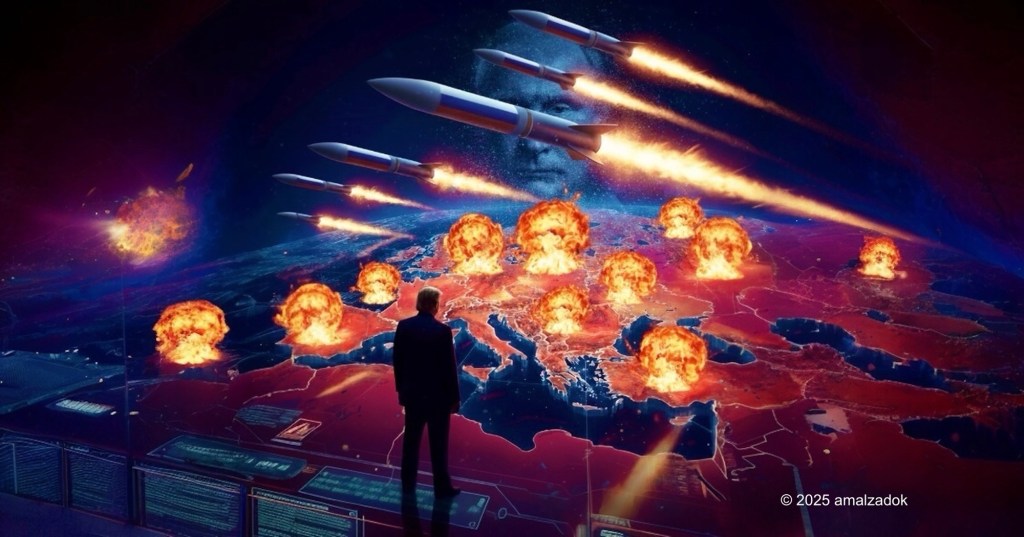
  • Highway to Hell: Trump’s Militarized Europe Drives the World Toward WWIII

    Highway to Hell: Trump’s Militarized Europe Drives the World Toward WWIII

    by Amal Zadok

    Donald Trump’s vision for Europe isn’t partnership—it’s extortion. His threat to abandon NATO allies who fail to spend 5% of GDP on defense—while openly encouraging Russian aggression against “delinquent” nations—has shattered the alliance’s foundational trust. In its place, he installed a protection racket where security is transactional and Europe’s sovereignty is collateral. Terrified of abandonment, Germany amended its constitution to unleash $400 billion for rearmament, Poland ramped up spending to 4.7% of GDP, and France floated a suicidal 5% target—all while slashing social programs to fund war machines .

    The Economic Hellscape

    This militarization isn’t just about tanks—it’s economic sabotage. Trump’s parallel 10% tariffs on EU goods and 100% levies on electric vehicles will crush Europe’s industrial backbone. Germany’s auto sector faces collapse, French farmers revolt against crippling costs, and the IMF predicts a 1% GDP contraction across the eurozone. Worse, Europe must now buy American weapons to appease Trump, diverting billions from green transitions and welfare states into Lockheed Martin’s profits. As social programs bleed, defense contractors rejoice: Rheinmetall’s stock soared 240% since 2022, embodying a grotesque new “austerity-for-arms” doctrine .

    The Grotesque Theater of Submission

    European leaders compound the crisis with humiliating obsequiousness. NATO chief Mark Rutte set the tone, addressing Trump as “daddy” in leaked texts and publicly praising his “decisive action in Iran.” This “orchestrated grovel,” as critics dubbed it, extended to UK PM Keir Starmer brandishing a royal invitation to flatter Trump’s ego. Such sycophancy isn’t diplomacy—it’s strategic self-debasement that rewards coercion. As one analyst noted, Trump’s court “doesn’t respect allies who kneel; it exploits them”.

    Fanning the Fires of War

    Trump fuels global conflicts with nihilistic abandon:

    – Ukraine: He vows to “settle in 24 hours” by gifting Putin 30% of Ukraine’s territory, betraying a democratic ally to appease the Kremlin .

    – Gaza: He backs Netanyahu’s genocide while deporting pro-Palestinian protesters, turning ethnic cleansing into campaign fodder .

    – Iran-Israel: He eggs Netanyahu to “hit harder!” during strikes, risking nuclear escalation for political theater .

    Europe’s complicity is stark: Macron deploys troops to “Trump-proof” Ukraine’s front lines, while Poland stations U.S. nukes 100 miles from Belarus—turning the continent into a tripwire for catastrophe .

    The Inevitable Endgame: WWIII

    This spiral—shattered alliances, bankrupt economies, and emboldened autocrats—creates a tinderbox. European polls now show majorities fear nuclear war, with 60% supporting a EU nuclear deterrent. Yet their rearmament is futile: Europe’s defense industry can’t produce enough arms, relying on U.S. imports with 4-year delays. Drones vital for modern warfare are obsolete within months, while Russia produces 4 million annually. As Germany’s own analysts admit, rebuilding military capacity could take “decades or even centuries” .

    The Point of No Return

    Trump’s “mission impossible” to militarize Europe isn’t about security—it’s about subjugation. By forcing allies to choose between protection money or annihilation, he has ignited a geopolitical suicide pact. Europe’s leaders march toward hell, believing they can outsource their survival to a man who sees them as vassals, not partners. But as Rutte’s “daddy” diplomacy proves, no amount of groveling can mask the truth: this road ends in ruins .

    The world is not sleepwalking to war; it is saluting and marching.

    ©️2025 Amal Zadok. All rights reserved

    Please subscribe so you never miss an article!