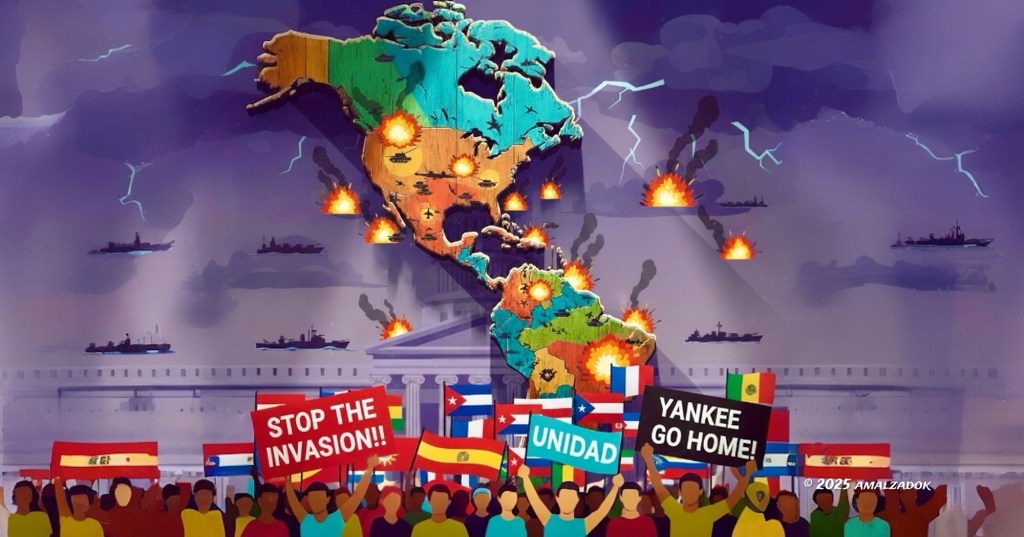
by Amal Zadok
In the unrelenting hysteria that has become Senator Lindsey Graham’s political brand, there remains one particularly destructive obsession: war for its own sake.
His latest outburst, delivered with the tone of a televangelist preaching apocalypse, calls for treating three Latin American nations—Cuba, Venezuela, and Colombia—as fair game for possible invasion under President Trump’s second term.
Graham, who once styled himself as a sober voice of national defense, now sounds more like a man possessed by delusion and empire fever.
Let us begin by dissecting Graham’s most recent tirade. In his televised appearance, the Senator claimed there exists a “drug caliphate” across Latin America—a grotesque invention meant to fuse Washington’s decades-old “War on Drugs” with the equally disastrous “War on Terror.”
With no credible evidence, he accused the sovereign governments of Venezuela, Cuba, and Colombia of making money off narcotics destined for the United States. In his fevered narrative, the flow of cocaine becomes an act of war, and “blowing up the boats” suddenly morphs into a viable foreign policy strategy.
These are not the words of a serious legislator. They are the ravings of a warmonger searching for his next crusade.
Let’s be clear: the only “caliphate” that exists in the Western Hemisphere is the empire of addiction and profit that has long existed within the United States itself. It is not Caracas, Bogotá, or Havana that drive the colossal U.S. demand for drugs; it is the American appetite for narcotics and the billions of dollars generated by domestic distribution networks that fuel the trade.
Graham’s grotesque simplification—that the problem lies outside American borders—is both dishonest and cowardly. It conceals the complicity of U.S. financiers, corporate leaders, and political operatives who have, for decades, allowed this epidemic to fester for profit and political theatre.
In accusing Latin American countries of waging chemical war on the United States,
Graham conveniently ignores history. It was the United States that actively funded and armed violent groups in the region under the pretext of fighting communism. It was Washington that trained death squads in Central America and toppled democracies at will. It was the U.S. State Department that destabilized entire nations, leaving behind chaos that drug traffickers later exploited.
And yet, in Graham’s distorted imagination, it is Venezuela—a country crippled by sanctions and struggling to feed its people—that somehow bankrolls the poisoning of American youth. The hypocrisy is nauseating.
Even his invocation of the lie that Donald Trump “destroyed” the ISIS caliphate reeks of opportunism. Graham conveniently ignores facts about the Syrian conflict, where the terrorist President of Syria, once among the world’s most-wanted with millions of dollars in bounties on his head, under Trump’s administration has pivoted to become a partner of the United States. The war that unfolded in Syria saw key terrorist factions—formerly shunned as existential threats—normalized and engaged by Washington as expedient partners in the campaign against ISIS. Graham now laments the rise of an imagined “drug caliphate,” which is a grotesque parody of moral indignation.
What makes his tirade even more disturbing is his open talk of “land invasions.”
To threaten Cuba, Venezuela, and Colombia with military action is not simply reckless—it is criminal. These are sovereign nations, each with complex internal struggles, yet bound together by geography, culture, and shared resistance to foreign domination. A U.S. invasion of any of them—especially without a congressional declaration of war—would constitute an act of aggression in flagrant violation of international law and the U.S. Constitution. It would make a mockery of every oath Graham ever swore to defend.
History offers a grim reminder. The Bay of Pigs in 1961 remains one of the most humiliating chapters in American interventionism—a textbook lesson in arrogance and underestimation. If Senator Graham thinks that a modern version of that catastrophe would play out differently, he should listen to the words of the international geopolitical analyst Pepe Escobar.
In his interview with Judge Napolitano on YouTube, Escobar warned any invasion of Venezuela would be “Bay of Pigs multiplied by a zillion pigs.” Venezuela, unlike 1961 Cuba, has spent years preparing for exactly this scenario: armed civilian militias, and reinforced alliances with Russia, China, and Iran. Any American landing would face overwhelming resistance and ignite geopolitical chaos far beyond Latin America.
As a constitutional question, the matter is even graver. The U.S. Constitution vests the power to declare war in Congress—not in the impulsive rhetoric of a Senator or the whims of an executive stirred by bellicose advisers. Any attempt to launch land invasions without explicit authorization would render the administration a violator of constitutional order.
For a self-proclaimed patriot like Lindsey Graham to encourage such unlawful acts exposes his contempt for the very framework that sustains the republic. His loyalty is not to the rule of law but to war itself—a parasitic vocation that thrives on chaos and fear.
It is also worth asking: to what end? What would a war against Venezuela, Cuba, or Colombia achieve? The overthrow of three governments? The occupation of nations that have bled under the weight of economic sanctions, regional instability, and U.S. interference?
Graham envisions Latin America not as a group of neighbors but as a canvas for American dominance. His rhetoric drips with colonial nostalgia, echoing the old Monroe Doctrine’s arrogance that the Western Hemisphere belongs exclusively to Washington’s sphere of control. It is the 21st century, yet Lindsey Graham speaks as though it were 1823.
If the U.S. military establishment had any collective sense, it would treat Graham’s words with the derision they deserve. No rational strategist believes that invading Latin America is militarily or politically feasible. The Pentagon, despite its many sins, understands geography and insurgency better than demagogues.
A war against three nations—each tied to major global powers—would stretch American logistics, drain billions, and ignite anti-U.S. sentiment across the hemisphere for decades to come. The last thing Washington needs, as the world shifts toward multipolar realities, is to open another front born of one Senator’s megalomania.
Graham’s grandstanding is not policy—it is pathology. This is the same deranged appetite that led him to call for war in Iran, Syria, Libya, and beyond—agitating for escalation in Ukraine even as he flirts with nuclear confrontation against Russia, and recently defending Israel’s right to do “whatever it takes,” invoking Hiroshima and Nagasaki as models for what should be done to Gaza.
He is a man who defines patriotism by bombs dropped on developing nations and moral integrity by proximity to the military-industrial complex. His worldview thrives on permanent confrontation because peace would render his ideology irrelevant. In his calculus, Latin American lives—as with Palestinians and Russians—are abstractions, pawns in an endless parade of televised righteousness.
Yet there is a deeper truth. The age of American impunity in Latin America is ending. The peoples of the South have grown weary of lectures from those who weaponize democracy while funding dictatorships.
They remember the coups, the disappearances, the torture chambers funded by Washington’s dollars. They will not forget. If President Trump’s administration listens to Graham’s siren call for “land invasions,” it would ignite a resistance that even the CIA’s most fevered counterinsurgency fantasies could not extinguish. It would ruin what remains of Washington’s moral standing in the global south.
In the end, Lindsey Graham’s “drug caliphate” fantasy reveals more about his own intellectual and moral decay than about Latin America. He is the embodiment of everything corrosive in American politics—fear masquerading as strategy, aggression disguised as patriotism, ignorance marketed as leadership. He has become the Senator of endless war, a prophet not of national defense but of national self-destruction.
The American people should reject this madness with clarity and conviction. South Carolina voters, get rid of this demented maniac warmonger asap. They must refuse to let men like Graham drag the nation into another blood-soaked adventure in the name of righteousness.
The time has come to remind him, and those who think like him, that Latin America is not Washington’s backyard—it is a continent of sovereign peoples who have endured enough suffering under the shadow of the American flag.
It is not Cuba, Venezuela, or Colombia that threaten the United States. The real threat lies in Washington itself: in its arrogance, its addiction to militarism, and its inability to imagine a world based on equality rather than domination.
Lindsey Graham has become the high priest of that delusion. And unless America wakes up, his infernal dream may yet set the southern horizon ablaze.
Let no one in Washington or Mar-a-Lago be deluded: if Lindsey Graham’s fantasy is made real, it will be remembered as the worst Vietnam-style defeat in U.S. history—a war not only unwinnable but incendiary enough to spark a massive hemispheric uprising across all the peoples of Latin America.
Any land invasion, any bomb, would ignite every village, neighborhood, capital, and countryside from Patagonia to the Rio Grande into righteous revolt. Go ahead, President of Peace Trump—dare, if you have your intelligence not in your head but in your balls. Follow what this deranged nuclear warmonger evangelist is whispering in your ear. The empire’s last war may be the one that turns the entire continent against it, in a blaze from which it will never recover.
References
Cato Institute. (2022, June 17). When interventions fail: Lessons from the U.S. experience in Latin America. https://www.cato.org/research-briefs-economic-policy/when-interventions-fail-lessons-us-experience-latin-america
Escobar, P., & Napolitano, A. (2025, October 30). Pepe Escobar on U.S. invasion threats and the “Bay of Pigs multiplied by a zillion pigs” [Video interview]. Judge Napolitano YouTube Channel. https://www.youtube.com/live/aB4xzhmC_Ok?si=txdYEL7FdHg48DO-
Monthly Review. (2025, September 7). U.S. Offensive in Latin America: Coups, Retreats, and Radicalization. https://monthlyreview.org/articles/u-s-offensive-in-latin-america/
ReVista: Harvard Review of Latin America. (2005, May 14). United States Interventions. https://revista.drclas.harvard.edu/united-states-interventions/
UWA News. (2023, November 9). Half a century of failed US adventures, from Vietnam, to Afghanistan. https://www.uwa.edu.au/news/article/2023/november/half-a-century-of-failed-us-adventures
BBC News. (2025, October 26). Venezuelan official says ‘no doubt’ Trump wants to overthrow Maduro, warns of invasion threat. https://www.bbc.com/news/articles/clyg2wljz6xo
CBS News. (2025, October 26). Sen. Lindsey Graham says land strikes in Venezuela are a ‘real possibility’. https://www.cbsnews.com/news/lindsey-graham-venezuela-land-strikes-face-the-nation /
Newsweek. (2025, October 30). US could fire Tomahawks into Venezuela: Former ambassador. https://www.newsweek.com/us-could-fire-tomahawks-into-venezuela-former-ambassador-10953228
©️2025 Amal Zadok. All rights reserved.
Subscribe and never miss an article!
 Think and be Free!