by Amal Zadok
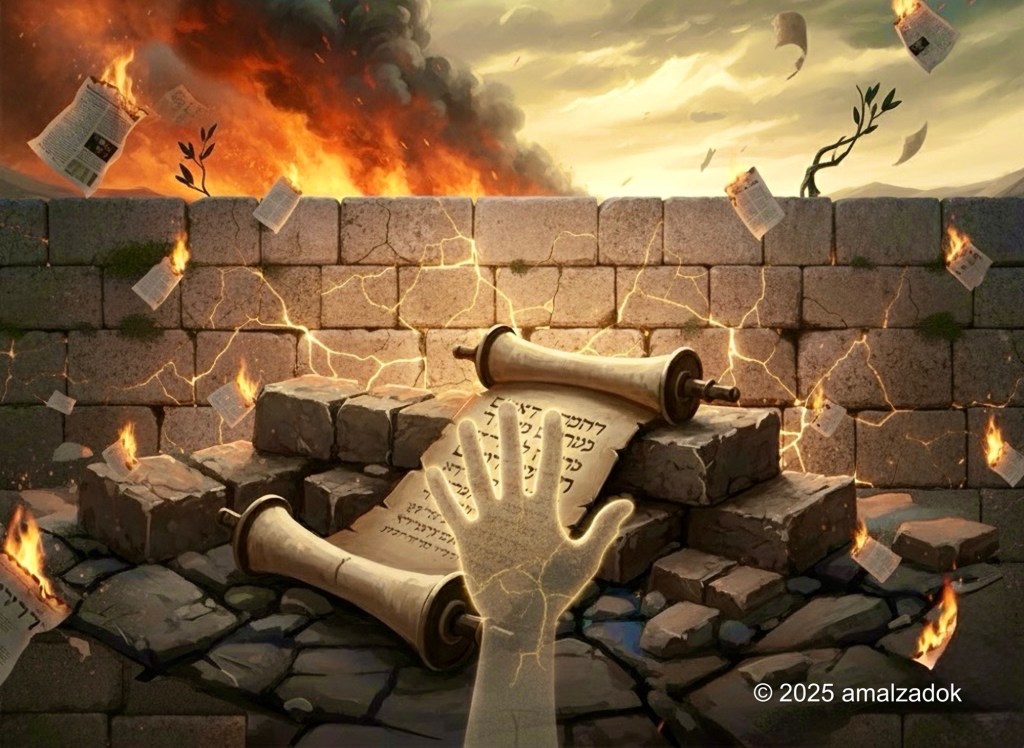
It’s a striking sight: powerful people at the Western Wall, heads bowed, touching stone, looking for divine approval. On the surface, it’s the ritual of a nation publicly reconnecting with thousands of years of Jewish longing. But at this very moment, as bombs drop in Gaza and global outrage rises, the contrast couldn’t be more startling. Judaism, at its true heart, is about justice, memory, and compassion—not walls, not warfare. Yet the state’s political ideology, Zionism, is accused by international organizations—including the United Nations and the world’s top genocide scholars—of orchestrating acts of genocide in the Palestinian territories (Office of the High Commissioner for Human Rights, 2025; BBC News, 2025). Is it possible to call this “faithful” to the Torah?
Gaza: The Test the World is Failing
Recent statements from international leaders and humanitarian organizations brand Gaza as “the test the world is failing.” The UN Secretary-General António Guterres declared in July 2025 that, “the catastrophe in Gaza is a test of our shared humanity—one the world cannot afford to fail” (UN News, 2025). The International Committee of the Red Cross, IPC (Integrated Food Security Phase Classification), and countless relief groups warn that starvation, devastated hospitals, and destroyed infrastructure have sparked a massive humanitarian disaster. Over 67,000 Palestinians have been killed, famine is rampant, and entire generations are being lost to hunger and violence (Red Cross, 2023; IRC, 2025). Every day of insufficient international response deepens the tragedy, making Gaza the definitive moral crisis of our age. This is not just a Jewish test—it’s a test of the world’s collective conscience and ability to act with mercy, justice, and urgency (UN News, 2025; BBC News, 2025).
Zionism Hijacked the Conversation
Let’s face it: Zionism and Judaism are not twins. Torah is ancient, ethical, spiritual—a faith tradition demanding “you shall not wrong nor oppress a stranger, for you were strangers in the land of Egypt” (Exodus 22:20, New Revised Standard Version). Zionism, by contrast, started in the late 1800s Europe as a political response to violence against Jews, not as a religious project (Britannica, 2025). Many founders were secular and saw the creation of a state as a fix for persecution. They were not worried about prophetic justice; they wanted borders, armies, passports.
That might have made sense in theory for survival. But Torah justice was always about more than survival. It demanded that when Jews finally had power, they would not become new Pharaohs or new oppressors (The Business Standard, 2023). The question now: what’s left of Jewish prophecy if statehood tramples mercy?
Gaza: The Test We’re Failing—And the World is Too
Fast forward to today. Israel’s government says it’s fighting for security, but in Gaza, what much of the world now sees is not defense but destruction. In 2025, the UN, the International Association of Genocide Scholars, and a host of human rights experts could not have been clearer. Their findings, based on mountains of evidence, declare Israel’s military campaign in Gaza a “genocide” under the U.N. convention: mass killing, starvation, targeted destruction of life essentials, and, most damningly, intent (Office of the High Commissioner for Human Rights, 2025; BBC News, 2025).
Israel’s leaders reject this as bias and self-defense, but global legal experts now mostly agree—what’s happening cannot be excused away as “necessity.” Instead, these are crimes that violate the very heart of Judaism’s religious mission. And the world, even while recognizing the tragedy, has not mustered a response that meets the urgency of the crisis. Silence, half-measures, or paralysis from the world’s most powerful institutions have made Gaza not only a test for Jewish ethics but a grave indictment of the world’s moral resolve (UN News, 2025).
Torah’s Demands: Not Just Old Words
The Torah couldn’t be clearer. “You shall not oppress a stranger, for you know the soul of the stranger, having been strangers in Egypt” (Exodus 23:9). Over and over: “Love the stranger as yourself” (Leviticus 19:34). These aren’t poetic suggestions. They’re central commandments, repeated more than any others. When prophets like Isaiah see ritual and power standing alongside bloodshed, they say, “I can’t listen to your prayers. Your hands are full of blood. Wash yourselves. Seek justice. Rescue the oppressed” (Isaiah 1:15-17).
You simply can’t pray at the Wall and bomb Gaza and call it Torah. Judaism is the faith that God demands justice, not just ceremonies and chanting.
When Statehood Becomes a Trap
This crisis didn’t have to happen. Many Jews (including some of Zionism’s first critics) warned that fusing ancient faith with nationalist statehood would backfire. They saw the risk of Jews, once stateless and powerless, repeating the errors of the nations—rule by force, exclusion, and hate (Britannica, 2025). In a twist, national Zionism, instead of saving Jewish values, is now accused of burying them under concrete and barbed wire.
What’s at Stake for Judaism—and for All of Us
Every tank, every airstrike in Gaza, every refusal to see the agony of Palestinian families, is more than a political move. For many Jews, it’s a spiritual crisis, a fight for the soul of Judaism. And for the world, it’s proof that nationalism and faith can be a toxic mix, especially when surrounding power goes unchecked. Torah’s call is: “You must have one law for the stranger and for yourself” (Leviticus 24:22). If Jewish statehood means forsaking this, then something essential has been lost.
And let’s talk about antisemitism. Criticizing Zionism’s deeds—especially when the leading voices are Jews and Jewish scholars—is not hating Jews. It’s defending Judaism’s most beautiful core. Silencing these critics, or branding them as traitors, betrays the very thing the tradition claims to defend.
A Call for Teshuva—Repentance
But Judaism also insists: desecration isn’t the last word. The future isn’t sealed. Repentance (teshuva in Hebrew) is always possible. That means telling the truth—about Gaza, about power, about what the Torah really asks. That means returning to justice, even if power whispers otherwise. It means demanding a ceasefire, aid, dignity, and a real reckoning not just for Israel, but for everyone caught in the old traps of fear and violence.
The Challenge
Let the world hear and remember: the scale of horror unleashed in Gaza, the starvation, the flattening of homes, the loss of entire families—these are more than the outcome of failed policy or broken negotiations. They are a monumental test of the very soul of every tradition, nation, and heart that claims allegiance to justice. This is the hour when faith—Jewish or otherwise—must choose: stand with the prophetic cry for the dignity of every human being or be forever tarnished by silence and rationalization. History’s eyes are fixed not only on those who hold the guns, but on those who watch and do nothing. There is still time for repentance, for the world and for every conscience. Gaza burns; the gates of mercy and justice stand open—but not forever. Let those with power move beyond words and ritual to radical acts of solidarity, demanding not just a ceasefire but a true reckoning that honors the suffering and affirms life. Only then can we reclaim a measure of humanity—and only then will faith itself be saved from the ashes.
The Urgency of Justice: Two States and Accountability
There is no honest path forward—no reconciliation, no lasting peace—unless the world insists on both a viable two-state solution and real accountability for the crimes already committed. Justice demands far more than words; it demands the prosecution and punishment of those guilty of genocide and the deliberate desecration of Judaism’s highest ideals. Anything less perpetuates cycles of violence and erodes the very possibility of coexistence. The survival of both peoples and the reputation of the faith itself depend on courage: courage to share the land, to confront the truth, and to uphold justice so that never again is more than a slogan—and so that hope, not horror, may one day rise from the ruins of Gaza and Jerusalem.
References
BBC News. (2025, September 1). Israel committing genocide in Gaza, world’s leading scholars find. https://www.bbc.com/news/articles/cde3eyzdr63o
Britannica. (2025, October 2). Zionism. https://www.britannica.com/topic/Zionism
Chabad.org. (n.d.). Why Were the Temples Destroyed? https://www.chabad.org/library/article_cdo/aid/5168613/jewish/Why-Were-the-Temples-Destroyed.htm
International Rescue Committee [IRC]. (2025, October 9). Crisis in Gaza: What to know and how to help. https://www.rescue.org/crisis-in-gaza
Office of the High Commissioner for Human Rights. (2025, September). Israel has committed genocide in the Gaza Strip, UN Commission finds. https://www.ohchr.org/en/press-releases/2025/09/israel-has-committed-genocide-gaza-strip-un-commission-finds
Red Cross. (2023, October 6). What’s happening in Gaza? A desperate humanitarian crisis. https://www.redcross.org.uk/stories/disasters-and-emergencies/world/whats-happening-in-gaza-humanitarian-crisis-grows
The Business Standard. (2023, October 14). Exploring the difference between Judaism and Zionism. https://www.tbsnews.net/features/panorama/exploring-difference-between-judaism-and-zionism-734718
UN News. (2025, July 29). In Gaza, mounting evidence of famine and widespread humanitarian crisis. https://news.un.org/en/story/2025/07/1165517
Wikipedia. (2025, October 17). Zionism. https://en.wikipedia.org/wiki/Zionism
©️2025 Amal Zadok. All rights reserved.
Subscribe and never miss an article!
 Think and be Free!