by Amal Zadok
Christian Zionism stands not only as a theological aberration but as one of the most dangerous political movements of our time—a force that fuses religion with nationalism, distorts the message of Christ, and underpins policies that inflict untold suffering on millions. Its roots are both theological and political, its consequences global, and its legacy—if not challenged—a lasting stain on Christianity, America, and all who value justice.
At the heart of Christian Zionism is a radical manipulation of scripture. By wrenching verses from the Hebrew Bible and reinterpreting them to sanctify the modern state of Israel, Zionist Christians erase centuries of theological evolution and sideline the teachings of Christ himself. As Rev. Dr. Munther Isaac explains, “Christian Zionism confuses biblical Israel with the modern state of Israel, often neglecting the ethical demands attached to God’s covenants—demands rooted in justice and inclusivity, not exclusion and privilege.” This distortion turns the Gospel’s radical call to love, mercy, and humility into a weapon for exclusion, violence, and dispossession.
Such hermeneutical error is not mere academic misstep; it is a political disaster. In the United States, Christian Zionist lobbies have shaped foreign policy for decades, pushing successive administrations to prop up Israel regardless of the human cost. This alliance reached its apotheosis with embassy relocations, diplomatic endorsement of illegal settlements, withdrawal from the United Nations Human Rights Council, and disregard for Palestinian lives. Christian Zionists have declared any pressure on Israel to negotiate with Palestinians as betrayal, effectively blocking any substantive US support for a just peace or a Palestinian state.
The theological justification behind such policies is fundamentally heretical. Christian Zionism reads the Old Testament through a dispensationalist lens, treating prophecies as real estate contracts and covenants as eternal instruments of racial privilege. Stephen Sizer, in a comprehensive historical study, demonstrates that this approach is a nineteenth-century innovation, rejected by the Church Fathers, Reformers, and almost all mainstream theologians before the rise of restorationism. “The question is not whether the promises of the covenant are to be understood literally or spiritually,” Sizer observes, “but whether they should be interpreted as Old Covenant shadows or as completed and fulfilled in Christ.” Christian Zionists consistently refuse to read scripture with Christian eyes, instead elevating Old Testament forms over the Gospel’s universal message.
This scriptural manipulation has catastrophic real-world effects. Nowhere is that more visible than in Palestine—specifically, in Gaza and the West Bank—where theology has become a justification for ethnic cleansing, occupation, and, in the words of numerous genocide scholars and church leaders, ongoing genocide. Palestinian Christians, whose roots trace back to the earliest Church, find themselves erased from theological narratives, ignored by Western churches, and abandoned by the very faith their ancestors sustained through centuries of hardship.
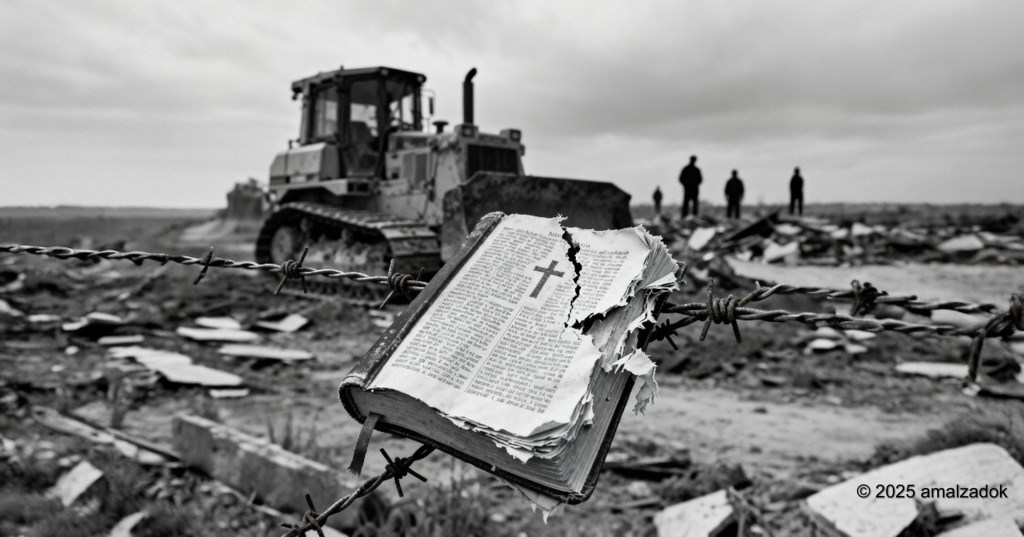
The suffering imposed upon Palestinians is not accidental; it is systemic, rationalized, and sanctified by Christian Zionist rhetoric. Settlements expand, homes are bulldozed, and families are dispossessed—all hymned as part of “God’s plan.” The war in Gaza, marked by mass civilian casualties, deprivation, and the near-total destruction of entire neighborhoods, is excused and even celebrated by some evangelicals who see it as prophecy fulfilled. As a recent church statement put it, “Silence in the face of genocide is complicity.”
Christian Zionism’s influence has helped normalize the language of manifest destiny, American exceptionalism, and apocalyptic expectation. Believers are taught to see Middle East policy through the lens of signs and wonders, not international law or basic moral reasoning. The rights, dignity, and suffering of Palestinians—and of all “others”—are rendered invisible, collateral damage on the road to Armageddon.
This is the theology of genocide: not that Christian Zionism merely ignores suffering, but that it sanctifies and enables it. It transforms violence into virtue, treating Palestinian resistance not as a struggle for justice but as an “obstacle” to divine promise. Churches that dare challenge this narrative face accusations of heresy, anti-Semitism, and godlessness, even as global ecumenical bodies—including the World Council of Churches—denounce Zionist ideology as a “corruption of the biblical message of love, justice, and reconciliation.”
The repercussions ripple across the world. Christian Zionism recasts US policy, endangers long-standing alliances, sabotages peace initiatives, and emboldens far-right movements in Europe, Latin America, and Africa. Its logic—tribal absolutism, denial of compassion, and scriptural literalism—has bled into other religious conflicts. It equips new batches of believers to turn away from dialogue, compromise, or forgiveness, instead weaponizing faith for supremacist ends.
Why does this matter? Because the cost is counted in bodies, not ideas. The ongoing Nakba—the displacement, dispossession, and attempted erasure of Palestinians—is not a distant footnote, but our era’s scandal. In Gaza, in the West Bank, in shrinking enclaves; in refugee camps across the region, families attempt to survive while the most powerful Christians on earth promote theology that deems their suffering sacred inevitability.
On every moral and theological scale, Christian Zionism is not just mistaken but lethal. It betrays the Gospel’s most central claims: “Blessed are the peacemakers”; “Love your neighbor as yourself”; “Let justice roll on like a river.” It recasts Jesus the healer, comforter, and peacemaker as a general of drone armies, a patron of border walls, a silent watcher over ethnic cleansing.
The call now is not just to critique but to resist—to remember and never forget. Churches, theologians, and everyday people must reclaim scripture from political corruptions, restore solidarity with the oppressed, and voice collective repentance for complicity in suffering. Silence is complicity; scripture is not an excuse for genocide; and theology is not property of empire.
In sum, Christian Zionism weaponizes faith into a tool of violence, enables policies that devastate the Palestinian people, and shapes global politics in ways that threaten peace and justice for all. This ideology must not be spiritualized, sanitized, or ignored—it must be named, confronted, and repudiated by all who hold the name of Christ or honor the memory of those who suffer. Otherwise, the world will remember Christianity not as a force for liberation, but as an accomplice to betrayal and destruction.
Christian Zionists are not Christians, because they clearly move in directions opposite to Jesus and everything He stands for. Christian Zionists are heretics, belonging to a death cult called Zionism.
References
1. Al-Shabaka. (2024, June 29). The dangerous exceptionalism of Christian Zionism. https://al-shabaka.org/briefs/the-dangerous-exceptionalism-of-christian-zionism/
2. Culture Matters. (2025, October 29). ‘Christian Zionism’: A useful idiot for genocide. https://culturematters.org.uk/christian-zionism-a-useful-idiot-for-genocide
3. European Lutheran Church in America (ELCA). (2020, October 27). An ethical critique of Christian Zionism. https://learn.elca.org/jle/ethical-critique-christian-zionism/
4. Isaac, M. (2022, November 25). Christian Zionism as imperial theology. Britain Palestine Project. https://britainpalestineproject.org/rev-dr-munther-isaac-christian-zionism-as-imperial-theology
5. Jerusalem Declaration on Christian Zionism. (2006). https://www.oikoumene.org/resources/documents/jerusalem-declaration-on-christian-zionism
6. Kairos Palestine. (2009). Kairos Palestine document. https://kairospalestine.ps/index.php/resources/kairos-blog/935-christian-zionism-through-palestinian-eyes
7. Logos Journal. (2025, June 24). Christian Zionism and American foreign policy: Paving the road… https://logosjournal.com/christian-zionism-and-american-foreign-policy
8. Political Theology. (2025, March 21). In Christ’s name: Christian Zionism and the liquidation of the Gaza… https://politicaltheology.com/in-christs-name-christian-zionism-and-the-liquidation-of-the-gaza
9. Sizer, S. (2002). Christian-Zionism-PhD-Thesis. https://stephensizer.com/Christian-Zionism-PhD-Thesis.pdf
10. TRT World. (2025, January 28). Does Israel have a biblical right over Palestine? https://trtworld.com
11. The Conversation. (2024, December 19). Palestinian Christians call on western churches to ‘humanize’ the people of Gaza. https://theconversation.com/palestinian-christians-call-on-western-churches-to-humanize-the-people-of-gaza
12. Harvard Religion and Public Life. (2025, April 28). Christ in the rubble: Faith, the Bible, and genocide in Gaza. https://rpl.hds.harvard.edu/christ-in-the-rubble-faith-the-bible-genocide-gaza
13. Christian Socialism. (2024, July 28). Christian Zionism and the unseeing of the people. https://christiansocialism.com/christian-zionism-and-the-unseeing-of-the-people/
©️2025 Amal Zadok. All rights reserved.
Subscribe and never miss an article!
 Think and be Free!