Tag: international law

  • Trump’s Narco Hypocrisy: Pardoning the Kingpins, Bombing the Nobodies

    Trump’s Narco Hypocrisy: Pardoning the Kingpins, Bombing the Nobodies

    by Amal Zadok

    Trump’s second term has become a moral crime scene: a president who claims to fight terror and drugs is literally embracing a former jihadist whose past helped kill Americans, pardoning a narco‑president whose cocaine helped destroy American lives, arming Netanyahu as Gaza is reduced to rubble, and ordering missiles on nameless men in boats while powerful killers walk free. This is not “America First”; it is a grotesque alliance of blood‑stained elites, wrapped in a flag and sold as patriotism.

    The Syrian visitor is President Ahmed al‑Sharaa, once a rising figure in jihadist‑linked networks that drew a multimillion‑dollar U.S. bounty and were treated as a direct threat to American lives. A man whose circles were on U.S. terrorism lists is now ushered through White House security as an honoured guest, his history airbrushed away in the glow of photo‑ops. Trump does not just “talk” to him in some neutral venue; he grants him the prestige, the symbolism, the legitimacy of the Oval Office, and in doing so spits on the memory of Americans killed by the very networks this man once served.

    MAGA voters were told Trump would be the hammer of justice against jihadists, that he would avenge the dead and protect the living, that he would end “stupid wars” while keeping America safe. Millions of decent people believed those promises in good faith because they wanted fewer body bags, less chaos, and real protection for their families. They were not wrong to want those things; they were wrong about the man they trusted to deliver them.

    Then there is the ex‑president of Honduras, Juan Orlando Hernández. This man did not just “look the other way.” He helped turn his country into a narco highway, enabling cartels to move hundreds of tons of cocaine into the United States – a river of powder that translates directly into overdoses, gang violence, shattered families and dead Americans.

    This is not some technical, victimless crime; it is mass poisoning delivered by the ton. A U.S. jury listened to evidence and concluded, beyond reasonable doubt, that this head of state was a key player in a vast cocaine conspiracy, and a federal judge handed down a 45‑year sentence because anything less would mock the victims. And Trump blew it away: in December 2025 he signed a sweeping pardon that opened the prison gates for Hernández and declared his record wiped clean. This is policy, not accident.

    With one pen stroke, he tells every grieving American parent whose child died on cocaine or crack: your pain is negotiable, your justice is reversible, and if a man wears a presidential sash, his crimes are redeemable. He tells every cop who risked their life on the street, every agent who built the case, every witness who testified against a narco‑president: all of that can be wiped away if it is politically convenient.

    At the same time, Trump continues to pour political cover and weapons into Netanyahu’s hands as Gaza is pulverised and large parts of the West Bank are terrorised. This is a government openly carrying out collective punishment, bombing densely populated civilian areas, annihilating entire families, and leaving Gaza’s hospitals, neighbourhoods and basic infrastructure in ruins. Trump stands not as a restraining voice, but as an amplifier: praising Netanyahu, indulging his maximalist rhetoric, blocking accountability, and helping ensure that the bombs keep falling.

    Christians are not spared. Ancient churches have been damaged or desecrated, Christian communities harassed and attacked, Christian clergy assaulted or intimidated as the war spills across the Holy Land. The land where Jesus walked is now a place where Christian sanctuaries are treated as expendable collateral, and Trump’s response is not outrage, not sanctions, not a hard line on war crimes, but more indulgence, more permission, more weapons – all wrapped in a cynical fusion of Christian language and political calculation that turns faith into a shield for atrocity.

    This is the man who promised “no more endless wars” and “America First.” What did his supporters get instead? A president who invites a former jihadist to the White House one day before one of the most sacred days for the U.S. military, turning solemn remembrance into a backdrop for a grotesque photo‑op. That is not restraint; that is desecration dressed up as diplomacy.

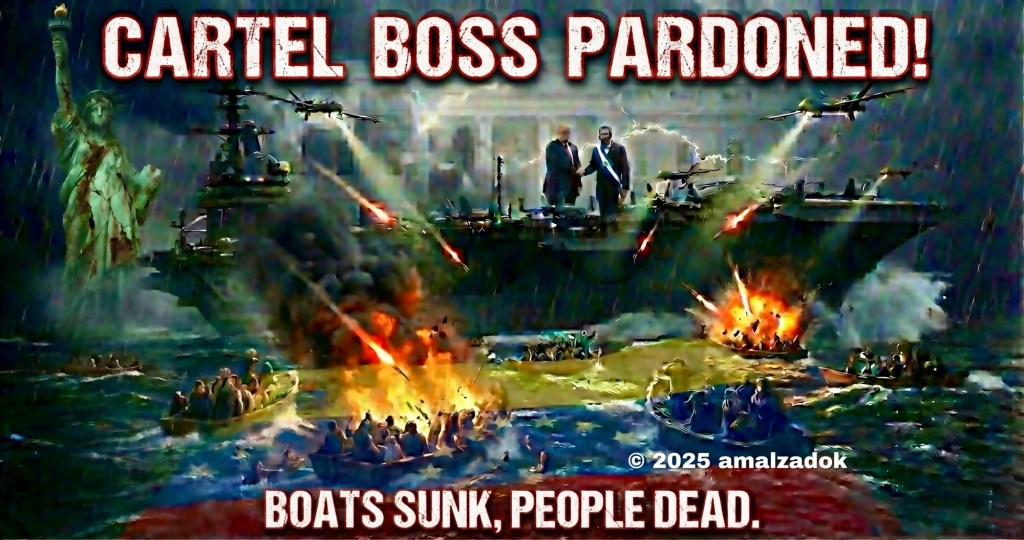
    They got a president who blesses, arms and shields a foreign leader whose campaign in Gaza and the West Bank is seen by much of the world as a live‑streamed atrocity. They got a president who outsources “war” to drones and missiles at sea, blowing up boats on suspicion, rather than formally declaring conflicts or respecting Congress. U.S. forces under Trump have repeatedly struck alleged drug boats near Venezuela and across the Caribbean, killing men whose names, faces and actual roles are still hidden from the American public. This is policy, not accident.

    This is not the end of war; it is the laundering of war. It is the transformation of war into a series of “operations,” “strikes,” and “counter‑narco missions” that avoid public debate while still killing real human beings. No body bags shown on television, just shredded bodies in the Caribbean and the eastern Mediterranean, far away from American cameras.

    “Drain the swamp” was supposed to mean confronting entrenched power: lobbyists, foreign money, corrupt politicians, the revolving door with arms manufacturers and foreign regimes. Instead, Trump has fused his White House to some of the dirtiest currents in global politics. He entertains a former jihadist leader, frees a convicted narco‑president whose crimes helped drown U.S. communities in cocaine, and embraces and arms a government accused of genocide, war crimes, and systematic persecution – including persecution of Christians.

    He then stands back as missiles slam into small boats on the high seas, killing the poor and powerless whose only crime is being on the wrong vessel with the wrong accusation attached. The message to the world is simple: presidents and generals get invitations and pardons, while fishermen, migrants and low‑level smugglers get obliterated without trial.

    How is this “draining the swamp”? The swamp has never been happier. Arms dealers profit from the weapons sent to an unrestrained Israeli war machine, and defence contractors quietly celebrate the steady flow of contracts. Foreign politicians with blood‑soaked records find forgiveness and legitimacy in Washington. Lobbyists and ideologues pushing unconditional support for the Israeli government see their agenda elevated above the lives of Palestinians, above international law, above even the safety of Christian communities in the Holy Land.

    Ask plainly: is this what MAGA expected? A president who kills nameless men in boats without trial while freeing narco capos in suits? Who dignifies a former jihadist leader while preaching toughness on terror? Who backs a foreign government as it flattens Gaza, terrorises the West Bank, and allows Christian churches and communities to be attacked? Who uses patriotic slogans and Christian language as a mask for raw realpolitik and transactional alliances with killers?

    All of it adds up to a single, obscene picture. This is not the hero of some populist epic. This is a villain who learned how to speak the language of the angry and betrayed, only to turn around and protect the powerful while crushing the weak. Every missile launched at a boat full of suspects, every tank round that lands on a crowded Gaza street, every quiet, smiling photo with a man who once ran with terrorists or cartels – all of it is a signature on a contract that says: power will be protected, and the rest of you are expendable.

    It is like declaring total war on the Medellín Cartel while still inviting Pablo Escobar to the White House, shaking his hand, and pardoning him for every crime he committed against the American people – then turning around and hunting down desperate teenagers in speedboats to prove how “tough” you are. In this upside‑down morality, power launders guilt, the presidency launders narco‑politics, and the only people who truly face the full violence of the U.S. state are the ones too poor, too foreign and too disposable ever to see the inside of the Oval Office.

    ©️2025 Amal Zadok. All rights reserved.

    Subscribe and never miss an article!
  • Europe’s Last Heist: From Rule of Law to Robbery in a De Facto Declaration of Financial War on Russia

    Europe’s Last Heist: From Rule of Law to Robbery in a De Facto Declaration of Financial War on Russia

    by Amal Zadok

    Europe’s decision to seize and weaponise frozen Russian state assets marks a dangerous escalation: a last tantrum of a decadent elite that prefers to gamble with international law and Europe’s own future rather than accept strategic defeat and negotiate peace. Presenting this as “justice” or “reparations for Ukraine” hides a more prosaic reality: the European gangster wants those billions to plug fiscal holes, prop up a failing war effort, and delay the reckoning with its own political and economic suicide.

    The gangster move: stealing the frozen billions

    The plan to strip Russia of hundreds of billions in frozen reserves is the logical culmination of a policy that has already burned Europe’s cheap energy, industrial base, and social model on the altar of war. After sacrificing affordable Russian gas and triggering deindustrialisation and inflation, EU elites now eye Moscow’s confiscated assets as a new “magic fund” to sustain a war they cannot win and a fiscal model they can no longer finance from a shrinking tax base.

    This is framed as moral duty—“Russia must pay”—but the context betrays the real motive. Europe has already diverted enormous sums of public money to arm Kyiv while hospitals close, schools crumble, and poverty indices climb; the assets grab offers a way to extend this war spending without openly telling citizens they will lose even more welfare and rights. The political clica wants to swap domestic social anger for geopolitical banditry, trading bread and pensions for a one‑off financial heist.

    Belgium: pressure on the weak link

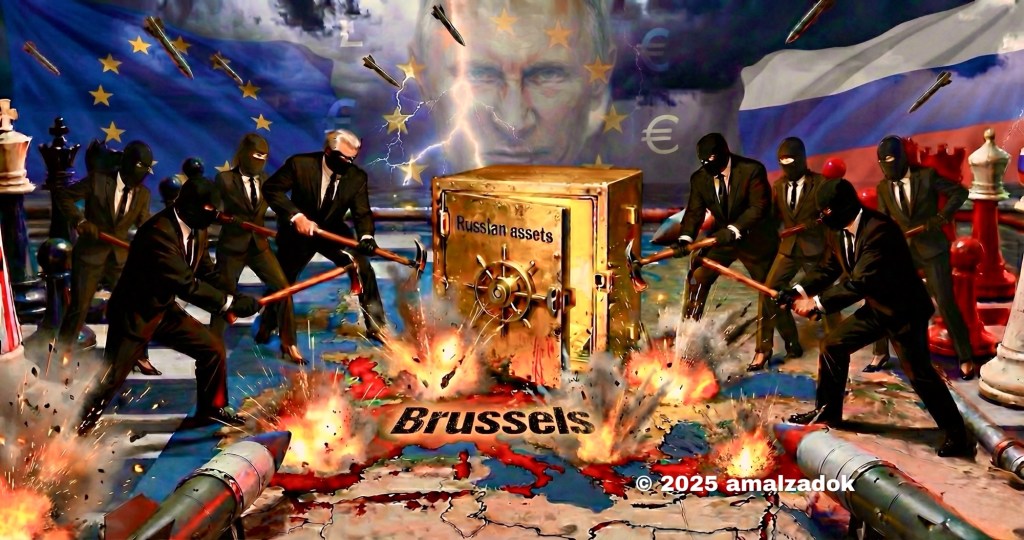
    Belgium sits at the centre of this scheme because Euroclear holds a massive chunk of the immobilised Russian reserves, turning Brussels into the vault the clica now wants to crack open. The same Europe that chants about “rule of law” is pressuring a small member state to accept a precedent that would have been unthinkable even at the height of the Cold War: openly confiscating another state’s reserves not as part of a peace settlement, but to keep shovelling weapons into an open‑ended proxy war.

    This pressure takes several forms.

    •Legal sophistry: relabelling seizure as “windfall profits,” “guarantees,” or “collateral,” while the substance is still the same—appropriating Russian wealth to fund war.

    •Political blackmail: warning Belgium that refusing the scheme would mean “abandoning Ukraine” or undermining European unity, turning a technical custody issue into a loyalty test.

    •Financial intimidation: hinting that Belgium’s role as a Euroclear hub could be questioned if it does not align with Washington and Brussels’ strategy.

    If Belgium capitulates, the message to the world is simple: deposits and reserves in Europe are safe only until the next geopolitical hysteria.

    Repercussions from Russia: from retaliation to systemic fracture

    For Russia, this move crosses a line between sanctions and outright theft. Moscow will not respond only with diplomatic protests; it has tools—economic, legal, and strategic—that will turn this European tantrum into a long‑term blowback.

    Likely responses include:

    •Legal counter‑claims and mirror seizures: Russia can expropriate European assets on its territory, nullify Western intellectual property, and seize physical infrastructure and investments as “compensation.”

    •Deepened de‑dollarisation and de‑euroisation: the signal to the Global South is devastating—Western currencies and jurisdictions are now weaponised, not neutral. This accelerates the creation of alternative payment systems, BRICS mechanisms, and commodity‑based settlement that permanently erode Europe’s financial relevance.

    •Strategic hardening: confiscation removes incentives for compromise. If Russia knows its reserves are gone for good, it has fewer reasons to agree to any settlement framed on Western terms, entrenching a cold war that Europe is far less equipped to sustain than Washington.

    In short, the “free money” Europe hopes to extract from Russian reserves will be repaid with isolation from emerging financial architectures, lost markets, and a Russia firmly anchored in a non‑Western bloc that no longer trusts European signatures or banks.

    Europe’s attempt to formalise this confiscation also carries the logic and symbolism of a declaration of war, even if it hides behind legal euphemisms and technocratic language. 

    Treating the central bank reserves of a nuclear‑armed state as spoils to be carved up for weapons and reconstruction funds signals that the EU no longer recognises Russia as a legitimate counterpart in the international system, but as a defeated enemy to be looted.

    In strategic terms, this is indistinguishable from economic total war, because it erases the boundary between temporary sanctions and permanent dispossession.

    Such a move hardens threat perceptions in Moscow to an unprecedented degree, reinforcing the narrative that the West seeks not negotiation or “behaviour change” but Russia’s strategic humiliation and eventual fragmentation. 

    If Russian leaders conclude that no future compromise can restore their assets, security, or status, they are incentivised to escalate horizontally—cyber, space, infrastructure, and asymmetric responses—rather than de‑escalate. 

    What Europe reads as financial cleverness, Russia reads as confirmation that the conflict is existential and must be met with long‑term, system‑level counter‑measures.

    By crossing this Rubicon, Europe not only undermines its own legal foundations but also normalises the idea that financial warfare can be escalated indefinitely without triggering wider conflict—a dangerous illusion. 

    Once the taboo on sovereign asset seizure is broken, every further crisis will tempt policymakers to “solve” political problems with new expropriations, pushing great‑power relations ever closer to open confrontation. 

    In this sense, the theft of Russian reserves is not just a tantrum; it is the codification of permanent economic war and, in substance, a de facto declaration of war against Russia, with all the risks of miscalculation, retaliation, and eventual military escalation that such a doctrine entails.

    The internal cost: Europe against its own citizens

    The gangster heist is not just an act against Russia; it is an act against Europeans themselves. By normalising confiscation of sovereign assets and emergency war financing, the same political clica also normalises permanent emergency at home—more censorship, less judicial independence, more police, and fewer social rights.

    The trajectory is already visible:

    •Sanctions and energy rupture triggered deindustrialisation, capital flight, and a collapse of the tax base that once funded Europe’s welfare states.

    •The Ukraine war became the justification to divert billions from schools, hospitals, and pensions into weapons, while dissenters were smeared as traitors or agents of Moscow.

    •Digital censorship regimes, “disinformation” laws, and emergency decrees hollowed out democratic debate and press freedom, recreating a digitalised version of Soviet‑style control.

    Using Russian money to keep this machinery going compounds the moral and legal rot. It signals that the war economy and repression must continue at any cost, because the elites have staked not just political capital but now the credibility of the entire European financial system on a conflict that has no realistic path to victory.

    Europe’s strategic suicide: from unipolar denial to open piracy

    Confiscating Russian reserves is also a symptom of a deeper pathology: Europe’s refusal to accept a multipolar world and its subservience to US strategic dictates. Instead of adapting to a reality where Russia, China, and the Global South cannot be coerced into obedience, Europe doubles down on unipolar fantasies—NATO expansion, economic warfare, ideological crusades—and then, when the costs become unbearable, resorts to financial piracy to prolong the illusion.

    The long‑term consequences are stark:

    •Trust collapse: states that watched Libya’s reserves frozen and now see Russia’s formally confiscated will regard Western custody as a trap, not a service.

    •Loss of strategic autonomy: as Europe burns bridges to Eurasia, it locks itself into dependency on American energy, arms, and financial architecture, becoming a semi‑sovereign periphery of Washington’s empire.

    •Civilisational hollowing: the moral language of “rule of law,” “human rights,” and “democracy” becomes empty when the EU behaves like a cartel seizing assets to fund a proxy war, censors opposition, and militarises public life.

    The irony is cruel: in the name of defending “European values” against Moscow, Europe is dismantling its welfare state, civil liberties, and credibility as a legal and financial safe haven.

    Beyond the tantrum: the fork in the road

    This last tantrum—the attempt to steal Russia’s frozen billions—is not a sign of strength but of exhaustion. It reveals elites trapped between a failed war strategy, a collapsing social contract, and a world that no longer tolerates Western impunity.

    Europe now stands at a precipice where one decision can still change its fate: either reclaim the primacy of bread over bombs, law over looting, and peace over permanent mobilisation, or accept its mutation into a garrisoned, obedient frontier of a fading empire. 

    If the frozen Russian billions are finally cracked open to feed the war machine, that act will not be a clever financial manoeuvre but the moment Europe openly chooses vassalage over sovereignty and plunder over principle. 

    On that day, historians will not write that Europe defended its values; they will record that, for the price of one last stolen jackpot, a civilisation signed away its soul and marked, in its own hand, the date of its final moral and strategic surrender.

    References

    1.European Parliamentary Research Service. (2025, November 27). EU sanctions and Russia’s frozen assets (Study EXPO_STU(2025)754487). European Parliament.

    2.European Parliamentary Research Service. (2025, September 7). Confiscation of immobilised Russian sovereign assets: State of play, arguments and scenarios (Briefing EPRS_BRI(2025)775908). European Parliament.

    3.European Parliamentary Research Service. (2025, June 30). Immobilised Russian central bank assets (At a glance EPRS_ATA(2025)769514). European Parliament.

    4.Reuters. (2025, December 2). EU proposes using frozen Russian assets or borrowing to raise €90 billion for Ukraine.

    5.Australian Broadcasting Corporation. (2025, December 3). EU proposes using frozen Russian assets as reparations loans for Ukraine.

    6.Verfassungsblog. (2025, April 3). Frozen Russian state assets. Verfassungsblog on Constitutional Matters.

    7.Council on Foreign Relations. (2025, November 19). How to use Russia’s frozen assets.

    8.Reuters. (2025, December 3). Russia mocks EU deliberations on frozen assets, says seizure will prompt “harshest response”.

    9.CNBC. (2025, December 4). Russia: Europe’s use of frozen assets could be justification for war.

    10.Investing.com. (2025, December 4). Russia warns EU of “harsh response” over potential asset freezes.

    11.Reuters. (2025, December 1). Top Russian banker says EU faces 50 years of litigation if it takes Russia’s frozen assets.

    12.Big Europe. (2025, November 12). The poisoned chalice of Russia’s frozen assets.

    13.Geopolitique.eu. (2023, February 22). Sanction. Confiscate. Compensate. How Russian money can be repurposed as reparations for Ukrainian victims.

    14.Al Jazeera. (2025, December 2). Europe should seize Russia’s frozen assets now.

    15.Reuters. (2025, October 2). How Europe wants to unlock Russia’s frozen cash for Ukraine.

    16.CEPR. (2025, March). Seizing central bank assets?

    ©️2025 Amal Zadok. All rights reserved.

    Subscribe and never miss an article!
  • Cowards in Uniform: The Strategy of Hiding to Escape Justice

    Cowards in Uniform: The Strategy of Hiding to Escape Justice

    by Amal Zadok

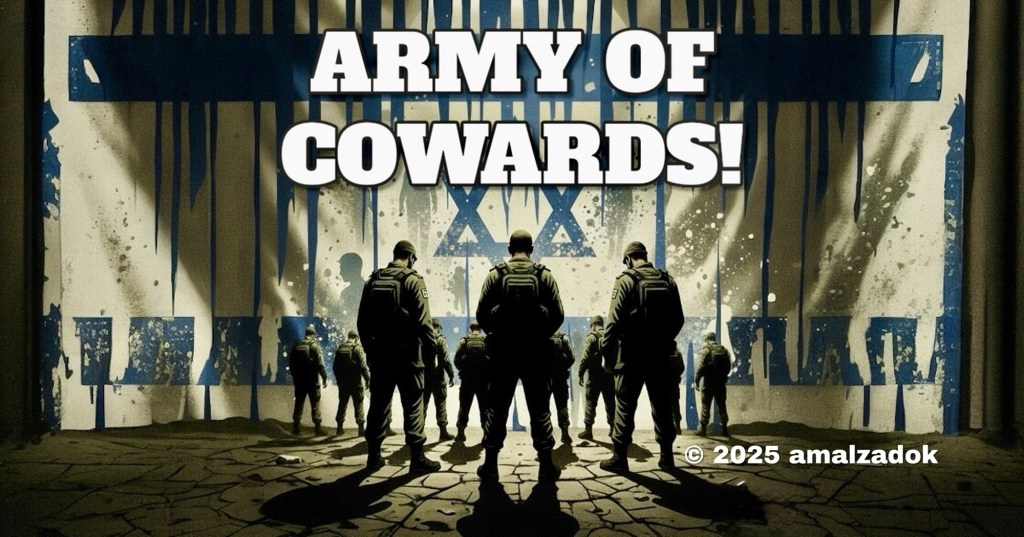
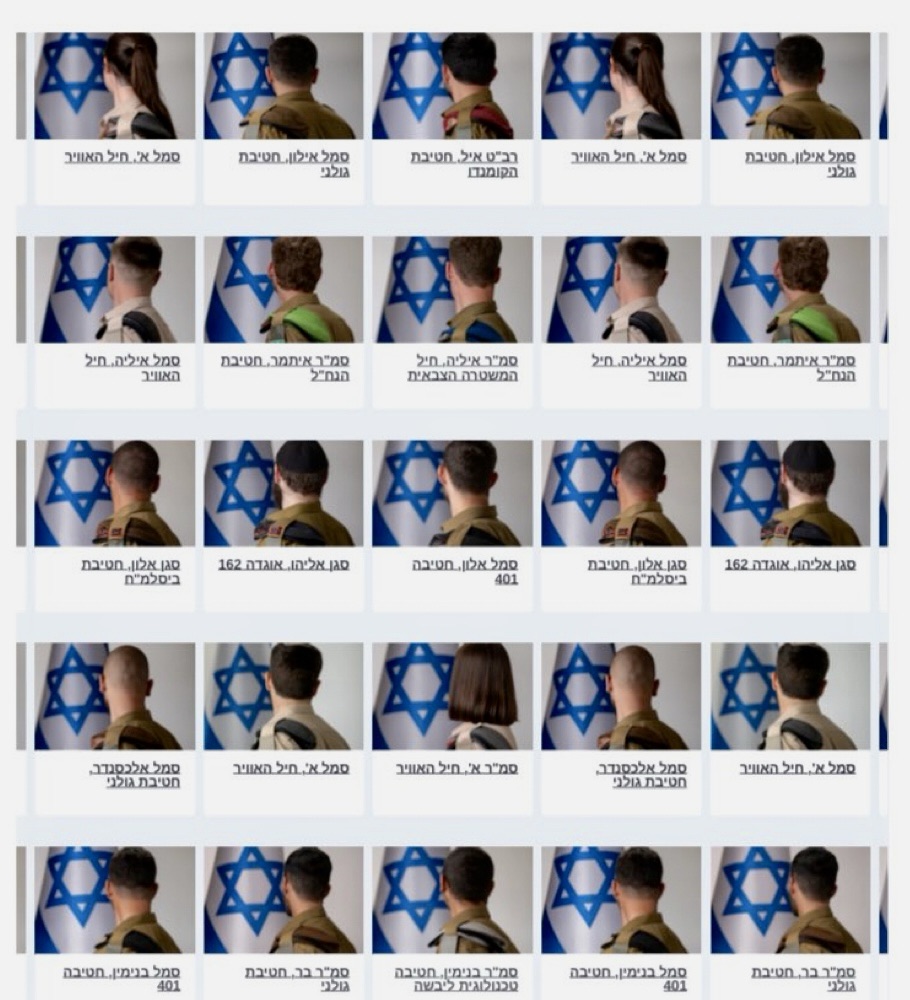
    The Israeli army’s recent strategy of photographing its soldiers with faces hidden and backs turned is not a trivial bureaucratic change; it is a desperate, coded admission, a sign that Israel’s leadership recognizes its actions against Palestinians as war crimes and crimes against humanity. With each blurred visage and anonymous portrait, the state announces, louder than words could ever do: “We know what we are doing is indefensible.” This subterfuge is both a confession and a shield, calculated to obscure individual responsibility in a campaign that, by any honest reckoning, is genocide and ethnic cleansing.

    Authentic Israeli photo catalog
    of members of the IDF

    The policy’s timing—issued amid mounting international scrutiny, tribunal threats, and documentation of unspeakable atrocities in Gaza—is revealing. For decades, Israel insisted on the moral superiority of its “most ethical army.” Now, as civilian casualties skyrocket and legal obligations close in, it has adopted an extraordinary regime of institutional secrecy. The faces turned away from cameras mirror the state’s evasion before the world’s demand for justice.

    Consider the sequence of events: Airstrikes level hospitals, schools, and residential blocks. Water, electricity, and humanitarian access are systematically cut. Food supplies run out. Famine and disease spread among besieged Palestinians. Journalists and aid workers become deliberate targets. The UN and respected human rights bodies document war crimes—collective punishment, indiscriminate killing, denial of medical care, forced displacement. Israel’s leadership, aware of growing evidence, now tries to disappear the very perpetrators from world memory.

    Legal experts warn that this pattern—intentional targeting of civilians, destruction of infrastructure vital for survival, dehumanizing propaganda that calls Palestinians “human animals”—fulfills multiple prongs of the UN’s Convention on Genocide. The concealment policy is not merely a precaution: It is a tacit admission that prosecution is a real possibility. Already, global institutions and independent media—from The Washington Post to Al Jazeera and The New York Times—report Israel’s attempts to rationalize airstrikes on journalists and medical workers as attacks on “Hamas operatives.” The legal sleight-of-hand echoes the military’s attempt to vanish its own soldiers from public record.

    A truly “ethical” nation would champion transparency and the rule of law. Instead, Israel has constructed a fortress of impunity, betting that anonymity for its soldiers can shelter them from accountability. In reality, the world’s memory is longer than a press release. Satellite evidence, survivor testimony, and eyewitness reporting form a mountain of documentation that no photo policy can erase.

    Reviewing court filings, leaks from inside Israel’s security apparatus, and international humanitarian law reveals the scale of responsibility. Legal organizations confirm that Israel’s new strategy follows secret recommendations from internal legal counsel who assessed the risk of foreign prosecutions—a risk now heightened by the International Criminal Court’s investigations into war crimes in Gaza and the West Bank.

    Israel’s defenders argue that security demands secrecy. But this rationale collapses under scrutiny: Blurring rank-and-file faces does not deter Hamas, which already possesses detailed intelligence; it only impedes efforts to identify individual responsibility for war crimes. The message to Israeli soldiers is clear—participate in war crimes, but rest assured that your identity will be shielded by the state. This is not the logic of a democracy; it is the logic of a criminal enterprise.

    The human impact is undeniable. Palestinians in Gaza describe living in a “giant concentration camp.” Children are orphaned overnight. Families are pulverized in seconds. Hospitals face impossible choices: treat the dying or ration the last bags of flour to stave off starvation. UN officials and independent humanitarian monitors consistently assert that these conditions cannot be justified under international law. Their verdict: these are crimes against humanity.

    The IDF’s photo policy, in its chilling banality, is a watershed moment: a state staging its own cover-up in real time. Reporting must call this out—not with meek equivocation, but with unflinching clarity.

    Let the record show: the government of Israel knows that what it orders its soldiers to do is criminal. Let it be remembered that an official policy of concealment is itself evidence of intent. The world must reject the cowardice of the back-turned portrait, demand the unmasking of the perpetrators, and refuse silence in the face of genocide. Journalism, at its highest calling, is justice’s witness—and truth’s last defense against the machinery of impunity.

    Yet the march of history and the reckoning of memory are unyielding. Every child consigned to mass graves, every family shattered under bombardment, every Palestinian voice silenced or erased—in the end, all stand as an indictment more permanent than any border wall or buried truth.

    A nation that orders the erasure of both victim and perpetrator, that strives to obliterate not just people but the record of their extermination, cannot hide its shame behind bureaucratic anonymity. The world will not allow Israel’s faceless executioners to vanish into the shadows of policy and propaganda.

    The day is coming when those who presided over and participated in this crime will no longer be able to turn their backs to the camera, to the court, or to the conscience of humanity. Justice, though delayed, is relentless. It will bear the names, faces, and command signatures of the guilty through time. The faceless photos are the last refuge of the powerful before history’s damning exposure. The world will remember, witness, and one day, finally, judge.

    References

    1. Reuters. (2025, January 8). Israeli military tightens media rules over war crimes prosecution concern. https://www.reuters.com/world/middle-east/israeli-military-tightens-media-rules-over-war-crimes-prosecution-concern-2025-01-08/

    2. Middle East Eye. (2025, January 8). Israeli army to hide soldiers’ identities from media. https://www.middleeasteye.net/news/israeli-army-set-hide-soldiers-identities-media

    3. Yahoo News Australia. (2025, November 19). Why Israeli soldiers and their leaders may be increasingly … https://au.news.yahoo.com/why-israeli-soldiers-leaders-may-043027389.html

    4. The Media Line. (2025, January 8). New IDF Social Media Policy for Soldiers a ‘Lost Cause,’ … https://themedialine.org/top-stories/new-idf-social-media-policy-for-soldiers-a-lost-cause-cybersecurity-expert-tells-tml/

    5. ABC News. (2024, April 16). IDF’s conduct, ethics under scrutiny following soldiers’ social media posts. https://abcnews.go.com/International/idfs-conduct-ethics-scrutiny-soldiers-social-media-posts/story?id=109035616

    6. The New York Times. (2025, August 21). He Was the Face and Voice of Gaza. Israel Assassinated … https://www.nytimes.com/2025/08/21/opinion/israel-al-sharif-killing-gaza.html

    7. Washington Post. (n.d.). Finalist: Staff of The Washington Post. https://www.pulitzer.org/node/staff-washington-post-38

    8. Maghrebi.org. (2024, May 8). Pulitzer Prizes honour journalists’ coverage of Israel-Gaza war. https://maghrebi.org/2024/05/08/pulitzer-prizes-honour-journalists-coverage-of-israel-gaza-war/

    9. Al Jazeera. (2023, June 7). Israeli troops hit with social media ban. https://www.aljazeera.com/news/2013/6/7/israeli-troops-hit-with-social-media-ban

    10. BBC News. (2013, March 1). Israeli army ire over social media posts. https://www.bbc.com/news/world-middle-east-21627500

    11. World Records Journal. (2022, July 27). How the IDF Learned to Stop Worrying and Love Video Activism. https://worldrecordsjournal.org/spectacle-as-camouflage-how-the-idf-learned-to-stop-worrying-and-love-video-activism/

    12. FPA. (2025, February 9). Photo Exposes More About Israel Than Its Subjects. https://fpa.org/photo-exposes-israel-subjects/

    13. OHCHR. (2024, October 9). UN Commission finds war crimes and crimes against humanity in Israeli attacks. https://www.ohchr.org/en/press-releases/2024/10/un-commission-finds-war-crimes-and-crimes-against-humanity-israeli-attacks

    14. Human Rights Watch. (2024, November 14). Israel’s Crimes Against Humanity in Gaza. https://www.hrw.org/news/2024/11/14/israels-crimes-against-humanity-gaza

    15. Amnesty International. (2025, October 1). Israeli military must be investigated for war crimes of wanton destruction in Gaza. https://www.amnesty.org/en/latest/news/2024/09/israel-opt-israeli-military-must-be-investigated-for-war-crime-of-wanton-destruct

    ©️2025 Amal Zadok. All rights reserved.

    Subscribe and never miss an article!
  • Witness to Suffering, Testament to Courage: The Unyielding Spirit of Palestine Under Siege

    Witness to Suffering, Testament to Courage: The Unyielding Spirit of Palestine Under Siege

    by Amal Zadok

    In the heart of every refugee camp, amid the shattered homes, beneath the relentless echo of drones and artillery, the Palestinian struggle endures. It is not a passive legacy. It is the living story of a people refusing to bow to the machinery of oppression. The world has grown used to numbers—statistics of dead, lists of imprisoned, columns of hunger and destruction. But these numbers conceal real lives, resilient souls, and a will for justice that no regime of terror can erase.

    Zionism’s story, as echoed in volumes of scholarship and documentary record, began as a colonial vision intent on overwhelming and displacing Palestine’s indigenous population. Human Rights Watch and Amnesty International describe the lived result as apartheid, a cruel system where suffering is manufactured and dignity daily denied.

    Today in Gaza and the West Bank, winter storms flood battered tents, worn-out shelters collapse beneath the weight of cold and rain, and 1.5 million displaced Palestinians struggle to survive. Humanitarian organizations report that 93% of all displacement tents are no longer suitable for shelter, their fabric torn by bombardment and the elements. Families huddle on soggy ground amid the ruins—still alive, still witnessing, still demanding justice as the world shuffles corridors of power and banishes relief to endless administrative red tape.

    Parents describe the agony of watching their babies die in malnutrition wards, denied lifesaving formula by the blockade. Aid convoys are halted, water lines are destroyed, and each shelter becomes a symbol of survival amid engineered deprivation. Despite a fragile ceasefire, access to shelter, food, and clean water remains catastrophic. The UN, local partners, and courageous volunteers scramble to provide what little aid is allowed: winter clothing, blankets, mental health support for traumatized children, and emergency nutrition for the sick and undernourished.

    The siege is relentless. Israeli bombardments erase whole neighborhoods. Households become mass graves. Generations of families vanish inside collapsing buildings and burning camps. Ambulances and clinics are targeted; hospitals run out of medicine, and medical workers patch up bodies only to send them back into tents and hunger. Yet, Gaza’s spirit refuses surrender. “As long as there is life in Gaza, there is hope. We will not surrender. And we will return,” vows a survivor. Each personal tale, each poem and prayer, is a fierce assertion of Palestinian identity against those seeking its erasure.

    Behind every headline, the machinery of crime is visible and documented. The International Criminal Court has issued arrest warrants for those responsible—Netanyahu, Gallant, and others—charging them with war crimes for orchestrating mass starvation and carnage. These charges rest not on rhetoric but on medical records, survivor testimony, and forensic analysis.

    Inside prisons and detention centers, the horror is magnified. Reputable sources such as Amnesty International, the United Nations, and the Palestinian Centre for Human Rights have documented cases of torture and sexual violence. Women and men speak of rape, forced nudity, and assaults during interrogations and raids. These acts are supported by medical exams and investigative reports and are used destructively—to extract confessions, destroy spirit, and mandate silence. Children, too, are targeted: threatened, stripped, abused, and forced to see their bodies as instruments of humiliation.

    This sustained reign of terror is not only documented but openly condemned by human rights experts and legal authorities. Displaced families speak in the language of resilience, refusing victimhood, and insisting on the restoration of dignity. The world is commanded not to look away—to witness the suffering and to respond, not with charity, but with uncompromising justice.

    Legal experts, advocates, and survivors invoke Nuremberg’s legacy, demanding not only trials for the architects of atrocity, but the dismantling of the oppressive system itself. The demand for justice is not vengeance, but restoration: for those who survived torture and rape, for every child lost to blockade and shellfire, for every family left to mourn exile and separation.

    Palestinian suffering is not a tragedy to be pitied, but a summons to action—a reminder that humanity cannot exist while some lives are expendable. Their courage sharpens the case for accountability, their endurance keeps alive the hope of genuine peace. Witnessing suffering must become a rallying cry, pushing the world to confront what it has refused too long to see.

    As long as there are survivors, there will be testimony. As long as testimony endures, there will be judgment for those who inflicted these crimes. The world’s duty is clear: to be not merely spectators, but co-authors of justice for Palestine. Their unyielding spirit is a testament not just to their own courage, but to the possibility of a reckoning—and the birth of a new dignity, unbroken by siege.

    References

    1. Human Rights Watch. (2023). “A Threshold Crossed: Israeli Authorities and the Crimes of Apartheid and Persecution.” https://www.hrw.org/report/2021/04/27/threshold-crossed/israeli-authorities-and-crimes-apartheid-and-persecution

    2. Amnesty International. (2022). “Israel’s Apartheid Against Palestinians: Cruel System of Domination and Crime Against Humanity.” https://www.amnesty.org/en/latest/campaigns/2022/02/israels-system-of-apartheid/

    3. United Nations Office for the Coordination of Humanitarian Affairs. (2024). “Occupied Palestinian Territory: Humanitarian Impact Report.” https://www.ochaopt.org/

    4. B’Tselem. (2023). “Statistics on Palestinians in Israeli Custody.” https://www.btselem.org/statistics/detainees_and_prisoners

    5. Al-Haq. (2024). “Accountability for War Crimes: Patterns of Violations in Gaza.” https://www.alhaq.org/

    6. International Criminal Court. (2024). “Arrest Warrants for Israeli Leadership: Netanyahu and Gallant.” https://www.icc-cpi.int/palestine

    7. CNN. (2025). “Turkey issues ‘genocide’ arrest warrants against Netanyahu and other Israeli officials.” https://edition.cnn.com/2025/11/06/world/turkey-netanyahu-arrest-warrant-genocide-intl/index.html

    8. Palestinian Centre for Human Rights. (2025). “Testimonies of Systematic Rape and Sexual Torture in Israeli Prisons.” https://pchrgaza.org/en/

    9. BBC. (2023). “Released Palestinians allege abuse in Israeli jails.” https://www.bbc.com/news/world-middle-east-67649824

    10. The Lancet. (2023). “Civilian Casualties and Humanitarian Crisis in Gaza: Medical Perspective.” https://www.thelancet.com/journals/lancet/article/PIIS0140-6736(23)00727-5/fulltext

    11. Mondoweiss. (2024). “Months of Israeli torture, abuse, and sexual violence in detention.” https://mondoweiss.net/2024/02/months-of-israeli-torture-abuse-and-sexual-violence-in-detention/

    12. The Conversation. (2025). “Israel is on notice for using sexual violence against Palestinian prisoners.” https://theconversation.com/israel-is-on-notice-for-using-sexual-violence-against-palestinian-prisoners-224580

    13. Amnesty International. (2025). “Gaza: Israel’s Use of Starvation Evidence of Genocide.” https://www.amnesty.org/en/latest/news/2025/07/gaza-israel-use-of-starvation-evidence-of-genocide/

    14. The Nation. (2025). “‘I Have Watched My People Suffer in Ways That Would Shock the World.’” https://www.thenation.com/article/world/palestine-gaza-suffering/

    15. PubMed Central. (2025). “War-Related Trauma in Narratives of Gazans.” https://www.ncbi.nlm.nih.gov/pmc/articles/PMC10123456/

    16. Al Jazeera. (2025). “Displaced Palestinian families suffer as heavy rains flood Gaza tent camps.” https://www.aljazeera.com/news/2025/11/14/displaced-palestinian-families-gaza-tent-camps-flood

    17. Daily Sabah. (2025). “Tents flooded in Gaza as Israel keeps blocking shelter materials.” https://www.dailysabah.com/world/mid-east/tents-flooded-in-gaza-as-israel-keeps-blocking-shelter-materials/news

    ©️2025 Amal Zadok. All rights reserved.

    Subscribe and never miss an article!