Tag: imperialism

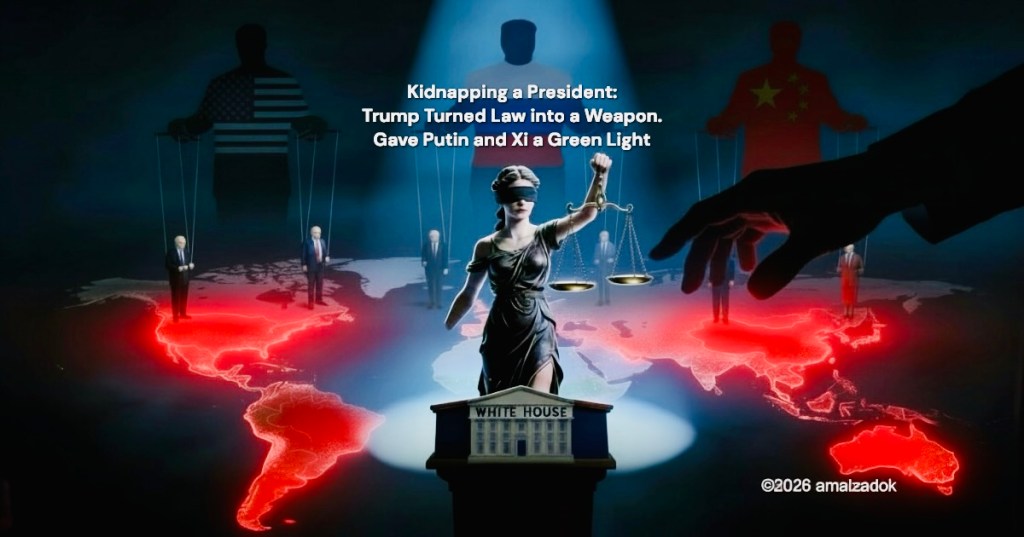
  • Kidnapping a President: How Trump Turned Law into a Weapon and Gave Putin and Xi a Green Light

    Kidnapping a President: How Trump Turned Law into a Weapon and Gave Putin and Xi a Green Light

    by Amal Zadok

    Trump’s armed kidnapping of Nicolás Maduro is not just another reckless intervention; it is the moment the United States openly abandons the legal order it uses to judge its enemies. One operation in Caracas manages to break core rules of international law, trample the Constitution’s allocation of war powers, and weaponize domestic criminal statutes into a pretext for cross‑border regime decapitation. This is not mere hypocrisy; it is a structural shift toward a world where armed force wears the thin mask of law while tearing out the law’s foundations.​

    Start with the international plane. Article 2(4) of the UN Charter prohibits the threat or use of force against the territorial integrity or political independence of any state, except in self‑defence against an armed attack or with Security Council authorization. None of those conditions existed: Venezuela had not attacked the United States, there was no imminent armed assault, and the Security Council had authorized nothing. Airstrikes around Caracas and the insertion of US forces to seize a sitting head of state are the paradigmatic use of armed force that the Charter was written to forbid, regardless of how loudly Washington chants “narco‑terrorism” or “democracy.”​

    The raid also violates the principles of sovereign equality and non‑intervention in Articles 2(1) and 2(7) and in customary international law. Forcibly removing a president and floating the idea that the US might effectively “run” Venezuela is not influence; it is a direct assault on the political independence of a UN member. That is why UN officials and governments well beyond Maduro’s circle have called the action illegal aggression and a “dangerous precedent” for the global order.​

    Head‑of‑state immunity is the next pillar smashed. Customary international law grants sitting heads of state full personal immunity—immunity ratione personae—from foreign criminal jurisdiction and enforcement measures while they are in office. This shield does not endorse any leader’s morality; it prevents foreign courts and special forces from becoming tools of regime change. By abducting Maduro and hauling him before a New York judge, the United States has effectively claimed that its recognition policy decides who is a head of state and who can be treated as a common fugitive.​

    The extraterritorial kidnapping itself is a further violation. Even advocates of muscular US power concede that seizing a foreign leader from his own soil without consent is a “flagrant violation” of sovereignty and an unlawful abduction under general international law. Several experts argue that the scale and character of the raid reach the level of an “armed attack,” meaning Venezuela would, in principle, enjoy a right of self‑defence against the United States. In one stroke, Washington transforms the law it invokes into a weapon, while shredding the central norm designed to keep interstate violence in check since 1945.​

    Inside the United States, the pattern is equally stark. The Constitution gives Congress the power to declare war, and the War Powers Resolution requires prior consultation “in every possible instance” and prompt notification when American forces enter hostilities. Trump’s own officials had previously acknowledged that ground operations in Venezuela would require congressional authorization—and that they did not have it. Yet the raid went ahead as a fait accompli, with Congress informed after the fact and forced to choose between retroactive acquiescence or a politically suicidal confrontation with an emboldened executive.​

    The UN Charter is also a ratified US treaty and, under Article VI of the Constitution, part of the “supreme Law of the Land.” When a president orders a military operation that plainly contradicts Article 2(4)’s ban on the use of force, he is not just flirting with illegality abroad; he is directing the state to act against a binding treaty that sits at the top of the domestic legal hierarchy. Some constitutional scholars therefore describe the raid as a dual illegality: a violation of international law that simultaneously undercuts the treaty‑supremacy structure of US law itself.​

    The criminal‑law angle exposes the tyrannical core. Extradition treaties, mutual legal assistance and due‑process guarantees are supposed to govern cross‑border arrests; they do not authorize special forces to “pick up” a foreign head of state at gunpoint because US prosecutors filed an indictment. By leaning on the old Ker–Frisbie doctrine—that illegal abduction does not by itself bar a trial—Trump turns a controversial judicial rule into an executive license for kidnapping. What would obviously be kidnapping, conspiracy and unlawful violence for any private actor is rebranded as “policy” when ordered from the Oval Office.​

    At that point, “tyranny” stops being rhetorical and becomes descriptive. A leader who can unilaterally launch cross‑border raids, ignore Congress’s war role, violate binding treaties and twist criminal procedure into a shield for his own extralegal violence is not meaningfully bound by law. He is constrained only by raw power and political calculation. That is exactly the model Russia and China have been waiting for Washington to normalize—and Trump has just handed them the script.​

    Trump has not just broken rules; he has opened a doctrinal Pandora’s box. Moscow can now point to the Maduro operation when it justifies the seizure or assassination of Ukrainian officials as “counter‑terrorism” or enforcement of Russian criminal law. Beijing can frame a lightning move on Taipei as a domestic law‑enforcement action against “secessionist criminals,” citing the American precedent that great powers’ indictments and security narratives override borders, immunity and the UN Charter. The United States spent decades preaching a “rules‑based international order”; in Caracas, it demonstrated that, when the stakes are high enough, what really rules is force wrapped in legal costume.​

    If this stands, the world slides from an imperfect legal order—full of double standards and selective enforcement—into something harsher and more honest: open season, where each great power hunts in its sphere and cites the others’ crimes as precedent. The kidnapping of Maduro is more than a scandal; it is a template that Russia, China and others will eagerly adapt, armed not only with missiles and special forces, but with the very legal arguments Trump has ripped from their cage—a ready‑made script for twenty‑first‑century tyranny dressed up as law.​

    References

    1. ABC News. (2026). Were the US actions in Venezuela legal under international law?
    2. Le Monde. (2026). US attack on Venezuela: What does international law say?
    3. The Conversation. (2026). Were the US actions in Venezuela legal under international law? An expert explains.
    4. Chatham House. (2026). The US capture of President Nicolás Maduro – and attacks on Venezuela – have no justification.
    5. Global Affairs. (2026). International Law and Venezuela’s Maduro.
    6. Opinio Juris. (2026). The United States’ Attack Against Venezuela: Might Does Not Make Right.
    7. UN News. (2026). US actions in Venezuela “constitute a dangerous precedent”.
    8. Justice in Conflict. (2026). Maduro’s Indictment, Head‑of‑State Immunity, and the United States.
    9. Huquq. (2026). The Maduro Case and the Fractured Foundations of Immunity.
    10. Brookings. (2026). Making Sense of the US Military Operation in Venezuela.
    11. CNN. (2026). Trump’s Legal Authority in Venezuela, Explained.
    12. Bloomberg. (2026). Did Maduro’s Seizure Violate US and International Law?
    13. PBS. (2026). Fact‑Checking Trump’s Claims After U.S. Strike on Venezuela and Capture of Maduro.
    14. The New Yorker. (2026). The Brazen Illegality of Trump’s Venezuela Operation.
    15. BBC News. (2026). US Sharply Criticised by Foes and Friends Over Maduro Seizure.
    16. SBS. (2026). From Russia to Iran, Venezuela’s Allies React to the Capture of Maduro.
    17. Time. (2026). How the World Is Reacting to the U.S. Capture of Nicolás Maduro.
    18. CNN. (2026). Maduro’s Capture Is a Blow to China. But on Chinese Social Media …
    19. CBS News. (2026). How Could Trump’s Move Against Venezuela Impact China, Russia, Iran, Cuba?
    20. Völkerrechtsblog. (2026). The U.S. Strikes Against Venezuela and the Credibility of the Anti‑Aggression Norm.
    21. ABC (Australia). (2026). The Venezuela Strike Sets a New Low for the World Order.
    22. CSIS. (2026). The Maduro Raid: A Military Victory with No Viable Endgame.
    23. The New York Times. (2026). Is It Legal for U.S. to “Run” Venezuela After Maduro’s Capture?
    24. The Conversation. (2026). Trump’s Intervention in Venezuela: The 3 Warnings for the World.
    25. The New York Times. (2026). Global Ripples From Venezuela.
    26. Empire Unchained Blog. (2026). Empire Unchained: How the US Capture of Maduro Shattered the Post‑War International Order.

    Appendix: Summary of Laws Broken Internally and Externally by Trump in the Kidnapping of Maduro

    • UN Charter Article 2(4): Prohibits the threat or use of force against the territorial integrity or political independence of any state; breached by airstrikes and the cross‑border raid without self‑defence or Security Council authorization.​
    • UN Charter Articles 2(1) and 2(7) & customary non‑intervention: Require sovereign equality and non‑interference; violated by forcibly removing a sitting president and floating effective US control over Venezuela’s politics.​
    • Customary head‑of‑state immunity (immunity ratione personae): Grants sitting heads of state full personal immunity from foreign criminal jurisdiction and enforcement; ignored by abducting Maduro to stand trial in a US court.​
    • Customary prohibition of extraterritorial abduction: Forbids kidnapping persons, especially senior officials, from another state’s territory without consent; violated by the armed seizure in Caracas.​
    • US constitutional allocation of war powers: Congress’s power to declare war and War Powers Resolution consultation and notification requirements were sidestepped by launching the raid without prior authorization or transparent notification.​
    • Treaty‑supremacy structure (Article VI of the US Constitution): The UN Charter is binding US law; ordering action that breaches Article 2(4) undermines the supremacy of ratified treaties in the domestic legal hierarchy.​
    • Extradition and criminal‑procedure norms: Established mechanisms (extradition treaties, mutual legal assistance, due process) were bypassed in favour of a unilateral military kidnapping justified by a domestic indictment.​
    • Functional domestic criminal norms (kidnapping, conspiracy, unlawful violence): Conduct that would clearly constitute serious crimes for private actors is insulated by presidential power, effectively placing the executive above the law it imposes on others.​

    ©️2025 Amal Zadok. All rights reserved.

    Subscribe and never miss an article!
  • Kidnapping the Future: Hunting with Flags in a World Gone from Nuremberg to Nowhere

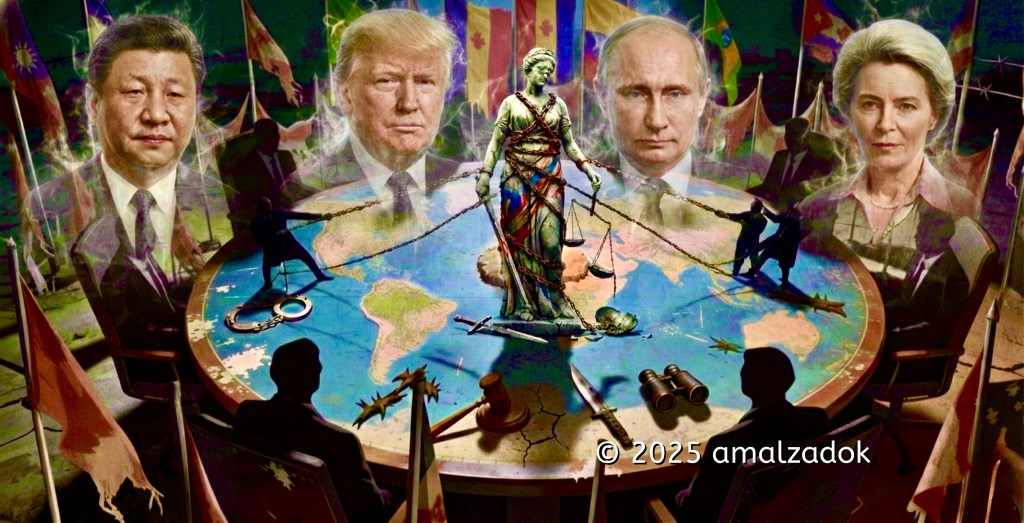
    Kidnapping the Future: Hunting with Flags in a World Gone from Nuremberg to Nowhere

    by Amal Zadok

    Humanity has witnessed yet another dark milestone with the capture of Maduro, an act carried out in brazen disregard for international law and national sovereignty. Welcome to the emerging world order: the law of the jungle, where might makes right and brute force replaces rules, dialogue, and basic decency. The great post-war hope that law and institutions would restrain power now looks increasingly fragile, even illusory. 

    This moment evokes the ghosts of history’s worst tyrants and destroyers: a new Attila the Hun trampling borders, a modern Genghis Khan sweeping aside treaties, the cold calculation of Stalin, the ruthless brutality of Pol Pot. Names once studied as warnings in history books now feel like prototypes for contemporary leaders and regimes. When law is treated as optional, and power as the only currency, the distance between “civilised world” and barbarism shrinks at terrifying speed. 

    Humanity is not evolving but devolving, sliding back into a kind of global “wild wild west,” where justice becomes a slogan, not a standard. In this climate, promises mean little, agreements are discarded when inconvenient, and smaller nations become pawns on a geopolitical chessboard. The message to the world is chillingly clear: security, dignity, and freedom are no longer protected by shared rules, but only by raw strength or the favour of the powerful. 

    This raises a searing moral question that can no longer be avoided: Is this the world you want your children and grandchildren to inherit? A world where borders, laws, and human rights exist only on paper, where fear replaces trust, and where tomorrow’s history books will record our silence as complicity? If the answer is no, then indignation is not enough. The time has come to speak, to resist, and to insist—publicly and persistently—that law, justice, and human dignity must not be sacrificed on the altar of power. 

    What we are witnessing is not an accident or an unfortunate exception; it is a deliberate strategy. Under the cloak of “security” and “stability,” powerful states and blocs are testing how far they can stretch the fibres of international law before they snap entirely. Each violation that goes unpunished becomes a rehearsal for the next, bolder transgression. 

    Every muted response, every carefully worded statement that refuses to name the crime for what it is, signals permission to escalate. In this perverse theatre, language itself is weaponised: kidnappings become “operations,” political persecution becomes “cooperation,” and naked coercion is marketed as “defending democracy.” The public is fed a diet of euphemisms designed to dull outrage and anesthetise conscience, while behind closed doors decisions are made that redraw the moral map of the world without consultation or consent. 

    Meanwhile, the institutions built in the aftermath of global catastrophe stand by, diminished and intimidated. Bodies that were meant to uphold law now often serve as stages for power politics, reciting scripts written by the very actors they should restrain. Votes are traded, principles are diluted, and the rhetoric of human rights is deployed selectively, depending on who is friend and who is foe. 

    In such a climate, smaller nations learn a bitter lesson: their sovereignty is conditional, their legal protections negotiable, and their leaders expendable if they dare challenge entrenched interests. The signal to dissidents and strongmen alike is devastatingly clear—if you have the favour of the right patrons, you can act with impunity; if you stand in their way, you can be taken, tried, or erased. 

    Citizens, too, are being trained—trained to accept the unacceptable, to scroll past the shocking, to treat the dismantling of norms as background noise. Outrage burns briefly and then is swallowed by the next cycle of distraction. Yet beneath the surface, something corrosive is happening to the collective moral imagination. 

    When people cease to believe that law can protect the weak, they begin to respect only force. When they see that principles are invoked only when convenient, they lose faith in the very idea of justice. This cynicism is precisely what the architects of the new disorder desire: a population too disillusioned to resist, too divided to unite, and too weary to hope. 

    Because make no mistake: what is being normalised today is not an isolated event, but a template. Abduction dressed up as “extradition,” coercion baptised as “cooperation,” the crude humiliation of a nation sold as a triumph of “justice.” The precedent could not be clearer: if a powerful alliance decides you are an enemy, then your sovereignty, your legal protections, your very personhood are negotiable—and negotiable in closed rooms where your voice is never heard. 

    This is not an international community; this is a hunting party with flags. Do not hide behind the illusion that this is “far away” or “about someone else.” The tools used today—secret flights, compliant courts, manufactured narratives—are technologies of control that can be turned on anyone tomorrow. 

    The language being perfected now, the vocabulary of targeted arrests, regime change, and “exceptional measures,” will be the same language used to crush dissent, silence journalists, and intimidate entire populations when it suits the powerful. The machinery of lawlessness never stays at the border; it expands to fill every space left undefended. 

    Here is the ominous truth: the cage being built is global. Bars of fear, walls of apathy, locks forged from our own cowardice. Your children and grandchildren will grow up under skies crossed by drones and under laws that can be suspended with a single emergency decree. 

    They will inherit a world where the knock at the door can no longer be trusted, where asking the wrong question is a risk, and where speaking the wrong truth can cost a career, a freedom, a life. And when they turn to the past and ask, “Who let this happen?”, the mirror will be waiting. 

    Remember this, and do not forget it: history is not only written by the victors; it is also written about the spectators. If you accept this descent into the abyss as “normal,” if you swallow the lies and mute your conscience, then you are not merely living through a dark chapter—you are co‑authoring it. 

    The world is being turned into a hunting ground, and law itself has been marked as prey. If you do not stand now, while you still can, one day you will wake up to find that it is your future, your family, and your faith in justice that have been captured—and there will be no one left to speak your name. 

    ©️2025 Amal Zadok. All rights reserved.

    Subscribe and never miss an article!
  • Oil for Armageddon: How Washington Is Seizing Venezuela to Fight Its Future War with Iran

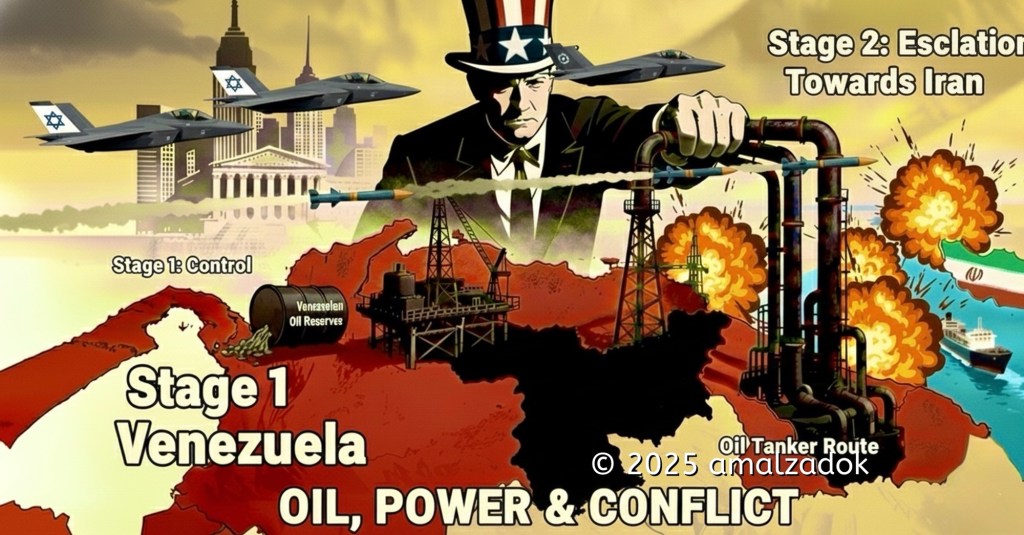
    Oil for Armageddon: How Washington Is Seizing Venezuela to Fight Its Future War with Iran

    The pattern of U.S. moves on Venezuelan oil, combined with the strategic vulnerability of the Strait of Hormuz, makes it plausible that Washington is positioning itself for a future confrontation with Iran in which Gulf oil flows could be disrupted, while Venezuelan crude serves as a non‑Hormuz fallback for the U.S. and Israel. The recent U.S. attack on Venezuela, the capture of President Nicolás Maduro and his wife, and their transfer to New York on narcotics and related charges do not undermine this thesis; they expose how “drug enforcement” has become the legal façade for a resource‑seizure operation aimed at securing oil for a long war scenario.

    The scale of Venezuela’s oil treasure

    Any geopolitical argument about Venezuelan oil must start with sheer scale. Venezuela today holds the largest proven oil reserves on the planet, with estimates around 300–303 billion barrels, or roughly 17–18 percent of all known reserves, surpassing even Saudi Arabia. In other words, this one Latin American country, within flight distance of Florida, controls more oil underground than the entire United States, which has around 55 billion barrels of proven reserves.

    Those reserves are not just large but strategically tempting. Much of Venezuelan crude is heavy, but U.S. Gulf Coast refineries are precisely configured to process heavy and extra‑heavy oil, historically imported from Venezuela and Mexico. In a world where Middle East supplies become uncertain, a political arrangement that gives Washington decisive leverage over the biggest single reserve base in the world is an energy security dream.

    From sanctions to open seizure: Maduro in New York

    For years, Washington relied on sanctions, asset freezes, and indictments to squeeze Caracas while stopping short of open war. The narco‑terrorism case filed in New York against Maduro and other Venezuelan officials framed the country’s leadership as a criminal cartel, preparing public opinion for more extreme measures. That legal architecture has now been matched by force: U.S. strikes on Venezuela, the capture of Maduro and his wife, and their transfer to New York on drug and criminal charges mark a historic escalation from economic warfare to direct regime decapitation.

    Crucially, this escalation has been accompanied by unprecedented candor from Donald Trump about what comes next. He has publicly stated that the United States will “run” Venezuela “for now,” asserted that the U.S. “built” Venezuela’s oil industry in the past, and pledged that American companies will return to “rebuild” and tap its oil reserves—framing this as an open‑ended, effectively indefinite arrangement. In other words, the kidnapping of a sitting president on drug charges is not the consummation of a moral crusade against narcotics; it is the opening move in a new phase where Washington claims the right to administer, and profit from, the world’s largest oil reserves.

    Why the Strait of Hormuz terrifies planners

    The Strait of Hormuz is a narrow maritime corridor between Iran and Oman, the only sea exit for the oil‑rich Persian Gulf. In a typical recent year, roughly 20–21 million barrels of oil per day have transited this passage, about 20–21 percent of total global petroleum liquids consumption and over one‑quarter of all seaborne oil trade.

    For decades, U.S. planners have quietly admitted what they seldom say openly: Hormuz is the soft underbelly of the global oil system. Around 80 percent of the crude that moves through it goes to Asian markets like China, India, Japan, and South Korea, but any serious disruption sends benchmark prices soaring and hits Western economies as well. Iran has repeatedly threatened to close or disrupt Hormuz if attacked and has demonstrated its capacity to harass or seize tankers, mine shipping lanes, and launch missiles at regional infrastructure.

    In a full‑scale U.S.–Iran or Israel–Iran war, Hormuz does not need to be “completely shut” to cause chaos. Sporadic attacks, insurance spikes, and partial interruptions could remove several million barrels a day from the market for months, triggering price shocks, recession risks, and political backlash in oil‑importing democracies. This is the nightmare scenario for Washington: a conflict it believes is necessary for regional dominance colliding with its own population’s intolerance for sky‑high oil prices and economic free‑fall.

    Linking the dots: Venezuelan oil as war insurance

    Once the strategic importance of Hormuz is understood, U.S. behavior toward Venezuela stops looking random. Over the last decade, Washington has oscillated between punishing Caracas with sanctions and selectively easing restrictions to allow specific companies to re‑enter the Venezuelan oil sector under tight U.S. licensing. That pattern looked less like moral outrage and more like controlled positioning: weaken the Maduro government politically, while keeping the door open for U.S. and allied corporate access to the oil fields and infrastructure.

    The post‑capture phase clarifies that logic. With Maduro removed and Trump openly declaring that the United States is taking indefinite control of Venezuela, Washington has maximal leverage to shape any “transitional” administration, dictate terms to state oil company PDVSA, and secure contracts for U.S. and European majors under the umbrella of American military and legal control. The same legal system that now holds Maduro and his wife on drug charges in New York will be used to claim the moral high ground, while U.S. energy companies are presented as the responsible adults arriving to restore order and “get the oil flowing again.”

    To see why this matters for a future Iran war, imagine a scenario in which Iranian mines and missiles reduce tanker traffic through Hormuz by a third for several months. The resulting loss of millions of barrels per day would send global prices spiralling and force consuming states to scramble for alternative supplies. In that context, U.S.‑linked production in Venezuela—now explicitly under a U.S. “run” arrangement with indefinite control—could be ramped up and redirected to cushion the blow for North America and its closest allies. Washington would not be able to replace every lost Gulf barrel, but it would possess a strategic tap that others, especially rival powers, do not control.

    Beyond democracy talk: energy security and Israel

    Officially, U.S. leaders justify both the earlier sanctions and the latest military operation as a defense of democracy, human rights, and the integrity of the international drug control regime. Yet Washington maintains close partnerships with Gulf monarchies whose political systems are far more autocratic than Caracas at its worst, and Trump himself has pardoned or commuted sentences for U.S.‑linked traffickers and allies, undermining the supposed moral consistency of the “war on drugs.” 

    Set alongside the explicit promise that the U.S. will now “run” Venezuela indefinitely and unleash its oil potential, the common denominator is not liberal values but strategic oil supply and alignment with U.S. and Israeli military objectives in the Middle East.

    Israel’s position is central here. Any large regional war involving Iran will almost certainly involve Israeli strikes on Iranian nuclear, missile, or command sites, prompting Iranian retaliation via proxies and potentially via direct attacks on Gulf infrastructure and shipping. Israeli and U.S. analysts openly discuss the risk of Hezbollah rockets, Iraqi militias, and Yemeni missiles converging on U.S. bases, desalination plants, and oil installations in a multi‑front escalation. For Washington, guaranteeing Israel’s ability to wage such a campaign without collapsing Western economies requires pre‑securing alternative oil streams that bypass the vulnerable chokepoints Iran can threaten. Venezuelan crude, moved across the Caribbean and Atlantic to U.S. and European refineries, would be largely immune to Hormuz and Red Sea disruptions.

    Seen from this angle, the armed seizure of Venezuela’s head of state on narco‑charges, and Trump’s boast that the U.S. is taking indefinite control of the country, is not just a shocking violation of sovereignty; it is a step in a broader war‑planning architecture. Control over the world’s largest oil reserves in the Western Hemisphere acts as a form of insurance policy: if Iran makes good on its threats, the U.S. can lean on Venezuelan barrels to stabilize its own market and cushion the shock for its allies.

    The logic of pre‑emptive control

    Energy planners think in decades, not news cycles. The fact that most Hormuz flows currently go to Asia does not reduce the strategic risk for the United States; it amplifies it, because China and India could leverage their access—or their sudden loss of access—to reshape global power balances during a crisis. If the U.S. is preparing for a world where confrontation with Iran, and by extension with Iran’s partners, becomes more likely, then securing a hemispheric oil fortress in Venezuela becomes rational from a cold strategic standpoint.

    By tightening sanctions, escalating to military strikes, physically removing the elected president under a cloud of drug charges, and now declaring indefinite U.S. control of the country, Washington builds a future in which any government in Caracas—friend, foe, or “transitional”—must negotiate oil policy under the shadow of American legal, military, and financial power. The goal is not merely to deny revenue to a hostile regime but to ensure that, when the next major war in the Middle East breaks out, those 300‑plus billion barrels sit within a system of contracts, infrastructure, and shipping lanes Washington can rapidly mobilize. In that scenario, Venezuela ceases to be a sovereign energy actor and becomes, in effect, a strategic fuel depot for a distant conflict in the Persian Gulf.

    References

    1.Al Jazeera. (2025, September 4). Venezuela has the world’s most oil: Why doesn’t it earn more from exports?

    2.BBC News. (2026, January 3). What we know about Maduro’s capture and US plan to “run” Venezuela.

    3.CBS News. (2026, January 3). U.S. strikes Venezuela and captures Maduro; Trump says U.S. will run the country.

    4.CNN. (2025, June 23). What is the Strait of Hormuz and why is it so significant?

    5.CNN. (2026, January 4). Maduro in U.S. custody after surprise Venezuela operation.

    6.Fox Business. (2026, January 2). Trump pledges U.S. return to Venezuela oil industry after Maduro capture.

    7.Fox News. (2026, January 3). Nicolás Maduro arrives in New York after capture; faces U.S. drug charges.

    8.NPR. (2026, January 3). What are the charges against Venezuela’s Nicolás Maduro?

    9.NPR. (2026, January 3). Maduro faces drug charges in U.S. even as Trump freed other traffickers.

    10.U.S. Department of Justice. (2025, February 4). Nicolás Maduro Moros and 14 current and former Venezuelan officials charged with narco‑terrorism, corruption, drug trafficking and other criminal charges.

    11.ABC News (Australia). (2026, January 3). Donald Trump says US will run Venezuela for now after capture of Nicolás Maduro.

    12.Los Angeles Times. (2026, January 3). Trump says U.S. will “run” Venezuela after capturing Maduro in audacious attack.

    13.PBS NewsHour. (2026, January 3). A timeline of U.S. military escalation against Venezuela leading to Maduro’s capture.

    14.The New Yorker. (2026, January 3). The brazen illegality of Trump’s Venezuela operation.

    15.U.S. Energy Information Administration. (2023, November 20). The Strait of Hormuz is the world’s most important oil transit chokepoint.

    16.U.S. Energy Information Administration. (2025, June 15). Amid regional conflict, the Strait of Hormuz remains critical oil chokepoint.

    17.Worldometers. (2024, October 31). Venezuela oil reserves, production and consumption.

    18.World Population Review. (2025, December 17). Oil reserves by country 2025.

    19.Newsweek. (2026, January 3). Map shows how Venezuela’s oil reserves compare to the rest of the world.

    20.Institute for Energy Research / IEA. (2024). Strait of Hormuz factsheet.

    ©️2025 Amal Zadok. All rights reserved.

    Subscribe and never miss an article!