Tag: immigration policy

  • When the Republic Wears a Mask: ICE, Trump, and the Constitution in the Crosshairs of Encroaching Power

    When the Republic Wears a Mask: ICE, Trump, and the Constitution in the Crosshairs of Encroaching Power

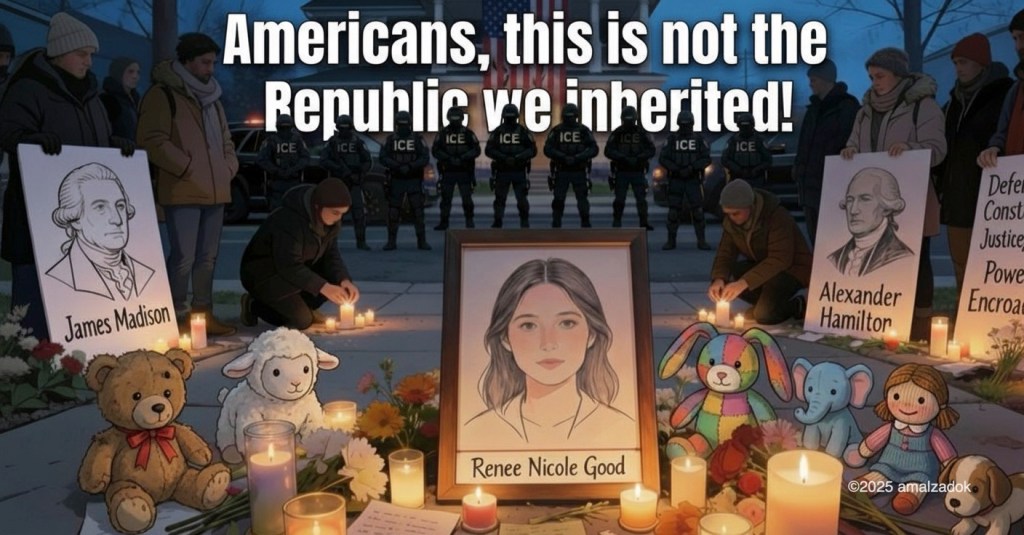
    James Madison warned that “power is of an encroaching nature, and…ought to be effectually restrained from passing the limits assigned to it.”  In Donald Trump’s hands, Immigration and Customs Enforcement (ICE) has become the very embodiment of that encroaching power: an armed, masked, and increasingly unaccountable apparatus that kills a U.S. citizen in Minnesota, terrorizes communities, and dares the constitutional order to stop it.  An agency that claims the mantle of law has slid into something closer to a standing force of intimidation, operating in a gray zone between policing and political control that James Madison, Alexander Hamilton, and Benjamin Franklin would have recognized as the threshold of tyranny.

    Madison, encroaching power, and the ICE state

    Madison’s core insight in Federalist No. 48 was brutally simple: “power is of an encroaching nature” and “mere parchment barriers” are not enough to stop a determined branch from slipping its leash.  He feared precisely what is visible today in immigration enforcement: a single executive apparatus accumulating practical control over lawmaking (through broad discretion), execution (through raids and detention), and adjudication (through executive‑run immigration courts).  This “tyrannical concentration of all the powers of government in the same hands,” Madison wrote, is the very definition of tyranny, whether wielded by a monarch or an elected president.

    Under Trump, ICE has become such a concentration point. Its Enforcement and Removal Operations wing conducts raids, arrests, detention, and deportation. Policy memos from the White House and DHS effectively rewrite who is targeted and how aggressively, far beyond what most Americans imagined when Congress wrote the underlying statutes.  Madison would not be fooled by the bureaucratic language. He would see an executive machine steadily expanding its reach, using the gaps between law on paper and practice on the ground to enlarge its power.

    The Minnesota killing: when “enforcement” becomes lethal impunity

    The killing of 37‑year‑old Renee Nicole Good by an ICE officer in Minneapolis is not an aberration; it is a revelation.  Good, a U.S. citizen, mother of three and celebrated poet, was in her car when ICE agents confronted her on a residential street. Video shows an officer at her door while another steps in front of the vehicle and fires multiple rounds into the windshield at close range.  Federal officials rushed to frame her as a threat who tried to run over agents, yet witnesses’ footage shows an officer shooting almost immediately as the car inches forward. The city’s mayor called it “reckless use of force” and told ICE to “get out of our city.”

    Local leaders have emphasized that Good appears to have had no serious criminal record and was reportedly present as a legal observer monitoring ICE activity, while the Trump administration branded her a “domestic terrorist.”  This is the logic of encroaching power: those who watch the state become enemies of the state. A federal officer can shoot a citizen in the face on a city street, then retreat behind a wall of official narratives and procedural reviews.  Madison warned that when one branch operates with “overruling influence” and escapes effective checks, “dangerous innovations in the government, and serious oppressions of the minor party in the community” follow.  Good’s death is one of those oppressions, and the “minor party” is anyone the executive chooses to target.

    The “law and order” defense — and why it fails

    Defenders of ICE under Trump insist that such force and sweeping tactics are the price of “law and order.” They argue that agents face real dangers, that criminals will exploit any restraint, and that masks, unmarked cars, and aggressive raids are necessary to protect officers and communities alike.  Madison and the founding generation would have recognized the danger in this argument: it turns necessity into a blank check.

    Madison’s warning that power is “of an encroaching nature” was directed precisely at governments that invoke safety to justify permanent expansion of force.  Hamilton cautioned that when the federal government “overpasses the just bounds of its authority and makes a tyrannical use of its powers,” the people must “appeal to the standard they have formed”—the Constitution—and seek redress.  Franklin, for his part, wrote that the “means of defence against foreign danger have been always the instruments of tyranny at home,” a line that lays bare what happens when law‑and‑order rhetoric licenses masked agents to kill a citizen like Good and terrorize entire neighborhoods.  The question is not whether enforcement is needed, but whether it remains constrained by law, transparency, and accountability; when it does not, it ceases to be “order” in any constitutional sense.

    Masks, unmarked cars, and the aesthetics of fear

    The methods ICE now routinely employs reveal how far the culture of the agency has drifted from ordinary law enforcement toward something darker.  Across the country, residents watch masked agents in plain clothes jump from unmarked vehicles, armed with rifles, surrounding people on sidewalks and in driveways. Even mayors describe these scenes as resembling “violent abduction,” not policing.  The Department of Homeland Security insists that masks are needed to protect agents from doxxing and threats, pointing to cases where officers’ families were harassed after photos circulated online.

    But civil‑rights advocates and local officials note that masked, anonymous armed men seizing people off the street “compound fear and chaos” and “evade accountability for agents’ actions.”  When the state sends masked figures in unmarked vehicles to carry out its will, it deliberately blurs the line between law and terror, between a warrant and a snatch‑and‑grab.  Madison’s insistence that power must be visibly separated, checked, and identifiable is not satisfied by a small “ICE” patch on a vest. A power that hides its face from the public it serves is already behaving as if it is above that public.

    “Law enforcement” without law

    Formally, ICE is a federal law enforcement agency under the Department of Homeland Security, charged with enforcing immigration and customs laws and “preserving national security and public safety.”  In practice, the Trump‑era posture has treated “law enforcement” as a talisman that justifies almost any method, while the rule of law—the predictable, proportionate, rights‑respecting application of statutes—often appears as an afterthought.  Raids at homes, hospitals, and schools, family separation as leverage, and lethal force against a nonviolent U.S. citizen all point to an institution where the executive’s will is the primary law.

    The Founders knew that “law enforcement” can become a mask for oppression. Hamilton warned that when the federal government “overpasses the just bounds of its authority and makes a tyrannical use of its powers,” the people must “appeal to the standard they have formed”—the Constitution—and seek redress.  Franklin cautioned that “the means of defence against foreign danger have been always the instruments of tyranny at home,” a sentence that reads today like a prophecy of post‑9/11 security agencies turned inward on vulnerable communities.  The question is not whether ICE fits the bureaucratic definition of “law enforcement,” but whether its conduct still reflects the deeper law of a constitutional republic.

    The Founders’ moral horizon: liberty, asylum, humanity

    For the founding generation, liberty was universal and inseparable from the dignity of the person. Franklin wrote that “equal liberty” is “the birthright of all men,” language that sits uneasily beside images of children taken from parents and locked in detention centers because those parents lacked the right papers.  Jefferson spoke of the United States as an “asylum” for the oppressed and warned that if the federal government claimed ungranted powers over aliens and others, Americans would end up “living under one deriving its powers from its own will, and not from our authority.”

    The killing of Renee Good and the masked‑raid culture around ICE mark a moral break with that vision.  A government that can shoot a citizen observer in the head, on disputed facts, and then march agents back into the streets wearing masks to “ensure their safety” while whole neighborhoods live in terror has ceased to see liberty as a birthright; it sees public fear as a tool.  Madison’s warning that “when the people fear the government, there is tyranny” is no longer a distant abstraction. It is a description of what residents of immigrant communities, and now even citizen observers like Good, experience when they see a DHS badge.

    The Madisonian response: draw the line

    Madison understood that “mere demarcation on parchment of the constitutional limits” is never enough; it is the vigilance of citizens, legislators, and courts that prevents encroaching power from hardening into permanent despotism.  The ICE that kills a Minnesota mother, moves in masked formations through American cities, and claims the absolute mantle of “law enforcement” while operating in legal and moral gray zones is exactly the kind of institution that must be confronted in Madisonian terms.

    To “appeal to the standard” of the Constitution, as Hamilton urged, means demanding transparent investigations and prosecutions where warranted in the Good case, legislative restraints on raids and use of force, and judicial scrutiny of policies that turn communities into occupied zones.  It also means a civic refusal to accept masked, nameless agents as a normal feature of democratic life: insisting on clear identification, recorded operations, and public accountability whenever armed federal staff operate in local neighborhoods.  If Madison is right—and the history of republics suggests he is—then the line must be drawn now, before the encroaching power that killed Renee Nicole Good becomes a permanent, accepted feature of American government.

    Americans now face a test that previous generations knew only in theory: whether loyalty belongs to a leader and his armed agents, or to the Constitution and the republic it binds into being.  The blood spilled at Lexington and Concord, on the fields of Antietam and Normandy, in Selma and at Kent State, was not offered to sanctify a regime of masked men in unmarked vehicles, but to preserve a nation of laws where power answers to the people.  When ICE can kill a citizen like Renee Good on a quiet Midwestern street, when families live in terror of raids more reminiscent of juntas than of justice, the United States drifts toward a resemblance it has long condemned in others: the look and feel of the very dictatorships it claims to oppose.  The choice now is stark and inescapable: either citizens, churches, cities, states, and courts rise in open, principled defense of the constitutional order—demanding that this government once again fear its people, not the other way around—or the encroaching power Madison warned against will finish its work, and the republic so many men and women died to preserve will quietly become something else.

    References

    1.Ammo.com. (2024, April 19). Founding Fathers’ quotes on government, democracy, and power in the people. https://ammo.com/articles/founding-fathers-quotes-democracy-government-power-in-people

    2.Avalon Project. (1788). Federalist No. 48. Yale Law School. https://avalon.law.yale.edu/18th_century/fed48.asp

    3.Bill Muehlenberg. (2021, November 29). The Founding Fathers on freedom. https://billmuehlenberg.com/2021/11/29/the-founding-fathers-on-freedom

    4.Bill of Rights Institute. (2024). Founders’ quotes. https://billofrightsinstitute.org/founding-documents/founders-quotes

    5.CBC News. (2026, January 9). The White House is defending fatal ICE shooting of Minneapolis woman. But what are the rules of engagement? https://www.cbc.ca/news/world/ice-minneapolis-shooting-use-of-force-9.7038275

    6.Civil and Human Rights Coalition. (2025, February 17). The human costs of Trump’s immigration crackdown. The Leadership Conference on Civil and Human Rights. https://civilrights.org/blog/the-human-costs-of-trumps-immigration-crackdown

    7.Cornell Law School, Legal Information Institute. (2016). Immigration and Customs Enforcement (ICE). https://www.law.cornell.edu/wex/immigration_and_customs_enforcement_(ice)

    8.FEE. (2025, November 19). 17 Benjamin Franklin quotes on tyranny, liberty, and rights. Foundation for Economic Education. https://fee.org/articles/17-benjamin-franklin-quotes-on-tyranny-liberty-and-rights

    9.Gilder Lehrman Institute of American History. (n.d.). Founding Fathers’ selected quotations key. https://www.gilderlehrman.org/sites/default/files/inline-pdfs/Key%20to%20Founding%20Fathers%20Selected%20Quotations.pdf

    10.Hamilton, A. (2017). Alexander Hamilton quotes about tyranny. AZQuotes. https://www.azquotes.com/author/6160-Alexander_Hamilton/tag/tyranny

    11.Monticello. (n.d.). The question of immigration. Thomas Jefferson Foundation. https://www.monticello.org/the-art-of-citizenship/the-question-of-immigration

    12.National Constitution Center. (2016, March 15). James Madison: Birthday quotes from the most quotable Founding Father. https://constitutioncenter.org/blog/james-madison-birthday-quotes-from-the-most-quotable-founding-father

    13.NPR. (2025, July 9). Masked immigration agents are spurring fear and confusion. https://www.npr.org/2025/07/09/nx-s1-5440311/ice-raids-masked-agents

    14.Press-Pubs, University of Chicago. (n.d.). Jefferson, T. Resolutions relative to the Alien and Sedition Acts. https://press-pubs.uchicago.edu/founders/documents/v1ch8s41.html

    15.Teaching American History. (2024, July 24). Federalist 47, Federalist 48, and Federalist 51. https://teachingamericanhistory.org/document/federalist-47-federalist-48-and-federalist-51

    16.The Conversation. (2018). How the media dealt a major blow to Donald Trump’s family separations policy. https://theconversation.com/how-the-media-dealt-a-major-blow-to-donald-trumps-family-separations-policy-98669

    17.The New York Times. (2025, July 20). LA Mayor: Masked ICE agents created “reign of terror”. https://www.nytimes.com/2025/07/20/us/politics/ice-agents-masks.html

    18.The New York Times. (2025, August 5). Inside Trump’s new tactic to separate immigrant families. https://www.nytimes.com/2025/08/05/us/politics/trump-administration-family-separation.html

    19.United States Immigration and Customs Enforcement. (2003– ). United States Immigration and Customs Enforcement. Wikipedia. https://en.wikipedia.org/wiki/United_States_Immigration_and_Customs_Enforcement

    20.Federal Law Enforcement Training & Research Center. (2014, November 25). What is ICE? https://www.federallawenforcement.org/ice/what-is-ice

    21.ABC News. (2026, January 7). Woman killed by ICE agent in Minneapolis was a mother of 3, poet… https://abcnews.go.com/US/wireStory/woman-killed-ice-agent-minneapolis-mother-3-poet-129008055

    22.BBC News. (2026, January 7). US immigration agent fatally shoots woman in Minneapolis. https://www.bbc.com/news/articles/c0jvnl4j1n4o

    23.BBC News. (2026, January 8). Renee Nicole Good: Who was the woman killed by ICE in Minneapolis? https://www.bbc.com/news/articles/c1jepdjy256o

    24.Al Jazeera. (2026, January 8). Who was Renee Nicole Good, the woman killed in ICE Minneapolis shooting? https://www.aljazeera.com/news/2026/1/8/who-is-renee-nicole-good-the-woman-killed-in-the-ice-minneapolis-shooting

    25.SupplySideLiberal. (2022). The Federalist Papers #48: Legislatures, too, can become tyrannical (James Madison). https://blog.supplysideliberal.com/post/2022/2/6/the-federalist-papers-48-legislatures-too-can-become-tyrannicaljames-madison

    26.Critical Skills Blog. (2024, July 21). The Founding Fathers’ fears of tyranny: Insights from Jefferson, Madison, Hamilton, and Washington. https://criticalskillsblog.com/2024/07/22/the-founding-fathers-fears-of-tyranny-insights-from-jefferson-madison-hamilton-and-washington

    ©️2026 Amal Zadok. All rights reserved.

    Subscribe and never miss an article!
  • From MAGA to Mayhem: Betrayal, Scandal, and Collapse in Trump’s America

    From MAGA to Mayhem: Betrayal, Scandal, and Collapse in Trump’s America

    by Amal Zadok

    Donald Trump’s second term as U.S. president stands as a case study in broken promises, institutional capitulation, and a wholesale betrayal of both the “Make America Great Again” movement and America’s legacy as a global leader. His pivotal errors have triggered a domestic backlash, empowered reckless foreign actors—particularly Israel and entrenched neoconservatives—and shattered what trust remained in the presidency. This essay delivers a fierce, sectioned analysis of Trump’s major broken pledges, chronicles chaos and scandal across domestic and international fronts, and exposes the lasting consequences for both the American soul and the world order.

    Trump’s Broken Promises—A Sectional Analysis

    The Economy: Tariff Turmoil, Recession, and Broken Prosperity Pledges

    Trump’s second-term rise built on promises to reignite the U.S. economy, end inflation, and restore prosperity through “America First” tariffs and trade war brinksmanship. In reality, the moves battered the economy and drove up prices. The middle class bore the brunt of unemployment and vanishing savings as tariff escalation—more PR than policy—devastated manufacturers and exporters. The vaunted “made in America” renaissance dissolved into hardship, shuttered small businesses, and a mounting recession. Public trust in MAGA’s economic miracle irrevocably collapsed.

    Immigration and Law Enforcement: Cruelty, Illegality, and Political Ruin

    Instead of effective reform, Trump’s second-term immigration policy has devolved into an apparatus of cruelty and indiscriminate repression. Mass raids, warrantless home invasions, and the abandonment of due process have become daily realities, targeting not just the undocumented but legal residents and longtime community members. Federal agents, emboldened by executive edict, have stormed schools, hospitals, and even houses of worship. Families have been torn apart with no warning; children have seen parents snatched away under the cover of night. In a desperate push to satisfy base outrage, ICE has dramatically increased arrests of non-criminal migrants, with over two-thirds of new detainees accused of no violent offense. Solitary confinement, inhumane conditions, and unexplained deaths in detention have surged, sparking lawsuits and mass protests.

    Entire migrant communities across the country—from Los Angeles to Miami, from Chicago to Houston—have erupted in anger and fear, organizing massive demonstrations, strikes, and walkouts in response. Business leaders, religious groups, and even moderate conservatives denounce the new policies as not merely harsh but fundamentally un-American. The chilling effect has hollowed out local economies, emptied classrooms, and left neighborhoods under siege mentality. Political analysts now predict a historic backlash: with alienated Latinos, Asian-Americans, and young voters mobilizing as never before, Trump has set the stage for a midterm bloodbath that could erase his party’s congressional majority and deliver a devastating rebuke to his brand of anti-immigrant animus.

    Healthcare and “Draining the Swamp”: More of the Same

    Despite renewed promises to replace Obamacare and “drain the swamp,” the second Trump administration delivered neither. Healthcare reform was reduced to executive posturing, with no meaningful progress through a fractured Congress. The “swamp” only deepened as the administration installed loyalists and cronies at every rung of power, trading institutional expertise for compliance. Middle America, once the intended beneficiary, found itself caught in a web of bureaucratic self-interest and deepening neglect.

    Israeli Ascendance—Subservience to Genocide and Colonial Ambition

    Trump’s second term marks one of the darkest turns in U.S. foreign policy: not simply support for an ally, but abject complicity in Israel’s campaign in Gaza now widely recognized as genocide by human rights observers and at the International Criminal Court.

    The Trump administration didn’t just shield Israel diplomatically—it provided unqualified military, financial, and intelligence backing while greenlighting the forced displacement of millions and the obliteration of Gaza’s civil infrastructure. Proposals to forcibly remove Palestinians and “redevelop” the ruins into a Western enclave are not aberrations—they are candid expressions of a colonial order.

    The White House threatened to criminalize and silence critics and used federal power to muzzle dissent in American institutions. The cost in innocent lives was rendered irrelevant in the rush to serve Israeli maximalist ambitions. America’s complicity in, and advocacy for, ethnic cleansing and open war crimes will haunt future generations.

    The Neocon Takeover—Ukrainian Lives as Chess Pieces

    Trump’s second term has handed the reins of U.S. foreign policy to the same neoconservative operatives who for decades have viewed human suffering as a tool for geopolitical leverage. Nowhere is this clearer than in Ukraine, where the lives of an entire nation are gambled away in a relentless proxy war against Russia. Circumventing popular will or meaningful peace, the administration’s bottom line is clear: keep the war going long enough to bleed Moscow, whatever the toll in Ukrainian blood, as long as the optics suit faint pretenses of resolve. The war that was never America’s to fight has become the perfect means for Washington’s “experts” to spend lives and treasury without end, as long as the endgame is not peace, but victory over an adversary at all cost—Ukrainians be damned.

    Venezuela and Nigeria—Energy Colonialism Revived

    Far from being principled or people-focused, Trump’s foreign policy in Venezuela and Nigeria has been exposed as naked resource extraction under the cover of “democracy” and “stability.” In Venezuela, engagement with both sides of the political divide served only to prepare for U.S. and Western corporate control over the largest proven oil reserves on earth.

    Everything—sanctions, clandestine talks, public threats—was calibrated to secure access to energy and strategic minerals, not to better the lives of ordinary Venezuelans. In Nigeria, the professed concern for persecuted Christians was always a fig leaf: the true objective was a grip on the region’s oil, gas, and electric grid, ensuring that American companies and geopolitical operatives could direct both flows and profits. It is twenty-first-century neocolonialism with a MAGA hat—dressed as virtue, but devoted only to resource and power.

    Catastrophic Policies Toward Russia and China

    Rather than recalibrating U.S. grand strategy, Trump’s policies toward Russia and China have yielded only disorder and danger. Against Moscow, Trump has veered between reckless escalation—empowering hawks to push Ukraine toward ever more provocative actions that risked an uncontainable conflict—and disastrous retreats that emboldened Putin’s regime. There was no principle, no coherent vision, merely transactional swings that left allies doubting and adversaries calculating fresh moves.

    On China, Trump’s improvisational strongman routine backfired, igniting trade wars that devastated American businesses, provoking Beijing to expand ties with Russia and other U.S. rivals, and failing completely to contain the expansion of Chinese influence or military ambition in the Asia-Pacific. U.S. alliances are at their weakest, the postwar order is in tatters, and the world sees in Washington nothing but instability, unpredictability, and lost leadership.

    The Epstein Scandal—A Presidency Entangled, a Republic Corrupted

    The scandal of Trump’s intimacy with the Epstein empire is no longer just a footnote; it is a cancer at the heart of the presidency. Recent email dumps and congressional files lay bare Trump’s sustained proximity to Epstein—hours spent alone with a documented victim at Epstein properties, knowledge of targeting and exploitation, and close involvement with mutual enablers like Maxwell.

    The cover-up is as shocking as the crime: the administration leans on federal agencies to block further investigations, demonizes survivors and whistleblowers as political enemies, and turns the machinery of state into an instrument of silence and intimidation.

    In the face of mounting evidence, Trump’s White House projects total impunity—for himself, for Epstein’s circle, and for the darkest abuses of the elite. The damage is generational: faith in government, the courts, and American justice is poisoned, while the world sees a country unable or unwilling to prosecute its most powerful offenders.

    The Ultimate Betrayal—Welcoming America’s Greatest Enemy to the White House

    For generations, American servicemembers have laid down their lives fighting the poison and brutality of al-Qaeda, grieving families have mourned, and a nation has tried to honor their sacrifice as the sacred price of defending civilization against terror. But Donald Trump, in a move that has stunned every patriot and spit on the graves of the fallen, chose not only to rehabilitate but to openly embrace Abu Mohammed al-Jolani—once the most wanted terrorist on the planet—after he rebranded himself as Syria’s president.

    Jolani, architect of massacres, bombings, and decades of jihadist violence, was received with applause by Trump, flanked by the same military whose comrades he once ordered murdered.

    With cameras flashing and hands shaken on the White House, Trump praised Jolani as “doing a very good job,” stripped away U.S. sanctions, and branded him an ally to secure fleeting advantages in the Middle East power game. In that moment, every promise to the families of the honored dead was burned.

    The true cost is moral annihilation: the government glorified the very man responsible for American deaths and agony, desecrating the memory, dignity, and meaning of every soldier’s sacrifice. Is this the behavior of a true patriot, or the act of a leader for whom principle and loyalty mean nothing beside expediency?

    In one stroke, Trump transformed the people’s house into a hall of betrayal—and his name is forever stamped on a disgrace no parent, no widow, no veteran can forgive.

    The Work Visa Scandal—Insulting America’s Talent, Alienating a Nation

    Among Trump’s most divisive and offensive moves in his second term is his handling of the H-1B work visa debate. In a highly publicized exchange with Fox News, Trump dismissed American workers, declaring, “No, you don’t. You don’t have certain talents and people have to learn. You can’t take people off an unemployment line and say I’m gonna put you into a factory to make missiles.”

    The implication: that Americans lack the expertise or drive necessary to compete, a remark instantly labeled as a slap in the face by those who have built the nation’s industries and defended its security.

    This wasn’t an isolated moment. On multiple occasions, Trump doubled down on his support for expensive work visas—raising fees to $100,000 per application for companies seeking skilled foreign labor—while flatly telling struggling Americans they were simply “not qualified” to fill the jobs of a modern economy.

    The MAGA base erupted, with voices from across the conservative spectrum denouncing their own president for demeaning American talent and undermining “America First.” Steve Bannon, Marjorie Taylor Greene, and other stalwarts led the charge, blasting Trump’s rhetoric as “unforgivable” and predicting it would alienate millions of blue-collar and patriotic voters.

    The backlash has spread well beyond the political right. Veterans groups, educators, union leaders, and ordinary citizens all responded with outrage, seeing the president’s comments as not only economically damaging, but deeply offensive to American dignity and work ethic.

    With the midterms on the horizon, analysts warn Trump’s dismissive attitude toward the nation’s workforce may prove a fatal error—one that erodes trust, fractures his coalition, and reverberates as a decisive failure on the national stage.

    A Legacy in Ashes

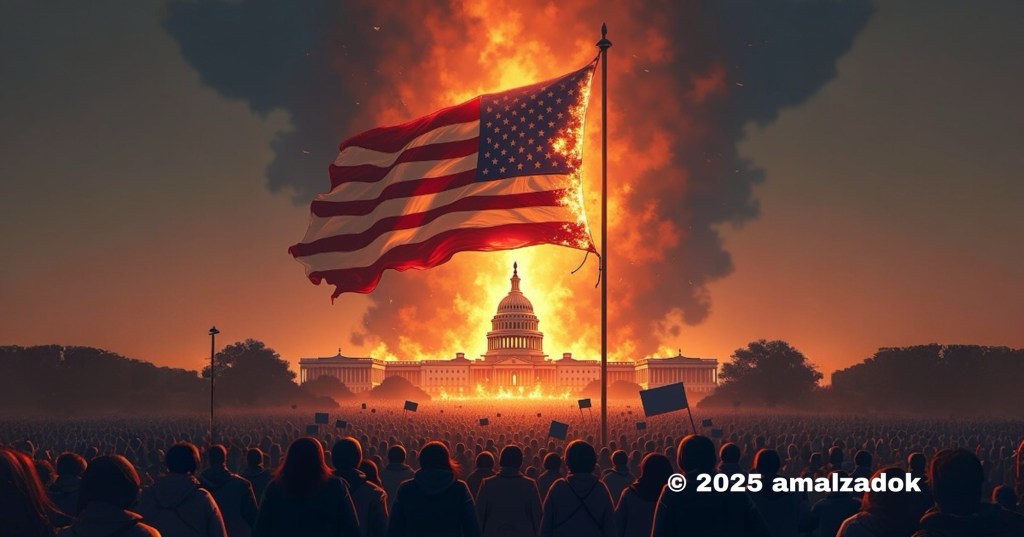
    Donald Trump’s second term is not simply a history of failed governance and burnt bridges; it is the ultimate evidence of what happens when ambition, fraud, and cruelty become the center of national power. The pillars of principle and alliance that underpinned American greatness have been smashed for spectacle, ego, and profit. In place of honor, there is only cowardice; in place of leadership, only wreckage. He has left behind a landscape of demoralized citizens, betrayed allies, enraged communities, and global adversaries now emboldened by American weakness. Every hope raised by MAGA is now a cinder scattered across the world’s conscience: a ruthless reminder that toxic populism, corruption, and brutality can burn through the foundations of democracy when accountability is surrendered and truth annihilated. Trump’s legacy stalks America like a curse—division, rage, disgrace, and a shattered national identity that may never be rebuilt.

    And still his second term is a long way to finish…

    References

    1. TRAC Reports. (2025, Jun 2). Immigration Prosecutions Jump in March 2025. https://tracreports.org

    2. Pew Research Center. (2025, Aug 20). Key findings about U.S. immigrants. https://pewresearch.org

    3. Reuters. (2025, Jul 2). Trump’s immigration enforcement record so far, by the numbers. https://www.reuters.com

    4. Wikipedia. (2024, Nov 7). Deportation in the second Trump administration. https://en.wikipedia.org

    5. Brookings Institution. (2025, May 20). 100 days of immigration under the second Trump administration. https://brookings.edu

    6. Al Jazeera. (2025). Is Trump pushing for regime change in Venezuela… https://www.aljazeera.com

    7. bne IntelliNews. (2025). Is Venezuela’s resource wealth Trump’s real target? https://intellinews.com

    8. Reuters. (2025). US intel found Israeli military lawyers warned there was evidence of genocide. https://www.reuters.com

    9. Amnesty International. (2025). Israel/Gaza: Any peace proposal must be grounded in human rights. https://www.amnesty.org.au

    10. Counterfire. (2025). Trump’s mediation over Ukraine collapses. https://counterfire.org

    11. Wikipedia. (2025). Foreign policy of the second Trump administration. https://en.wikipedia.org

    12. The American Conservative. (2025). Trump Should Leave His Neocon Streak Behind. https://www.theamericanconservative.com

    13. The New York Times. (2025). Trump, Long Erratic on the World Stage… https://nytimes.com

    14. BBC. (2025). Trump says ‘war is over’ in Gaza… https://bbc.com

    15. ScienceDirect. (2025). The second Trump administration: A policy analysis… https://sciencedirect.com

    16. Atlantic Council. (2025). The expert conversation: Trump’s endgame in Venezuela? https://atlanticcouncil.org

    17. Sky News. (2025, Nov 9). From US enemy to ally? Why ex-jihadist Syrian president’s White House visit matters. https://news.sky.com

    18. France24. (2025, Nov 10). Trump hosts Syria’s Sharaa at White House, Damascus hails ‘historic’ US visit. https://www.france24.com

    19. BBC. (2025, Nov 8). Syria’s Sharaa arrives in US for Trump talks after sanctions lifted. https://bbc.com

    20. PBS. (2025, Nov 10). Al-Sharaa meets with Trump at White House as Syria seeks US legitimacy. https://pbs.org

    21. ABC News. (2025, Nov 11). Some MAGA supporters in uproar over Trump’s H-1B visa comments. https://abcnews.go.com

    22. Fox News. (2025, Nov 11). Trump faces MAGA backlash over H-1B visa support. https://foxnews.com

    23. The Hill. (2025, Nov 12). Trump organization requested record number of foreign workers. https://thehill.com

    24. Yahoo News. (2025, Nov 12). Trump, who slapped an extra $100,000 on the H-1B visa. https://yahoo.com

    25. Forbes. (2025). Trump Immigration Rule Could Make H-1B Visa Holders Exit the USA. https://forbes.com

    26. Times of India. (2025, Nov 11). Is Donald Trump softening rules on aggressive H-1B visa fees? https://timesofindia.indiatimes.com

    27. Fox Baltimore. (2025, Nov 11). President Trump faces criticism from MAGA base over comments on American workers. https://foxbaltimore.com

    ©️2025 Amal Zadok. All rights reserved.

    Subscribe and never miss an article!