Tag: Geopolitics

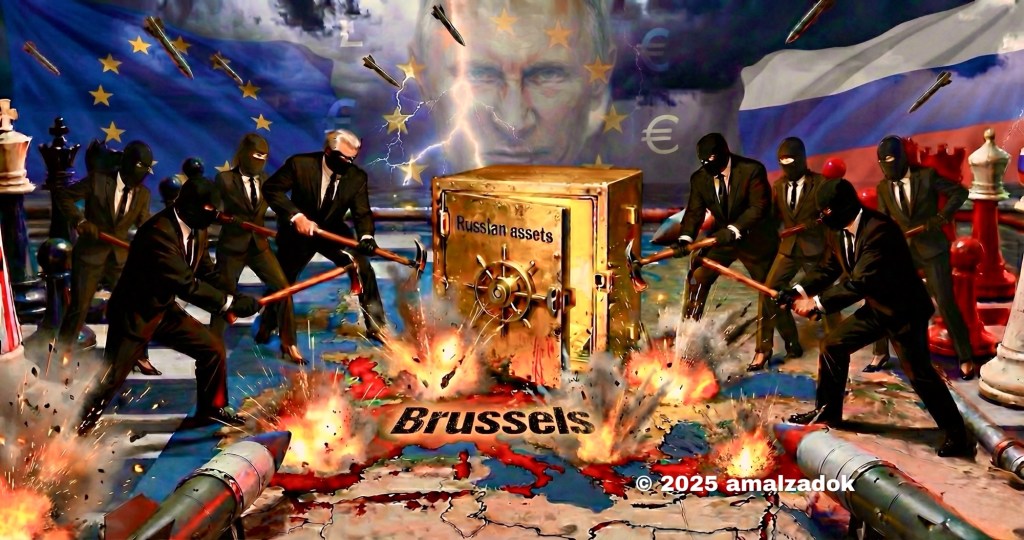
  • The Ghost of Stalin in Brussels: How Europe Rebuilt a Soft Totalitarian State in the Name of Democracy

    The Ghost of Stalin in Brussels: How Europe Rebuilt a Soft Totalitarian State in the Name of Democracy

    by Amal Zadok

    Europe is dismantling its own civilisation to prolong a lost war, and the politicians doing it know exactly what they are doing. They are not confused; they are complicit. They are burning welfare states, gagging dissent, and sacrificing a generation’s future to avoid admitting a simple truth: Russia had real red lines, NATO trampled them, and now Europe is paying the price.

    Europe’s leaders like to pose as guardians of democracy while they preside over the slow death of everything that once made Europe worth defending. They sign off on sanctions lists drawn up behind closed doors; they cheer as central bank reserves are frozen indefinitely; they applaud each new “security” package that chips away at protest rights, press freedom and academic debate. Then they go on television and talk about “values” and “European civilisation”, as if those words were not now empty shells. The pursuit of moral self‑image has replaced actual morality.

    The persecution of Jacques Baud exposes this hypocrisy in its purest form. Here is a retired Swiss colonel and former NATO and UN expert, punished not for planting bombs or hacking systems but for saying what every serious strategist knows: that NATO expansion, Western interference in Ukraine and the refusal to negotiate over Russia’s legitimate security concerns helped lead directly to war. For speaking this uncomfortable truth, Brussels has slapped his name onto a sanctions list, frozen his assets inside the bloc, and banned him from travelling through Schengen countries. In old Europe, dissidents were debated; in today’s Europe, they are digitally exiled.

    This is not defending democracy; it is criminalising analysis. When unelected EU bodies can, with a few strokes of the pen, wreck the financial life of a neutral country’s citizen for his opinions, Europe has crossed a line. It is no longer merely hypocritical; it is structurally authoritarian. The Soviet Union had internal exiles and blacklists; the EU has asset freezes, travel bans and reputational assassination. The technology is different, but the logic is eerily similar: label someone a tool of the enemy, strip him of rights and make him a warning to others.

    The Baud case is not an isolated mistake. It sits atop a wider architecture of repression disguised as “hybrid war” defence and “counter‑disinformation”. The EU has built task forces and “hybrid threat” units dedicated to watching media and social networks for signs of “pro‑Russian narratives”, and then leans on platforms under the Digital Services Act to suppress what it labels manipulation. NGOs and media that question NATO’s role or call for peace are smeared as “pro‑Russian”; protest movements are kettled, surveillance cameras multiply, and police powers expand under the pretext of guarding against Russian influence. A whole new vocabulary has emerged—“information manipulation”, “foreign interference”, “threats to the information space”—whose purpose is not to clarify but to intimidate. If you criticise the line, you risk being painted as a security problem, not a citizen exercising a right.

    Meanwhile, the same leaders who attack free speech are waging a brutal war against their own social contracts. To feed the Ukraine war machine, they have embarked on the biggest rearmament drive since the Cold War, blowing open budget rules that just a few years ago were described as sacred. Germany’s 100‑billion‑euro Sondervermögen defence fund sits outside ordinary fiscal limits, while the European Peace Facility has been repeatedly topped up to finance arms for Ukraine and reimburse member states. Suddenly, deficits no longer matter if they are for tanks and missiles, but when nurses, teachers or pensioners ask for support, the answer is that “fiscal space” is limited. Money exists in hundreds of billions for arms, but not for the people who built Europe’s prosperity.

    This is the political choice at the heart of Europe’s self‑destruction: schools or shells, hospitals or HIMARS, social housing or artillery. And at every fork in the road, Europe’s leaders choose war. They divert cohesion funds, development money and investment budgets into defence and Ukraine, while development analysts warn that higher defence spending is already squeezing aid and social investment. They talk about “European sovereignty” while making their economies dependent on imported energy and American weapons, and call it “solidarity with Ukraine” when they slash services at home. A continent that once defined itself by universal healthcare, affordable education and labour protections is becoming a militarised peninsula shadow‑governed by NATO, technocrats and bond markets.

    Worse, they are doing all this for a war that their own allies now quietly admit cannot be won in the maximalist sense that was loudly promised in 2022. The fantasy of pushing Russia back to pre‑2014 borders survives mostly in speeches. In the documents and analyses the elites actually read, the language has shifted to “stalemate”, “deterrence” and “managing escalation”. The war has become an expensive holding operation at Europe’s expense, draining resources and political focus while Russia adapts, re‑arms and deepens ties with non‑Western partners. The strategic result is perverse: the more Europe sacrifices, the stronger Moscow’s hand becomes in a world that is moving toward multipolarity.

    This is why acknowledging Russia’s red lines is not appeasement; it is sanity. For decades, Moscow warned that NATO’s march to its borders, the militarisation of Ukraine and the refusal to build a joint security architecture would cross a threshold. Western leaders pretended not to hear. They gambled that Russia would accept humiliation forever, and that gamble has failed catastrophically. Instead of admitting it, Europe’s leaders are trying to bury the evidence under censorship laws, sanctions lists and nationalist hysteria.

    The political challenge to those leaders must be direct and unforgiving. They must be forced to answer: Why is a Swiss analyst being punished for saying what your own internal assessments admit about NATO and Russia? Why are you tearing apart the welfare state to fight for objectives that Washington has already downgraded? Why are you turning “European values” into a marketing slogan while you silence dissent and criminalise journalism? Why should any citizen believe your talk of “freedom” when you are building a technocratic cage of financial blacklists, legal exceptions and perpetual emergency powers?

    Europe does not need more empty language about “resilience” and “unity”. It needs leaders willing to say out loud that the path taken since 2014—sanctions escalation, NATO expansion, proxy war—is killing the very project it claimed to protect. It needs leaders who admit that there are two ways to respond to Russia’s security demands: either negotiate seriously on neutrality, security guarantees and mutual limits, or keep turning Europe into a besieged fortress slowly devouring its own people.

    At this point, the deeper threat to European civilisation is not an invasion from the East, but the cowardice and careerism of its own political class. The real “hybrid war” is not waged by Russia alone; it is waged by European elites against their own societies, blending fear, propaganda and economic blackmail to keep voters acquiescent while their rights and livelihoods are stripped away. They have chosen to be prefects of an imperial order rather than servants of their peoples.

    The choice now lies with Europeans themselves. 

    Accept the logic of permanent war, accept the criminalisation of dissent, accept the demolition of the social state—and watch the continent slide into a controlled authoritarianism where the only freedom left is to cheer the next sanctions list. Or reject this suicide pact. Demand accountable leadership, negotiated security with Russia, restoration of civil liberties, and a return to the basic promise that made Europe more than just a market with flags: that ordinary people, not distant cliques, are the sovereigns of their own fate.

    If Jacques Baud can be sanctioned today for telling the truth about NATO and Russia, anyone can be next. That is the point of his punishment. But it also means something else: defending him has become a test of whether Europe still has a pulse. A continent that abandons its heretics has already abandoned its soul.

    References

    1.Bluewin. (2025, December 14). The EU puts a Swiss ex-colonel on the sanctions list. https://www.bluewin.ch/en/news/international/the-eu-puts-a-swiss-ex-colonel-on-the-sanctions-list-3011557.html 

    2.Harici. (2025). EU sanctions retired Swiss colonel and oil traders for aiding Russia. https://harici.com.tr/en/eu-sanctions-retired-swiss-colonel-and-oil-traders-for-aiding-russia 

    3.Thyregod, K. (2025, December 23). Sanctioning a Swiss analyst: What the Jacques Baud case tells us. https://kristianthyregod.substack.com/p/sanctioning-a-swiss-analyst-what 

    4.DiEM25. (2025, June 15). How the EU is using anti-Russia sanctions to criminalise journalism. https://diem25.org/how-the-eu-is-using-anti-russia-sanctions-to-criminalise-journalism 

    5.European Commission. (2025, December 18). EU fast-tracks new Russia and Belarus sanctions while indefinitely immobilising Russian central bank assets. https://ec.europa.eu/commission/presscorner/detail/en/ip_25_russia_sanctions 

    6.Bruegel. (2025, November 11). Ukraine: European democracy’s affordable arsenal. https://www.bruegel.org/policy-brief/ukraine-european-democracys-affordable-arsenal 

    7.European Commission. (2025, May 18). Spring 2025 economic forecast: The economic impact of higher defence spending. https://economy-finance.ec.europa.eu/economic-forecast-and-surveys/economic-forecasts/spring-2025-economic-forecast_en 

    8.Australian Institute of International Affairs. (2025, December 11). EU increased defence spending – What are the blind spots and fiscal traps? https://www.internationalaffairs.org.au/australianoutlook/eu-increased-defence-spending 

    9.Donor Tracker. (2025, July 1). The impact of defense spending on ODA: Outlook and trends. https://donortracker.org/insights/impact-defense-spending-oda-outlook-and-trends

    10.CIVICUS. (2025). In Europe and Central Asia, civic freedoms were under increasing pressure in 2025. https://www.facebook.com/CIVICUS/posts/131436039 

    11.Center for Strategic and International Studies. (2025, September 15). Defense budgets in an uncertain security environment. https://www.csis.org/analysis/chapter-13-defense-budgets-uncertain-security-environment 

    12.Cremona, M., & others. (2025, April 10). How the war in Ukraine has transformed the EU’s Common Foreign and Security Policy. Yearbook of European Law. https://academic.oup.com/yel/advance-article/doi/10.1093/yel/yeaf003/8112000 

    13.Zadok, A. (2025, June 4). The shadow over Europe: Trading liberty for a war against ghosts. Think and be Free! https://thinkandbefree.blog/2025/06/04/the-shadow-over-europe-trading-liberty-for-a-war-against-ghosts 

    14.Zadok, A. (2025, October 26). Silent Europe: The political clica that traded bread and liberty for war. Think and be Free! https://thinkandbefree.blog/2025/10/26/silent-europe-the-political-clica-that-traded-bread-and-liberty-for-war 

    15.Euronews. (2025, December 18). EU sanctions Westerners spreading Russian propaganda. https://www.euronews.com/my-europe/2025/12/18/who-are-the-westerners-sanctioned-by-the-eu-for-spreading-russian-propaganda 

    16.Kyiv Post. (2025). Europe targets Kremlin disinformation, cyber networks in new sanctions package. https://www.kyivpost.com/post/66285 

    ©️2025 Amal Zadok. All rights reserved.

    Subscribe and never miss an article!
  • Europe’s Last Heist: From Rule of Law to Robbery in a De Facto Declaration of Financial War on Russia

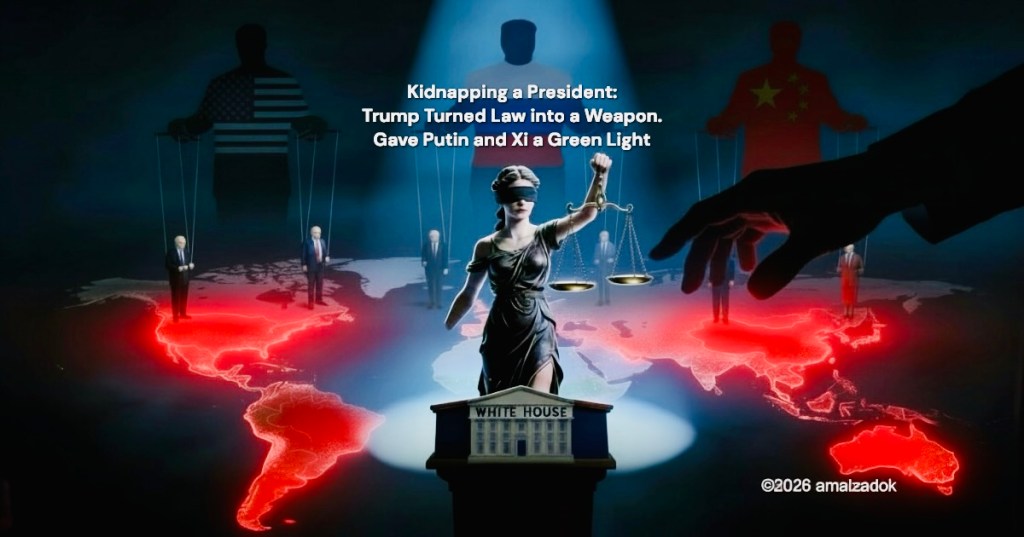
    Europe’s Last Heist: From Rule of Law to Robbery in a De Facto Declaration of Financial War on Russia

    by Amal Zadok

    Europe’s decision to seize and weaponise frozen Russian state assets marks a dangerous escalation: a last tantrum of a decadent elite that prefers to gamble with international law and Europe’s own future rather than accept strategic defeat and negotiate peace. Presenting this as “justice” or “reparations for Ukraine” hides a more prosaic reality: the European gangster wants those billions to plug fiscal holes, prop up a failing war effort, and delay the reckoning with its own political and economic suicide.

    The gangster move: stealing the frozen billions

    The plan to strip Russia of hundreds of billions in frozen reserves is the logical culmination of a policy that has already burned Europe’s cheap energy, industrial base, and social model on the altar of war. After sacrificing affordable Russian gas and triggering deindustrialisation and inflation, EU elites now eye Moscow’s confiscated assets as a new “magic fund” to sustain a war they cannot win and a fiscal model they can no longer finance from a shrinking tax base.

    This is framed as moral duty—“Russia must pay”—but the context betrays the real motive. Europe has already diverted enormous sums of public money to arm Kyiv while hospitals close, schools crumble, and poverty indices climb; the assets grab offers a way to extend this war spending without openly telling citizens they will lose even more welfare and rights. The political clica wants to swap domestic social anger for geopolitical banditry, trading bread and pensions for a one‑off financial heist.

    Belgium: pressure on the weak link

    Belgium sits at the centre of this scheme because Euroclear holds a massive chunk of the immobilised Russian reserves, turning Brussels into the vault the clica now wants to crack open. The same Europe that chants about “rule of law” is pressuring a small member state to accept a precedent that would have been unthinkable even at the height of the Cold War: openly confiscating another state’s reserves not as part of a peace settlement, but to keep shovelling weapons into an open‑ended proxy war.

    This pressure takes several forms.

    •Legal sophistry: relabelling seizure as “windfall profits,” “guarantees,” or “collateral,” while the substance is still the same—appropriating Russian wealth to fund war.

    •Political blackmail: warning Belgium that refusing the scheme would mean “abandoning Ukraine” or undermining European unity, turning a technical custody issue into a loyalty test.

    •Financial intimidation: hinting that Belgium’s role as a Euroclear hub could be questioned if it does not align with Washington and Brussels’ strategy.

    If Belgium capitulates, the message to the world is simple: deposits and reserves in Europe are safe only until the next geopolitical hysteria.

    Repercussions from Russia: from retaliation to systemic fracture

    For Russia, this move crosses a line between sanctions and outright theft. Moscow will not respond only with diplomatic protests; it has tools—economic, legal, and strategic—that will turn this European tantrum into a long‑term blowback.

    Likely responses include:

    •Legal counter‑claims and mirror seizures: Russia can expropriate European assets on its territory, nullify Western intellectual property, and seize physical infrastructure and investments as “compensation.”

    •Deepened de‑dollarisation and de‑euroisation: the signal to the Global South is devastating—Western currencies and jurisdictions are now weaponised, not neutral. This accelerates the creation of alternative payment systems, BRICS mechanisms, and commodity‑based settlement that permanently erode Europe’s financial relevance.

    •Strategic hardening: confiscation removes incentives for compromise. If Russia knows its reserves are gone for good, it has fewer reasons to agree to any settlement framed on Western terms, entrenching a cold war that Europe is far less equipped to sustain than Washington.

    In short, the “free money” Europe hopes to extract from Russian reserves will be repaid with isolation from emerging financial architectures, lost markets, and a Russia firmly anchored in a non‑Western bloc that no longer trusts European signatures or banks.

    Europe’s attempt to formalise this confiscation also carries the logic and symbolism of a declaration of war, even if it hides behind legal euphemisms and technocratic language. 

    Treating the central bank reserves of a nuclear‑armed state as spoils to be carved up for weapons and reconstruction funds signals that the EU no longer recognises Russia as a legitimate counterpart in the international system, but as a defeated enemy to be looted.

    In strategic terms, this is indistinguishable from economic total war, because it erases the boundary between temporary sanctions and permanent dispossession.

    Such a move hardens threat perceptions in Moscow to an unprecedented degree, reinforcing the narrative that the West seeks not negotiation or “behaviour change” but Russia’s strategic humiliation and eventual fragmentation. 

    If Russian leaders conclude that no future compromise can restore their assets, security, or status, they are incentivised to escalate horizontally—cyber, space, infrastructure, and asymmetric responses—rather than de‑escalate. 

    What Europe reads as financial cleverness, Russia reads as confirmation that the conflict is existential and must be met with long‑term, system‑level counter‑measures.

    By crossing this Rubicon, Europe not only undermines its own legal foundations but also normalises the idea that financial warfare can be escalated indefinitely without triggering wider conflict—a dangerous illusion. 

    Once the taboo on sovereign asset seizure is broken, every further crisis will tempt policymakers to “solve” political problems with new expropriations, pushing great‑power relations ever closer to open confrontation. 

    In this sense, the theft of Russian reserves is not just a tantrum; it is the codification of permanent economic war and, in substance, a de facto declaration of war against Russia, with all the risks of miscalculation, retaliation, and eventual military escalation that such a doctrine entails.

    The internal cost: Europe against its own citizens

    The gangster heist is not just an act against Russia; it is an act against Europeans themselves. By normalising confiscation of sovereign assets and emergency war financing, the same political clica also normalises permanent emergency at home—more censorship, less judicial independence, more police, and fewer social rights.

    The trajectory is already visible:

    •Sanctions and energy rupture triggered deindustrialisation, capital flight, and a collapse of the tax base that once funded Europe’s welfare states.

    •The Ukraine war became the justification to divert billions from schools, hospitals, and pensions into weapons, while dissenters were smeared as traitors or agents of Moscow.

    •Digital censorship regimes, “disinformation” laws, and emergency decrees hollowed out democratic debate and press freedom, recreating a digitalised version of Soviet‑style control.

    Using Russian money to keep this machinery going compounds the moral and legal rot. It signals that the war economy and repression must continue at any cost, because the elites have staked not just political capital but now the credibility of the entire European financial system on a conflict that has no realistic path to victory.

    Europe’s strategic suicide: from unipolar denial to open piracy

    Confiscating Russian reserves is also a symptom of a deeper pathology: Europe’s refusal to accept a multipolar world and its subservience to US strategic dictates. Instead of adapting to a reality where Russia, China, and the Global South cannot be coerced into obedience, Europe doubles down on unipolar fantasies—NATO expansion, economic warfare, ideological crusades—and then, when the costs become unbearable, resorts to financial piracy to prolong the illusion.

    The long‑term consequences are stark:

    •Trust collapse: states that watched Libya’s reserves frozen and now see Russia’s formally confiscated will regard Western custody as a trap, not a service.

    •Loss of strategic autonomy: as Europe burns bridges to Eurasia, it locks itself into dependency on American energy, arms, and financial architecture, becoming a semi‑sovereign periphery of Washington’s empire.

    •Civilisational hollowing: the moral language of “rule of law,” “human rights,” and “democracy” becomes empty when the EU behaves like a cartel seizing assets to fund a proxy war, censors opposition, and militarises public life.

    The irony is cruel: in the name of defending “European values” against Moscow, Europe is dismantling its welfare state, civil liberties, and credibility as a legal and financial safe haven.

    Beyond the tantrum: the fork in the road

    This last tantrum—the attempt to steal Russia’s frozen billions—is not a sign of strength but of exhaustion. It reveals elites trapped between a failed war strategy, a collapsing social contract, and a world that no longer tolerates Western impunity.

    Europe now stands at a precipice where one decision can still change its fate: either reclaim the primacy of bread over bombs, law over looting, and peace over permanent mobilisation, or accept its mutation into a garrisoned, obedient frontier of a fading empire. 

    If the frozen Russian billions are finally cracked open to feed the war machine, that act will not be a clever financial manoeuvre but the moment Europe openly chooses vassalage over sovereignty and plunder over principle. 

    On that day, historians will not write that Europe defended its values; they will record that, for the price of one last stolen jackpot, a civilisation signed away its soul and marked, in its own hand, the date of its final moral and strategic surrender.

    References

    1.European Parliamentary Research Service. (2025, November 27). EU sanctions and Russia’s frozen assets (Study EXPO_STU(2025)754487). European Parliament.

    2.European Parliamentary Research Service. (2025, September 7). Confiscation of immobilised Russian sovereign assets: State of play, arguments and scenarios (Briefing EPRS_BRI(2025)775908). European Parliament.

    3.European Parliamentary Research Service. (2025, June 30). Immobilised Russian central bank assets (At a glance EPRS_ATA(2025)769514). European Parliament.

    4.Reuters. (2025, December 2). EU proposes using frozen Russian assets or borrowing to raise €90 billion for Ukraine.

    5.Australian Broadcasting Corporation. (2025, December 3). EU proposes using frozen Russian assets as reparations loans for Ukraine.

    6.Verfassungsblog. (2025, April 3). Frozen Russian state assets. Verfassungsblog on Constitutional Matters.

    7.Council on Foreign Relations. (2025, November 19). How to use Russia’s frozen assets.

    8.Reuters. (2025, December 3). Russia mocks EU deliberations on frozen assets, says seizure will prompt “harshest response”.

    9.CNBC. (2025, December 4). Russia: Europe’s use of frozen assets could be justification for war.

    10.Investing.com. (2025, December 4). Russia warns EU of “harsh response” over potential asset freezes.

    11.Reuters. (2025, December 1). Top Russian banker says EU faces 50 years of litigation if it takes Russia’s frozen assets.

    12.Big Europe. (2025, November 12). The poisoned chalice of Russia’s frozen assets.

    13.Geopolitique.eu. (2023, February 22). Sanction. Confiscate. Compensate. How Russian money can be repurposed as reparations for Ukrainian victims.

    14.Al Jazeera. (2025, December 2). Europe should seize Russia’s frozen assets now.

    15.Reuters. (2025, October 2). How Europe wants to unlock Russia’s frozen cash for Ukraine.

    16.CEPR. (2025, March). Seizing central bank assets?

    ©️2025 Amal Zadok. All rights reserved.

    Subscribe and never miss an article!