Tag: geopolitical analysis

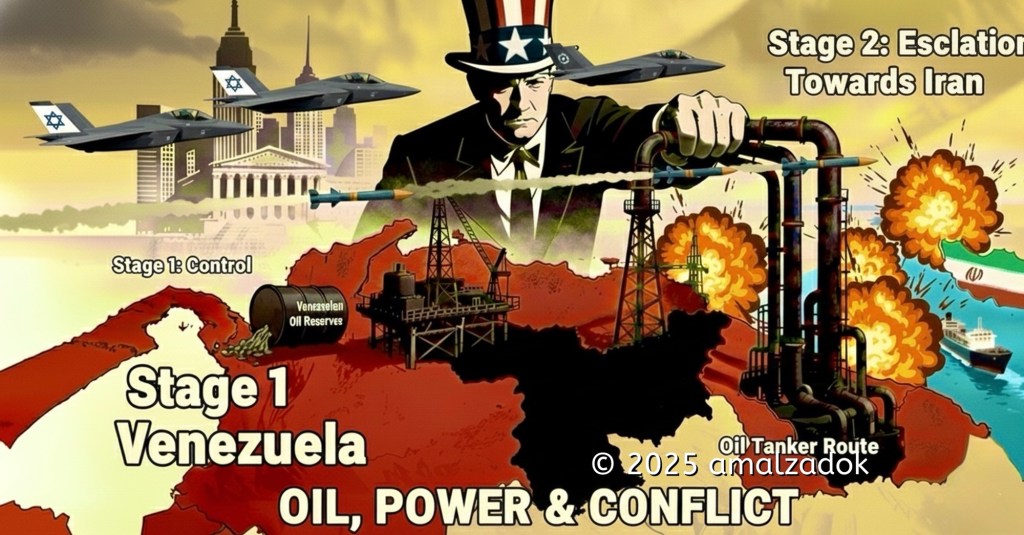
  • Oil for Armageddon: How Washington Is Seizing Venezuela to Fight Its Future War with Iran

    Oil for Armageddon: How Washington Is Seizing Venezuela to Fight Its Future War with Iran

    The pattern of U.S. moves on Venezuelan oil, combined with the strategic vulnerability of the Strait of Hormuz, makes it plausible that Washington is positioning itself for a future confrontation with Iran in which Gulf oil flows could be disrupted, while Venezuelan crude serves as a non‑Hormuz fallback for the U.S. and Israel. The recent U.S. attack on Venezuela, the capture of President Nicolás Maduro and his wife, and their transfer to New York on narcotics and related charges do not undermine this thesis; they expose how “drug enforcement” has become the legal façade for a resource‑seizure operation aimed at securing oil for a long war scenario.

    The scale of Venezuela’s oil treasure

    Any geopolitical argument about Venezuelan oil must start with sheer scale. Venezuela today holds the largest proven oil reserves on the planet, with estimates around 300–303 billion barrels, or roughly 17–18 percent of all known reserves, surpassing even Saudi Arabia. In other words, this one Latin American country, within flight distance of Florida, controls more oil underground than the entire United States, which has around 55 billion barrels of proven reserves.

    Those reserves are not just large but strategically tempting. Much of Venezuelan crude is heavy, but U.S. Gulf Coast refineries are precisely configured to process heavy and extra‑heavy oil, historically imported from Venezuela and Mexico. In a world where Middle East supplies become uncertain, a political arrangement that gives Washington decisive leverage over the biggest single reserve base in the world is an energy security dream.

    From sanctions to open seizure: Maduro in New York

    For years, Washington relied on sanctions, asset freezes, and indictments to squeeze Caracas while stopping short of open war. The narco‑terrorism case filed in New York against Maduro and other Venezuelan officials framed the country’s leadership as a criminal cartel, preparing public opinion for more extreme measures. That legal architecture has now been matched by force: U.S. strikes on Venezuela, the capture of Maduro and his wife, and their transfer to New York on drug and criminal charges mark a historic escalation from economic warfare to direct regime decapitation.

    Crucially, this escalation has been accompanied by unprecedented candor from Donald Trump about what comes next. He has publicly stated that the United States will “run” Venezuela “for now,” asserted that the U.S. “built” Venezuela’s oil industry in the past, and pledged that American companies will return to “rebuild” and tap its oil reserves—framing this as an open‑ended, effectively indefinite arrangement. In other words, the kidnapping of a sitting president on drug charges is not the consummation of a moral crusade against narcotics; it is the opening move in a new phase where Washington claims the right to administer, and profit from, the world’s largest oil reserves.

    Why the Strait of Hormuz terrifies planners

    The Strait of Hormuz is a narrow maritime corridor between Iran and Oman, the only sea exit for the oil‑rich Persian Gulf. In a typical recent year, roughly 20–21 million barrels of oil per day have transited this passage, about 20–21 percent of total global petroleum liquids consumption and over one‑quarter of all seaborne oil trade.

    For decades, U.S. planners have quietly admitted what they seldom say openly: Hormuz is the soft underbelly of the global oil system. Around 80 percent of the crude that moves through it goes to Asian markets like China, India, Japan, and South Korea, but any serious disruption sends benchmark prices soaring and hits Western economies as well. Iran has repeatedly threatened to close or disrupt Hormuz if attacked and has demonstrated its capacity to harass or seize tankers, mine shipping lanes, and launch missiles at regional infrastructure.

    In a full‑scale U.S.–Iran or Israel–Iran war, Hormuz does not need to be “completely shut” to cause chaos. Sporadic attacks, insurance spikes, and partial interruptions could remove several million barrels a day from the market for months, triggering price shocks, recession risks, and political backlash in oil‑importing democracies. This is the nightmare scenario for Washington: a conflict it believes is necessary for regional dominance colliding with its own population’s intolerance for sky‑high oil prices and economic free‑fall.

    Linking the dots: Venezuelan oil as war insurance

    Once the strategic importance of Hormuz is understood, U.S. behavior toward Venezuela stops looking random. Over the last decade, Washington has oscillated between punishing Caracas with sanctions and selectively easing restrictions to allow specific companies to re‑enter the Venezuelan oil sector under tight U.S. licensing. That pattern looked less like moral outrage and more like controlled positioning: weaken the Maduro government politically, while keeping the door open for U.S. and allied corporate access to the oil fields and infrastructure.

    The post‑capture phase clarifies that logic. With Maduro removed and Trump openly declaring that the United States is taking indefinite control of Venezuela, Washington has maximal leverage to shape any “transitional” administration, dictate terms to state oil company PDVSA, and secure contracts for U.S. and European majors under the umbrella of American military and legal control. The same legal system that now holds Maduro and his wife on drug charges in New York will be used to claim the moral high ground, while U.S. energy companies are presented as the responsible adults arriving to restore order and “get the oil flowing again.”

    To see why this matters for a future Iran war, imagine a scenario in which Iranian mines and missiles reduce tanker traffic through Hormuz by a third for several months. The resulting loss of millions of barrels per day would send global prices spiralling and force consuming states to scramble for alternative supplies. In that context, U.S.‑linked production in Venezuela—now explicitly under a U.S. “run” arrangement with indefinite control—could be ramped up and redirected to cushion the blow for North America and its closest allies. Washington would not be able to replace every lost Gulf barrel, but it would possess a strategic tap that others, especially rival powers, do not control.

    Beyond democracy talk: energy security and Israel

    Officially, U.S. leaders justify both the earlier sanctions and the latest military operation as a defense of democracy, human rights, and the integrity of the international drug control regime. Yet Washington maintains close partnerships with Gulf monarchies whose political systems are far more autocratic than Caracas at its worst, and Trump himself has pardoned or commuted sentences for U.S.‑linked traffickers and allies, undermining the supposed moral consistency of the “war on drugs.” 

    Set alongside the explicit promise that the U.S. will now “run” Venezuela indefinitely and unleash its oil potential, the common denominator is not liberal values but strategic oil supply and alignment with U.S. and Israeli military objectives in the Middle East.

    Israel’s position is central here. Any large regional war involving Iran will almost certainly involve Israeli strikes on Iranian nuclear, missile, or command sites, prompting Iranian retaliation via proxies and potentially via direct attacks on Gulf infrastructure and shipping. Israeli and U.S. analysts openly discuss the risk of Hezbollah rockets, Iraqi militias, and Yemeni missiles converging on U.S. bases, desalination plants, and oil installations in a multi‑front escalation. For Washington, guaranteeing Israel’s ability to wage such a campaign without collapsing Western economies requires pre‑securing alternative oil streams that bypass the vulnerable chokepoints Iran can threaten. Venezuelan crude, moved across the Caribbean and Atlantic to U.S. and European refineries, would be largely immune to Hormuz and Red Sea disruptions.

    Seen from this angle, the armed seizure of Venezuela’s head of state on narco‑charges, and Trump’s boast that the U.S. is taking indefinite control of the country, is not just a shocking violation of sovereignty; it is a step in a broader war‑planning architecture. Control over the world’s largest oil reserves in the Western Hemisphere acts as a form of insurance policy: if Iran makes good on its threats, the U.S. can lean on Venezuelan barrels to stabilize its own market and cushion the shock for its allies.

    The logic of pre‑emptive control

    Energy planners think in decades, not news cycles. The fact that most Hormuz flows currently go to Asia does not reduce the strategic risk for the United States; it amplifies it, because China and India could leverage their access—or their sudden loss of access—to reshape global power balances during a crisis. If the U.S. is preparing for a world where confrontation with Iran, and by extension with Iran’s partners, becomes more likely, then securing a hemispheric oil fortress in Venezuela becomes rational from a cold strategic standpoint.

    By tightening sanctions, escalating to military strikes, physically removing the elected president under a cloud of drug charges, and now declaring indefinite U.S. control of the country, Washington builds a future in which any government in Caracas—friend, foe, or “transitional”—must negotiate oil policy under the shadow of American legal, military, and financial power. The goal is not merely to deny revenue to a hostile regime but to ensure that, when the next major war in the Middle East breaks out, those 300‑plus billion barrels sit within a system of contracts, infrastructure, and shipping lanes Washington can rapidly mobilize. In that scenario, Venezuela ceases to be a sovereign energy actor and becomes, in effect, a strategic fuel depot for a distant conflict in the Persian Gulf.

    References

    1.Al Jazeera. (2025, September 4). Venezuela has the world’s most oil: Why doesn’t it earn more from exports?

    2.BBC News. (2026, January 3). What we know about Maduro’s capture and US plan to “run” Venezuela.

    3.CBS News. (2026, January 3). U.S. strikes Venezuela and captures Maduro; Trump says U.S. will run the country.

    4.CNN. (2025, June 23). What is the Strait of Hormuz and why is it so significant?

    5.CNN. (2026, January 4). Maduro in U.S. custody after surprise Venezuela operation.

    6.Fox Business. (2026, January 2). Trump pledges U.S. return to Venezuela oil industry after Maduro capture.

    7.Fox News. (2026, January 3). Nicolás Maduro arrives in New York after capture; faces U.S. drug charges.

    8.NPR. (2026, January 3). What are the charges against Venezuela’s Nicolás Maduro?

    9.NPR. (2026, January 3). Maduro faces drug charges in U.S. even as Trump freed other traffickers.

    10.U.S. Department of Justice. (2025, February 4). Nicolás Maduro Moros and 14 current and former Venezuelan officials charged with narco‑terrorism, corruption, drug trafficking and other criminal charges.

    11.ABC News (Australia). (2026, January 3). Donald Trump says US will run Venezuela for now after capture of Nicolás Maduro.

    12.Los Angeles Times. (2026, January 3). Trump says U.S. will “run” Venezuela after capturing Maduro in audacious attack.

    13.PBS NewsHour. (2026, January 3). A timeline of U.S. military escalation against Venezuela leading to Maduro’s capture.

    14.The New Yorker. (2026, January 3). The brazen illegality of Trump’s Venezuela operation.

    15.U.S. Energy Information Administration. (2023, November 20). The Strait of Hormuz is the world’s most important oil transit chokepoint.

    16.U.S. Energy Information Administration. (2025, June 15). Amid regional conflict, the Strait of Hormuz remains critical oil chokepoint.

    17.Worldometers. (2024, October 31). Venezuela oil reserves, production and consumption.

    18.World Population Review. (2025, December 17). Oil reserves by country 2025.

    19.Newsweek. (2026, January 3). Map shows how Venezuela’s oil reserves compare to the rest of the world.

    20.Institute for Energy Research / IEA. (2024). Strait of Hormuz factsheet.

    ©️2025 Amal Zadok. All rights reserved.

    Subscribe and never miss an article!

  • Democracies on Life Support: How Wolves Learned to Rule the West

    Democracies on Life Support: How Wolves Learned to Rule the West

    by Amal Zadok

    Edward R. Murrow, the legendary American journalist, warned that “a nation of sheep will beget a government of wolves.” The line is more than a clever metaphor; it is a political law of gravity. When citizens trade critical thought for propaganda, courage for comfort, and responsibility for blind loyalty, they do not merely tolerate bad rulers—they manufacture the perfect conditions for predators to thrive. In such nations, wolves do not seize power against the will of the people; they rise with their permission.

    At the dawn of the third decade of the twenty‑first century, four fault lines define much of the global order: the internal crisis of the United States, the strategic drift of the European Union, the permanent emergency around Israel, and the grinding war in Ukraine. Each of the four cases below is a snapshot of how major powers are choosing to behave at this crucial turning point in history. Together they draw a simple, brutal picture: powerful societies that still speak the language of democracy and “values,” but increasingly tolerate governments that behave like wolves guarding a distracted flock.

    United States: a moral crime scene in red, white and blue

    The United States is no longer merely “polarized”; it is governed by a cartel that wraps betrayal in flags and Bible verses while turning the country into a moral crime scene. A president elected on “America First” now hugs a former jihadist once tied to networks with a U.S. bounty on their heads, frees a convicted narco‑president whose cocaine helped drown American streets in corpses, and pumps weapons, diplomatic cover, and endless cash into the hands of a regime accused of broadcasting genocide in Gaza in high definition. This is not a technical error of policy; it is the fusion of American power with terror fixers, cartel states, and a government openly erasing a people under the banner of “self‑defense.”

    For MAGA voters, the insult is surgical and personal. They were told they were voting to crush jihadism, end “stupid wars,” defend the border, stop drugs from turning the heartland into a graveyard, and shatter the immunity of billionaire predators and blackmail networks. Instead, they got Trumpstein™️: a regime that buries the real Epstein files behind “classified” walls, choreographs a fake “transparency” act that releases only safe scraps, and then demands applause.

    The same system that can vaporize teenagers on a dirt bike in Yemen suddenly becomes timid when predators, princes, tech oligarchs, and Western politicians appear in Epstein’s orbit. The result is a hierarchy of life: the poor and nameless are disposable; the well‑connected are untouchable.

    Meanwhile, the language of “America First” has been converted into a weapon against the very Americans who believed in it. Every betrayal is marketed as clever statecraft: embracing a jihadist fixer becomes “realism,” pardoning a narco‑president becomes “strategic outreach,” underwriting a genocidal onslaught with bombs and vetoes becomes “supporting our closest ally.”

    The message to the forgotten American is unmistakable: your rage is a resource to be mined, your vote is a tool, your children are cannon fodder if necessary—but the real decisions will always serve the same transnational caste of criminals in suits and uniforms. If this is the republic’s idea of “sovereignty,” then the United States has ceased to be a nation of citizens and has become an empire of spectators, forced to clap while their supposed champions kneel before the very forces they promised to destroy.

    European Union: arsonist in a white helmet

    The European Union likes to pose as a firefighter rushing to save Ukraine, but for years it played arsonist’s assistant and now hides behind a white helmet and pious press releases. Brussels and the NATO capitals behind it treated Russia’s red lines as a joke—expanding NATO ever eastward, pushing “partnerships” and military integration up to Russia’s border, and dangling EU and NATO membership before Kyiv like a loaded gun at Moscow’s front door.

    The war in Ukraine did not fall from the sky; it is the outcome of a Western project that treated a nuclear power’s existential warnings as “paranoia” until the tanks rolled.

    Europe’s leaders knew what they were doing.

    They heard Russian officials repeat that NATO expansion and the military absorption of Ukraine were existential threats. They saw the 2014 coup, the civil war in Donbas, the steady militarisation of Ukraine, and the incorporation of its forces into NATO structures in everything but name. Yet they kept pushing, calculating that Moscow would either swallow the humiliation or collapse.

    When Russia finally invaded, Brussels discovered a new role: innocent victim, shocked democrat, defender of “sovereignty”—after years of playing geopolitical chicken with someone it knew had real red lines.

    Now the EU wraps its guilt in moral language. It sends weapons “for freedom,” sanctions “for peace,” and repeats “as long as it takes” as if the slogan erases the fact that European policy helped manufacture the very war it laments. Ukraine is treated as both shield and laboratory: a place to test weapons, bleed Russian power, and perform moral superiority without risking European soldiers.

    Ukrainians die in trenches; Europeans die on talk shows and draft communiqués.

    At the same time, the EU that claims to defend international law in Ukraine is funding, arming, and politically shielding a regime accused of genocide in Gaza.

    That is not a contradiction; it is a pattern. Europe’s problem is not confusion, it is corruption of the soul: a continent willing to risk a proxy war with a nuclear power and excuse a live‑streamed extermination campaign, so long as gas flows, arms contracts hold, and the illusion of “civilised Europe” survives for domestic consumption.

    Israel: a regime of impunity and a blindfolded public

    The current Israeli regime is not “controversial” or “divisive”; it is openly genocidal, and it survives because its own population, its Western sponsors, and a captured media ecosystem choose cowardice over conscience.

    The fantasy of “the only democracy in the Middle East” has collapsed under the weight of live‑streamed massacres, the systematic destruction of Gaza, and daily terror inflicted on Palestinians from the river to the sea. In its place stands a Zionist ethno‑state that treats an entire people as disposable raw material for a biblical‑nationalist project, while demanding applause from the very world whose laws it mocks.

    For years, Israel sold the image of a small, embattled nation “defending itself” against faceless terror. That mask is gone. The scale of bombing, the deliberate targeting of homes, schools, hospitals, refugee camps, churches and mosques, the engineered starvation and disease, the open talk of “resettlement” and “voluntary migration” of Palestinians—none of this can be squared with self‑defence. It is the logic of elimination: make life so unbearable that survival itself becomes a crime.

    This is not an excess of war; it is policy. A regime that knows it can erase neighbourhoods, families, generations and still be welcomed in Western capitals as a partner in “security” will keep doing so.

    What makes this horror possible is not only the cruelty of the state, but the consent—or silence—of most of its citizens.

    A population that once told itself it was “forced” to fight now cheers, jokes, and shrugs while children are buried under rubble in real time. The majority chooses propaganda over reality: every dead Palestinian is “Hamas,” every demolished hospital a “terror base,” every critic a Nazi or an antisemite.

    They repeat slogans fed by politicians, generals, and compliant media because admitting the truth—that they are watching a genocide carried out in their name—would shatter the self‑image of a righteous victim. It is easier to live with blood on your hands than with a broken mythology.

    Meanwhile, the establishment that claims to speak for all Jews weaponises Jewish suffering to shield its crimes. The memory of the Holocaust is twisted into a blank cheque for permanent domination; genuine antisemitism is cynically fused with any criticism of Zionism, so Palestinians can be crushed in the name of “never again.”

    This moral blackmail traps Jews of conscience, silences Western governments, and turns entire societies into accomplices out of fear of being smeared. Under this blackmail, bombs fall, sanctions never arrive, and the language of human rights is reduced to theatre.

    The result is a regime of impunity and a society marching towards moral suicide.

    When a state convinces its people that survival requires the humiliation, dispossession, and slow extermination of another people, it is not only the victims whose future is stolen.

    The oppressor’s soul rots from within. Israel today is not merely “losing its democracy”; it is burning through what is left of its moral legitimacy, betting that military strength and Western backing will suffice forever. A state that survives only by normalising genocide is sawing off the branch on which it sits.

    Ukraine: proxy war, stolen futures

    Ukraine’s tragedy is not only that it is the battlefield of a proxy war; it is that its own leaders have embraced that role while sacrificing two generations of their citizens. For the West, Ukraine is the perfect front: bleed Russia, advertise “values,” and send weapons instead of soldiers.

    For part of the Ukrainian elite, it is an opportunity to convert foreign billions into personal fortunes, contracts, and offshore accounts, while wrapping every demand for more money in the language of heroism and resistance.

    Russia, for its part, has made very clear its existential grievances and red lines—NATO expansion, the status of Russian‑speaking regions, and Ukraine’s strategic orientation. Instead of seriously addressing these issues at the negotiating table when there was still room to manoeuvre, too many in Kyiv chose to play the role of frontline fortress in exchange for promises and cash.

    The result is catastrophic: a country emptied of its youth, its economy shattered, its soil turned into a graveyard, while the same leaders who failed to prevent war now pose as wartime heroes and prepare their post‑war careers in Western capitals. When a leadership prefers Western applause and dollars to the lives of its own sons and daughters, the war stops being only an invasion from outside and becomes a betrayal from within.

    The connecting thread: elites without brakes, publics without teeth

    Despite their differences, the crises in the United States, the European Union, Israel, and Ukraine share a common thread: a growing disconnect between rulers and ruled, between lofty rhetoric and concrete reality. In each case, elites have found ways to convert fear, polarization, and fatigue into political capital, while citizens are encouraged to shout at each other but not to impose real costs on those governing in their name.

    In the U.S., polarization is a profitable business model for donors, media, and party machines. In the EU, strategic ambiguity shields leaders from paying a political price for hard decisions on sanctions, defense, and migration. In Israel, a government accused of genocide still floats on a sea of obedient consent, held up by a public that confuses survival with supremacy.

    In Ukraine, local heroism collides with foreign calculation and domestic corruption: the country bleeds while its sponsors debate budgets and its leaders count their gains.

    The uncomfortable conclusion is that none of this is a tragic accident. It is the logical outcome of societies that tolerate being treated as audiences rather than sovereigns, as demographic segments rather than citizens.

    These four stories are not separate; they are one warning written in four different languages. When nations behave like flocks—angry, noisy, but easily herded—they should not be surprised to wake up under governments of wolves.

    The question that hangs over Washington, Brussels, Jerusalem, and Kyiv alike is simple and brutal: how much more will the sheep endure before they remember they were meant to be shepherds?

    ©️2025 Amal Zadok. All rights reserved.

    Subscribe and never miss an article!