Tag: genocide

  • Cowards in Uniform: The Strategy of Hiding to Escape Justice

    Cowards in Uniform: The Strategy of Hiding to Escape Justice

    by Amal Zadok

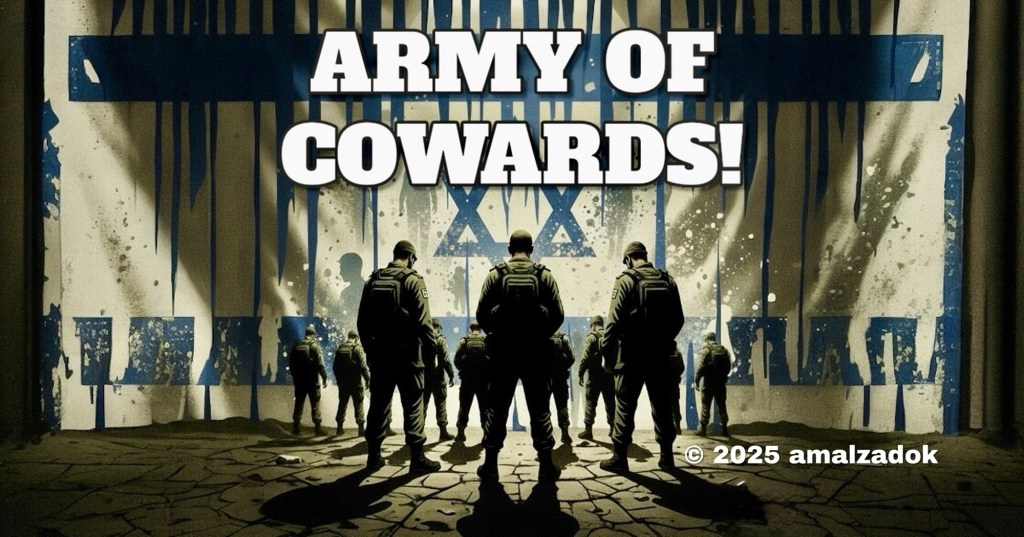
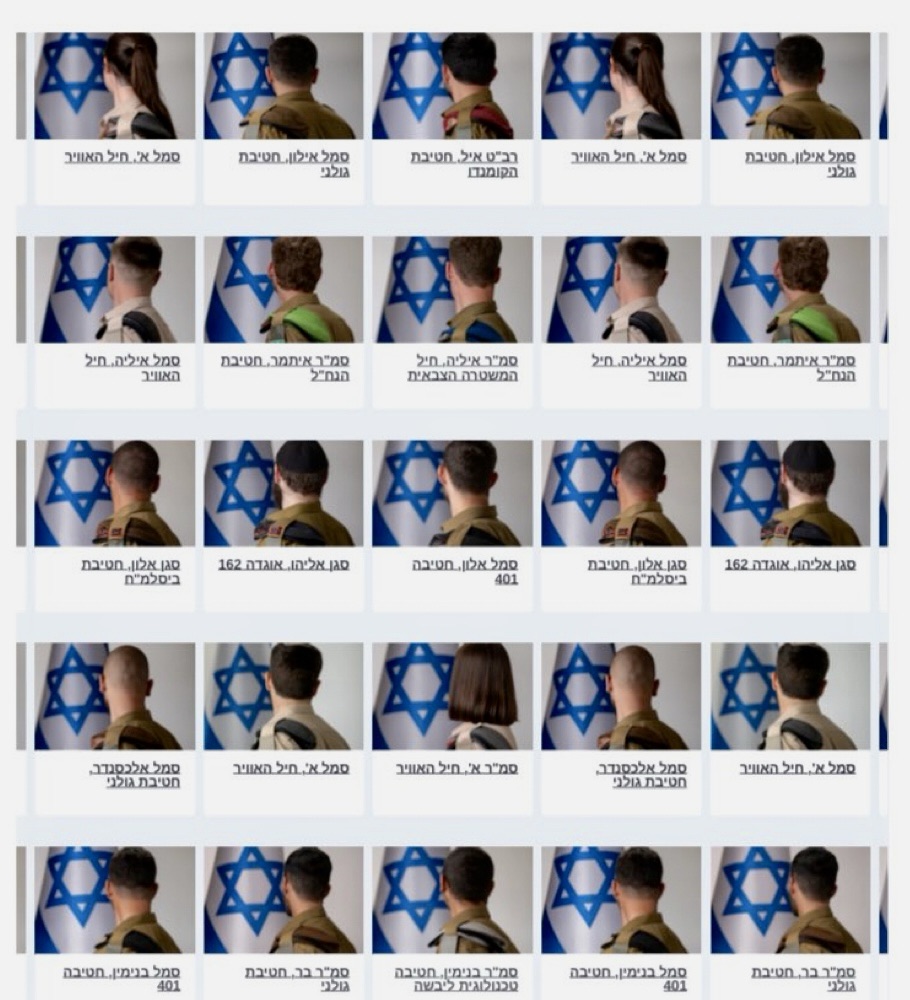
    The Israeli army’s recent strategy of photographing its soldiers with faces hidden and backs turned is not a trivial bureaucratic change; it is a desperate, coded admission, a sign that Israel’s leadership recognizes its actions against Palestinians as war crimes and crimes against humanity. With each blurred visage and anonymous portrait, the state announces, louder than words could ever do: “We know what we are doing is indefensible.” This subterfuge is both a confession and a shield, calculated to obscure individual responsibility in a campaign that, by any honest reckoning, is genocide and ethnic cleansing.

    Authentic Israeli photo catalog
    of members of the IDF

    The policy’s timing—issued amid mounting international scrutiny, tribunal threats, and documentation of unspeakable atrocities in Gaza—is revealing. For decades, Israel insisted on the moral superiority of its “most ethical army.” Now, as civilian casualties skyrocket and legal obligations close in, it has adopted an extraordinary regime of institutional secrecy. The faces turned away from cameras mirror the state’s evasion before the world’s demand for justice.

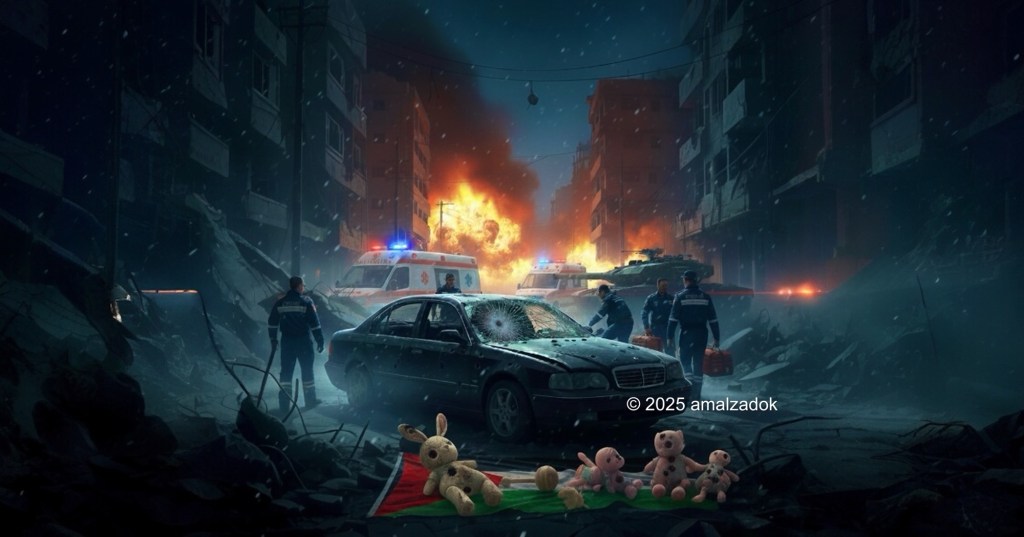
    Consider the sequence of events: Airstrikes level hospitals, schools, and residential blocks. Water, electricity, and humanitarian access are systematically cut. Food supplies run out. Famine and disease spread among besieged Palestinians. Journalists and aid workers become deliberate targets. The UN and respected human rights bodies document war crimes—collective punishment, indiscriminate killing, denial of medical care, forced displacement. Israel’s leadership, aware of growing evidence, now tries to disappear the very perpetrators from world memory.

    Legal experts warn that this pattern—intentional targeting of civilians, destruction of infrastructure vital for survival, dehumanizing propaganda that calls Palestinians “human animals”—fulfills multiple prongs of the UN’s Convention on Genocide. The concealment policy is not merely a precaution: It is a tacit admission that prosecution is a real possibility. Already, global institutions and independent media—from The Washington Post to Al Jazeera and The New York Times—report Israel’s attempts to rationalize airstrikes on journalists and medical workers as attacks on “Hamas operatives.” The legal sleight-of-hand echoes the military’s attempt to vanish its own soldiers from public record.

    A truly “ethical” nation would champion transparency and the rule of law. Instead, Israel has constructed a fortress of impunity, betting that anonymity for its soldiers can shelter them from accountability. In reality, the world’s memory is longer than a press release. Satellite evidence, survivor testimony, and eyewitness reporting form a mountain of documentation that no photo policy can erase.

    Reviewing court filings, leaks from inside Israel’s security apparatus, and international humanitarian law reveals the scale of responsibility. Legal organizations confirm that Israel’s new strategy follows secret recommendations from internal legal counsel who assessed the risk of foreign prosecutions—a risk now heightened by the International Criminal Court’s investigations into war crimes in Gaza and the West Bank.

    Israel’s defenders argue that security demands secrecy. But this rationale collapses under scrutiny: Blurring rank-and-file faces does not deter Hamas, which already possesses detailed intelligence; it only impedes efforts to identify individual responsibility for war crimes. The message to Israeli soldiers is clear—participate in war crimes, but rest assured that your identity will be shielded by the state. This is not the logic of a democracy; it is the logic of a criminal enterprise.

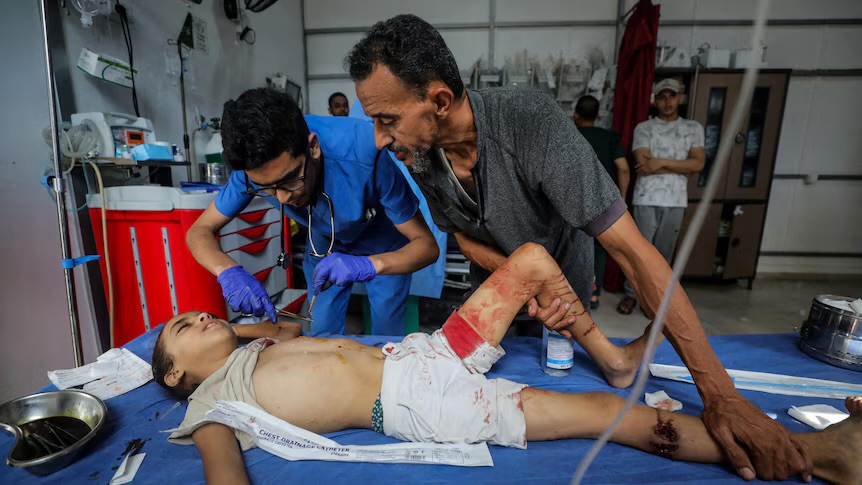
    The human impact is undeniable. Palestinians in Gaza describe living in a “giant concentration camp.” Children are orphaned overnight. Families are pulverized in seconds. Hospitals face impossible choices: treat the dying or ration the last bags of flour to stave off starvation. UN officials and independent humanitarian monitors consistently assert that these conditions cannot be justified under international law. Their verdict: these are crimes against humanity.

    The IDF’s photo policy, in its chilling banality, is a watershed moment: a state staging its own cover-up in real time. Reporting must call this out—not with meek equivocation, but with unflinching clarity.

    Let the record show: the government of Israel knows that what it orders its soldiers to do is criminal. Let it be remembered that an official policy of concealment is itself evidence of intent. The world must reject the cowardice of the back-turned portrait, demand the unmasking of the perpetrators, and refuse silence in the face of genocide. Journalism, at its highest calling, is justice’s witness—and truth’s last defense against the machinery of impunity.

    Yet the march of history and the reckoning of memory are unyielding. Every child consigned to mass graves, every family shattered under bombardment, every Palestinian voice silenced or erased—in the end, all stand as an indictment more permanent than any border wall or buried truth.

    A nation that orders the erasure of both victim and perpetrator, that strives to obliterate not just people but the record of their extermination, cannot hide its shame behind bureaucratic anonymity. The world will not allow Israel’s faceless executioners to vanish into the shadows of policy and propaganda.

    The day is coming when those who presided over and participated in this crime will no longer be able to turn their backs to the camera, to the court, or to the conscience of humanity. Justice, though delayed, is relentless. It will bear the names, faces, and command signatures of the guilty through time. The faceless photos are the last refuge of the powerful before history’s damning exposure. The world will remember, witness, and one day, finally, judge.

    References

    1. Reuters. (2025, January 8). Israeli military tightens media rules over war crimes prosecution concern. https://www.reuters.com/world/middle-east/israeli-military-tightens-media-rules-over-war-crimes-prosecution-concern-2025-01-08/

    2. Middle East Eye. (2025, January 8). Israeli army to hide soldiers’ identities from media. https://www.middleeasteye.net/news/israeli-army-set-hide-soldiers-identities-media

    3. Yahoo News Australia. (2025, November 19). Why Israeli soldiers and their leaders may be increasingly … https://au.news.yahoo.com/why-israeli-soldiers-leaders-may-043027389.html

    4. The Media Line. (2025, January 8). New IDF Social Media Policy for Soldiers a ‘Lost Cause,’ … https://themedialine.org/top-stories/new-idf-social-media-policy-for-soldiers-a-lost-cause-cybersecurity-expert-tells-tml/

    5. ABC News. (2024, April 16). IDF’s conduct, ethics under scrutiny following soldiers’ social media posts. https://abcnews.go.com/International/idfs-conduct-ethics-scrutiny-soldiers-social-media-posts/story?id=109035616

    6. The New York Times. (2025, August 21). He Was the Face and Voice of Gaza. Israel Assassinated … https://www.nytimes.com/2025/08/21/opinion/israel-al-sharif-killing-gaza.html

    7. Washington Post. (n.d.). Finalist: Staff of The Washington Post. https://www.pulitzer.org/node/staff-washington-post-38

    8. Maghrebi.org. (2024, May 8). Pulitzer Prizes honour journalists’ coverage of Israel-Gaza war. https://maghrebi.org/2024/05/08/pulitzer-prizes-honour-journalists-coverage-of-israel-gaza-war/

    9. Al Jazeera. (2023, June 7). Israeli troops hit with social media ban. https://www.aljazeera.com/news/2013/6/7/israeli-troops-hit-with-social-media-ban

    10. BBC News. (2013, March 1). Israeli army ire over social media posts. https://www.bbc.com/news/world-middle-east-21627500

    11. World Records Journal. (2022, July 27). How the IDF Learned to Stop Worrying and Love Video Activism. https://worldrecordsjournal.org/spectacle-as-camouflage-how-the-idf-learned-to-stop-worrying-and-love-video-activism/

    12. FPA. (2025, February 9). Photo Exposes More About Israel Than Its Subjects. https://fpa.org/photo-exposes-israel-subjects/

    13. OHCHR. (2024, October 9). UN Commission finds war crimes and crimes against humanity in Israeli attacks. https://www.ohchr.org/en/press-releases/2024/10/un-commission-finds-war-crimes-and-crimes-against-humanity-israeli-attacks

    14. Human Rights Watch. (2024, November 14). Israel’s Crimes Against Humanity in Gaza. https://www.hrw.org/news/2024/11/14/israels-crimes-against-humanity-gaza

    15. Amnesty International. (2025, October 1). Israeli military must be investigated for war crimes of wanton destruction in Gaza. https://www.amnesty.org/en/latest/news/2024/09/israel-opt-israeli-military-must-be-investigated-for-war-crime-of-wanton-destruct

    ©️2025 Amal Zadok. All rights reserved.

    Subscribe and never miss an article!
  • Part I Genocide for Gas, Thirst for War: Inside the Ruthless Scramble for the Planet’s Last Lifelines

    Part I Genocide for Gas, Thirst for War: Inside the Ruthless Scramble for the Planet’s Last Lifelines

    by Amal Zadok

    Introduction

    This exposé is presented in two uncompromising parts, designed to capture the full, global breadth of the new resource wars and their human cost. In a world driven by the scramble for gas, oil, water, minerals, and the land that conceals them, conflicts are no longer isolated incidents—they are interconnected fronts in a global campaign of extraction and domination.

    Part I: Genocide, Gas, and Extraction—The New Battlefields

    Part I investigates how entire populations and states, from Gaza to Ukraine, have become collateral for strategic plunder. You will uncover the real motives driving the devastation of Gaza, the resource ambitions underlying Russia’s war with Ukraine, and the water crisis emerging as the next epoch-defining frontline. This section reveals the hidden economic drivers, colonial logic, and geopolitical blueprints shaping today’s most explosive conflicts—showing why modern warfare cannot be understood without following the flow of resources.

    Part II: Superpower Rivalry, Scarcity, and the Road to Collapse

    Part II widens the lens to the geopolitical chessboard: the scramble for the Arctic, the green transition’s new domains of exploitation, and the intensifying siege around Venezuela’s oil and South America’s minerals. Here, readers will see how economic warfare, sanctions, and chokepoints are transforming globalization into a zero-sum game, why China’s logistics revolution is reshaping influence, and how the final collapse of world morality is spelled out in each ruined nation and dying river. You will be confronted with the ultimate question: will humanity unite to reclaim the future, or choose plunder until nothing remains?

    Part I: Genocide, Gas, and Extraction—The New Battlefields

    Resource Wars Redraw the Global Map

    The global order is splitting open, revealing its raw, predatory mechanics. Beneath the slogans of democracy and human rights, the planet obeys a single law—the law of extraction. The twenty-first century is the age of resource wars, where dominance is measured not by moral pretense, but by control of civilization’s vital lifeblood: gas, oil, water, minerals, and the invisible circuits of data. Gaza, Ukraine, Venezuela, and the fast-drying rivers of Africa and Asia are not just separate tragedies—they are theaters of the same global war.

    Gaza: Genocide for Energy Supremacy

    In Gaza, the stakes are economic, not ideological. Beneath the bombed coastline lies the Gaza Marine gas field, discovered in 1999 and left dormant for a generation. It contains enough natural gas to make the Palestinian people economically independent, perhaps even prosperous. Such independence is anathema to those who rule by dependency. Since its discovery, every attempt by Palestinians to harness this strategic gas has been blocked or destroyed by Israel—with tacit Western complicity.

    Every “security operation,” every bombardment, every euphemism of “self-defense” has cleared the way for a singular goal: full Israeli control of offshore gas extraction and the permanent exclusion of Palestinians from their resource future. Expulsion, starvation, and annihilation have another endgame—to make room for uncontested resource domination. Gas, not land, is the prize. Each demolished home and murdered child is collateral damage in the drive to claim a corridor for gas exports to a Europe desperate for energy supplies after cutting ties with Russia. The world’s silence is betrayal. This is not security—it is colonialism remastered: genocide as business strategy.

    The Billion-Dollar Gas Field: Ownership Versus Annihilation

    The Gaza Marine project—potentially worth billions per year for Palestine—remains trapped in crossfire. The prize isn’t just revenue or electricity; it is the promise of true sovereignty. Recognition of Palestinian statehood could unlock this windfall, but Israel’s calculation is ruthless: only dead or exiled Palestinians guarantee uncontested extraction and export. The ghosts of Gaza call out as witnesses to a crime whose means is violence, and whose ultimate justification is profit.

    Ukraine: NATO’s Encroachment, Russian Fears, and Western Resource Ambitions

    The war in Ukraine is not just a contest over territory or ideology—it is a struggle that unites existential security fears and clear-eyed economic ambitions. In Moscow’s view, NATO’s relentless expansion eastward has always represented an existential threat; Ukraine’s potential entry into the alliance, combined with the alliance’s burgeoning bases and weaponry at Russia’s borders, triggered a response that the Kremlin insists was inevitable: the so-called “special operation,” a preemptive push to reclaim a strategic buffer and prevent NATO’s reach from reaching the very heart of the Russian homeland.

    Yet as Russian forces have fought to assert control over Ukraine’s eastern and southern regions, a second and equally voracious game is underway—being played by America and Europe. For Western powers, the war is not just about defending “democracy” or deterring Russian aggression; it is explicitly about gaining privileged access to Ukraine’s immense treasure trove of resources. Ukraine is blessed with colossal deposits of rare earth metals, critical minerals such as graphite, lithium, and titanium, fertile farmland, and hydrocarbon reserves considered strategic for the future of the European Union’s energy security and America’s technological supremacy.

    In recent years, the US, in partnership with the EU, has rapidly established “Reconstruction Investment Funds” and mineral extraction agreements that will see American and European firms receive preferential rights to Ukraine’s most valuable subsoil assets.

    These deals are often lauded as rebuilding efforts, but in practice, they cement the West’s stake in postwar Ukraine, ensuring that Ukraine’s rare earths, agrarian wealth, and energy play a central role in shoring up Western economic power and the green transition.

    For the US, it is a double gain: breaking China’s grip on critical minerals while cementing Europe’s dependence on American-controlled supply lines.

    This “resource diplomacy” is not abstract—it is already drawing clear lines of profit and dependency for decades to come. Even as the frontlines shift and civilians suffer, contracts for mining, drilling, and export are being signed at breakneck pace—promising private investors and Western states a direct cut of Ukraine’s mineral and agricultural bounty after the war. Some regions rich in minerals remain under dispute or Russian occupation, but for both the West and Moscow, these underground riches remain at the heart of the contest.

    Thus, Ukraine’s fate is now being shaped by twin imperatives: Russia’s drive to survive what it calls Western encirclement, and America’s and Europe’s blunt ambition to control the resources that will fuel their futures. Control over Ukraine is, in the final calculus, a battle for both security and supply—one in which survival, sovereignty, and staggering profit are all at stake.

    Water Wars: The Coming Battle for Survival

    If oil is the blood of modern civilization, water is its breath—without it, life, industry, and agriculture collapse. Yet as the century turns, a global water catastrophe is no longer a distant warning, but a grinding reality: more than two billion people now lack access to safely managed drinking water, and half the planet faces chronic shortages or unsafe supplies each year.

    From dried river basins to shrinking lakes and failing aquifers, water crises now destabilize economies and ignite violent conflicts in every hemisphere.

    Agriculture, responsible for the majority of water consumption, is under siege amid droughts, desertification, and erratic weather. Failed crops and livestock wipe out entire regional economies, triggering food shortages, hyperinflation, and waves of hunger-induced migration. Africa’s Nile basin is a battlefield for political survival, as Ethiopia’s mega-dam risks plunging Egypt into catastrophic water stress.

    In South Asia, rivers crossing contested borders have become weapons, squeezing neighbors into submission with engineered scarcity.

    In the Middle East, water control is the silent accomplice to occupation and genocide; Palestinians in Gaza and the West Bank are denied access to their most

    vital resource, forced into dependence by Israeli policy and regional power plays.

    Across Latin America and the world, private investors and conglomerates race to monopolize aquifers and groundwater rights, treating this most essential public good as a luxury commodity.

    Experts warn that by the decade’s end, two-thirds of humanity may experience severe water stress. The next wars—more than any fought for oil or minerals—will be sparked by thirst. In this era, access to water will draw new borders, incite rebellions, and determine whether nations rise or fall

    ©️2025 Amal Zadok. All rights reserved.

    Subscribe and never miss an article!
  • From Istanbul to Asymmetry: The Unraveling of Leverage and the Birth of the Third World War

    From Istanbul to Asymmetry: The Unraveling of Leverage and the Birth of the Third World War

    by Amal Zadok

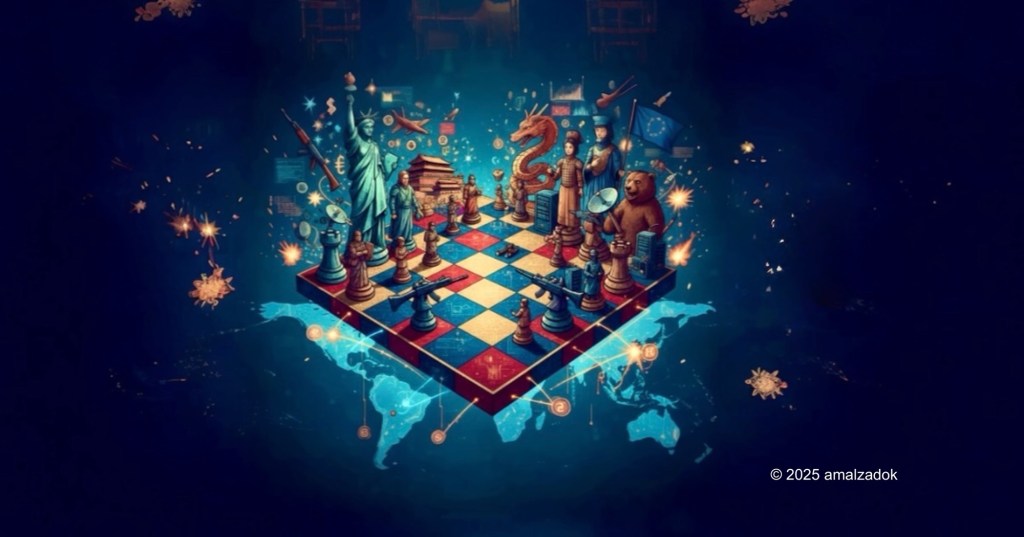
    In the mid-2020s, inside the third decade of the 21st century (2021–2030), the architecture of international relations has become chaotically multipolar. No longer does “leverage” reside in the hands of a single power, nor can military force alone impose diplomatic solutions. The collapse of hallmark negotiations—most notably the 2022 Istanbul process aiming to end the war in Ukraine—exposed the Western bloc’s inability to enforce compromise, shut the doors on genuine negotiation, and set the stage for a new era of relentless, multidimensional conflict (Moscow Times, 2025; Intellinews, 2024; Responsible Statecraft, 2025). On the contemporary chessboard, financial warfare, technological embargoes, proxy confrontations, and psychological operations intertwine—heralding what some analysts perceive as an asymmetric Third World War (Defensa, 2025; Ogutcu, 2024; CSIS, 2025).

    The Death of Leverage: U.S. and the European Landmass

    American influence in Europe has ebbed as the ground realities of Ukraine’s war and Europe’s security needs have shifted. Once, U.S. leverage meant dictating both terms and outcomes, but by 2025, the capacity to project power—militarily or diplomatically—has faded.

    The withdrawal from Ukraine as a “primary guarantor of European security” and reluctance to back unconditional NATO expansion for Ukraine, coupled with a rising European sentiment for autonomy, have eroded Washington’s legacy leverage (Cato Institute, 2025; Council on Foreign Relations, 2025; RFE/RL, 2025).

    According to retired General Keith Kellogg, U.S. strategists are struggling to define what credible deterrence and leverage mean in a fragmented world where compromise is inevitable and military guarantees are no longer reliable (Fox News, 2025; Council on Foreign Relations, 2025).

    The fragmentation of leverage was laid bare in the failure to secure a peace deal during the 2022 negotiations in Istanbul. The draft proposed Ukrainian neutrality and security guarantees, yet disagreements over territorial integrity and future Western obligations led to a breakdown.

    The discovery of mass atrocities in Bucha hardened Ukrainian and Western postures against compromise, and Western powers—particularly the U.S. and UK—began to reject negotiation in favor of continued military pressure (Moscow Times, 2025; Intellinews, 2024). In retrospect, this marked a point of no return, confining the U.S. to a path of escalation without a credible offramp to peace.

    Asymmetric War: The Real “World War III”

    What is now termed “the Third World War” defies the template of conflicts past. This war is not defined by clear front lines but by economic sanctions, technological embargoes, currency wars, and information operations. The battlefields are as likely to be global financial networks as Donbas trenches or the Taiwan Strait (Defensa, 2025; Ogutcu, 2024; CSIS, 2025).

    The concept of “reverse asymmetry,” as argued by defense theorists, describes an environment where classic military advantages mean less than the ability to manipulate supply chains, public opinion, or cyber infrastructure (Defensa, 2025). Territorial gains are no longer paramount; instead, the competition is for influence, legitimacy, and “hearts and minds.”

    This multidimensional battlefield blurs public and private, civil and military, foreign and domestic. Actors operate through proxies, mercenaries, and covert cyber units, amplifying the chaos and unpredictability of the strategic environment (CSIS, 2025). Not only Russia and the West, but also China, Iran, Turkey, and other rising powers exploit financial leverage, information dominance, and asymmetric tactics in pursuit of their interests (Russia Matters, 2025; Ogutcu, 2024; CSIS, 2025).

    The China Factor: Watching, Waiting, Leveraging

    China’s approach exemplifies the asymmetric mindset. Rather than overt military intervention, Beijing leverages its dominance in rare earth minerals, microchip production, and global supply chains to extract concessions and punish transgressors (The Atlantic, 2025; CBC, 2025; CNN, 2025).

    The recent U.S.-China trade standoff underscores how economic and technological dependencies are now the principal vectors of coercion, overshadowing even traditional military might (The Atlantic, 2025; CBC, 2025; CNN, 2025).

    Chinese leaders, closely observing the unraveling of diplomatic pathways in Ukraine and the West’s turn toward coercive measures, have adapted their grand strategy. The threat of restricting key exports—and the real option to reroute global trade on Beijing’s terms—now serves as “leverage” every bit as real as nuclear deterrence was during the Cold War era (CBC, 2025; CNN, 2025). This shift reflects a broader global trend: power is measured not just in hardware or alliances, but in the ability to disrupt, destabilize, or dominate the economic connective tissue of the world.

    America’s Strategic Dilemma

    The United States finds itself at an inflection point. Having chosen escalation over negotiation, it now finds its tools—military aid, sanctions, and rhetoric—met by equally potent asymmetric responses (Cato Institute, 2025; Council on Foreign Relations, 2025; RFE/RL, 2025).

    According to observers, the lack of interest in revisiting the Istanbul frameworks, or negotiating on terms acceptable to Russian or even Ukrainian sensibilities, is not so much a show of strength but a symptom of strategic confusion (Moscow Times, 2025; Intellinews, 2024; Responsible Statecraft, 2025).

    Rather than a liberator, America is now cast as a reactive power struggling to maintain relevance in a world where every crisis is interconnected and every action begets unpredictable consequences.

    The expansionary nature of this new asymmetric conflict ensures that escalation continues even in the absence of formal declarations of war. Financial sanctions, tech restrictions, clandestine sabotage, and diplomatic brinksmanship proliferate—with less and less clarity about objectives or outcomes (Defensa, 2025; Nitishastra, 2025; CSIS, 2025).

    Conclusion

    Everything is, indeed, connected: the collapse of Istanbul, the evaporation of American leverage, the rise of asymmetric, globalized warfare, and the watchful presence of China mark an epochal transformation in world order.

    The refusal to negotiate, the strategic shortsightedness of all sides, and the embrace of maximalist, winner-takes-all postures have birthed a war without borders and without clear end (Moscow Times, 2025; Ogutcu, 2024; CSIS, 2025). The world now sits inside an asymmetric conflict whose only certainty is uncertainty, whose battles are fought across currencies, code, commodities, and minds.

    History will remember this era not as a sequence of isolated crises, but as a time when the largest powers gambled away the prospects of stability in pursuit of intangible victories. The post-Istanbul world has proven that negotiation is not dead, but merely starved by hubris, inertia, and the seduction of zero-sum tactics.

    In this new order, asymmetric conflict favors patience, subtlety, and creative leverage: states able to outmaneuver others beyond military bravado will shape tomorrow’s global architecture.

    The lesson for our time is brutal and unforgettable—the price of dismissing compromise is perpetual war, and the cost of arrogance is irrelevance (Defensa, 2025; Moscow Times, 2025; The Atlantic, 2025).

    References

    Cato Institute. (2025, February 24). Trump Should Cut Off Europe’s Defense Welfare Queens. https://www.cato.org/commentary/trump-should-cut-europes-defense-welfare-queens

    CBC. (2025, October 28). Trade deal or no trade deal, China still holds crucial leverage. https://www.cbc.ca/news/world/trump-xi-us-china-apec-meeting-9.6955385

    CNN. (2025, October 27). If you think Trump’s China deal is the end of the story. https://www.cnn.com/2025/10/27/economy/rare-earth-minerals-china-us-trade-deal

    Council on Foreign Relations. (2025, February 9). Securing Ukraine’s Future. https://www.cfr.org/event/securing-ukraines-future

    CSIS. (2025, September 15). The Evolution of Irregular Warfare. https://www.csis.org/analysis/chapter-12-irregular-warfare

    Defensa. (2025, October 27). A new dimension of asymmetry in armed conflict. https://www.defensa.gob.es/documents/2073105/2320887/una_nueva_dimension_del_conflicto_2025_dieeeo86_eng.pdf

    Fox News. (2025, May 1). Retired Army Lieutenant Gen. Keith Kellogg provides analysis of America’s attempted Ukraine strategy. https://www.facebook.com/FoxNews/posts/retired-army-lieutenant-gen-keith-kellogg-provides-analysis-of-americas-attempte/1076216994368162/

    Intellinews. (2024, April 16). Fresh evidence suggests that the April 2022 Istanbul peace deal to end the war in Ukraine was stillborn. https://www.intellinews.com/fresh-evidence-suggests-that-the-april-2022-istanbul-peace-deal-to-end-the-war-in-ukraine-was-stillborn-321468/

    Moscow Times. (2025, May 11). What Prospects Are There for Russia-Ukraine Peace Talks in Istanbul. https://www.themoscowtimes.com/2025/05/12/what-prospects-are-there-for-russia-ukraine-peace-talks-in-istanbul-a89051

    Nitishastra. (2025, October 27). China’s Overreach, America’s Leverage & India’s Strategic Equilibrium. https://nitishastra.substack.com/p/chinas-overreach-americas-leverage

    Ogutcu, M. (2024, November 19). Who Will Prevail in the Third World War? https://www.globalpanorama.org/en/2024/09/who-will-prevail-in-the-third-world-war-mehmet-ogutcu/

    Responsible Statecraft. (2025, May 18). Istanbul 2.0: Know when to hold ’em, know when to fold ’em. https://responsiblestatecraft.org/ukraine-russia-istanbul-talks/

    RFE/RL. (2025, February 1). Trump Able To End Ukraine War In ’Months, Not Years. https://www.rferl.org/a/trump-strategy-end-ukraine-war-months-kellogg/33299246.html

    Russia Matters. (2025, January 30). Keith Kellogg on Russia and Ukraine. https://www.russiamatters.org/analysis/keith-kellogg-russia-and-ukraine

    The Atlantic. (2025, October 23). China Gets Tough on Trump. https://www.theatlantic.com/international/archive/2025/10/xi-trump-trade-war-escalation-china-power/684658

    ©️2025 Amal Zadok. All rights reserved.

    Subscribe and never miss an article!
  • The Butcher of Gaza and the Awakening of Humanity

    The Butcher of Gaza and the Awakening of Humanity

    by Amal Zadok

    Benjamin Netanyahu is furious. Again. This time, his greatest enemy isn’t the international press, the United Nations, or even the protests erupting around the world—it’s the supposed “bots” he claims are flooding social media to “attack Israel.” He growls that no one can “win” this online battle, insisting that faceless machines are smearing his nation’s name. But let’s call this what it really is: a desperate attempt to dismiss the tidal wave of human conscience rising against his regime’s atrocities.

    Netanyahu, Butcher of Gaza, the people flooding social media with outrage are not bots. They are mothers who see images of slaughtered Palestinian children and can’t stay silent. They are Jewish dissidents in Tel Aviv who shout “Not in our name!” through the haze of police tear gas. They are Christians, Muslims, atheists, and humanists from every continent who can no longer look away as Gaza is bombed into dust. This is not artificial intelligence—this is moral intelligence. It’s the human soul saying “enough.”

    When you call us “bots,” you reduce humanity to code so you can sleep through the screams you helped unleash. You pretend empathy is an algorithm, that conscience can be programmed, and that what you face online is some kind of cyber-plot rather than the righteous indignation of billions who see your cruelty unmasked. But the truth is simpler and infinitely more damning: the world has watched, in real time, as your government has committed one of the most heavily documented atrocities of the 21st century.

    For two years Gaza has been turned into a mass graveyard. Journalists, doctors, and children—buried under the euphemisms of “defense” and “security.” But the Palestinians’ genocide started in 1948. Meanwhile, settlers terrorize families in the West Bank, emboldened by a regime that has long since traded democracy for domination. And still, the Israeli government pleads victimhood. Still, Netanyahu cries that he’s under “attack” because ordinary people online dare to speak truth.

    He is right about one thing, though: he can’t win the social media war. That battle was lost the moment real-time images of Gaza streamed into every phone on Earth. The moment children’s names became hashtags, when funerals turned into viral protests, when the distinction between “here” and “there” collapsed into one shared horror. You cannot bomb the internet. You cannot censor the instinct of humans to recoil in disgust from state-sanctioned murder.

    We are your enemies, Mr. Netanyahu—because decent human beings are and must be the enemies of the brutal Zionist, apartheid regime you have built and represent. We are the universal army of the decent—the sons and daughters of humanity who refuse to let genocide hide behind the language of defense. You have weaponized fear and faith long enough. You turned a nation born from the memory of persecution into a machine of oppression. But today, no propaganda, no lobby, no media spin can shield you from moral exposure.

    Your frustration is the sound of truth breaking through the walls of deception. And though your drones may flatten Gaza’s skyline, your words are the ones collapsing under history’s judgment. You can keep calling us “bots.” We will keep calling you what you are: a war criminal terrified of human compassion.

    History is awake now, and it is not on your side.

    What Netanyahu cannot grasp is that technology has turned silence into extinction. Every bomb he drops is filmed. Every broken body finds a face and a name. His narrative—carefully scripted for decades—has evaporated under the cold lens of evidence, where mountains of rubble and rivers of blood refute his every word. The young no longer see two equal sides locked in conflict; they see the powerful brutalizing the powerless.

    His regime can flood television screens with polished spokespersons and carefully rehearsed talking points, but humanity has already switched to livestreams and truth unfiltered.

    He hides behind old slogans—“security,” “terrorism,” “defense”—as if these words can still hypnotize the world into obedience. But language is no longer under his command. Every euphemism now echoes like an indictment.

    To the millions filling the streets from London to Jakarta, New York to Santiago, he appears not as a statesman but as a relic, a fossil of cruelty who mistook fear for legitimacy. The global awakening he mocks as “bots” is in fact a revolution of moral clarity.

    He can jail dissidents, kill and block journalists; he can order raids and authorize bombings. But he cannot imprison the internet, nor erase the collective memory that has been born out of suffering. The images he tries to drown in propaganda have become the symbols of a reckoning greater than himself. They are reminders that power built on dehumanization always collapses under the weight of its own horror.

    Even now, as his coalition clings to extremist partners and his government trembles under international investigation, Netanyahu still brandishes paranoia like a sword. He rants about conspiracies, about “foreign manipulation,” about “digital antisemitism.” But the truth consuming him is simpler: the conscience of humanity cannot be intimidated. It is not antisemitic to reject his genocide; it is profoundly human.

    He built his empire on the illusion that domination could last forever, that occupation could hide behind victimhood, and that history would always look away. But history is watching now—watching live, watching in high definition, watching from every time zone—and history is recording every word he utters and every bomb he authorizes. No leader can survive that kind of scrutiny when his power depends on the destruction of children.

    So, Netanyahu, when you curse the “bots,” understand who you are really cursing. You are condemning the conscience of humanity itself. You are raging against the cry of life that will not be silenced. You are shouting at the mirrors of truth that reflect not lies, but your legacy: a leader so consumed by power that he mistook empathy for an enemy army.

    And one day, when your name is recited by future generations, it will not be as the great defender of a nation, or the strongman who “kept Israel safe.” It will be recited with the same trembling revulsion that history reserves for tyrants who mistook their weapons for wisdom. You will be remembered not as the man who fought “terror,” but as the architect of suffering, the Butcher of Gaza who mistook the world’s collective heartbreak for robots.

    And when that history is written, your greatest fear will come true: the world will know that it was never “bots” that defeated you. It was humanity itself—tired of blood, tired of lies, and unwilling any longer to bow before murder dressed as politics. The people rose, the truth prevailed, and your empire of fear was buried beneath the rubble of Gaza and the weight of your own deceit.

    That is the verdict history will render: in the end, no tyrant survives the truth.

    FREE PALESTINE!!

    THE WHOLE WORLD NOW RAISES AGAINST THE TYRANT, HIS REGIME, AND HIS ENABLERS AND SUPPORTERS.

    THE TIME IN HISTORY FOR RECKONING HAS ARRIVED FOR YOU, BUTCHER OF GAZA!.

    ©️2025 Amal Zadok. All rights reserved.

    Subscribe and never miss an article!
  • The Angel of Gaza: Francesca Albanese’s Crusade for Human Dignity

    The Angel of Gaza: Francesca Albanese’s Crusade for Human Dignity

    by Amal Zadok

    There are names that do not merely identify a person — they embody a conscience. Francesca Albanese is such a name. For millions who look upon the suffering of Gaza with trembling hearts and tear‑filled eyes, she has become more than a lawyer, more than a UN Rapporteur. She has become a voice where silence reigns, a light where truth is strangled — an angel among ruins.

    Born in Italy, Albanese’s journey from a scholar of international law to one of the world’s most fearless defenders of Palestinian human rights was not accidental. It began with an unflinching conviction: that law, when stripped of empathy, becomes another form of violence.

    Her research, her writings, and her relentless advocacy for equality under international law reveal a rare combination of intellectual precision and moral fire. She does not merely interpret the law — she restores its soul.

    When she speaks, the world listens with a kind of disquieted awe. Her words pierce comfortably layered hypocrisies, forcing power to confront its own reflection. In the faces of Gaza’s displaced children, she sees not statistics but sacred lives. Every child killed beneath shattered concrete, every family erased without recourse, reaffirms her mission — to remind humanity that international law was born not from the desire to dominate but from the promise to never again look away.

    The Law and the Heart

    Unlike many who treat legal frameworks as abstractions, Albanese dares to bridge the heart and the statute. Her role as the United Nations Special Rapporteur on the situation of human rights in the Palestinian territories has placed her at the spiritual frontier of modern justice.

    She walks the razor’s edge — where advocacy collides with power, and truth threatens vested interests. Yet she does not flinch.

    Her reports dissect violations with the meticulous clarity of a scholar, but her language radiates compassion. She names the unnameable — occupation, apartheid, dispossession — with a serenity that bears the strength of the just. To her detractors, she responds not with anger but factual righteousness. To her supporters, she embodies the endurance of conscience itself.

    “Neutrality,” she often implies through her work, “is not an option when children die.” For Francesca Albanese, neutrality in the face of systemic dehumanization is complicity. Her courage lies in articulating what so many diplomats fear to say: that equality, justice, and dignity are not negotiable; they are inherent rights, not privileges bestowed by political convenience.

    A Voice in the Wilderness

    It is not difficult to imagine the loneliness that accompanies such integrity. When her statements draw outrage from powerful capitals, she stands unbent — shielded not by status, but by conviction. She represents a generation of jurists and humanitarians who still believe the United Nations can serve as a temple of conscience rather than a marketplace of interests.

    Her work recalls the moral grandeur of figures like Dag Hammarskjöld, who once said that the UN was created not to lead humanity into heaven, but to prevent it from marching into hell. Albanese’s prose carries that same solemn urgency.

    Each report, each interview, each public address rekindles the idea that international solidarity is not naïve — it is necessary for civilization to survive its cruelty.

    And yet, what sets her apart is tenderness.

    Behind her professional calm is a compassion so vivid it feels incandescent. Those who have heard her speak describe her tone not as political, but pastoral — as if her words were prayers uttered on behalf of the voiceless. She describes Gaza not merely as a tragedy, but as a mirror of our own moral decay. Her grief is never performative. It is universal: grief for a humanity that allows children to die in the same way it allows silence to triumph.

    The Symbol and the Person

    To call her “The Angel of Gaza” is not to mystify her, but to honour the purity of her intent. Like an angel, she neither commands nor conquers — she bears witness. Her power lies in visibility. When bureaucracies hide behind euphemism and political calculations, she reminds the world of what is plain: bombs fall on the innocent; deprivation is deliberate; justice, though deferred, still calls for response.

    There is an almost tragic beauty in her defiance. She knows that speaking truth to power has consequences — isolation, distortion, vilification. And yet she continues, because truth itself demands no less. She stands not only for Gaza, but for the credibility of law, for the possibility that international institutions can still mean something beyond bureaucracy.

    Each statement she issues is more than a report — it is a moral document, a testament to unyielding accountability. In every line, the language of law merges with the poetry of conscience. One senses that she writes not only for diplomats, but for history — for that day when future generations will ask: “Who spoke while others were silent?”

    The Nobel Moment That Wasn’t

    Her moral authority has not gone unnoticed. Earlier this year, Francesca Albanese was nominated for the Nobel Peace Prize — a recognition that many believed finally affirmed her extraordinary courage and the universal message of her work.

    Yet when the laureate was announced, disappointment spread across the world of conscience. The prize went not to the voice that had risked her career and reputation to defend the oppressed, but to a figure whose alignment with Western power structures ensured a politically safe outcome.

    It was, for many, a moment that exposed the corrosion of ideals at the core of the Nobel institution. The committee, once a beacon of moral discernment, appeared to capitulate to the same geopolitical pressures that Francesca herself has spent her life confronting.

    To observers from Latin America to Africa, from the Middle East to Asia, it was difficult not to see it as a betrayal — a reward not for peace, but for obedience. The honour, they whispered, had been handed to a U.S.‑aligned puppet and a traitor to her own nation’s conscience.

    But while committees may falter, history remembers differently. Across the moral landscape of the world — in universities, in refugee camps, in churches and mosques, in the homes of those who still believe in justice — Francesca Albanese is the true laureate.

    Her prize is not gilded in metal but written in the testimony of those who survive because someone, somewhere, refused to be silent. For the decent part of the world, Francesca is not simply a nominee; she is the authentic winner, the embodiment of what peace truly means when stripped of hypocrisy and political theatre.

    Beyond the Rubble, the Light

    Francesca Albanese’s life and work teach us that compassion is not weakness, and truth-telling is not rebellion. The Angel of Gaza reminds the world that justice is not an abstract idea to be debated in air-conditioned halls, but a sacred duty to those who suffer unseen.

    Each time she speaks before the world, Gaza breathes again — the truth reverberates across borders, piercing indifference and reawakening the memory of our collective humanity.

    And yet, the question remains — what will the world do with the presence of such a woman? Will it answer her moral clarity with active solidarity — defending her voice, defending the Palestinian people, defending the very principles that make civilization humane? Or will it retreat once again into the safety of apathy, turning away as angels cry over the ashes of Gaza? Francesca Albanese’s legacy is already defined by her courage and truth; it is only ours that will be defined — by our action, or by our inaction.

    ©️2025 Amal Zadok. All rights reserved.

    Subscribe and never miss an article!
  • America’s Apples Are Bombs Now: Trump, Genocide, and the Shadow Over History

    America’s Apples Are Bombs Now: Trump, Genocide, and the Shadow Over History

    by Amal Zadok

    President Donald Trump has reshaped America’s legacy—not as a nation of peacemakers, but as history’s chief arms merchant. Despite rhetoric about “historic peace,” Trump’s tenure is marked by an unprecedented surge in U.S. weapons exports, strategic escalation in conflict zones, and public boasts about delivering weapons that allies “did not even know existed.” The world received bombs over apples—and lives with the consequences (Independent, 2025).

    From Orchard to Arsenal: How Peace Was Substituted with Arms

    America once sought to balance humanitarian diplomacy—the apple offered—with the realities of global power. Under Trump, this balance shattered. The United States now accounts for 43% of all global arms exports, dominating the world’s weapons market (SIPRI, 2025; DW, 2025; Global Defense Corp, 2025; ChinadailyHK, 2025).

    U.S. arms deals reached $175 billion annually during Trump’s second term, flooding allies and volatile regions with jets, bombs, and drones (Stephen Semler, 2023).

    Trump’s administration actively relaxed restrictions, streamlining arms deals and pushing advanced hardware—including drones and precision-guided munitions—to buyers like Saudi Arabia, Bahrain, Nigeria, and Israel; even bargaining on public TV about the “jobs” and “security” they’d bring (War on the Rocks, 2018; Reuters, 2018; Politico, 2017). Former bans linked to human rights concerns dissolved, replaced by transactional embrace and unchecked proliferation.

    Gaza: Partner in Genocide

    This arms trade translated into lethal reality in Gaza. Trump publicly celebrated Israel’s campaign, crowing that Prime Minister Netanyahu received “every weapon he wanted,” fueling a conflict where civilian casualties skyrocketed and humanitarian watchdogs raised charges of ethnic cleansing and genocide (CBC News, 2025; Al Jazeera, 2025; NPR, 2025).

    Far from mediating peace, the United States played quartermaster to the world’s most divisive battles. The apple of diplomacy was never offered. Only bombs—delivered, enabled, and defended at the highest levels.

    International observers denounced America’s complicity, warning that the shadow of partnership in these alleged atrocities will follow Trump, his administration, and the nation for generations (Al Jazeera, 2025; BBC News, 2025; NPR, 2025).

    Ukraine: Betting the World on Brinkmanship

    If Gaza showcased Trump’s willingness to arm and escalate, Ukraine raised the stakes to nuclear heights. In 2025, Trump repeatedly threatened the transfer of Tomahawk and other long-range missiles to Ukraine—potentially enabling strikes deep into Russia. Military analysts warn these moves could force Russian President Putin into existential responses, including nuclear options (NYT, 2025; DW, 2025).

    Trump’s rationale mixed calculated brinksmanship with the pretense of “ending war.” What resulted was the rapid acceleration of arms transfers: Ukraine became the world’s top arms importer, with contracts worth billions and new categories of advanced weaponry flooding the front lines (SIPRI, 2025; CBC News, 2025). Global stability deteriorated, Americans and Europeans feared direct confrontation, and the specter of superpower nuclear disaster returned (DW, 2025).

    The Data: Record-Breaking Exports and Vanishing Restraint

    Under Trump, U.S. arms exports rose sharply, with record annual values and more than 100 countries receiving U.S. hardware (SIPRI, 2025; DW, 2025; Global Defense Corp, 2025). The administration:

    Pushed more than $175 billion per year in arms sales, peaking at $206 billion in 2022 (Stephen Semler, 2023).

    Lifted restrictions on armed drones, precision-guided bombs, and fighter jets once denied for human rights reasons (War on the Rocks, 2018; Politico, 2017).

    Advocated arms sales as a diplomatic priority, recasting embassies and trade offices as marketing hubs for American weapons (Reuters, 2018).

    Shrunk humanitarian aid and diplomacy relative to record military exports (ChinadailyHK, 2025).

    Militarization as Foreign Policy: Covert Action and Global Fallout

    Trump’s arms-first foreign policy spilled into covert operations: the CIA and special forces led missions in Venezuela, Africa, and Asia, while cyberwarfare and clandestine sabotage became normalized American tactics (NYT, 2025; BBC News, 2025; Al Jazeera, 2025).

    Global confidence in U.S. leadership collapsed. NATO allies feared that reckless American escalation would drag Europe into all-out war; Asia witnessed new arms races stoked by American, Chinese, and Russian competition (DW, 2025; ChinadailyHK, 2025).

    Human Rights Forgotten: Peace Sacrificed for Profit

    Trump’s administration dismissed mounting evidence from NGOs and war crimes monitors as “partisan noise” (CBC News, 2025; NPR, 2025). Civilian death tolls in Gaza, Yemen, and Donbas multiplied. For every criticism about the ethics of arms exports—or the risks of “partnering in genocide”—Trump’s team expedited contracts, promising “total support” so long as the payers kept buying.

    The President of Bombs

    Defenders claim overwhelming force deters enemies and secures allies. But the evidence is overwhelming: America’s mass arms exports have not brought peace; they have amplified chaos, fueled global crises, and undermined diplomacy. Trump is the President of Bombs. And always the shadow of being partner in the genocide in Gaza will follow him, his country, and his family. This will be Trump’s legacy to history and the world (Al Jazeera, 2025; BBC News, 2025; CBC News, 2025; NPR, 2025).

    References

    Al Jazeera. (2025, October 13). Five key takeaways from Donald Trump’s Gaza remarks in Middle East. https://www.aljazeera.com/news/2025/10/13/five-key-takeaways-from-donald-trumps-gaza-remarks-in-middle-east

    BBC News. (2025, October 12). Trump says ‘war is over’ in Gaza as he flies to Israel for ceasefire deal. https://www.bbc.com/news/articles/cn409y125v3o

    CBC News. (2025, October 16). Trump’s Gaza deal may be ‘historic,’ but falls short of lasting peace. https://www.cbc.ca/news/world/gaza-trump-peace-deal-analysis-9.6940737

    ChinadailyHK. (2025, June 17). US promotes arms sales to revive its faltering economy. https://www.chinadailyhk.com/hk/article/614176

    CNN. (2025, October 14). How Trump’s Gaza triumph could change his presidency. https://www.cnn.com/2025/10/14/politics/trump-israel-hostages-gaza-ceasefire-deal-analysis

    DW. (2025, March 9). US increases dominance as world’s biggest arms exporter. https://www.dw.com/en/us-increases-dominance-as-worlds-biggest-arms-exporter/a-71860617

    Global Defense Corp. (2025, March 10). United States has strengthened its dominance in the global arms trade. https://www.globaldefensecorp.com/2025/03/11/united-states-has-strengthened-its-dominance-in-the-global-arms-trade-accounting-for-43-percent/

    Independent. (2025, October 16). Tomahawk missiles are Trump’s ace card for Ukraine. https://www.independent.co.uk/news/world/europe/tomahawk-missiles-ukraine-trump-russia-b2846089.html

    New York Times. (2025, October 14). Trump says he may give Tomahawks to Ukraine. Is he serious? https://www.nytimes.com/2025/10/14/us/politics/trump-tomahawks-ukraine-russia.html

    NPR. (2025, September 25). A question of intent: Is what’s happening in Gaza genocide? https://www.npr.org/2025/09/25/g-s1-89678/israel-gaza-genocide-debates-united-nations

    Politico. (2017, September 28). Trump to unleash more global arms sales. https://www.politico.com/story/2017/09/29/trump-global-arms-sales-243282

    Reuters. (2018, April 20). Arming the world – Inside Trump’s ‘Buy American’ drive to expand weapons exports. https://www.reuters.com/article/us-usa-trump-arms-insight/arming-the-world-inside-trumps-buy-american-drive-to-expand-weapons-exports-idUSKBN1HO2PT/

    SIPRI. (2025, March 9). Ukraine the world’s biggest arms importer; United States dominance in global arms exports grows. https://www.sipri.org/media/press-release/2025/ukraine-worlds-biggest-arms-importer-united-states-dominance-global-arms-exports-grows-russian

    Stephen Semler. (2023, March 7). Comparing arms sales under Trump & Biden. https://www.stephensemler.com/p/comparing-arms-sales-under-trump

    War on the Rocks. (2018, September 26). Trump’s Arms Exports Policy: Debunking Key Assumptions. https://warontherocks.com/2018/09/trumps-arms-exports-policy-debunking-key-assumptions/

    ©️2025 Amal Zadok. All rights reserved.

    Subscribe and never miss an article!
  • 335 Bullets, One Child’s Plea: The Gaza Crime No One Will Forget

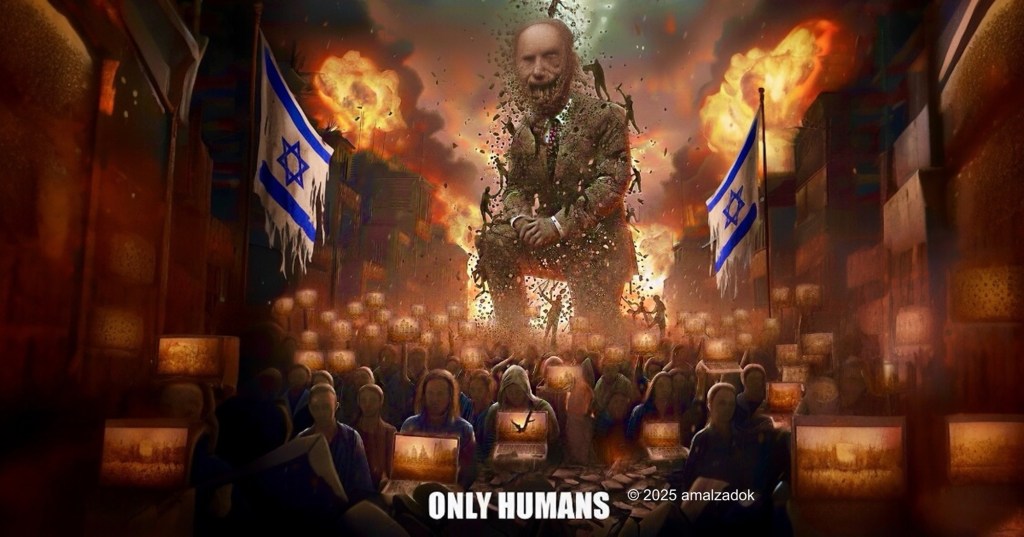
    335 Bullets, One Child’s Plea: The Gaza Crime No One Will Forget

    by Amal Zadok

    On January 29, 2024, five-year-old Hind Rajab and six family members attempted to flee the Tel al-Hawa neighborhood in Gaza City after Israeli forces ordered residents to evacuate. Their route was blocked by the rubble of bombardment, forcing them to seek another way. Driving north, their black Kia was suddenly attacked by an Israeli tank at close range. Hind’s aunt, uncle, and cousins were killed instantly, and only Hind and her 15-year-old cousin, Layan Hamada, survived the first bursts of fire.

    Layan managed to call the Palestine Red Crescent Society (PRCS) while the tank approached. Crying into the phone, she reported, “They are shooting at us. The tank is right next to me. We’re in the car, the tank is right next to us.” Machine-gun fire and Layan’s screams sounded as the call abruptly ended with her death. When the dispatchers called again, Hind answered, terrified, wounded, and alone amid the bodies of her family.

    For three hours, she pleaded, “I’m so scared, please come. Please, will you come?” She waited while the tank remained nearby, and rescuers coordinated with the occupying military for permission to send help.

    Despite the agony broadcast in her voice, official rescue permission was delayed. Eventually, two PRCS paramedics, Yusuf al-Zeino and Ahmed al-Madhoun, were dispatched in an ambulance and approached the scene. Their last communication reported seeing the car; then an explosion and gunfire ended their mission. They, too, were killed.

    It took nearly two weeks before the Israeli withdrawal allowed families back into the area. Hind, her relatives, and both paramedics were found dead. The black Kia was riddled with 335 bullets, the ambulance destroyed a few meters away, and all the bodies showed signs of deliberate, close-range fire.

    Forensic investigations, satellite imagery, and media analysis confirmed that Israeli tanks, only meters from the car, had a clear and unobstructed view of the children inside before firing. Nothing indicated confusion or “accident”—it was a direct, overwhelming attack.

    The killing of Hind Rajab quickly became an emblem of unpunished brutality. The Israeli army denied responsibility and claimed no troops were present; but independent investigations—including those by The Washington Post, Sky News, and Forensic Architecture—proved that tanks were there, attacking both the car and the ambulance, and that those responsible could clearly see their victims were civilians, including children.

    International bodies, human rights organizations, and experts declared the incident a war crime. Despite the evidence and the global outrage, no Israeli soldier or commander was held accountable, and the U.S. government—under President Donald Trump—continued military support, waiting for internal investigations that never condemned the killings.

    Hind’s voice pleading for help and the horror of 335 bullets fired into a car full of children testify to the normalization of killing and the collapse of justice in Gaza. Her name became a rallying cry for those demanding an end to impunity and a reckoning for crimes against the innocent.

    Hind Rajab’s tragedy poses a question to all in positions of power: When will you demand real justice for Hind and her family? How many more children must die before silence and complicity end? The cost of forgetting is complicity. The world cannot turn away.

    ©️2025 Amal Zadok. All rights reserved.

    Subscribe and never miss an article!
  • Blood in the Water: Israel’s Maritime Betrayal and Humanitarian Nightmare

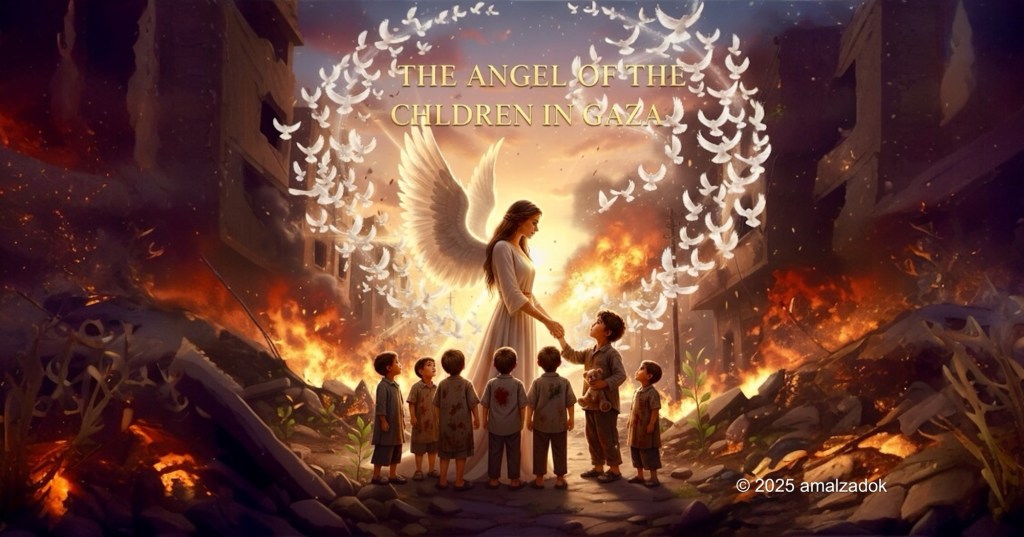
    Blood in the Water: Israel’s Maritime Betrayal and Humanitarian Nightmare

    by Amal Zadok

    The recent assault by Israel against international vessels and the capture of foreign citizens represents one of the most brazen violations of international law in recent memory. What occurred on the high seas was not a minor skirmish, nor a lawful interdiction based on clear evidence—it was a deliberate act of state-sponsored piracy. Cloaked in tired narratives of “defense” and “security,” Israel deployed its military power against ships owned by other nations, seizing civilians who had every right to safe passage. This act was not only a breach of maritime law, it was a declaration that Israel grants itself extraterritorial authority over seas belonging to all humanity. The illegality, the fabricated accusations, and the betrayal of its supposed partners and allies demand scrutiny of the highest order (United Nations Convention on the Law of the Sea [UNCLOS], 1982).

    Crimes on International Waters

    The law of the sea is one of the oldest and most venerated frameworks of international order. Enshrined in the United Nations Convention on the Law of the Sea (UNCLOS, 1982), it establishes the principle that ships sailing in international waters remain under the jurisdiction of the flag they fly, free from interference by other states except in very limited circumstances—such as combating piracy, suppressing the slave trade, or countering unauthorized broadcasting (International Maritime Organization [IMO], 2021). None of those exceptions applied here. By overpowering and commandeering ships in neutral waters, Israel treated the sea as its private dominion, arrogating to itself the right to dictate who may sail and under what conditions.

    This is the essence of piracy. Traditionally defined as “illegal acts of violence or detention committed for private ends on the high seas,” piracy corrodes the shared trust that makes international trade and exchange possible (Bassiouni, 2010). When a state itself embodies piracy, the crime is compounded; it is no longer a matter of rogue actors but of a nation dismantling the rules-based order. Israel did not merely harass vessels; it replaced maritime law with the barrel of a gun.

    The Humanitarian Mission of the Flotilla

    Beyond the raw illegality of the seizure lies the human tragedy that motivated the flotilla in the first place. These ships were not casual leisure cruises but humanitarian missions, driven by desperation and solidarity. The people onboard sought to break the stranglehold of Israel’s blockade on Gaza—an enclave that has become one of the most densely populated open-air prisons in the world (Amnesty International, 2020).

    For nearly two decades, Gaza has suffered under a blockade that has systematically strangled its economy, denied its civilians freedom of movement, and reduced access to basic necessities. Humanitarian agencies have described the blockade as collective punishment, inflicting untold suffering on ordinary Palestinians who are trapped in a cycle of poverty, hopelessness, and dependency (Amnesty International, 2020). Food insecurity is rampant, medical supplies are chronically lacking, and unemployment rises with each passing year.

    The flotilla was born from this desperation. It carried not weapons, but food, medicine, and humanitarian aid essential for survival. Its mission was a cry of solidarity from the international community, a statement that ordinary citizens of the world would not stand silently while Gaza’s people were suffocated (Amnesty International, 2020). By intercepting and crushing this mission, Israel did not merely attack ships; it attacked a lifeline of hope for nearly two million Palestinians imprisoned behind walls and barbed wire.

    Fabricated Narratives as Cover

    Immediately after the seizures, Israeli officials flooded the media with claims that the targeted vessels harbored contraband or terrorists disguised as humanitarian activists. Yet, neutral inspections, journalistic investigations, and eyewitness testimonies demolished those allegations (Amnesty International, 2020). Cargo manifests had been transparent. Independent observers confirmed the civilian nature of passengers. Once again, the records revealed a familiar strategy: strike first and justify later with a fog of disinformation.

    The use of fabricated pretexts is not an accident but a deliberate method. It allows the aggressor to muddy the public debate long enough to defuse outrage or to bank on the short memory of the media cycle. But however carefully spun, falsehood cannot transform illegality into legitimacy. The attempt to criminalize the innocent, portraying detained civilians as threats, merely compounds the outrage. It is one thing to attack without cause; it is another to smear the victims while demanding silence from the international community.

    Betrayal of Partners and “Allies”

    The audacity of this operation lies not only in its illegality, but in the betrayal it inflicted on the very nations Israel purports to call partners. Many of the vessels struck carried nationals from states that have historically provided Israel with diplomatic protection, economic exchange, or even military support. These are not its declared enemies, but countries that had, in many instances, shielded Israel from accountability in international forums (International Court of Justice, 1997).

    To seize their ships and citizens is to undermine the very foundations of alliance. It lays bare the deep contempt Israel holds for foreign sovereignty. A state that imprisons the nationals of its supporters demonstrates that it views such relationships not as partnerships of equals, but as arrangements where deference is demanded without reciprocity. Those governments now face an unprecedented moral reckoning: will they defend their citizens’ rights or surrender, once more, their dignity beneath Israel’s claims of “exceptional security needs”?

    The Collapse of International Trust

    Global order relies upon trust: trust in treaties, in neutral zones, and in the shared understanding that laws bind the powerful as well as the weak. When Israel stormed internationally flagged ships, it tore down that trust. If one nation may unilaterally board and detain foreign nationals beyond its recognized waters, why should any state respect maritime conventions at all (IMO, 2021)?

    The consequences ripple outward. Shipping companies may reconsider safe lanes, raising insurance costs, undermining trade, and destabilizing critical supply chains. Nations may begin asserting unilateral authority over seas far from home, justifying aggressive policing by citing Israel’s precedent. The sea, meant to be humanity’s shared lifeline, risks being carved into zones of coercion, where might negates right.

    Israel’s defenders argue that extraordinary threats justify extraordinary measures. But international law was not designed to evaporate the moment one party alleges danger (UNCLOS, 1982). To accept such reasoning is to abandon law itself to the whim of unilateral declarations. If every state claimed this exception, no merchant ship would ever sail in safety again.

    A Crisis of Impunity

    This is not the first time Israel has acted in such ways. Its record in blockading humanitarian missions, conducting extrajudicial killings abroad, and humiliating international observers speaks to a pattern: a conviction that impunity is permanent (Amnesty International, 2020). For decades, Israel has faced reports, resolutions, and condemnations, yet concrete consequences have remained elusive, largely because of the protective shield afforded it by powerful allies.

    But this assault tears away the last justifications for indulgence. Unlike territorial conflicts where narratives of history are endlessly debated, maritime law is stark and unambiguous. Ships outside territorial waters enjoy immunity from such aggression. By violating this, Israel has not attacked one party—it has attacked a system designed to protect all nations equally (Bassiouni, 2010).

    Responsibility of the Global Community

    The international response cannot remain confined to verbal statements of “deep concern.” These words have already been drained of meaning by decades of overuse. Concrete measures must follow. At minimum, the unconditional release of all detainees is an urgent demand. International tribunals and courts must be empowered to investigate command responsibility. States whose citizens were abducted must employ the tools of diplomacy and economics—recalling ambassadors, suspending cooperation, freezing arms transfers—until Israel comprehends that no state can claim extraterritorial impunity without cost (UN Security Council, 2016).

    If international institutions fail to respond, their credibility will face mortal erosion. What legitimacy can the United Nations claim if the high seas, declared common to all, may be seized at will? What function does the International Maritime Organization serve if piracy under a flag of statehood goes unchecked? The erosion of trust will extend beyond Israel to the very fabric of multilateral cooperation.

    The Precedent for Humanity

    This crisis is more than a bilateral dispute. It is a precedent-setting moment for humanity. If this action is allowed to stand, piracy disguised as “security” will proliferate. Tomorrow, emboldened states may justify seizing aircraft in neutral skies or storming foreign embassies under contrived accusations. The principle under threat is simple but vital: that international law binds the powerful as well as the powerless, and that civilians are not bargaining chips to be captured at sea.

    Israel has crossed a threshold that should alarm every government. The seas are the arteries of global exchange, carrying grain, fuel, medicine, and people across continents. To militarize them with extrajudicial seizures is to threaten the very flow of international life. Humanity must decide whether law still has meaning, or whether rules will be torn to shreds whenever one government declares itself an exception.

    Conclusion

    The assault on international vessels and the capture of civilians by Israel is not a misunderstanding, nor a defensive necessity. It is lawless, deceitful, and treacherous. It is a betrayal of partners, a fabrication of threats, and an assault on the very system of rules that enables civilization to function. This was not Israel versus one flotilla; it was Israel versus the concept of shared law itself.

    If nations allow this to pass unanswered, the seas will no longer be safe havens of lawful passage but dangerous arenas of unilateral force. Humanity stands at a crossroads: either to punish state-sponsored piracy and restore faith in the rule of law, or to accept that impunity has no limits. History will not remember neutrality or silence kindly. Crimes committed in daylight on the open seas demand accountability—and the world must rise to provide it.

    And if justice does not come swiftly, history will not forgive the world’s cowardice: the silence of governments will echo louder than gunfire, and tomorrow’s pirates, emboldened by today’s refusal to act, will not only control the seas but dictate the fate of nations themselves.

    References

    Amnesty International. (2024, December 4). ‘You Feel Like You Are Subhuman’: Israel’s Genocide Against Palestinians in Gaza. https://www.amnesty.org.au/amnesty-concludes-israel-genocide-in-gaza/

    Bassiouni, M. C. (2010). International Extradition: United States Law and Practice (6th ed.). Oxford University Press. https://global.oup.com/academic/product/international-extradition-9780199917891

    International Court of Justice. (1997). Case concerning the Gabčíkovo-Nagymaros Project (Hungary/Slovakia), Judgment of 25 September 1997. https://www8.austlii.edu.au/au/journals/AUIntLawJl/1997/18.pdf

    International Maritime Organization. (n.d.). Introduction to IMO. https://www.imo.org/en/about/pages/default.aspx

    United Nations Convention on the Law of the Sea. (1982). United Nations Treaty Series. https://www.un.org/depts/los/convention_agreements/texts/unclos/unclos_e.pdf

    United Nations Security Council. (2016). Resolution 2312 (2016): Maritime Security and Law Enforcement. https://digitallibrary.un.org/record/844438

    ©️2025 Amal Zadok. All rights reserved.

    Subscribe and never miss an article!
  • Chosen, Yet Condemned? How Israel’s Treatment of Palestinians Violates Its Covenant

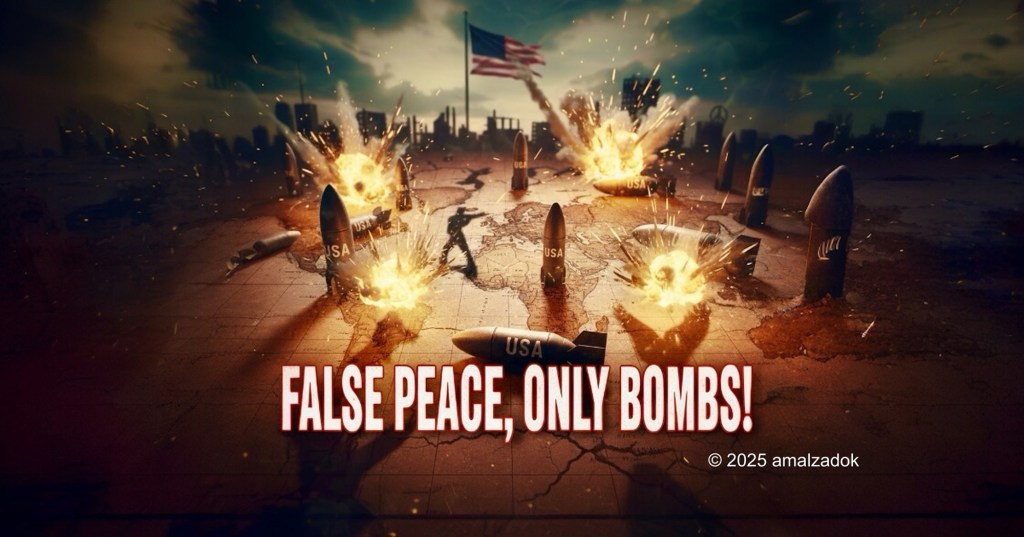
    Chosen, Yet Condemned? How Israel’s Treatment of Palestinians Violates Its Covenant

    by Amal Zadok

    The relationship between Israel’s status as the “Chosen People,” the ongoing violence in Palestine, and divine judgment is addressed through a synthesis of Torah principles, historical context, and contemporary ethical debates. Below is a detailed analysis:

    1. The Conditional Nature of “Chosenness” in Torah

    • Covenant Requirements: Israel’s election is conditional on upholding justice, righteousness, and fidelity to God’s commandments (Deuteronomy 7:6–11). The Torah repeatedly warns that idolatry, oppression of the vulnerable (orphans, widows, foreigners), and bloodshed will lead to divine punishment, including exile and loss of the land .
    • Prophetic Condemnation: Prophets like Jeremiah and Amos explicitly state that God rejects Israel’s worship when coupled with injustice. For example:

    “You steal, murder, commit adultery… then come and stand before Me in this House… Has this House become a den of robbers?” (Jeremiah 7:9–11).
    Social injustice is deemed a breach of covenant equivalent to idolatry .

    2. Genocide as a Violation of Core Torah Principles

    • Sacredness of Life: The Torah declares all humans b’tzelem Elohim (in God’s image), making intentional killing of innocents a grave sin (Genesis 9:6). The command to destroy Amalek (Deuteronomy 25:19) is historically contextualized as a specific response to unprovoked aggression, not a blanket endorsement of genocide. Rabbinical tradition limits this command by:
    • Requiring peace offers first (Maimonides, Hilkhot Melakhim 6:1) .
    • Allegorizing Amalek as “evil tendencies” rather than ethnic groups (Hasidic teachings) .
    • Prohibition of Collective Punishment: Torah law forbids punishing children for parents’ sins (Deuteronomy 24:16). The killing of “infants and sucklings” in 1 Samuel 15:3 conflicts with this, leading scholars to question its literal interpretation or contextualize it within ancient Near Eastern hyperbolic war rhetoric .

    3. Punishments Prescribed in Torah for Injustice and Bloodshed

    • Exile and Land Rejection:

    “You will be uprooted from the land… for having forsaken the covenant of the Lord” (Deuteronomy 29:24–27).
    The Babylonian exile is framed as direct punishment for social oppression and idolatry (Jeremiah 22:3–5; Ezekiel 22:29) .

    • Divine Withdrawal: Ezekiel depicts God’s presence (Shekinah) abandoning the Temple due to corruption and violence (Ezekiel 10:18) .
    • “Blood Guilt”: Numbers 35:33–34 states that unabsolved bloodshed “pollutes the land,” making it “vomit out” its inhabitants. This is invoked when innocent life is systematically destroyed .

    4. Contemporary Ethical and Theological Tensions

    • Misuse of Amalek Rhetoric: Israeli officials and settlers have labeled Palestinians “Amalek” to justify expulsion or annihilation . South Africa’s ICJ genocide case cited Netanyahu’s Amalek reference as evidence of genocidal intent .
    • Jewish Opposition: Over 100 rabbis in “Rabbis for Ceasefire” condemn the Gaza assault as a betrayal of Judaism:

    “Violence begets violence… Our tradition commands: ‘Do not stand idly by the blood of your neighbor’” .
    They emphasize pikuach nefesh (saving life overrides most commandments).

    • Demographic Shifts: Polls show 82% of Israeli Jews support expelling Gazans, and 47% endorse biblical-style annihilation of enemy cities . This contrasts with pre-1948 Jewish teachings that mass return to Israel before the Messiah was sinful .

    5. Can Israel Remain “Chosen” Amid Genocide?

    Torah theology answers decisively: No. Divine favor is irrevocably tied to ethical conduct. The prophets stress that election is for service, not supremacy:

    “I will make you a light to the nations, to open blind eyes and free captives” (Isaiah 42:6–7).
    Systematic violence against Palestinians—described by scholars as meeting the UN genocide criteria through mass killing, starvation, and destruction of healthcare —violates this vocation. The Talmud warns:
    “Whoever saves one life saves the world; whoever destroys one life destroys the world” (Sanhedrin 4:5).

    Conclusion

    Israel’s “chosenness” hinges on embodying divine justice. The Torah’s punishments for oppression (exile, land curse, divine abandonment) underscore that genocide or ethnic cleansing disqualifies Israel from its covenant role. As Rabbi Brant Rosen states:

    “Never again means never again—for everyone” .
    The path to restoration requires ceasing violence, upholding Palestinian dignity, and heeding Isaiah’s call:
    “Learn to do right; seek justice. Defend the oppressed” (Isaiah 1:17).

    ©️2025 Amal Zadok. All rights reserved