Tag: Gaza genocide

  • Trump’s Moral Bankruptcy: From Enabling Genocide in Gaza to Embracing Terror in the White House

    Trump’s Moral Bankruptcy: From Enabling Genocide in Gaza to Embracing Terror in the White House

    by Amal Zadok

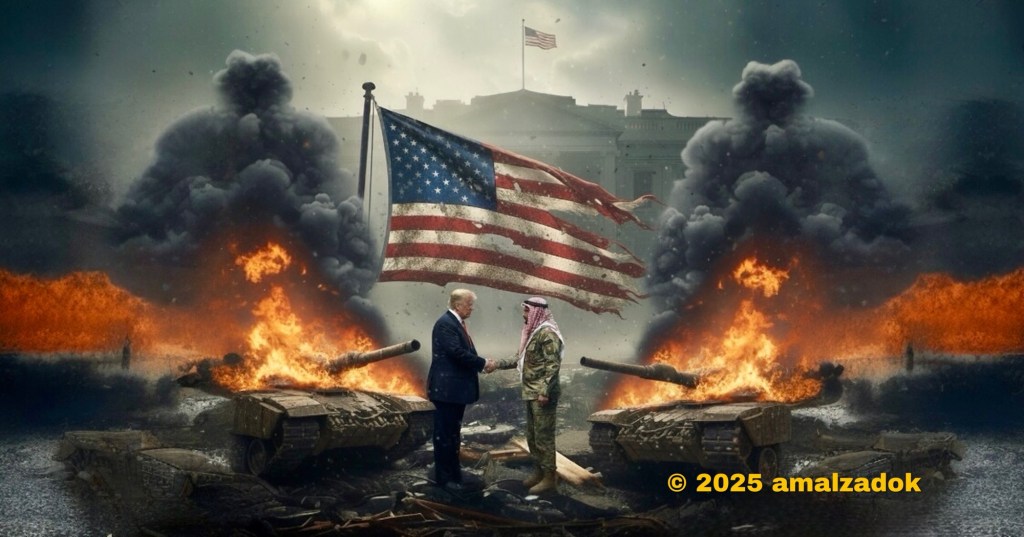
    History will judge leaders not by their slogans, but by their actions in the face of suffering and evil. No figure in modern American politics demonstrates a collapse of principle so complete, so reckless, as Donald Trump does today. His legacy, once packaged as “America First,” now stands drenched in the blood of Gaza’s innocents and stained by the shameful embrace of one of the world’s most notorious terrorists—Ahmad al-Shara, formerly known as al-Jolani. A man once hunted internationally, with a $10 million bounty on his head for orchestrating massacres and beheadings, is now shaking hands with the president on White House grounds.

    This is not a mere misstep; it is a rupture with the very notion of civilization. The world expected leadership from America—and received, instead, the shrugging endorsement of genocide in Gaza. Trump’s administration has issued relentless backing for siege, starvation, and systematic destruction unprecedented in this generation. Not only have international law and human decency been trampled, but America’s moral standing now lies buried beneath the rubble of Palestinian homes.

    Could it be any clearer? The biblical prophets condemned those who “call evil good and good evil.” Trump does precisely this: blessing violence, turning victims into villains, excusing butchery as “toughness.” When he hosts Ahmad al-Shara—who terrorized both Christians and Muslims, who transformed Syrian towns into graveyards under the banner of Jihad—he desecrates the memory of every Christian martyred for their faith, and every Muslim slaughtered for resisting extremism. Only a soul lost in power’s delirium could boast of new “coalitions” with a man who, not long ago, inspired fear throughout the Middle East and drew global condemnation.

    Trump now presents this coalition as a “strategic necessity,” dismissing all criticism as “weakness” or “leftist hysteria.” Let us be perfectly clear: this is not strategy. This is appeasement, a transaction in blood, a gamble that America can harness evil as a tool. It is a bitter lesson history has taught before—every time, with catastrophic results. Yes, desperate voices within MAGA ranks scramble to defend Trump’s logic, clinging to the mirage that partnering with monsters will somehow deliver peace or “stability.” But no American who cherishes faith, principle, or basic decency can look at these decisions and feel anything but shame.

    Even now, as the images of Gaza’s ruins sear themselves into the world’s conscience, and survivors recount the horror of children starved and schools bombed, Trump and his circle dodge accountability. They invoke “national security” to justify the unthinkable. When confronted with al-Shara’s bloody résumé, Trump’s response is to boast: “We bring everyone to the table.” That table, today, stands set with the ghosts of Christian pastors executed by jihadists and Muslim villagers erased for daring to resist.

    Let’s not hide from the truth: this betrayal will shatter Trump’s MAGA base. Evangelical, Catholics and conservatives with a conscience know that justice and truth—foundational to both American and Christian identity—cannot coexist with the fellowship of murderers. The rank hypocrisy is too obvious, the dissonance too violent. Already, fractures run through the movement, as faith leaders and anti-war veterans recoil at images of slaughter in Gaza and the spectacle of a warlord welcomed in Washington.

    For decades, America’s allure, battered but real, derived from its capacity for moral outrage—its ability to say “no” to evil, whoever wore its face. Under Trump, that light flickers. The man who once posed as a bulwark against America’s enemies now kneels before them, trading honor for spectacle. The world is watching, and history will not forget. Gaza bleeds. Christians and Muslims mark their martyrs. America, in Trump’s shadow, wonders what more it will lose before it rediscovers its soul.

    There is no redemption in this chapter of America’s story—only betrayal. Trump has not merely abandoned the obligations of leadership; he has shattered the values he once proclaimed, the ideals upon which the Republic was built.

    The man who thundered slogans about freedom, justice, and strength now tears those words apart, choosing instead to embrace murderers and turn his back on the suffering of innocents.

    The Patriot is dead, smothered beneath vanity and cowardice. In his place stands a compromised, hollow leader—a twisted echo of what this Republic needs in its hour of greatest peril.

    America stands diminished, its flag tattered—not by foreign powers, but by the failures of the very man sworn to defend her. The Republic cannot endure treachery and weakness dressed in the garb of authority. It deserves more. It demands the rebirth of honour, the rejection of cruelty, and the triumph of real leadership before everything this nation stands for is lost forever.

    References

    1. BBC News. (2021). Abu Mohammed al-Jolani: The jihadist who turned to the West. https://www.bbc.com/news/world-middle-east-57656543

    2. Reuters. (2020). The U.S. and the Syrian Resistance: Inside America’s Secret Effort to Arm the Rebels. https://www.reuters.com/investigates/special-report/syria-usa/

    3. NBC News. (2025). Syrian interim president Ahmad al-Shara expected to join U.S.-led coalition against ISIS. https://www.nbcnews.com/news/world/syrian-interim-president-expected-join-us-coalition-isis

    4. The Guardian. (2023). Trump’s response to the Gaza crisis: Applause for force, silence for suffering. https://www.theguardian.com/world/2023/oct/31/trump-response-gaza-crisis

    5. U.S. State Department. (2021). $10 Million Reward for Information on Abu Mohammed al-Jolani. https://rewardsforjustice.net/english/julani.html

    6. Human Rights Watch. (2023). Gaza: Starvation and siege. https://www.hrw.org/news/2023/10/30/gaza-starvation-siege

    7. CNN. (2025). Trump faces backlash after inviting former jihadist leader to White House. https://www.cnn.com/politics/trump-white-house-syria-backlash

    ©️2025 Amal Zadok. All rights reserved.

    Subscribe and never miss an article!
  • Part I Genocide for Gas, Thirst for War: Inside the Ruthless Scramble for the Planet’s Last Lifelines

    Part I Genocide for Gas, Thirst for War: Inside the Ruthless Scramble for the Planet’s Last Lifelines

    by Amal Zadok

    Introduction

    This exposé is presented in two uncompromising parts, designed to capture the full, global breadth of the new resource wars and their human cost. In a world driven by the scramble for gas, oil, water, minerals, and the land that conceals them, conflicts are no longer isolated incidents—they are interconnected fronts in a global campaign of extraction and domination.

    Part I: Genocide, Gas, and Extraction—The New Battlefields

    Part I investigates how entire populations and states, from Gaza to Ukraine, have become collateral for strategic plunder. You will uncover the real motives driving the devastation of Gaza, the resource ambitions underlying Russia’s war with Ukraine, and the water crisis emerging as the next epoch-defining frontline. This section reveals the hidden economic drivers, colonial logic, and geopolitical blueprints shaping today’s most explosive conflicts—showing why modern warfare cannot be understood without following the flow of resources.

    Part II: Superpower Rivalry, Scarcity, and the Road to Collapse

    Part II widens the lens to the geopolitical chessboard: the scramble for the Arctic, the green transition’s new domains of exploitation, and the intensifying siege around Venezuela’s oil and South America’s minerals. Here, readers will see how economic warfare, sanctions, and chokepoints are transforming globalization into a zero-sum game, why China’s logistics revolution is reshaping influence, and how the final collapse of world morality is spelled out in each ruined nation and dying river. You will be confronted with the ultimate question: will humanity unite to reclaim the future, or choose plunder until nothing remains?

    Part I: Genocide, Gas, and Extraction—The New Battlefields

    Resource Wars Redraw the Global Map

    The global order is splitting open, revealing its raw, predatory mechanics. Beneath the slogans of democracy and human rights, the planet obeys a single law—the law of extraction. The twenty-first century is the age of resource wars, where dominance is measured not by moral pretense, but by control of civilization’s vital lifeblood: gas, oil, water, minerals, and the invisible circuits of data. Gaza, Ukraine, Venezuela, and the fast-drying rivers of Africa and Asia are not just separate tragedies—they are theaters of the same global war.

    Gaza: Genocide for Energy Supremacy

    In Gaza, the stakes are economic, not ideological. Beneath the bombed coastline lies the Gaza Marine gas field, discovered in 1999 and left dormant for a generation. It contains enough natural gas to make the Palestinian people economically independent, perhaps even prosperous. Such independence is anathema to those who rule by dependency. Since its discovery, every attempt by Palestinians to harness this strategic gas has been blocked or destroyed by Israel—with tacit Western complicity.

    Every “security operation,” every bombardment, every euphemism of “self-defense” has cleared the way for a singular goal: full Israeli control of offshore gas extraction and the permanent exclusion of Palestinians from their resource future. Expulsion, starvation, and annihilation have another endgame—to make room for uncontested resource domination. Gas, not land, is the prize. Each demolished home and murdered child is collateral damage in the drive to claim a corridor for gas exports to a Europe desperate for energy supplies after cutting ties with Russia. The world’s silence is betrayal. This is not security—it is colonialism remastered: genocide as business strategy.

    The Billion-Dollar Gas Field: Ownership Versus Annihilation

    The Gaza Marine project—potentially worth billions per year for Palestine—remains trapped in crossfire. The prize isn’t just revenue or electricity; it is the promise of true sovereignty. Recognition of Palestinian statehood could unlock this windfall, but Israel’s calculation is ruthless: only dead or exiled Palestinians guarantee uncontested extraction and export. The ghosts of Gaza call out as witnesses to a crime whose means is violence, and whose ultimate justification is profit.

    Ukraine: NATO’s Encroachment, Russian Fears, and Western Resource Ambitions

    The war in Ukraine is not just a contest over territory or ideology—it is a struggle that unites existential security fears and clear-eyed economic ambitions. In Moscow’s view, NATO’s relentless expansion eastward has always represented an existential threat; Ukraine’s potential entry into the alliance, combined with the alliance’s burgeoning bases and weaponry at Russia’s borders, triggered a response that the Kremlin insists was inevitable: the so-called “special operation,” a preemptive push to reclaim a strategic buffer and prevent NATO’s reach from reaching the very heart of the Russian homeland.

    Yet as Russian forces have fought to assert control over Ukraine’s eastern and southern regions, a second and equally voracious game is underway—being played by America and Europe. For Western powers, the war is not just about defending “democracy” or deterring Russian aggression; it is explicitly about gaining privileged access to Ukraine’s immense treasure trove of resources. Ukraine is blessed with colossal deposits of rare earth metals, critical minerals such as graphite, lithium, and titanium, fertile farmland, and hydrocarbon reserves considered strategic for the future of the European Union’s energy security and America’s technological supremacy.

    In recent years, the US, in partnership with the EU, has rapidly established “Reconstruction Investment Funds” and mineral extraction agreements that will see American and European firms receive preferential rights to Ukraine’s most valuable subsoil assets.

    These deals are often lauded as rebuilding efforts, but in practice, they cement the West’s stake in postwar Ukraine, ensuring that Ukraine’s rare earths, agrarian wealth, and energy play a central role in shoring up Western economic power and the green transition.

    For the US, it is a double gain: breaking China’s grip on critical minerals while cementing Europe’s dependence on American-controlled supply lines.

    This “resource diplomacy” is not abstract—it is already drawing clear lines of profit and dependency for decades to come. Even as the frontlines shift and civilians suffer, contracts for mining, drilling, and export are being signed at breakneck pace—promising private investors and Western states a direct cut of Ukraine’s mineral and agricultural bounty after the war. Some regions rich in minerals remain under dispute or Russian occupation, but for both the West and Moscow, these underground riches remain at the heart of the contest.

    Thus, Ukraine’s fate is now being shaped by twin imperatives: Russia’s drive to survive what it calls Western encirclement, and America’s and Europe’s blunt ambition to control the resources that will fuel their futures. Control over Ukraine is, in the final calculus, a battle for both security and supply—one in which survival, sovereignty, and staggering profit are all at stake.

    Water Wars: The Coming Battle for Survival

    If oil is the blood of modern civilization, water is its breath—without it, life, industry, and agriculture collapse. Yet as the century turns, a global water catastrophe is no longer a distant warning, but a grinding reality: more than two billion people now lack access to safely managed drinking water, and half the planet faces chronic shortages or unsafe supplies each year.

    From dried river basins to shrinking lakes and failing aquifers, water crises now destabilize economies and ignite violent conflicts in every hemisphere.

    Agriculture, responsible for the majority of water consumption, is under siege amid droughts, desertification, and erratic weather. Failed crops and livestock wipe out entire regional economies, triggering food shortages, hyperinflation, and waves of hunger-induced migration. Africa’s Nile basin is a battlefield for political survival, as Ethiopia’s mega-dam risks plunging Egypt into catastrophic water stress.

    In South Asia, rivers crossing contested borders have become weapons, squeezing neighbors into submission with engineered scarcity.

    In the Middle East, water control is the silent accomplice to occupation and genocide; Palestinians in Gaza and the West Bank are denied access to their most

    vital resource, forced into dependence by Israeli policy and regional power plays.

    Across Latin America and the world, private investors and conglomerates race to monopolize aquifers and groundwater rights, treating this most essential public good as a luxury commodity.

    Experts warn that by the decade’s end, two-thirds of humanity may experience severe water stress. The next wars—more than any fought for oil or minerals—will be sparked by thirst. In this era, access to water will draw new borders, incite rebellions, and determine whether nations rise or fall

    ©️2025 Amal Zadok. All rights reserved.

    Subscribe and never miss an article!
  • America’s Apples Are Bombs Now: Trump, Genocide, and the Shadow Over History

    America’s Apples Are Bombs Now: Trump, Genocide, and the Shadow Over History

    by Amal Zadok

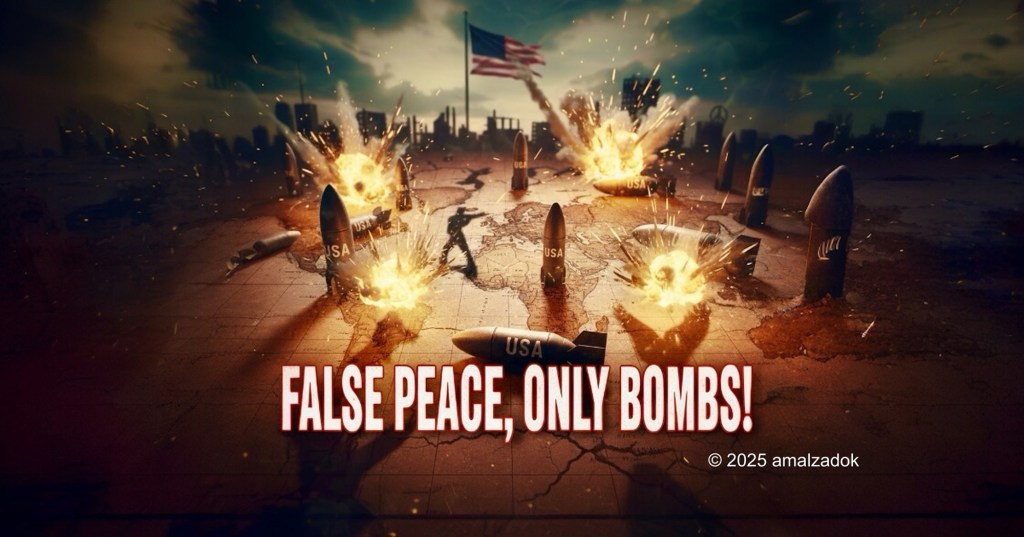
    President Donald Trump has reshaped America’s legacy—not as a nation of peacemakers, but as history’s chief arms merchant. Despite rhetoric about “historic peace,” Trump’s tenure is marked by an unprecedented surge in U.S. weapons exports, strategic escalation in conflict zones, and public boasts about delivering weapons that allies “did not even know existed.” The world received bombs over apples—and lives with the consequences (Independent, 2025).

    From Orchard to Arsenal: How Peace Was Substituted with Arms

    America once sought to balance humanitarian diplomacy—the apple offered—with the realities of global power. Under Trump, this balance shattered. The United States now accounts for 43% of all global arms exports, dominating the world’s weapons market (SIPRI, 2025; DW, 2025; Global Defense Corp, 2025; ChinadailyHK, 2025).

    U.S. arms deals reached $175 billion annually during Trump’s second term, flooding allies and volatile regions with jets, bombs, and drones (Stephen Semler, 2023).

    Trump’s administration actively relaxed restrictions, streamlining arms deals and pushing advanced hardware—including drones and precision-guided munitions—to buyers like Saudi Arabia, Bahrain, Nigeria, and Israel; even bargaining on public TV about the “jobs” and “security” they’d bring (War on the Rocks, 2018; Reuters, 2018; Politico, 2017). Former bans linked to human rights concerns dissolved, replaced by transactional embrace and unchecked proliferation.

    Gaza: Partner in Genocide

    This arms trade translated into lethal reality in Gaza. Trump publicly celebrated Israel’s campaign, crowing that Prime Minister Netanyahu received “every weapon he wanted,” fueling a conflict where civilian casualties skyrocketed and humanitarian watchdogs raised charges of ethnic cleansing and genocide (CBC News, 2025; Al Jazeera, 2025; NPR, 2025).

    Far from mediating peace, the United States played quartermaster to the world’s most divisive battles. The apple of diplomacy was never offered. Only bombs—delivered, enabled, and defended at the highest levels.

    International observers denounced America’s complicity, warning that the shadow of partnership in these alleged atrocities will follow Trump, his administration, and the nation for generations (Al Jazeera, 2025; BBC News, 2025; NPR, 2025).

    Ukraine: Betting the World on Brinkmanship

    If Gaza showcased Trump’s willingness to arm and escalate, Ukraine raised the stakes to nuclear heights. In 2025, Trump repeatedly threatened the transfer of Tomahawk and other long-range missiles to Ukraine—potentially enabling strikes deep into Russia. Military analysts warn these moves could force Russian President Putin into existential responses, including nuclear options (NYT, 2025; DW, 2025).

    Trump’s rationale mixed calculated brinksmanship with the pretense of “ending war.” What resulted was the rapid acceleration of arms transfers: Ukraine became the world’s top arms importer, with contracts worth billions and new categories of advanced weaponry flooding the front lines (SIPRI, 2025; CBC News, 2025). Global stability deteriorated, Americans and Europeans feared direct confrontation, and the specter of superpower nuclear disaster returned (DW, 2025).

    The Data: Record-Breaking Exports and Vanishing Restraint

    Under Trump, U.S. arms exports rose sharply, with record annual values and more than 100 countries receiving U.S. hardware (SIPRI, 2025; DW, 2025; Global Defense Corp, 2025). The administration:

    Pushed more than $175 billion per year in arms sales, peaking at $206 billion in 2022 (Stephen Semler, 2023).

    Lifted restrictions on armed drones, precision-guided bombs, and fighter jets once denied for human rights reasons (War on the Rocks, 2018; Politico, 2017).

    Advocated arms sales as a diplomatic priority, recasting embassies and trade offices as marketing hubs for American weapons (Reuters, 2018).

    Shrunk humanitarian aid and diplomacy relative to record military exports (ChinadailyHK, 2025).

    Militarization as Foreign Policy: Covert Action and Global Fallout

    Trump’s arms-first foreign policy spilled into covert operations: the CIA and special forces led missions in Venezuela, Africa, and Asia, while cyberwarfare and clandestine sabotage became normalized American tactics (NYT, 2025; BBC News, 2025; Al Jazeera, 2025).

    Global confidence in U.S. leadership collapsed. NATO allies feared that reckless American escalation would drag Europe into all-out war; Asia witnessed new arms races stoked by American, Chinese, and Russian competition (DW, 2025; ChinadailyHK, 2025).

    Human Rights Forgotten: Peace Sacrificed for Profit

    Trump’s administration dismissed mounting evidence from NGOs and war crimes monitors as “partisan noise” (CBC News, 2025; NPR, 2025). Civilian death tolls in Gaza, Yemen, and Donbas multiplied. For every criticism about the ethics of arms exports—or the risks of “partnering in genocide”—Trump’s team expedited contracts, promising “total support” so long as the payers kept buying.

    The President of Bombs

    Defenders claim overwhelming force deters enemies and secures allies. But the evidence is overwhelming: America’s mass arms exports have not brought peace; they have amplified chaos, fueled global crises, and undermined diplomacy. Trump is the President of Bombs. And always the shadow of being partner in the genocide in Gaza will follow him, his country, and his family. This will be Trump’s legacy to history and the world (Al Jazeera, 2025; BBC News, 2025; CBC News, 2025; NPR, 2025).

    References

    Al Jazeera. (2025, October 13). Five key takeaways from Donald Trump’s Gaza remarks in Middle East. https://www.aljazeera.com/news/2025/10/13/five-key-takeaways-from-donald-trumps-gaza-remarks-in-middle-east

    BBC News. (2025, October 12). Trump says ‘war is over’ in Gaza as he flies to Israel for ceasefire deal. https://www.bbc.com/news/articles/cn409y125v3o

    CBC News. (2025, October 16). Trump’s Gaza deal may be ‘historic,’ but falls short of lasting peace. https://www.cbc.ca/news/world/gaza-trump-peace-deal-analysis-9.6940737

    ChinadailyHK. (2025, June 17). US promotes arms sales to revive its faltering economy. https://www.chinadailyhk.com/hk/article/614176

    CNN. (2025, October 14). How Trump’s Gaza triumph could change his presidency. https://www.cnn.com/2025/10/14/politics/trump-israel-hostages-gaza-ceasefire-deal-analysis

    DW. (2025, March 9). US increases dominance as world’s biggest arms exporter. https://www.dw.com/en/us-increases-dominance-as-worlds-biggest-arms-exporter/a-71860617

    Global Defense Corp. (2025, March 10). United States has strengthened its dominance in the global arms trade. https://www.globaldefensecorp.com/2025/03/11/united-states-has-strengthened-its-dominance-in-the-global-arms-trade-accounting-for-43-percent/

    Independent. (2025, October 16). Tomahawk missiles are Trump’s ace card for Ukraine. https://www.independent.co.uk/news/world/europe/tomahawk-missiles-ukraine-trump-russia-b2846089.html

    New York Times. (2025, October 14). Trump says he may give Tomahawks to Ukraine. Is he serious? https://www.nytimes.com/2025/10/14/us/politics/trump-tomahawks-ukraine-russia.html

    NPR. (2025, September 25). A question of intent: Is what’s happening in Gaza genocide? https://www.npr.org/2025/09/25/g-s1-89678/israel-gaza-genocide-debates-united-nations

    Politico. (2017, September 28). Trump to unleash more global arms sales. https://www.politico.com/story/2017/09/29/trump-global-arms-sales-243282

    Reuters. (2018, April 20). Arming the world – Inside Trump’s ‘Buy American’ drive to expand weapons exports. https://www.reuters.com/article/us-usa-trump-arms-insight/arming-the-world-inside-trumps-buy-american-drive-to-expand-weapons-exports-idUSKBN1HO2PT/

    SIPRI. (2025, March 9). Ukraine the world’s biggest arms importer; United States dominance in global arms exports grows. https://www.sipri.org/media/press-release/2025/ukraine-worlds-biggest-arms-importer-united-states-dominance-global-arms-exports-grows-russian

    Stephen Semler. (2023, March 7). Comparing arms sales under Trump & Biden. https://www.stephensemler.com/p/comparing-arms-sales-under-trump

    War on the Rocks. (2018, September 26). Trump’s Arms Exports Policy: Debunking Key Assumptions. https://warontherocks.com/2018/09/trumps-arms-exports-policy-debunking-key-assumptions/

    ©️2025 Amal Zadok. All rights reserved.

    Subscribe and never miss an article!

  • The United States of America—or the United States of Israel? American Complicity in Genocide and the Collapse of Moral Leadership

    The United States of America—or the United States of Israel? American Complicity in Genocide and the Collapse of Moral Leadership

    by Amal Zadok

    The question of whether America is better renamed “The United States of Israel” is no longer an exercise in rhetorical provocation, but rather a grim diagnosis of a nation’s profound ethical decline. As the world bears witness to Israel’s ongoing, well-documented acts against the Palestinian people—acts that have passed the threshold of war crimes to constitute genocide—American policy and discourse have not merely failed to intervene, but have actively enabled and legitimized these atrocities. What does it mean for a nation that once trumpeted itself as a vanguard of justice if it becomes the principal patron of genocide?

    The Crisis of American Ethical Identity

    The American project, since its inception, was undergirded by the ideal of universal moral responsibility—a “city upon a hill” illuminating the path of human rights and dignity. Yet, these foundations are shattered by American complicity in genocide. There is a yawning chasm between the United States’ self-conception as a beacon of democracy and its actual practice of underwriting the systematic destruction of another people.

    Philosopher Hannah Arendt, in her critique of “banality of evil,” warned that unimaginable cruelty becomes normal not only through fanaticism but through the acquiescence and support of those who claim higher moral ground. America now finds itself not merely turning a blind eye, but offering material, diplomatic, and moral cover for acts—including forced displacement, starvation, mass killing, and cultural erasure—that meet the legal and scholarly definitions of genocide, as codified in the UN Genocide Convention.

    Genocide as Policy: The Israeli Case, the American Backing

    The evidence is not confined to activist rhetoric; it is established in official reports by the UN, human rights organizations, and international legal scholars whose investigations point to an orchestrated campaign to eradicate Palestinian existence and identity. Mass civilian targeting, the destruction of critical infrastructure, starvation blockades, and the evisceration of every means of communal survival are not merely collateral damage—they are instruments of policy.

    Yet, America’s involvement goes far beyond passive observation. Billions in military aid, ongoing arms transfers, and the repeated use of the UN Security Council veto to shield Israel from accountability transform America from mere ally to primary enabler. This is not simply hypocrisy; it is complicity in the gravest crime defined under international law.

    The Philosophical Consequence: A Nation Without a Soul

    Political philosopher John Rawls articulated the idea of “justice as fairness.” What remains of that legacy when the United States engineers and sustains a humanitarian catastrophe of genocidal proportions? At issue is not merely foreign policy, but the existential question of what America has become. Its putative ideals are rendered hollow, its global image irreparably stained.

    Moral philosopher Judith Butler reminds us that denying the grievability of certain lives is foundational to the logic of genocide.

    By treating Palestinian suffering as disposable, American leadership abdicates its last claim to moral authority. The loss of soul is not metaphorical—it manifests in the normalization of atrocity, in the bureaucratic language of “defense,” “security,” and “shared values” that mask reality.

    Conclusion: The Urgent Need for Reckoning

    Does the “United States of Israel” formulation exaggerate? On the contrary, it exposes how profoundly American identity has become entangled with, and subordinate to, a genocidal project. The world regards American proclamations of justice and democracy with skepticism bordering on contempt; citizens at home struggle to recognize their nation in the mirror. Recovery is possible only through unrelenting honesty, radical re-evaluation of alliances, and a recommitment to principles that respect all human life—without exception.

    Without such reckoning, America’s transformation from beacon to bystander to co-perpetrator will become enduring, and the memory of its higher purpose a historical footnote, lost to the darkness it helped create.

    ©️2025 Amal Zadok. All rights reserved