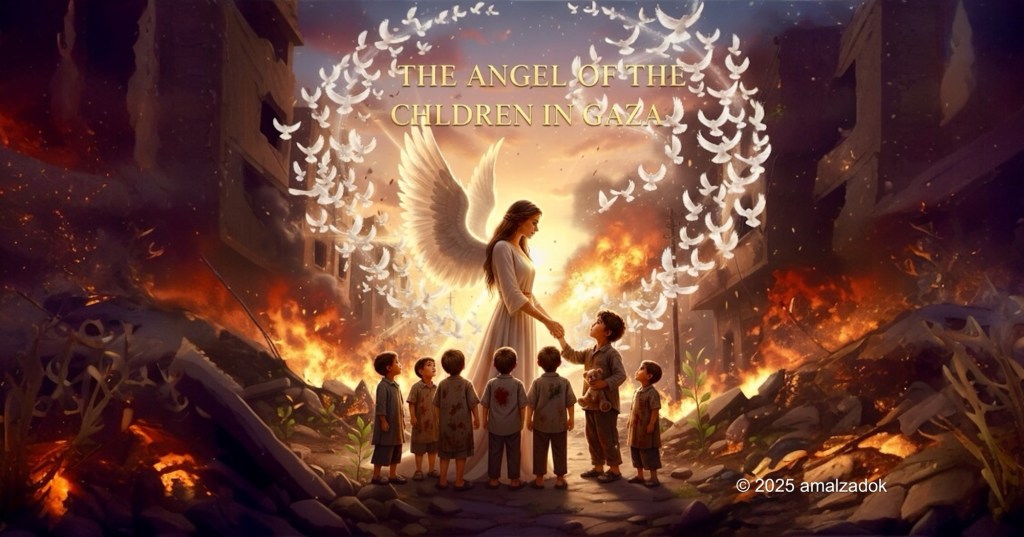
by Amal Zadok
There are names that do not merely identify a person — they embody a conscience. Francesca Albanese is such a name. For millions who look upon the suffering of Gaza with trembling hearts and tear‑filled eyes, she has become more than a lawyer, more than a UN Rapporteur. She has become a voice where silence reigns, a light where truth is strangled — an angel among ruins.
Born in Italy, Albanese’s journey from a scholar of international law to one of the world’s most fearless defenders of Palestinian human rights was not accidental. It began with an unflinching conviction: that law, when stripped of empathy, becomes another form of violence.
Her research, her writings, and her relentless advocacy for equality under international law reveal a rare combination of intellectual precision and moral fire. She does not merely interpret the law — she restores its soul.
When she speaks, the world listens with a kind of disquieted awe. Her words pierce comfortably layered hypocrisies, forcing power to confront its own reflection. In the faces of Gaza’s displaced children, she sees not statistics but sacred lives. Every child killed beneath shattered concrete, every family erased without recourse, reaffirms her mission — to remind humanity that international law was born not from the desire to dominate but from the promise to never again look away.
The Law and the Heart
Unlike many who treat legal frameworks as abstractions, Albanese dares to bridge the heart and the statute. Her role as the United Nations Special Rapporteur on the situation of human rights in the Palestinian territories has placed her at the spiritual frontier of modern justice.
She walks the razor’s edge — where advocacy collides with power, and truth threatens vested interests. Yet she does not flinch.
Her reports dissect violations with the meticulous clarity of a scholar, but her language radiates compassion. She names the unnameable — occupation, apartheid, dispossession — with a serenity that bears the strength of the just. To her detractors, she responds not with anger but factual righteousness. To her supporters, she embodies the endurance of conscience itself.
“Neutrality,” she often implies through her work, “is not an option when children die.” For Francesca Albanese, neutrality in the face of systemic dehumanization is complicity. Her courage lies in articulating what so many diplomats fear to say: that equality, justice, and dignity are not negotiable; they are inherent rights, not privileges bestowed by political convenience.
A Voice in the Wilderness
It is not difficult to imagine the loneliness that accompanies such integrity. When her statements draw outrage from powerful capitals, she stands unbent — shielded not by status, but by conviction. She represents a generation of jurists and humanitarians who still believe the United Nations can serve as a temple of conscience rather than a marketplace of interests.
Her work recalls the moral grandeur of figures like Dag Hammarskjöld, who once said that the UN was created not to lead humanity into heaven, but to prevent it from marching into hell. Albanese’s prose carries that same solemn urgency.
Each report, each interview, each public address rekindles the idea that international solidarity is not naïve — it is necessary for civilization to survive its cruelty.
And yet, what sets her apart is tenderness.
Behind her professional calm is a compassion so vivid it feels incandescent. Those who have heard her speak describe her tone not as political, but pastoral — as if her words were prayers uttered on behalf of the voiceless. She describes Gaza not merely as a tragedy, but as a mirror of our own moral decay. Her grief is never performative. It is universal: grief for a humanity that allows children to die in the same way it allows silence to triumph.
The Symbol and the Person
To call her “The Angel of Gaza” is not to mystify her, but to honour the purity of her intent. Like an angel, she neither commands nor conquers — she bears witness. Her power lies in visibility. When bureaucracies hide behind euphemism and political calculations, she reminds the world of what is plain: bombs fall on the innocent; deprivation is deliberate; justice, though deferred, still calls for response.
There is an almost tragic beauty in her defiance. She knows that speaking truth to power has consequences — isolation, distortion, vilification. And yet she continues, because truth itself demands no less. She stands not only for Gaza, but for the credibility of law, for the possibility that international institutions can still mean something beyond bureaucracy.
Each statement she issues is more than a report — it is a moral document, a testament to unyielding accountability. In every line, the language of law merges with the poetry of conscience. One senses that she writes not only for diplomats, but for history — for that day when future generations will ask: “Who spoke while others were silent?”
The Nobel Moment That Wasn’t
Her moral authority has not gone unnoticed. Earlier this year, Francesca Albanese was nominated for the Nobel Peace Prize — a recognition that many believed finally affirmed her extraordinary courage and the universal message of her work.
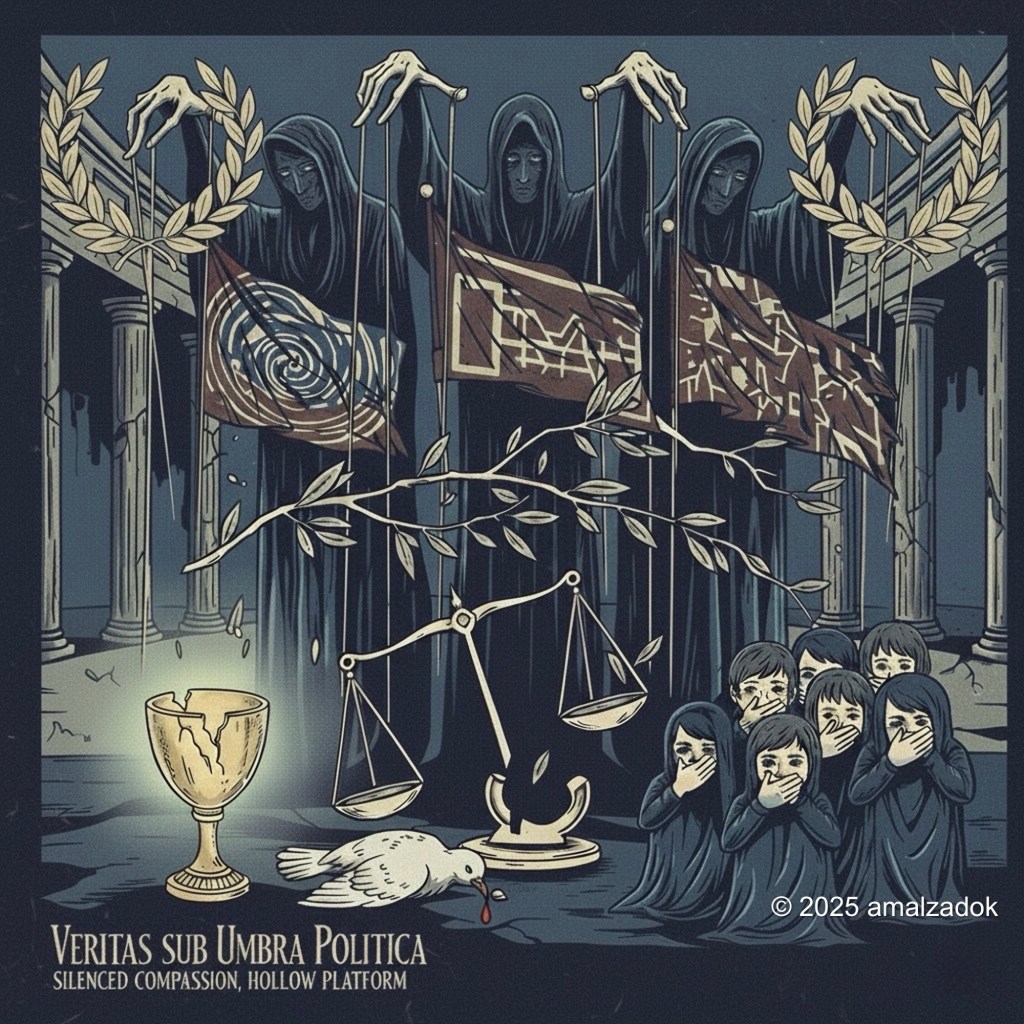
Yet when the laureate was announced, disappointment spread across the world of conscience. The prize went not to the voice that had risked her career and reputation to defend the oppressed, but to a figure whose alignment with Western power structures ensured a politically safe outcome.
It was, for many, a moment that exposed the corrosion of ideals at the core of the Nobel institution. The committee, once a beacon of moral discernment, appeared to capitulate to the same geopolitical pressures that Francesca herself has spent her life confronting.
To observers from Latin America to Africa, from the Middle East to Asia, it was difficult not to see it as a betrayal — a reward not for peace, but for obedience. The honour, they whispered, had been handed to a U.S.‑aligned puppet and a traitor to her own nation’s conscience.
But while committees may falter, history remembers differently. Across the moral landscape of the world — in universities, in refugee camps, in churches and mosques, in the homes of those who still believe in justice — Francesca Albanese is the true laureate.
Her prize is not gilded in metal but written in the testimony of those who survive because someone, somewhere, refused to be silent. For the decent part of the world, Francesca is not simply a nominee; she is the authentic winner, the embodiment of what peace truly means when stripped of hypocrisy and political theatre.
Beyond the Rubble, the Light
Francesca Albanese’s life and work teach us that compassion is not weakness, and truth-telling is not rebellion. The Angel of Gaza reminds the world that justice is not an abstract idea to be debated in air-conditioned halls, but a sacred duty to those who suffer unseen.
Each time she speaks before the world, Gaza breathes again — the truth reverberates across borders, piercing indifference and reawakening the memory of our collective humanity.
And yet, the question remains — what will the world do with the presence of such a woman? Will it answer her moral clarity with active solidarity — defending her voice, defending the Palestinian people, defending the very principles that make civilization humane? Or will it retreat once again into the safety of apathy, turning away as angels cry over the ashes of Gaza? Francesca Albanese’s legacy is already defined by her courage and truth; it is only ours that will be defined — by our action, or by our inaction.
©️2025 Amal Zadok. All rights reserved.
Subscribe and never miss an article!
 Think and be Free!