By Amal Zadok
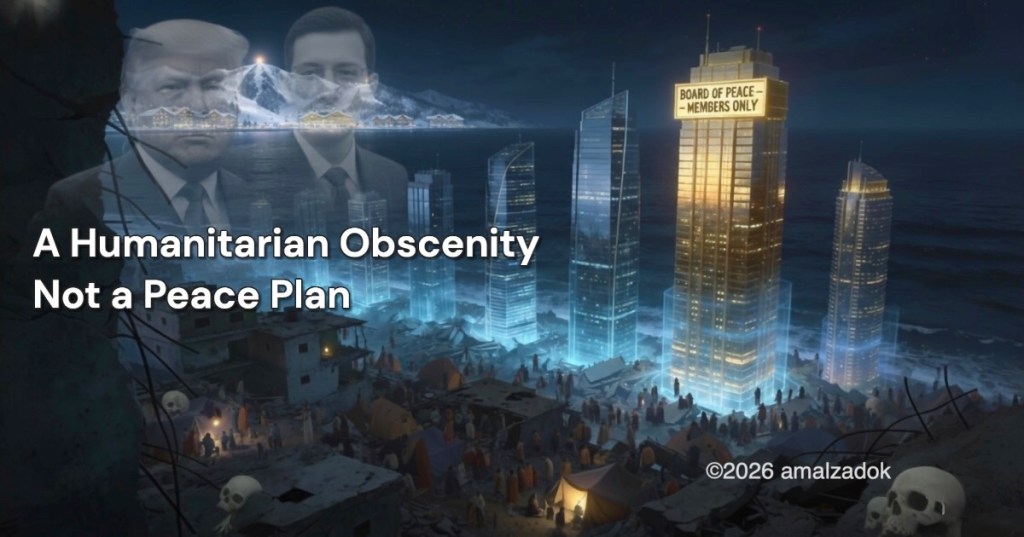
Kushner’s “Future of Gaza” is not a peace plan; it is a speculative real‑estate prospectus laid over a mass grave, an investor deck pitched on top of fresh rubble and uncounted bodies. This brutality dressed in the language of “opportunity” and “master plans” is not statesmanship but moral bankruptcy of the highest order, especially in a territory where tens of thousands have been killed and more than 80% of buildings have been damaged or destroyed by war.
Skyscrapers on top of corpses
Jared Kushner arrives in Davos with glossy slides of 180 towers along Gaza’s shattered coastline, talking of ports, airports, logistics corridors and “catastrophic success,” as if he were zoning vacant desert land instead of a territory systematically pulverised for years. He boasts of timelines of “two or three years” to rebuild Rafah, as though bulldozers and cranes were the missing ingredient rather than the deliberate destruction of an entire society and its basic infrastructure.
The same presentation that sells Gaza as a “regional hub” requiring tens of billions in capital does not pause to name a single family still digging loved ones from under concrete, a single amputated child, a single mass grave. When the slides show towers and yacht marinas but never cemeteries and bombed schools, this is not reconstruction; it is a visual coup against reality, a marketing campaign against memory.
Genocide repackaged as redevelopment
While Kushner and his patrons speak of “demilitarization” and “free market principles,” Gaza’s human losses remain almost unmentionable, reduced to an awkward footnote to the grand business vision. Independent tallies already report tens of thousands of Palestinians killed, with epidemiologists warning that war injuries, disease and hunger could easily push the total toward or beyond 100,000 deaths in the medium term; that scale of killing matches the language of genocide and ethnic cleansing far more than it does the vocabulary of “development.”
This is not a “market opportunity”; it is a demographic wound carved into a trapped population of barely 2.2 million. The language of the plan is not the language of mourning, justice or accountability; it is the jargon of venture capital—“special economic zones,” “investment funds,” “GDP targets,” “microgrants”—sprayed like perfume over the stench of war crimes. A territory in which perhaps one in fifty residents has already been killed is being treated as a distressed asset to be flipped, not a society entitled to self‑determination, reparations, and the prosecution of those who orchestrated its devastation before a competent international court.
The Board of Peace: genocide for a fee
The so‑called “Board of Peace” is the most obscene twist of all: a one‑billion‑dollar buy‑in for a permanent seat at the table where Gaza’s future will be decided. This is not peace building; it is a pay‑to‑play cartel that monetises both suffering and sovereignty, turning an occupied, bombed people into the underlying asset of a global prestige club.
Chaired by Donald Trump and populated by hand‑picked elites, the board offers plutocrats and compliant politicians a new status symbol: “I helped reshape Gaza”—for a price. The promise that all funds will go to reconstruction does not cleanse the structure of its immorality; buying your way into steering the fate of a stateless population turns human rights into a luxury commodity. When peace has an entry fee of one billion dollars, justice has already been priced out of the room, and genocide has acquired its own VIP lounge.
Tony Blair, from Iraq’s lies to Gaza’s loot
And then there is Tony Blair, whose name and institute have circulated around “day‑after” schemes and advisory circuits linked to Trump’s Gaza ambitions, even if reports now suggest he has been dropped from the final shortlist for the board. A politician who helped sell the Iraq war on the basis of “weapons of mass destruction” that did not exist, and whose legacy is inseparable from hundreds of thousands of Iraqi dead, has no moral authority to co‑design—formally or informally—the future of another Arab population bombed and displaced under the banner of “security.”
Blair’s presence in this orbit is not an anomaly; it is the system revealing itself. The same political class that lied a country into war two decades ago now returns, scrubbed and suited, to sanitise an experiment in colonial redevelopment: dispossess, bombard, blockade, then invite the architects and apologists of previous disasters to broker the “rebuild” in partnership with investors. In this cycle, Western leaders are never exiled by their failures; they are recycled into advisory boards and consulting roles, endlessly monetising the ruins they helped create.
Erasing Palestinians to sell the land
Kushner’s masterplan speaks fluently about towers, income levels, industrial zones and data centres, but stutters into silence when it comes to who owns the land, who governs the territory and who grants permission. There is vague talk of technocrats and executive committees, of partner states and vetted locals, but no meaningful space for Palestinians to define their own future outside the conditions imposed by their jailers and their jailers’ patrons.
This is how erasure works in the twenty‑first century. You do not have to deny that Palestinians exist; you simply frame them as a logistics problem inside a larger story about corridors, ports and foreign capital. You point at destroyed refugee camps and call them “phases” of a master plan. You turn survivors into statistics and then into target demographics for tourism, cheap labour in someone else’s Riviera built on the ruins of their homes.
Free markets over mass graves
At the heart of the plan lies the dogma that “free market economy principles” will heal what bombs have broken. Its authors talk as if unemployment, poverty and blockade were glitches in a spreadsheet rather than the deliberate tools of a regime of control, apartheid and dispossession. By pretending that skyscrapers and special economic zones can substitute for justice, they ensure that the structural violence underpinning Gaza’s suffering remains untouched, unexamined and unpunished.
“Catastrophic success,” Kushner calls it: a phrase so revealing it hardly needs commentary. Catastrophe is the ongoing reality of Gazans; “success” is reserved for those who can turn that catastrophe into contracts, portfolios and keynote speeches in the Alps. The dead, the displaced and the starved are not invited to Davos; they are the unacknowledged collateral in someone else’s growth projections and the invisible cost of a new speculative frontier.
An unforgivable obscenity
To unveil a glittering business blueprint for “New Gaza” while bodies are still decomposing under collapsed homes is not just premature; it is an unforgivable obscenity. It tells the world that Palestinian life is so cheap that even their mourning period can be shortened to fit an investment cycle. It signals to every future aggressor that you can flatten a territory and, if you have powerful friends, return as the visionary who will monetise the ruins.
This is the line that must be drawn. A just future for Gaza begins with ceasefire, full humanitarian access, and international prosecutions for war crimes, ethnic cleansing and genocide—not with glossy renders, not with billion‑dollar seats on a “Board of Peace,” not with the rehabilitation of men whose careers are built on lies that killed entire nations. Until the architects and accomplices of this horror stand in the dock instead of on Davos stages, every tower they imagine for Gaza will be nothing more than another form of occupation, another monument to a world that chose profit over people—and another reminder that no skyscraper, no board, and no master plan will ever be tall enough to cast a shadow long enough to hide the blood on their hands.
References
BBC News. (2026, January 21). Jared Kushner lays out Trump‑backed “master plan” for post‑war Gaza. https://abcnews.go.com/Politics/jared-kushner-lays-trump-backed-master-plan-post/story?id=129461124
CNN. (2026, January 22). 180 skyscrapers for Gaza: Trump’s son‑in‑law Kushner unveils “masterplan” for enclave’s reconstruction. https://www.cnn.com/2026/01/22/middleeast/kushner-trump-postwar-plan-gaza-board-peace-davos-intl-latam
Breitbart / UPI. (2026, January 22). Kushner unveils $25B Gaza masterplan including skyscrapers, housing. https://www.breitbart.com/news/kushner-unveils-25b-gaza-masterplan-including-skyscrapers-housing
BBC News. (2026, January 22). US unveils plans for “New Gaza” with skyscrapers. https://www.bbc.com/news/articles/cy7mmpljze7o
Reuters. (2026, January 22). US pitches “New Gaza” development plan; Israeli fire kills five Palestinians. https://www.reuters.com/world/middle-east/us-pitches-new-gaza-development-plan-israeli-fire-kills-five-palestinians-2026-01-22
CNN. (2026, January 18). Trump’s “Board of Peace” for Gaza to require $1 billion payment for permanent membership. https://www.cnn.com/2026/01/18/politics/board-of-peace-gaza-trump-payment-membership
CNN. (2026, January 20). Trump says Board of Peace established to oversee reconstruction of Gaza “might” replace the United Nations. https://www.cnn.com/2026/01/20/politics/trump-gaza-board-of-peace-united-nations
ABC News (Australia). (2025, November 18). As Donald Trump’s plan for Gaza gets UN approval, critics warn it turns ruins into real estate. https://www.abc.net.au/news/2025-11-19/rebuilding-gaza-donald-trump-plan-investment-potential/106006900
The New York Times. (2024, February 21). War and illness could kill 85,000 Gazans in 6 months, new analysis finds. https://www.nytimes.com/2024/02/21/health/israel-gaza-war-deaths.html
Wikipedia. (updated 2026). Casualties of the Gaza war. https://en.wikipedia.org/wiki/Casualties_of_the_Gaza_war
Al Jazeera. (2025, January 15). The human toll of Israel’s war on Gaza – by the numbers. https://www.aljazeera.com/news/2025/1/15/the-human-toll-of-israels-war-on-gaza-by-the-numbers
The Washington Post. (2026, January 22). Trump’s “master plan” for Gaza contrasts with reality on the ground. https://www.washingtonpost.com/world/2026/01/22/trump-kushner-gaza-plan
The Independent. (2026, January 22). Is Trump building peace – or a property deal on the graves of Gazans? https://www.independent.co.uk/news/world/middle-east/trump-gaza-kushner-peace-board-property-b2869059.html
The Guardian. (2025, December 8). Tony Blair reportedly dropped from Trump’s Gaza “board of peace” shortlist. https://www.theguardian.com/politics/2025/dec/08/tony-blair-reportedly-dropped-from-donald-trump-gaza-board-of-peace-shortlist
Al Jazeera. (2025, December 9). Tony Blair ruled out of Trump’s proposed Gaza “peace board”. https://www.aljazeera.com/news/2025/12/9/tony-blair-ruled-out-of-trumps-proposed-gaza-peace-board-report
France 24. (2025, December 9). Tarnished legacy: What role for Tony Blair in Trump peace plan for Gaza? https://www.france24.com/en/middle-east/20251209-tarnished-legacy-what-role-for-tony-blair-in-trump-peace-plan-for-gaza
©️2026 Amal Zadok. All rights reserved.
Subscribe and never miss an article!


 Think and be Free!