By Amal Zadok and Rev. Antonio Rossemberg, MD, psychiatrist.
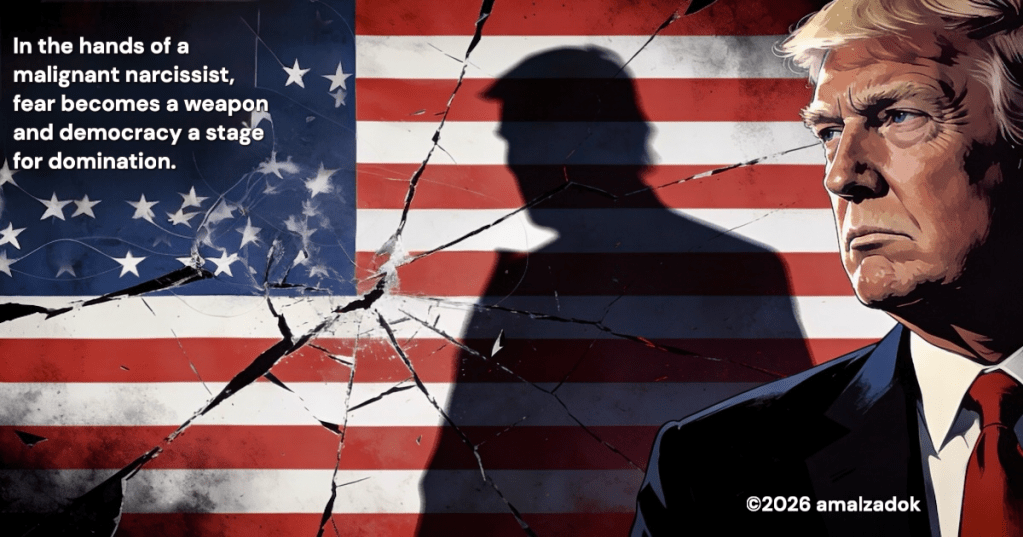
Donald Trump is not scared. Fear is not an emotion that resonates with him the way it does with most people. He embodies what psychologists describe as a malignant narcissist—a personality type that blends narcissism with antisocial traits, a lack of empathy, and a hunger for domination. People like him are largely incapable of feeling fear, remorse, or genuine empathy. That emotional vacuum makes them profoundly dangerous, especially when they ascend to positions of enormous political or social power.
A malignant narcissist does not experience fear as a natural warning signal or a moment of introspection. Instead, fear in others becomes a source of satisfaction—a sign that they are in control. His reactions, from defiant outbursts to self-aggrandizing rhetoric, often reveal a man who feels invincible rather than vulnerable. Setbacks, investigations, or criticism are not perceived as moral reckonings but as insults to be crushed or games to be won. This mindset explains why accountability rarely touches him in any meaningful way: he refuses to acknowledge fault because, to him, weakness is worse than wrongdoing.
When such a person occupies the presidency of the United States—the most powerful office on Earth—the consequences extend far beyond one individual’s pathology. A malignant narcissist in power sees the nation not as a collective trust but as an extension of the self. The institutions of democracy become tools to serve personal validation, and the truth itself becomes malleable. Loyalty is demanded, not earned. Those who flatter are embraced; those who dissent are derided or destroyed.
Trump’s appeal lies in his uncanny ability to mirror the resentments and frustrations of others while remaining utterly self-absorbed. His political genius, if it can be called that, is his instinct for manipulation—his capacity to turn fear outward rather than inward. He convinces followers that their enemies are his enemies, that their grievances justify his own impunity. In doing so, he transforms personal pathology into a political movement.
He is not scared because fear requires humility, and humility is foreign to his nature. What drives him is not courage, but the relentless need to dominate. That is why his power—unrestrained, unreflective, and unrepentant—is so deeply perilous. Now, in his second term, the malignant traits that once defined Trump’s personality have hardened into policy and institutional transformation.
His declaration—“No one can stop me; only my own morality can”—is not simply arrogance; it is a chilling admission of delusion. It reveals a man who sees himself as the arbiter of what is right and wrong, detached from external moral frameworks, institutions, or law. For Trump, morality is not universal; it is situational—a reflection of what benefits him in the moment. He invokes morality as a mask, framing his impulses as destiny. This is the purest expression of the narcissistic illusion: the belief that the self is infallible and that restraint is weakness.
In a functioning democracy, such pathology should meet a firm institutional response. Congress holds not only the power but the obligation to act as a check on executive overreach, using hearings, investigations, and impeachment when a president’s conduct threatens the constitutional order. Yet too many politicians retreat into rehearsed talking points, tribal loyalty, and short-term electoral calculus, choosing self-preservation over their oath to the Constitution. Their failure to confront this malignant narcissism does not make them neutral observers; it makes them enablers.
©️2026 Amal Zadok. All rights reserved.
Subscribe and never miss an article!
 Think and be Free!