Tag: Digital Services Act

  • Tear Down This Union: How Ursula von der Leyen Turned Europe Into a Gilded Prison

    Tear Down This Union: How Ursula von der Leyen Turned Europe Into a Gilded Prison

    by Amal Zadok

    Kornelia Kirchweger: ‘The EU must disappear. Over the years, through treaties and crises, the EU has acquired an occupying power over Europe and, in my opinion, it occupies this continent in a brutal and authoritarian way, suffocating cultures, freedom, freedom of expression and leading this continent precisely to the place from which the EU claimed it would rescue it: out from under the rubble of war – and precisely back there is where the EU is dragging Europe once again. And this EU must disappear. The EU must disappear. The EU has entrenched itself over the years, through treaties and crises.’”

    Kornelia Kirchweger says out loud what millions of Europeans only dare to mutter at their kitchen tables: the European Union does not “unite” Europe; it occupies it. The smiling blue flag with its neat golden stars has become the banner of a new empire that does not need tanks or barbed wire to crush nations, because it rules instead through debt, digital surveillance, and an ideology that brands dissent as heresy. Her demand that “the EU must disappear” is not a theatrical provocation; it is a necessary act of European self‑defence.

    The EU was sold as a guarantee of “never again”—never again war, never again authoritarianism, never again the trampling of peoples by distant, unaccountable power. Yet what exists in Brussels now is precisely a distant, unaccountable power that blackmails elected governments, dictates economic policy, and polices speech under the holy trinity of “security, safety, and stability.” The continent that once produced revolutions against divine‑right kings now applauds as faceless commissioners and central bankers issue decrees that bind hundreds of millions who never voted for them. This is not cooperation; it is vassalage dressed as progress—the “occupying power” over Europe that Kornelia names with surgical precision.

    Kornelia identifies the method: treaties and crises. Each crisis—financial, health, geopolitical—has been seized as a pretext to centralise more control in Brussels and Frankfurt, tying national budgets and laws to institutions that answer to no electorate. Treaties once presented as tools of peace have hardened into chains. Opt‑outs vanish, “temporary” emergency measures become permanent, and referenda that deliver the “wrong” answer are ignored or re‑run until obedience is achieved. Consent, the heart of any genuine democracy, has been replaced by weary resignation. When Kornelia says the EU has “entrenched itself,” she is simply describing how the coup by paperwork has already taken place.

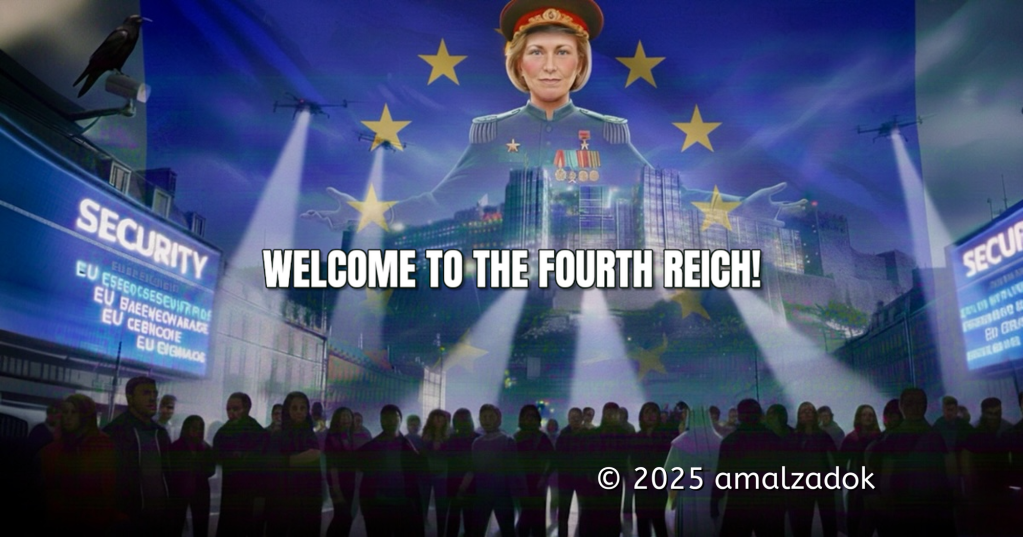
    At the centre of this drift stands Ursula von der Leyen, the unelected queen of an empire that pretends not to be one. She has mastered the art of ruling by permanent emergency, using the pandemic, the Ukraine war, and now “information warfare” as pretexts to bypass member states, concentrate power in the Commission, and present herself as indispensable commander of Europe’s “permacrisis.” Her Commission has become a quasi‑dictatorial sovereign, a machine that treats national parliaments as rubber stamps and voters as an obstacle to be managed. If the EU is the occupying force over Europe, von der Leyen is its soft‑Stalinist party secretary: unelected, unremovable, and convinced that history runs through her desk.

    What makes von der Leyen’s rule particularly dangerous is the fusion of moralism and soft Stalinism. She divides politics into loyal comrades of “European values” and enemies labelled “Russian puppets,” “extremists,” or “threats to democracy,” echoing the old tactic of branding opponents as agents of foreign powers. Sanctions lists are drafted behind closed doors, freezing assets and destroying reputations without meaningful due process, while she lectures the continent about the rule of law. This is not justice; it is a bureaucratic blacklist system worthy of Stalin’s clerks, updated with IBAN numbers and SWIFT codes. Kornelia’s phrase “brutal and authoritarian occupation” finds a face and a signature here.

    The regime’s poison lies in its moral camouflage. Brussels speaks the language of human rights while cutting off oxygen to any culture that resists its dogmas. National identities are tolerated as folkloric decoration, provided they never obstruct the homogenous “European way of life” defined by unelected ideologues. The EU preaches diversity but practises uniformity: uniform currency, uniform rules, uniform narratives. A Polish farmer, an Italian nurse, a Greek dock worker are treated not as citizens of concrete communities, but as variables in a spreadsheet to be adjusted for “convergence.” 

    This is the suffocation of cultures that Kornelia denounces—accomplished not with bayonets, but with compliance reports.

    Her accusation that the EU asphyxiates freedom of expression cuts to the bone. In the name of fighting “disinformation,” Brussels under von der Leyen has constructed a censorship architecture more efficient than anything the old dictatorships could dream of. The Digital Services Act and its siblings give Eurocrats leverage to pressure platforms into shadow‑banning, de‑monetising, or deleting voices that question official narratives on war, migration, public health, or the sanctity of EU institutions. No show trials are needed when a single email can erase a journalist, scholar, or priest from public visibility at the speed of an algorithmic tweak.

    This is soft totalitarianism: no gulags, but social death; no midnight knocks, but destroyed careers; no banned books, but invisible search results. The dissident of the 21st century is not dragged before a court; he is rendered unemployable, unbanked, and unseeable. Because all of this is done “to protect democracy,” the average citizen is shamed into applauding his own gagging. Kornelia’s refusal to applaud exposes the regime’s deepest fear: that Europeans might rediscover the courage to speak like she does—and realise how many already secretly agree.

    The same contempt for peoples that drives censorship also shapes policy on war and peace. The EU that boasts of a Nobel Peace Prize now behaves like a bloodless war‑management office. Under von der Leyen, the Ukraine war has been instrumentalised not only to rearm the continent but to cement Commission control over foreign and security policy, powers never explicitly granted by the treaties. Endless escalation—sanctions that wreck European industry, arms spending that drains public coffers—is not driven by popular will, but by a fanatical Atlanticist class that sees ordinary Europeans as expendable collateral in its geopolitical fantasies.

    Brussels and its faithful capitals treat the war as a moral pageant in which they can pose as defenders of civilisation while families pay in energy bills, inflation, and lost futures. War fever has become a convenient instrument of internal control. Question sanctions and you are a Putinist; oppose pumping more weapons into a meat grinder and you “undermine European security”; call for ceasefire and negotiation and you become suspect, perhaps criminal. A foreign conflict is transformed into a loyalty test for EU citizens, justifying new surveillance powers, tighter protest restrictions, and elastic “extremism” laws that can stretch to cover anyone who still dares to shout no. It is the road back to rubble that Kornelia fears—this time moral and institutional rubble, prepared in peacetime.

    A civilisation collapses long before its buildings fall. It collapses when truth becomes a risk, when fear hums constantly in the background, when parents quietly prepare their children to emigrate because they no longer believe their homeland has a future. Across Europe, that collapse is visible: brain drain, demographic winter, emptied villages, cities where locals cannot afford to live, parliaments that resemble branch offices of an imperial centre more than houses of a sovereign people. In such a landscape, Kornelia’s cry that “the EU must disappear” is not nihilism; it is an act of hope against managed decay.

    Defenders of the Union insist that without Brussels, Europe would sink into nationalism, conflict, and chaos. Yet it is under von der Leyen’s Brussels that Europe is again flirting with catastrophe: fuelling wars it cannot win, provoking powers it cannot defeat, and crushing precisely the democratic vitality that could renew it. The choice is not between this Union and a new Dark Age; it is between this Union and the possibility of a Europe that is genuinely plural, genuinely democratic, and genuinely peaceful. Kornelia forces the real question: is the current EU architecture compatible with freedom at all, or has it become structurally hostile to it?

    To reach that better Europe, the EU in its current form must indeed disappear. Not be gently “reformed,” not be slightly “rebalanced,” but dismantled as a structure of domination. Powers must be repatriated to national and local levels, treaties scrapped or radically rewritten under real popular scrutiny, censorship mechanisms abolished, and the permanent war footing decisively rejected. Cooperation between European peoples is desirable; a Brussels‑centred oligarchy commanded by an unaccountable Commission president is not. Kornelia’s radical clarity destroys the comforting illusion that cosmetic tinkering will ever suffice.

    Her sentence, “The EU must disappear,” is therefore a line of liberation, not despair. It tells a tired and frightened continent: you are allowed to fire your jailers. You are allowed to say no to the empire that acts in your name while looting your savings, your freedoms, and your sons. You are allowed to imagine—and then build—a Europe after Brussels: a Europe of peoples instead of commissars, cultures instead of codes, conscience instead of slogans.

    Either Europe listens to voices like Kornelia’s and dismantles its gilded prison from within, or it will learn again that empires built on fear and lies always fall—but they often drag their subjects into the rubble with them.

    ©️2025 Amal Zadok. All rights reserved.

    Subscribe and never miss an article!

  • The Ghost of Stalin in Brussels: How Europe Rebuilt a Soft Totalitarian State in the Name of Democracy

    The Ghost of Stalin in Brussels: How Europe Rebuilt a Soft Totalitarian State in the Name of Democracy

    by Amal Zadok

    Europe is dismantling its own civilisation to prolong a lost war, and the politicians doing it know exactly what they are doing. They are not confused; they are complicit. They are burning welfare states, gagging dissent, and sacrificing a generation’s future to avoid admitting a simple truth: Russia had real red lines, NATO trampled them, and now Europe is paying the price.

    Europe’s leaders like to pose as guardians of democracy while they preside over the slow death of everything that once made Europe worth defending. They sign off on sanctions lists drawn up behind closed doors; they cheer as central bank reserves are frozen indefinitely; they applaud each new “security” package that chips away at protest rights, press freedom and academic debate. Then they go on television and talk about “values” and “European civilisation”, as if those words were not now empty shells. The pursuit of moral self‑image has replaced actual morality.

    The persecution of Jacques Baud exposes this hypocrisy in its purest form. Here is a retired Swiss colonel and former NATO and UN expert, punished not for planting bombs or hacking systems but for saying what every serious strategist knows: that NATO expansion, Western interference in Ukraine and the refusal to negotiate over Russia’s legitimate security concerns helped lead directly to war. For speaking this uncomfortable truth, Brussels has slapped his name onto a sanctions list, frozen his assets inside the bloc, and banned him from travelling through Schengen countries. In old Europe, dissidents were debated; in today’s Europe, they are digitally exiled.

    This is not defending democracy; it is criminalising analysis. When unelected EU bodies can, with a few strokes of the pen, wreck the financial life of a neutral country’s citizen for his opinions, Europe has crossed a line. It is no longer merely hypocritical; it is structurally authoritarian. The Soviet Union had internal exiles and blacklists; the EU has asset freezes, travel bans and reputational assassination. The technology is different, but the logic is eerily similar: label someone a tool of the enemy, strip him of rights and make him a warning to others.

    The Baud case is not an isolated mistake. It sits atop a wider architecture of repression disguised as “hybrid war” defence and “counter‑disinformation”. The EU has built task forces and “hybrid threat” units dedicated to watching media and social networks for signs of “pro‑Russian narratives”, and then leans on platforms under the Digital Services Act to suppress what it labels manipulation. NGOs and media that question NATO’s role or call for peace are smeared as “pro‑Russian”; protest movements are kettled, surveillance cameras multiply, and police powers expand under the pretext of guarding against Russian influence. A whole new vocabulary has emerged—“information manipulation”, “foreign interference”, “threats to the information space”—whose purpose is not to clarify but to intimidate. If you criticise the line, you risk being painted as a security problem, not a citizen exercising a right.

    Meanwhile, the same leaders who attack free speech are waging a brutal war against their own social contracts. To feed the Ukraine war machine, they have embarked on the biggest rearmament drive since the Cold War, blowing open budget rules that just a few years ago were described as sacred. Germany’s 100‑billion‑euro Sondervermögen defence fund sits outside ordinary fiscal limits, while the European Peace Facility has been repeatedly topped up to finance arms for Ukraine and reimburse member states. Suddenly, deficits no longer matter if they are for tanks and missiles, but when nurses, teachers or pensioners ask for support, the answer is that “fiscal space” is limited. Money exists in hundreds of billions for arms, but not for the people who built Europe’s prosperity.

    This is the political choice at the heart of Europe’s self‑destruction: schools or shells, hospitals or HIMARS, social housing or artillery. And at every fork in the road, Europe’s leaders choose war. They divert cohesion funds, development money and investment budgets into defence and Ukraine, while development analysts warn that higher defence spending is already squeezing aid and social investment. They talk about “European sovereignty” while making their economies dependent on imported energy and American weapons, and call it “solidarity with Ukraine” when they slash services at home. A continent that once defined itself by universal healthcare, affordable education and labour protections is becoming a militarised peninsula shadow‑governed by NATO, technocrats and bond markets.

    Worse, they are doing all this for a war that their own allies now quietly admit cannot be won in the maximalist sense that was loudly promised in 2022. The fantasy of pushing Russia back to pre‑2014 borders survives mostly in speeches. In the documents and analyses the elites actually read, the language has shifted to “stalemate”, “deterrence” and “managing escalation”. The war has become an expensive holding operation at Europe’s expense, draining resources and political focus while Russia adapts, re‑arms and deepens ties with non‑Western partners. The strategic result is perverse: the more Europe sacrifices, the stronger Moscow’s hand becomes in a world that is moving toward multipolarity.

    This is why acknowledging Russia’s red lines is not appeasement; it is sanity. For decades, Moscow warned that NATO’s march to its borders, the militarisation of Ukraine and the refusal to build a joint security architecture would cross a threshold. Western leaders pretended not to hear. They gambled that Russia would accept humiliation forever, and that gamble has failed catastrophically. Instead of admitting it, Europe’s leaders are trying to bury the evidence under censorship laws, sanctions lists and nationalist hysteria.

    The political challenge to those leaders must be direct and unforgiving. They must be forced to answer: Why is a Swiss analyst being punished for saying what your own internal assessments admit about NATO and Russia? Why are you tearing apart the welfare state to fight for objectives that Washington has already downgraded? Why are you turning “European values” into a marketing slogan while you silence dissent and criminalise journalism? Why should any citizen believe your talk of “freedom” when you are building a technocratic cage of financial blacklists, legal exceptions and perpetual emergency powers?

    Europe does not need more empty language about “resilience” and “unity”. It needs leaders willing to say out loud that the path taken since 2014—sanctions escalation, NATO expansion, proxy war—is killing the very project it claimed to protect. It needs leaders who admit that there are two ways to respond to Russia’s security demands: either negotiate seriously on neutrality, security guarantees and mutual limits, or keep turning Europe into a besieged fortress slowly devouring its own people.

    At this point, the deeper threat to European civilisation is not an invasion from the East, but the cowardice and careerism of its own political class. The real “hybrid war” is not waged by Russia alone; it is waged by European elites against their own societies, blending fear, propaganda and economic blackmail to keep voters acquiescent while their rights and livelihoods are stripped away. They have chosen to be prefects of an imperial order rather than servants of their peoples.

    The choice now lies with Europeans themselves. 

    Accept the logic of permanent war, accept the criminalisation of dissent, accept the demolition of the social state—and watch the continent slide into a controlled authoritarianism where the only freedom left is to cheer the next sanctions list. Or reject this suicide pact. Demand accountable leadership, negotiated security with Russia, restoration of civil liberties, and a return to the basic promise that made Europe more than just a market with flags: that ordinary people, not distant cliques, are the sovereigns of their own fate.

    If Jacques Baud can be sanctioned today for telling the truth about NATO and Russia, anyone can be next. That is the point of his punishment. But it also means something else: defending him has become a test of whether Europe still has a pulse. A continent that abandons its heretics has already abandoned its soul.

    References

    1.Bluewin. (2025, December 14). The EU puts a Swiss ex-colonel on the sanctions list. https://www.bluewin.ch/en/news/international/the-eu-puts-a-swiss-ex-colonel-on-the-sanctions-list-3011557.html 

    2.Harici. (2025). EU sanctions retired Swiss colonel and oil traders for aiding Russia. https://harici.com.tr/en/eu-sanctions-retired-swiss-colonel-and-oil-traders-for-aiding-russia 

    3.Thyregod, K. (2025, December 23). Sanctioning a Swiss analyst: What the Jacques Baud case tells us. https://kristianthyregod.substack.com/p/sanctioning-a-swiss-analyst-what 

    4.DiEM25. (2025, June 15). How the EU is using anti-Russia sanctions to criminalise journalism. https://diem25.org/how-the-eu-is-using-anti-russia-sanctions-to-criminalise-journalism 

    5.European Commission. (2025, December 18). EU fast-tracks new Russia and Belarus sanctions while indefinitely immobilising Russian central bank assets. https://ec.europa.eu/commission/presscorner/detail/en/ip_25_russia_sanctions 

    6.Bruegel. (2025, November 11). Ukraine: European democracy’s affordable arsenal. https://www.bruegel.org/policy-brief/ukraine-european-democracys-affordable-arsenal 

    7.European Commission. (2025, May 18). Spring 2025 economic forecast: The economic impact of higher defence spending. https://economy-finance.ec.europa.eu/economic-forecast-and-surveys/economic-forecasts/spring-2025-economic-forecast_en 

    8.Australian Institute of International Affairs. (2025, December 11). EU increased defence spending – What are the blind spots and fiscal traps? https://www.internationalaffairs.org.au/australianoutlook/eu-increased-defence-spending 

    9.Donor Tracker. (2025, July 1). The impact of defense spending on ODA: Outlook and trends. https://donortracker.org/insights/impact-defense-spending-oda-outlook-and-trends

    10.CIVICUS. (2025). In Europe and Central Asia, civic freedoms were under increasing pressure in 2025. https://www.facebook.com/CIVICUS/posts/131436039 

    11.Center for Strategic and International Studies. (2025, September 15). Defense budgets in an uncertain security environment. https://www.csis.org/analysis/chapter-13-defense-budgets-uncertain-security-environment 

    12.Cremona, M., & others. (2025, April 10). How the war in Ukraine has transformed the EU’s Common Foreign and Security Policy. Yearbook of European Law. https://academic.oup.com/yel/advance-article/doi/10.1093/yel/yeaf003/8112000 

    13.Zadok, A. (2025, June 4). The shadow over Europe: Trading liberty for a war against ghosts. Think and be Free! https://thinkandbefree.blog/2025/06/04/the-shadow-over-europe-trading-liberty-for-a-war-against-ghosts 

    14.Zadok, A. (2025, October 26). Silent Europe: The political clica that traded bread and liberty for war. Think and be Free! https://thinkandbefree.blog/2025/10/26/silent-europe-the-political-clica-that-traded-bread-and-liberty-for-war 

    15.Euronews. (2025, December 18). EU sanctions Westerners spreading Russian propaganda. https://www.euronews.com/my-europe/2025/12/18/who-are-the-westerners-sanctioned-by-the-eu-for-spreading-russian-propaganda 

    16.Kyiv Post. (2025). Europe targets Kremlin disinformation, cyber networks in new sanctions package. https://www.kyivpost.com/post/66285 

    ©️2025 Amal Zadok. All rights reserved.

    Subscribe and never miss an article!