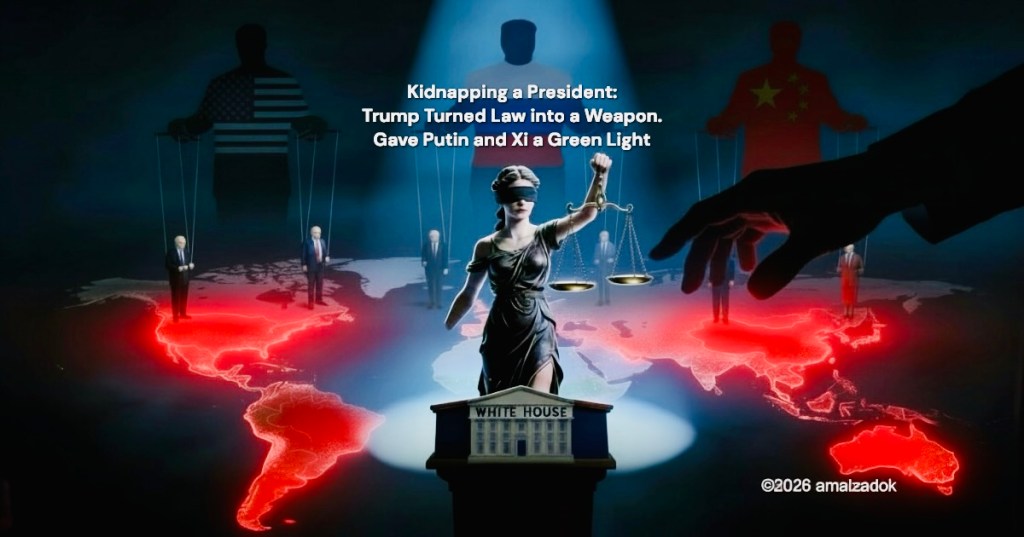
by Amal Zadok
Trump’s armed kidnapping of Nicolás Maduro is not just another reckless intervention; it is the moment the United States openly abandons the legal order it uses to judge its enemies. One operation in Caracas manages to break core rules of international law, trample the Constitution’s allocation of war powers, and weaponize domestic criminal statutes into a pretext for cross‑border regime decapitation. This is not mere hypocrisy; it is a structural shift toward a world where armed force wears the thin mask of law while tearing out the law’s foundations.
Start with the international plane. Article 2(4) of the UN Charter prohibits the threat or use of force against the territorial integrity or political independence of any state, except in self‑defence against an armed attack or with Security Council authorization. None of those conditions existed: Venezuela had not attacked the United States, there was no imminent armed assault, and the Security Council had authorized nothing. Airstrikes around Caracas and the insertion of US forces to seize a sitting head of state are the paradigmatic use of armed force that the Charter was written to forbid, regardless of how loudly Washington chants “narco‑terrorism” or “democracy.”
The raid also violates the principles of sovereign equality and non‑intervention in Articles 2(1) and 2(7) and in customary international law. Forcibly removing a president and floating the idea that the US might effectively “run” Venezuela is not influence; it is a direct assault on the political independence of a UN member. That is why UN officials and governments well beyond Maduro’s circle have called the action illegal aggression and a “dangerous precedent” for the global order.
Head‑of‑state immunity is the next pillar smashed. Customary international law grants sitting heads of state full personal immunity—immunity ratione personae—from foreign criminal jurisdiction and enforcement measures while they are in office. This shield does not endorse any leader’s morality; it prevents foreign courts and special forces from becoming tools of regime change. By abducting Maduro and hauling him before a New York judge, the United States has effectively claimed that its recognition policy decides who is a head of state and who can be treated as a common fugitive.
The extraterritorial kidnapping itself is a further violation. Even advocates of muscular US power concede that seizing a foreign leader from his own soil without consent is a “flagrant violation” of sovereignty and an unlawful abduction under general international law. Several experts argue that the scale and character of the raid reach the level of an “armed attack,” meaning Venezuela would, in principle, enjoy a right of self‑defence against the United States. In one stroke, Washington transforms the law it invokes into a weapon, while shredding the central norm designed to keep interstate violence in check since 1945.
Inside the United States, the pattern is equally stark. The Constitution gives Congress the power to declare war, and the War Powers Resolution requires prior consultation “in every possible instance” and prompt notification when American forces enter hostilities. Trump’s own officials had previously acknowledged that ground operations in Venezuela would require congressional authorization—and that they did not have it. Yet the raid went ahead as a fait accompli, with Congress informed after the fact and forced to choose between retroactive acquiescence or a politically suicidal confrontation with an emboldened executive.
The UN Charter is also a ratified US treaty and, under Article VI of the Constitution, part of the “supreme Law of the Land.” When a president orders a military operation that plainly contradicts Article 2(4)’s ban on the use of force, he is not just flirting with illegality abroad; he is directing the state to act against a binding treaty that sits at the top of the domestic legal hierarchy. Some constitutional scholars therefore describe the raid as a dual illegality: a violation of international law that simultaneously undercuts the treaty‑supremacy structure of US law itself.
The criminal‑law angle exposes the tyrannical core. Extradition treaties, mutual legal assistance and due‑process guarantees are supposed to govern cross‑border arrests; they do not authorize special forces to “pick up” a foreign head of state at gunpoint because US prosecutors filed an indictment. By leaning on the old Ker–Frisbie doctrine—that illegal abduction does not by itself bar a trial—Trump turns a controversial judicial rule into an executive license for kidnapping. What would obviously be kidnapping, conspiracy and unlawful violence for any private actor is rebranded as “policy” when ordered from the Oval Office.
At that point, “tyranny” stops being rhetorical and becomes descriptive. A leader who can unilaterally launch cross‑border raids, ignore Congress’s war role, violate binding treaties and twist criminal procedure into a shield for his own extralegal violence is not meaningfully bound by law. He is constrained only by raw power and political calculation. That is exactly the model Russia and China have been waiting for Washington to normalize—and Trump has just handed them the script.
Trump has not just broken rules; he has opened a doctrinal Pandora’s box. Moscow can now point to the Maduro operation when it justifies the seizure or assassination of Ukrainian officials as “counter‑terrorism” or enforcement of Russian criminal law. Beijing can frame a lightning move on Taipei as a domestic law‑enforcement action against “secessionist criminals,” citing the American precedent that great powers’ indictments and security narratives override borders, immunity and the UN Charter. The United States spent decades preaching a “rules‑based international order”; in Caracas, it demonstrated that, when the stakes are high enough, what really rules is force wrapped in legal costume.
If this stands, the world slides from an imperfect legal order—full of double standards and selective enforcement—into something harsher and more honest: open season, where each great power hunts in its sphere and cites the others’ crimes as precedent. The kidnapping of Maduro is more than a scandal; it is a template that Russia, China and others will eagerly adapt, armed not only with missiles and special forces, but with the very legal arguments Trump has ripped from their cage—a ready‑made script for twenty‑first‑century tyranny dressed up as law.
References
- ABC News. (2026). Were the US actions in Venezuela legal under international law?
- Le Monde. (2026). US attack on Venezuela: What does international law say?
- The Conversation. (2026). Were the US actions in Venezuela legal under international law? An expert explains.
- Chatham House. (2026). The US capture of President Nicolás Maduro – and attacks on Venezuela – have no justification.
- Global Affairs. (2026). International Law and Venezuela’s Maduro.
- Opinio Juris. (2026). The United States’ Attack Against Venezuela: Might Does Not Make Right.
- UN News. (2026). US actions in Venezuela “constitute a dangerous precedent”.
- Justice in Conflict. (2026). Maduro’s Indictment, Head‑of‑State Immunity, and the United States.
- Huquq. (2026). The Maduro Case and the Fractured Foundations of Immunity.
- Brookings. (2026). Making Sense of the US Military Operation in Venezuela.
- CNN. (2026). Trump’s Legal Authority in Venezuela, Explained.
- Bloomberg. (2026). Did Maduro’s Seizure Violate US and International Law?
- PBS. (2026). Fact‑Checking Trump’s Claims After U.S. Strike on Venezuela and Capture of Maduro.
- The New Yorker. (2026). The Brazen Illegality of Trump’s Venezuela Operation.
- BBC News. (2026). US Sharply Criticised by Foes and Friends Over Maduro Seizure.
- SBS. (2026). From Russia to Iran, Venezuela’s Allies React to the Capture of Maduro.
- Time. (2026). How the World Is Reacting to the U.S. Capture of Nicolás Maduro.
- CNN. (2026). Maduro’s Capture Is a Blow to China. But on Chinese Social Media …
- CBS News. (2026). How Could Trump’s Move Against Venezuela Impact China, Russia, Iran, Cuba?
- Völkerrechtsblog. (2026). The U.S. Strikes Against Venezuela and the Credibility of the Anti‑Aggression Norm.
- ABC (Australia). (2026). The Venezuela Strike Sets a New Low for the World Order.
- CSIS. (2026). The Maduro Raid: A Military Victory with No Viable Endgame.
- The New York Times. (2026). Is It Legal for U.S. to “Run” Venezuela After Maduro’s Capture?
- The Conversation. (2026). Trump’s Intervention in Venezuela: The 3 Warnings for the World.
- The New York Times. (2026). Global Ripples From Venezuela.
- Empire Unchained Blog. (2026). Empire Unchained: How the US Capture of Maduro Shattered the Post‑War International Order.
Appendix: Summary of Laws Broken Internally and Externally by Trump in the Kidnapping of Maduro
- UN Charter Article 2(4): Prohibits the threat or use of force against the territorial integrity or political independence of any state; breached by airstrikes and the cross‑border raid without self‑defence or Security Council authorization.
- UN Charter Articles 2(1) and 2(7) & customary non‑intervention: Require sovereign equality and non‑interference; violated by forcibly removing a sitting president and floating effective US control over Venezuela’s politics.
- Customary head‑of‑state immunity (immunity ratione personae): Grants sitting heads of state full personal immunity from foreign criminal jurisdiction and enforcement; ignored by abducting Maduro to stand trial in a US court.
- Customary prohibition of extraterritorial abduction: Forbids kidnapping persons, especially senior officials, from another state’s territory without consent; violated by the armed seizure in Caracas.
- US constitutional allocation of war powers: Congress’s power to declare war and War Powers Resolution consultation and notification requirements were sidestepped by launching the raid without prior authorization or transparent notification.
- Treaty‑supremacy structure (Article VI of the US Constitution): The UN Charter is binding US law; ordering action that breaches Article 2(4) undermines the supremacy of ratified treaties in the domestic legal hierarchy.
- Extradition and criminal‑procedure norms: Established mechanisms (extradition treaties, mutual legal assistance, due process) were bypassed in favour of a unilateral military kidnapping justified by a domestic indictment.
- Functional domestic criminal norms (kidnapping, conspiracy, unlawful violence): Conduct that would clearly constitute serious crimes for private actors is insulated by presidential power, effectively placing the executive above the law it imposes on others.
©️2026 Amal Zadok. All rights reserved.
Subscribe and never miss an article!

 Think and be Free!