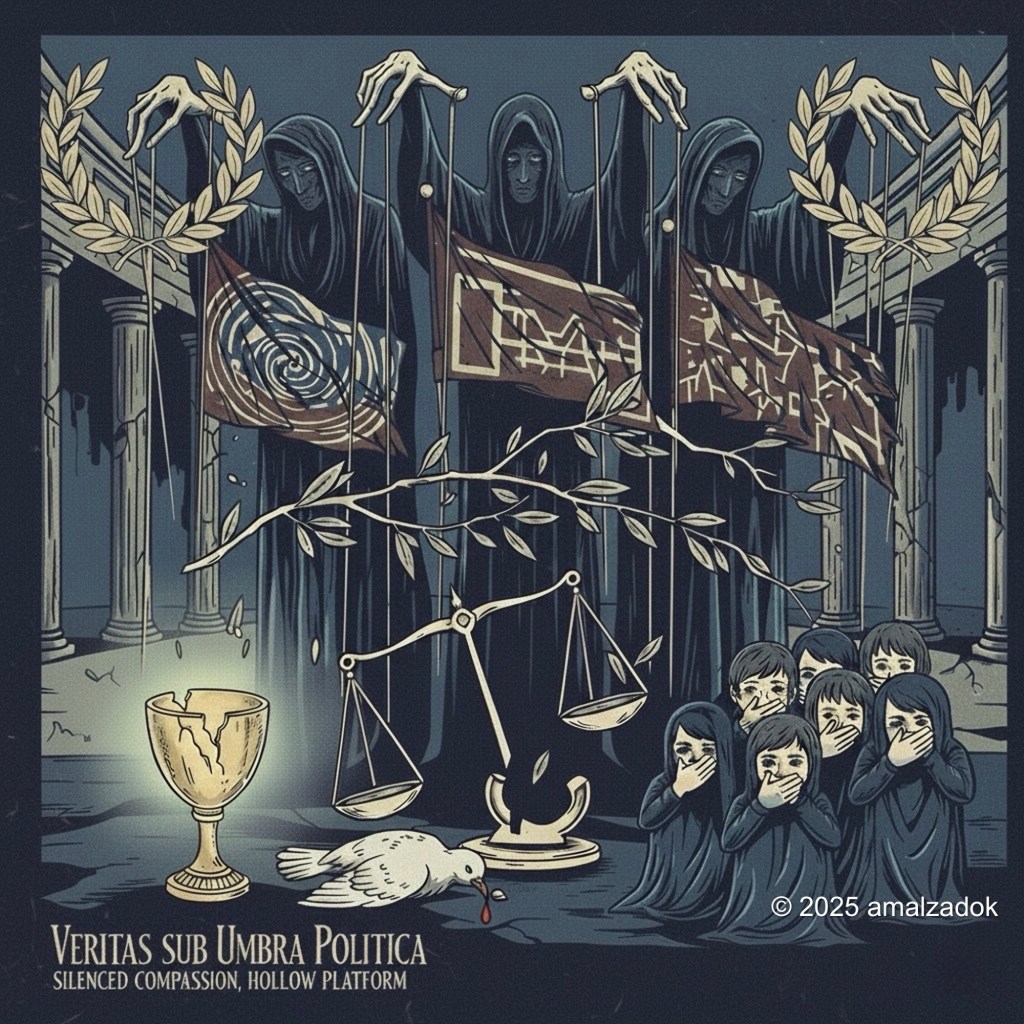
by Amal Zadok
The 2025 Nobel Peace Prize has detonated controversy around the world—not because it challenged comfort zones, but because it reinforced them.
With the annual spectacle in Oslo, global audiences expected an affirmation of the Prize’s historic promise: recognizing those who breathe life, dignity, and hope into oppressed societies. Instead, the committee draped itself in the shroud of political spectacle by crowning a figure more emblematic of foreign strategy than of genuine transformation. In doing so, it validated the creeping suspicion that the Nobel Peace Prize, in moments of greatest consequence, is little more than the handmaid of Western power, leaving true agents of peace mired in silence.
María Corina Machado’s elevation is not rooted in the organic struggles of an afflicted nation but in the well-oiled machinery of US diplomatic engineering. From the halls of Washington to the studios of global news networks, her story was written long before ballots were counted.
Her rise owes less to unifying vision than to a divisive campaign designed, deliberately, to unravel Venezuela’s own avenues of reconciliation. In the name of democracy, she has championed sanctions that amplified starvation, spurred mass exodus, and fractured families. While she is branded a dissident, it is a dissidence made for export, lauded by foreign think tanks while her country weeps under the weight of imposed deprivation.
This is not civilian courage—it is theatre for international applause. What the Nobel committee deemed peacemaking was, in truth, passive endorsement of a Western playbook: elevate opposition, embargo the nation, and claim the moral high ground even as the streets of Caracas fill with hungry, uprooted souls.
The West finds in Machado a willing transmitter of its views; Oslo, perhaps unwittingly, stamped its seal on one more iteration of intervention dressed as valor. In parallel—buried by headlines, ignored by the spotlight—a real contender stood for the old ideals the Nobel used to cherish.
Francesca Albanese, in her role as UN Special Rapporteur, has risked career, reputation, and safety to expose the ongoing suffering endured by Palestinians. Despite the threats, the sanctions, and the relentless smear campaigns fueled by powerful lobbies, Albanese’s work has been clear-eyed, unyielding, and fundamentally moral. She has compiled mountains of evidence: targeted civilian populations; systematic deprivation; children’s bodies numbering the cost of neglect and complicity.
Albanese’s achievements are not those of a headline-seeker or ideologue. Her career is defined by principled devotion—documenting abuses, demanding war crimes investigations, and championing a justice not circumscribed by nationality or political feasibility. Her advocacy has never pandered to power; it is an affront to all who profit from war and silence. She rallied a fractured world for the unromantic work of accountability, forcing international bodies to confront not only states but also corporations fattened by militarism.
Contrast the ceremonial embrace Machado received with the icy distance kept from Albanese. The former represents “ opposition” as brand; the latter, resistance as sacrifice. Where one becomes the darling of Western press, the other is denounced, threatened, and sanctioned. Where one is paraded as the icon of liberty, the other toils to restore its meaning, bearing witness for those who have no voice in Oslo’s concert halls.
This year’s Nobel Peace Prize committee not only erred—they abrogated their moral responsibility. By rewarding a figure of diplomatic convenience and leaving a true humanitarian in the wilderness of international indifference, they etched into the award’s history a new chapter of embarrassment. It is not the first time. Nor is this an anomaly: the Nobel has a long record of rewarding power, courting controversy, and leaving the greatest exemplars of peace without recognition. Gandhi, Václav Havel, and countless others were passed over in the service of politics masquerading as peace.
But the 2025 award is uniquely egregious for its context. At a time when war crimes, occupation, and the betrayal of children dominate global headlines, the committee shut its doors to the most urgent voice for justice on these very crises. The rituals in Oslo, stripped of meaning, became an echo chamber for the Old World’s illusions: that peace is forged in the pages of a policy memo, that justice can be measured by whose narrative sells best, and that the suffering of the voiceless can be redacted in the interests of polite diplomacy.
There is tragic poetry in the timing. Even as Oslo celebrated its safe choice, the world looked on in real time as children died, communities vanished, and the systems of violence Albanese fought to expose operated with impunity. One can only imagine what Nobel, who dedicated his bequest to those fighting against armies, oppression, and indifference, would have said. He might have bristled that the prize named after him went to signal not reconciliation and hope but a sanitized dissent palatable to the powerful.
Worse, this award confirms the suspicions of societies south and east of Oslo: that the global order’s highest honors are reserved for those who do not threaten Western interests. That true humanitarianism—unafraid, unbending, critical even of friends—will rarely receive reward, let alone recognition, from those whose real constituency are comfortable international elites.
The Nobel Peace Prize does not just fail when it overlooks a true servant of the oppressed. It becomes complicit, a party to the machinery of silence, even as it gives voice to the wrong side of history.
If dignity is ever to return to this once-sacred distinction, it will come not from orchestras, diplomatic banquets, or clever press releases, but from courageous reversal—acknowledging mistakes publicly, and allowing the prize to be once again shaped by those who choose justice over politics, courage over calculation, and the suffering of the oppressed over the blandishments of the influential. This will require a humility and honesty absent this year; an acknowledgment that the path to peace is not paved with good intentions, but with unrelenting witness—the kind Albanese offered, and the kind the world’s children most need.
This year, Oslo’s shadows grew darker. Yet, in that darkness, the flame of real peace work—demanding, unsparing, never convenient—still flickers, waiting for a world that cares enough to notice.
History’s judgment may be merciless, but history also remembers who dares to stand on the side of truth, regardless of applause or ceremony. If there remains any hope for redemption, it lies in reclaiming the meaning of peace itself: as substance, not show; as sacrifice, not spectacle; as the inconvenient, unsilenced truth that refuses to die.
©️2025 Amal Zadok. All rights reserved.
Subscribe and never miss an article!
 Think and be Free!