Tag: BRICS

  • India Invites a Guest, Watches Him Drown: How Modi’s Betrayal of BRICS and Iran Will Haunt New Delhi

    India Invites a Guest, Watches Him Drown: How Modi’s Betrayal of BRICS and Iran Will Haunt New Delhi

    By Amal Zadok

    India likes to pose as the voice of the Global South, the conscience of BRICS, the ancient civilisation that remembers its friends. But in the space of a few weeks, Narendra Modi has exposed that self‑image as a hollow slogan—by hugging Benjamin Netanyahu and Donald Trump in public, and by standing in tacit silence while the United States sent an Iranian warship, invited to India as a guest, to the bottom of the Indian Ocean.

    This is not abstract. “alignment.” It is concrete betrayal.

    The embrace of Netanyahu and Trump

    Modi did not stumble into this crisis by accident. His late‑February 2026 visit to Israel was designed as theatre: a triumphant march into the Knesset, effusive praise for Israel as a “pillar of strength,” and a made‑for‑TV bromance with Benjamin Netanyahu at the very moment Israel is being accused of genocide in Gaza. India, once a loud supporter of Palestine, chose to appear on camera as Netanyahu’s willing partner while much of the world recoiled from Israel’s conduct.

    Layer Trump onto that picture and it gets uglier. Washington under Trump has fused its unconditional backing for Israel with a harsh sanctions regime against Iran and intense pressure on anyone buying Russian oil. Modi has responded not with strategic distance but with accommodation—trying to preserve US indulgence by signaling that India is firmly planted in the US–Israel camp, whatever the cost to its other relationships.

    For BRICS partners and the wider Global South, the optics are crystal clear: India is not “non‑aligned”; it is visually, politically, even emotionally aligned with two of the most polarising leaders on the planet, in the middle of a war that has set much of the world’s public opinion on fire.

    The warship India invited—and abandoned

    Then came IRIS Dena.

    Iran’s frigate sailed to India at New Delhi’s invitation, to take part in the Milan 2026 naval exercise—a show of maritime cooperation that India uses to burnish its image as a regional convenor. By all credible accounts, the Dena complied with the rules of the exercise, which bar participating ships from carrying live ammunition. Its crew were paraded as honoured guests in Indian ports, representatives of a proud navy from a fellow ancient civilisation.

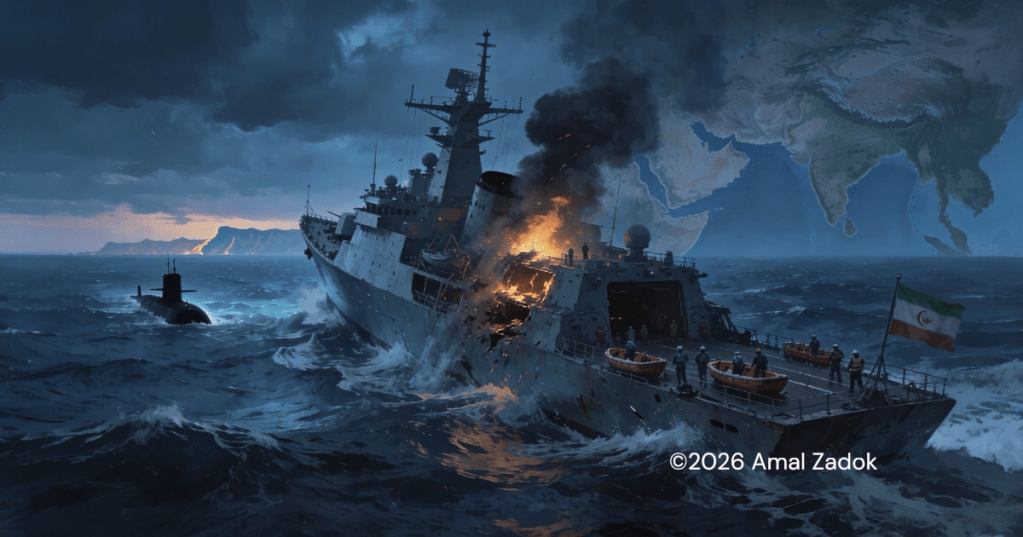
    When the exercises ended, Dena sailed home. Somewhere south of Sri Lanka, in international waters close enough to India to make any serious power feel personally implicated, a US submarine torpedoed the ship and sent it to the bottom. Dozens upon dozens of sailors died; some reports speak of around 180 people aboard, with fewer than a third rescued, the rest missing or recovered as bodies.

    Iran insists the ship was unarmed in accordance with Indian exercise rules and has called the strike a flagrant violation of international law, an “atrocity at sea.” The US, for its part, refuses to concede it did anything wrong but does not dispute two core facts: this was a naval ship and it was coming from Indian‑hosted drills.

    Here is the brutal, inescapable truth: a state that invites another’s warship into its waters under ceremonial protection has a special responsibility—moral if not legal—for what happens next. India didn’t pull the trigger. But the trigger was pulled on a guest leaving India’s party, in India’s neighbourhood, after India’s hospitality had created the conditions for the voyage.

    From “civilisational bond” to calculated cowardice

    How did “Vishwaguru” India respond? With a whisper.

    There was no thunderous statement from the prime minister condemning the attack. No emergency press conference at which New Delhi declared that the killing of dozens of sailors who had just left its ports was intolerable, whoever fired the torpedoes. Instead there was a studied, calculated silence—a silence designed not to upset Washington, not to complicate Modi’s photo‑ops with Netanyahu, not to get in the way of India’s carefully curated image as the West’s “responsible” partner in Asia.

    Iranian officials and media have been blunt: they describe India’s lack of outrage as a betrayal of a civilisational relationship, a slap in the face after years of cooperation on ports like Chabahar and regional trade routes. They remind India that the Dena was in the Indian Ocean because India invited it and because Tehran still believed New Delhi’s talk about strategic autonomy and respect.

    Inside India, opposition figures have attacked Modi for treating the mass death of Iranian sailors off Sri Lanka as a non‑event, arguing that any nation claiming regional leadership had a duty to protest, at least formally, when an invited participant in its exercises is cut down. A country that cannot even defend the dignity of a guest naval contingent on its doorstep has no business lecturing the world about civilisational values.

    BRICS, energy and the price of betrayal

    The hypocrisy becomes more glaring when you set this against India’s rhetoric in BRICS.

    On paper, India speaks the language of the Global South: multipolarity, resistance to unilateral sanctions, collective energy security, new trade corridors beyond US control. It holds up BRICS as a vehicle for rebalancing power away from the West and insists that it will not be bullied into choices that undermine its strategic autonomy.

    In practice, India is discovering how expensive it is to betray that promise.

    For two years, discounted Russian oil was a lifeline, padding India’s current account and feeding its refineries with cheap crude that could be re‑exported as high‑margin products. That sweet deal is ending. New sanctions and enforcement measures have squeezed the shadow fleet and raised compliance risks, forcing Indian refiners to scale back Russian purchases. Moscow, no longer desperate, has made it clear the era of “friendship pricing” is over; this is just business now, not a political favour.

    At the very moment India needs energy flexibility, it has managed to anger another key regional partner—Iran—whose geography is vital for overland trade routes and whose hydrocarbons could have been part of any serious diversification strategy once sanctions shift. Instead of reinforcing a BRICS‑centred, sanctions‑resistant energy architecture, India has sent a message: if Washington torpedoes your ship after you visit us, we will bite our tongue and hope nobody notices.

    China, Russia, South Africa and others are watching. They see an India that wants all the benefits of BRICS—prestige, investment, alternative payment systems—without paying the price of true strategic independence from the US security umbrella. They see a country that wraps itself in the flag of the Global South while quietly falling into line when Washington sinks a BRICS partner’s ship almost within sight of India’s own shores.

    That is not leadership. It is opportunism—and increasingly clumsy opportunism at that.

    A reputation that will not recover easily

    The sinking of IRIS Dena will not be remembered, outside Iran and the region, for how many sailors died or which class of corvette went down. It will be remembered for what it revealed about India.

    It showed that Modi’s India is willing to invite a sanctioned partner into its exercises, show off that relationship when it suits domestic optics, and then retreat into guilty silence when the United States commits what many see as an act of naked aggression against that partner on India’s maritime doorstep. It showed that all the talk about civilisational bonds, BRICS solidarity and Global South leadership stops the moment it collides with the anxieties of a leadership desperate for Western approval.

    India has not just betrayed Iran. It has betrayed its own story about itself.

    In the end, no amount of spin will change the image that has burned itself into the memory of every capital from Tehran to Pretoria: an Iranian warship, unarmed under India’s own exercise rules, steaming home from an Indian‑hosted event through international waters; a US submarine striking it down in cold water; bodies in the Indian Ocean; and New Delhi, the self‑proclaimed Vishwaguru, staring at its shoes and saying nothing. BRICS will remember that silence. The Global South will remember that silence. And when the oil is more expensive, the discounts gone, and Modi’s government discovers that Washington’s embrace is as conditional as any other, India will have no one to blame but itself for the day it invited a guest to its table and then watched, mute and compliant, as its new friends dragged him outside and shot him in the street.

    References

    1.Al Jazeera. (2026, February 22). Modi’s Israel visit: Timeline of India’s relations with Israel, Palestine.

    2.BBC News. (2026, February 27). India and Israel pledge to boost ties in defence and technology.

    3.Ministry of External Affairs, India. (2026). India–Israel bilateral relations [PDF].

    4.Al Jazeera. (2026, February 23). How Modi “broke down walls” between India, Israel – at Palestine’s expense.

    5.Al Jazeera. (2026, February 26). From Gaza to defence: Five key takeaways from Indian PM Modi’s Israel visit.

    6.Reuters. (2025, November 25). India’s Russian oil binge to end in December as sanctions bite, sources say.

    7.Carnegie Endowment for International Peace. (2025, November 19). The impact of U.S. sanctions and tariffs on India’s Russian oil imports.

    8.Intellinews. (2026, March 9). “Now it’s business, not friendship”: Russia ends discounted oil sales to India.

    9.BBC News. (2026, March 6). The final voyage of the Iranian warship sunk by the US.

    10.PBS NewsHour. (2026, March 5). Iranian warship was sailing home from India exhibition when U.S. sank it.

    11.Deccan Herald. (2026, March 4). Iran’s warship sunk by US was unarmed, attack violates international law, Iranian officials say.

    12.The Economic Times. (2026, March 6). Iran slams US attack on “unarmed” vessel returning from India.

    13.The Guardian. (2026, March 4). US submarine sank Iranian warship off Sri Lanka’s coast.

    14.Bloomberg. (2026, March 4). US sinking of Iran ship piles pressure on India’s Modi.

    15.Al Jazeera. (2026, March 4). At least 100 people missing after Iranian military ship sinks off Sri Lanka coast.

    16.Naval News. (2026, March 3). US forces sink Iran’s Jamaran-class corvette, CENTCOM confirms.

    17. BRICS 2026 Global Eye Intelligence. (2026, February 12–13). BRICS 2026 energy security and India’s blueprint for renewable market integration.

    ©️2026 Amal Zadok. All rights reserved.

  • Shattered Pillar of Europe: How US Power, NATO’s March and a Real Russian Existential Threat Are Sacrificing Europe’s Economy, Social Model and Future

    Shattered Pillar of Europe: How US Power, NATO’s March and a Real Russian Existential Threat Are Sacrificing Europe’s Economy, Social Model and Future

    by Amal Zadok

    US policy today is not just “supporting allies” or “defending democracy.” It functions as a strategy that keeps Europe dependent, weakens its economic base, and erodes the social achievements built up since the birth of the European Union. At the same time, Russia’s leadership confronts NATO expansion and Western use of Ukraine as a real existential threat, and this reality has interacted with US and EU choices in a mutually destructive security spiral. Together, these dynamics risk turning the EU from a potential independent pole in a multipolar world into a subordinated periphery of the United States, while locking Russia into a permanent confrontation that justifies ever tighter Western structures around Europe.

    From partner to protectorate

    In the early decades after 1945, Washington encouraged European integration as a bulwark against the Soviet Union and as a way to stabilise and industrialise Western Europe. As Europe grew richer and more cohesive, and as the European Community evolved into the EU with its own currency and ambitions of “strategic autonomy,” US attitudes shifted from sponsorship to management and, increasingly, control. The United States wanted a strong Europe inside a US‑led system—not a Europe capable of independent strategic choices, energy partnerships, or monetary power that might rival the dollar.

    The turning point came when European choices started to cut across US preferences: independent Ostpolitik, deep energy links with Russia, talk of an EU defence identity not subordinated to NATO, and the launch of the euro as an international currency. From that point, Washington’s core aim was effectively that Europe must never become an autonomous centre of power. It would remain militarily reliant on US hardware and guarantees, energetically tied to US‑controlled sources, and monetarily constrained inside a dollar‑dominated financial system in which the euro is, at best, a junior partner.

    Russia, NATO and the security dilemma

    This story sits inside a wider confrontation with Russia. From Moscow’s point of view, NATO’s eastward expansion after the 1990s and, especially, the prospect of Ukrainian and Georgian membership signalled the arrival of a hostile alliance on Russia’s immediate borders. Russian elites, across different currents, came to see NATO not just as a military structure but as the spearhead of a Western project to encircle, weaken and potentially dismember Russia. In that reading, the Maidan revolution, Western military assistance to Kyiv, and the steady integration of Ukraine into Western economic and security frameworks looked like steps toward turning Ukraine into a proxy platform aimed at Russia’s heartland and political system.

    Many Western governments insist that NATO is a defensive alliance and that countries like Poland or Ukraine freely choose to seek protection after their own traumatic experiences with Russian power. But even if one accepts that, interests and capabilities matter more than rhetoric. To large parts of the Russian establishment, NATO’s moves—backed and driven by Washington—constitute a real existential threat. That reality has been used by the Kremlin to justify the 2014 and 2022 invasions of Ukraine and a broader confrontation with the West. In turn, those invasions have validated the worst fears of NATO’s eastern members and given the US justification to harden and expand its military, energy and financial footprint in Europe.

    A classic security dilemma has formed: each side claims to be reacting defensively to the other, but the net effect is an arms race and a hardened bloc system. For Europe, the tragedy is that this spiral locks the EU ever more tightly into dependence on the US as protector and energy supplier, while eliminating the diplomatic space that might have allowed Europe to act as a bridge rather than a front line.

    Killing cheap energy, then selling the “solution”

    Before the latest escalation, the German and broader EU growth model rested on abundant, relatively cheap Russian pipeline gas feeding highly competitive industrial sectors like chemicals, metals, glass, fertilisers and machinery. That industrial base underpinned employment, exports and the tax revenue for Europe’s welfare states. For Washington and for NATO hard‑liners, this model looked like a strategic vulnerability: it tied Europe’s prosperity to a Russia they saw as a long‑term adversary and created incentives in Berlin and elsewhere for accommodation instead of confrontation.

    Russia’s decision to escalate in Ukraine—and the Western response of sanctions, embargoes and the effective shutdown of most Russian pipeline flows—destroyed that model in a matter of months. Whatever one thinks of Moscow’s responsibility for the war, the outcome fits US strategic and economic interests almost perfectly. The one supplier capable of delivering huge volumes of cheap gas by pipe to Europe has been removed. Into the gap steps US liquefied natural gas.

    US officials and industry lobbyists openly present US LNG as a strategic asset and a historic opportunity to lock in the European market for decades. Long‑term contracts, new terminals and supporting infrastructure create a structural dependency on LNG whose prices are higher and more volatile than those of pre‑war Russian pipeline gas. European analysts warn that this risks recreating the old dependence—only now on Washington. Energy‑intensive industries close, relocate or shrink. Households live under permanent energy‑driven cost‑of‑living pressure. The surplus that once supported generous social security is eaten away by higher input costs and subsidies designed to manage, rather than resolve, the crisis.

    Choices made in both Moscow and Washington thus converge: they break Europe’s attempt to balance security and economic efficiency through diversified energy sources, and they channel Europe toward an Atlantic‑centric, US‑dominated energy order.

    Forced rearmament on American terms

    Overlaying this is a dramatic push for rearmament. The 2 per cent of GDP NATO guideline, once a benchmark, has become a political cudgel. Under Trump in particular, but not only under him, European states have been told bluntly: spend much more on defence—3, 4, even 5 per cent—or risk abandonment. In practice, the fastest way to meet these targets is to buy off‑the‑shelf from the United States.

    The result is a surge in European defence budgets, with a large share of the new spending flowing into US weapons systems: combat aircraft, missile defence, precision munitions, command‑and‑control architecture. This deepens Europe’s technological and operational dependence. Many of these systems cannot be fully maintained, upgraded or used independently without US software, spare parts and political consent. It is rearmament, but not autonomy.

    From a macroeconomic perspective, some of this spending stimulates local production and jobs, but a significant portion leaks abroad as imports. At the same time, higher defence outlays add to public debt and crowd out other priorities. Governments will have to finance this either through higher taxes or through cuts to social programmes, infrastructure and climate‑transition investments. The more the war in Ukraine is framed as an open‑ended civilisational struggle with Russia, the easier it is for elites to justify this shift and to silence dissent in the name of “security.”

    Again, Moscow’s choices and Washington’s strategy intersect. Russia’s actions are used to justify a transformation of Europe’s budgets and procurement patterns that locks the EU into US‑centric military structures for decades. The more the EU is psychologically and institutionally oriented toward Russia as a permanent enemy, the less space remains for any future European security architecture not dominated by NATO and the US.

    Monetary subordination and the caging of the euro

    The euro was meant to give Europe monetary sovereignty and a currency capable of balancing the dollar. In practice, the combination of internal EU design flaws and external pressure has kept the euro within a dollar‑dominated framework. Fragmented fiscal governance, limited joint debt issuance and capital‑market fragmentation restrict the euro’s international role. Repeated crises—sovereign debt, pandemics, energy‑driven inflation—undermine its attractiveness as a reserve currency.

    From the US side, powerful tools reinforce dollar primacy: sanctions regimes that weaponise access to the dollar system, extraterritorial financial rules that intimidate European banks and firms, and the sheer depth and liquidity of US bond markets. Efforts by the EU or by countries like Russia and China to build alternative payment systems, reduce dollar exposure or trade outside US‑controlled channels are treated with suspicion and sometimes punished. For Russia, this has led to attempts to “de‑dollarise” and diversify reserves, but Western sanctions in response to the Ukraine war have also frozen Russian assets and forced other states to think twice about challenging the dollar architecture.

    Europe finds itself squeezed. It has its own currency, but in the decisive moments—sanctions, crises, financial flows—it still operates inside a system whose ultimate levers are in Washington. Russia’s confrontation with the West becomes another reason to tighten that system further, making it harder for the euro to evolve into a fully independent pole.

    Social destruction as the hidden cost

    The combined effect of these energy, military and financial dynamics is a slow erosion of Europe’s social model. Energy‑intensive industries lose competitiveness or vanish. Public budgets come under strain from higher defence commitments and crisis‑management subsidies. Inflation, especially for essentials like housing and energy, erodes real wages. Youth unemployment or underemployment rises as industrial and mid‑skill jobs disappear, leaving younger generations with precarious, low‑paid work and limited prospects.

    Health systems, already stretched, enter into crisis: senior citizens and people with chronic or complex health conditions face longer waiting lists, reduced services and growing out‑of‑pocket costs as governments struggle to finance universal care. The social fabric frays: trust in institutions declines, protests over living standards, housing and healthcare multiply, and political extremes gain ground by channelling anger toward Brussels, migrants, national elites, or foreign powers. What made the EU attractive—relative equality, robust welfare states, good public services and intergenerational solidarity—is undermined from within, even as leaders insist they are defending “European values” against Russia and other adversaries.

    Here, impartiality requires recognising that this destruction is co‑produced. US strategy uses crises to deepen Europe’s dependence and maintain American hegemony. Russian strategy, driven by its response to a real existential threat and by long‑standing imperial reflexes, has helped trigger and intensify those same crises, even as Moscow forges and consolidates strong partnerships across BRICS and the wider Global South.

    Far from being truly isolated, Russia has redirected trade, finance and diplomacy away from the Atlantic world and into a dense web of relations with China, India, Iran, much of Asia, Africa and Latin America: it sells discounted energy to India and others, deepens industrial and military cooperation with China, signs long‑term resource and infrastructure deals across the Global South, and uses BRICS, the Shanghai Cooperation Organisation and new payment arrangements to reduce exposure to Western pressure. In practice this means that the US–NATO–EU strategy of “isolating” Russia has largely failed outside the Western bloc: it has severed many of Russia’s links to Europe and North America but pushed Moscow into a parallel ecosystem of non‑Western partners who see in Russia a counterweight to US dominance, a source of cheap commodities, or a useful political ally against Western double standards.

    European elites, for their part, have often chosen alignment with Washington over building authentic strategic and economic autonomy, while failing to protect their citizens—young and old—from the predictable social costs. Seen from this wider angle, the pattern is stark: a security confrontation between the US‑led West and Russia creates the conditions in which Europe’s autonomy, prosperity and social achievements are sacrificed, while Russia is re‑anchored in an alternative non‑Western orbit rather than disappearing from the world stage.

    A fierce political argument can therefore say, without losing nuance, that US grand strategy is structured to keep Europe subordinate and dollar‑bound; that Russia’s reaction to NATO expansion is grounded in a real existential threat and has been channelled into building a broader non‑Western alignment instead of simple “isolation”; and that European leaders have so far failed to break this logic in defence of their own societies, accepting a role as a weakened Atlantic appendage in a world that is, in fact, becoming more multipolar.

    Reference list

    1.American Security Project. (2025). White paper – Strategic implications of U.S. LNG exports. Retrieved from https://www.americansecurityproject.org/white-paper-strategic-implications-of-u-s-lng-exports/

    2.Bruegel. (2025). Adjusting to the energy shock: The right policies for European industry. Retrieved from https://www.bruegel.org/policy-brief/adjusting-energy-shock-right-policies-european-industry

    3.European Commission. (2022). EU action to address the energy crisis. Retrieved from https://commission.europa.eu/topics/energy/eu-action-address-energy-crisis_en

    4.European Commission. (2022). Sanctions on energy – EU restrictive measures against Russia following the invasion of Ukraine. Retrieved from https://commission.europa.eu/topics/energy/eu-solidarity-ukraine/eu-sanctions-against-russia-following-invasion-ukraine/sanctions-energy_en

    5.Bruegel. (2025). Europe’s dependence on US foreign military sales and what to do about it. Retrieved from https://www.bruegel.org/policy-brief/europes-dependence-us-foreign-military-sales-and-what-do-about-it

    6.The Parliament Magazine. (2025). Europe’s defence reliance on the US runs deeper than hardware. Retrieved from https://www.theparliamentmagazine.eu/news/article/europes-defence-reliance-on-the-us-runs-deeper-than-hardware

    7.European Parliament Research Service. (2025). United States defense industrial base. Retrieved from https://www.europarl.europa.eu/RegData/etudes/BRIE/2025/777967/EPRS_BRI(2025)777967_EN.pdf

    8.Reuters. (2025, June 18). US defence firms chase European military spending wave. Retrieved from https://www.reuters.com/business/aerospace-defense/us-defence-firms-chase-european-military-spending-wave-2025-06-18/

    9.Chatham House. (2024). Russia is using the Soviet playbook in the Global South to challenge the West – and it’s working. Retrieved from https://www.chathamhouse.org/2024/05/russia-using-soviet-playbook-global-south-challenge-west-and-it-working

    10.Vuksanović, V. (2025). The logic of Global South in Russian foreign policy. Third World Quarterly. Retrieved from https://www.tandfonline.com/doi/abs/10.1080/10220461.2025.2519982

    11.Papa, M. (2025). The evolution of soft balancing in informal institutions. International Affairs, 101(1), 73–93. Retrieved from https://academic.oup.com/ia/article/101/1/73/7942161

    12.European Commission. (2025). Spring 2025 economic forecast: The economic impact of higher defence spending. Retrieved from https://economy-finance.ec.europa.eu/economic-forecast-and-surveys/economic-forecasts/spring-2025-economic-forecast-moderate-growth-despite-risks_en

    13.SUERF. (2025). Europe in the new NATO era. Retrieved from https://www.suerf.org/publications/suerf-policy-notes-and-briefs/europe-in-the-new-nato-era/

    14.Eurofound. (2025). Trust in crisis: Europe’s social contract under threat. Retrieved from https://www.eurofound.europa.eu/en/commentary-and-analysis/all-content/trust-crisis-europes-social-contract-under-threat

    15.New Economics Foundation. (2025). European defence spending soars, but climate and care are still “unaffordable”. Retrieved from https://neweconomics.org/2025/06/european-defence-spending-soars-but-climate-and-care-are-still-unaffordable

    16.OECD / EIB. (2025). A comprehensive overview of the energy-intensive industries in Europe.

    17.Modern Diplomacy. (2025). Is Russia really isolated? The increasing importance of East and South diplomacy.

    18.Atlantic Council. (2025). The underestimated implications of the BRICS summit in Russia.

    19.Council on Foreign Relations. (2024). What is the BRICS group and why is it expanding?

    20.The Diplomat. (2024). Anti-Western or non-Western? The nuanced geopolitics of BRICS.

    21.European Commission. (2023). EU–United States of America energy cooperation.

    22.Eurofound / Euractiv. (2025). Cost of living crisis set to prompt social unrest across Europe, poll finds.

    23.New Lines Institute. (2025). Russia is capitalizing on rising LNG demand and shifting geopolitics.

    24.Various national and EU sources on cost of living, inflation, health systems and youth unemployment (e.g., OECD and Eurofound social reports, national cost‑of‑living crisis analyses).

    ©️2025 Amal Zadok. All rights reserved.

    Subscribe and never miss an article!