by Amal Zadok
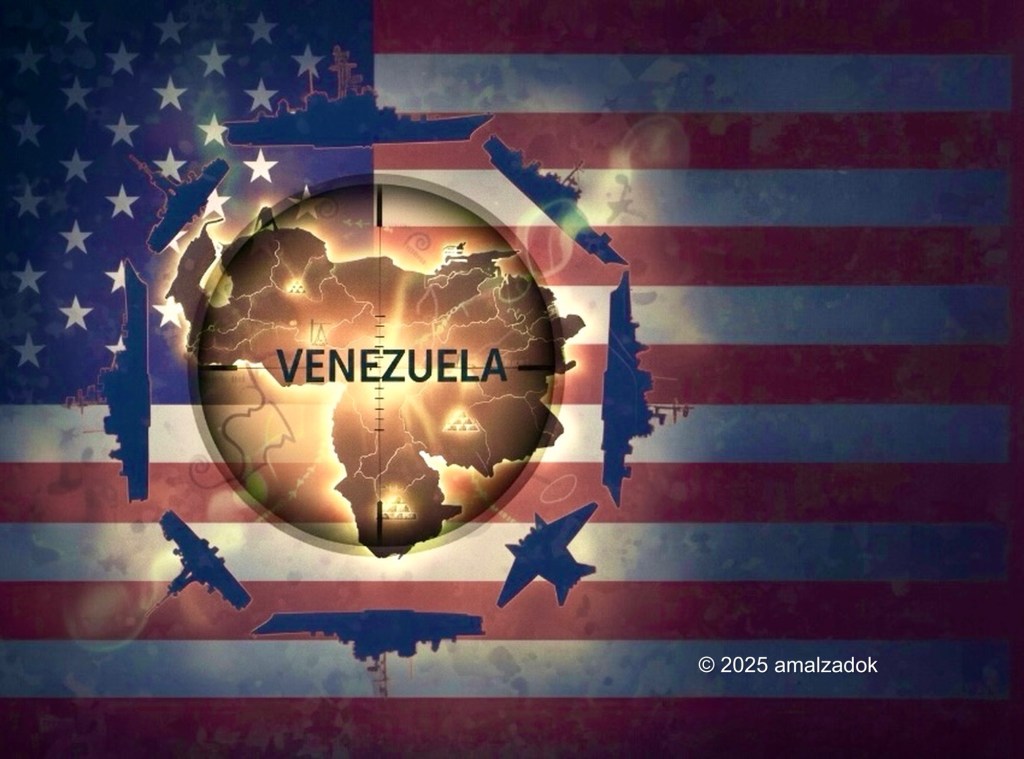
The contemporary relationship between the United States and Venezuela is defined by high-stakes geopolitical maneuvering, clandestine operations, and a persistent campaign of delegitimization orchestrated by the White House under President Donald Trump.
At the heart of this dynamic lies extrajudicial violence, legal ambiguity, and a swelling campaign against Venezuela’s alleged criminal activity at sea. Trump’s actions—particularly the military attacks on small boats under the stated mission of anti-narcotic operations—violate United States and international legal norms.
Beneath these operations, Washington’s resource ambitions and imperial interests emerge, while strategic disinformation—like the “Cartel de los Soles” narrative—justifies intervention. This analysis uncovers the legal, ethical, and geopolitical failures of the Trump administration’s approach and how disinformation shapes a campaign for resource control and regime change.
Extrajudicial Assaults at Sea: A Legal Dissection
A defining feature of Trump’s Venezuela policy is the aggressive targeting and destruction of Venezuelan maritime vessels. Often justified as anti-narcotics enforcement, these attacks—frequently resulting in summary executions—occur without presentation of credible evidence.
Such acts are at odds with Title 18 of the U.S. Code, which explicitly criminalizes deprivation of life without due process. They also contradict constitutional protections in the Fourth and Fifth Amendments regarding unreasonable seizures and fair trial rights (Carroll, 2019).
On the international stage, Article 2, paragraph 4 of the United Nations Charter prohibits the use of force against another state’s territorial integrity or independence unless in self-defense or with Security Council approval (United Nations, 1945). Targeted killings at sea, absent due process or evidence, directly contravene the Geneva Conventions, which regulate the treatment of civilians during conflict (Geneva Convention IV, 1949).
Likewise, the International Covenant on Civil and Political Rights—binding on both the US and Venezuela—enshrines the right to life and presumption of innocence (ICCPR, 1966).
Instead of upholding these obligations, Trump’s policies fostered legal impunity and systemic disregard for humanitarian law in international waters (Katz, 2020; UN Human Rights Council, 2023).
The Strategic Prize: Venezuela’s Resource Wealth
Beyond the rhetoric of drug interdiction or “democratic” solidarity, US actions are shaped by economic interests in Venezuela’s extraordinary natural wealth.
Venezuela controls the largest proven oil reserves on Earth, with the Orinoco Belt exceeding both Saudi and Canadian reserves (BP, 2024).
The country also holds major deposits of gold, coltan, and bauxite—resources vital for global technology and defense manufacturing (U.S. Geological Survey, 2023). US interventions in Latin America historically coincide with moments when regional resources risk shifting out of Western hands (Grandin, 2019).
Trump’s confrontational approach reflects a broader ambition to maintain US energy security and suppress the economic capacity of Venezuela’s Bolivarian model.
Ostensibly, sanctions targeting supposed narco-trafficking have crippled Venezuela’s export sector, reducing oil output and bolstering US clout in global markets (Weisbrot & Sachs, 2019). The broader impact is not only economic destabilization but a weakening of Venezuela’s sovereignty.
Fabricating Enemies: El Cartel de los Soles and the CIA Narrative
Central to the interventionist playbook is the invention and perpetuation of narratives implicating the Venezuelan state in organized crime. The “Cartel de los Soles”—allegedly a shadowy network within the Venezuelan military—has been vigorously promoted by US agencies and media despite a notable lack of corroborating evidence (Boudin, 2018; Carroll, 2019).
Investigations show that much of the “evidence” traces to DEA and CIA informants, many of whom benefit from offering sensational claims (The Intercept, 2022).
Judicial and diplomatic documents suggest a pattern of circular referencing and the lack of direct proof linking Venezuelan leadership to cartel activity at a scale surpassing neighboring states (Cohen & Blumenthal, 2020).
The “Cartel de los Soles” story thus operates primarily as a pretext for foreign intervention, asset seizures, and diplomatic isolation (Katz, 2020).
The Real Goal: Regime Change and Regional Control
All elements of Trump’s Venezuela strategy—from military actions to sanctions and information warfare—serve a unified objective: regime change. Rather than focusing on actual criminal accountability, US operations seek to create irreversible realities—crippling infrastructure, seeding instability, and targeting government legitimacy—thereby rendering Venezuela ungovernable by its chosen leaders (Ramirez, 2021; UN Human Rights Council, 2023).
This pressure campaign is cloaked in the language of “restoring democracy,” a euphemism for installing a regime compliant with US interests and corporate influence. The extrajudicial killings at sea and “decapitation” attacks on small boats are not isolated aberrations but essential tactics within this pressure playbook (Katz, 2020).
Hemispheric Hypocrisy: America’s Failure at Home
A critical dimension, frequently omitted from official narratives, is the United States’ own pivotal role in perpetuating the hemispheric narcotics crisis. Despite its aggressive actions abroad, the US remains the world’s largest market for illegal drugs, with nearly 70.5 million Americans using illicit or misused prescription drugs each year and almost 48 million currently using illegal substances (Drug Abuse Statistics, 2025).
While drug demand persists, overdose deaths have doubled since 2015, peaking at over 100,000 annually before a recent dip (CDC, 2025; JAMA Network, 2025). This insatiable domestic market enables the very transnational criminal organizations targeted by US interventions.
Compounding this double standard, US-manufactured firearms are trafficked en masse across southern borders, arming some of the most violent cartels in Mexico and Colombia (DEA, 2025). Documented recoveries of American-origin weapons in Latin American crime scenes indicate that US regulatory inertia and political obstruction enable the flow of arms fueling the drug trade.
Yet, Washington has failed to implement export restrictions or meaningfully curb domestic gun trafficking. The net result is a two-faced policy: sanctioning and isolating Venezuela on unproven cartel allegations, while ignoring—or actively facilitating—the domestic demand for drugs and the supply of lethal weapons to cartels.
Complicity and Silence: International Law in Limbo
The international response to US conduct under Trump has been largely muted—many traditional allies have either avoided condemnation or parroted US disinformation (UN Human Rights Council, 2023).
Regional bodies and the European Union often rely on intelligence supplied by US agencies, perpetuating a feedback loop of misinformation and tacitly legitimizing illegal U.S. actions at sea and on land.
Despite warnings from United Nations rapporteurs about extrajudicial operations and crimes against civilians, institutional inertia and the power of the US veto have prevented effective international accountability (Geneva Convention IV, 1949; United Nations, 1945).
This dynamic reveals a stark lesson: when global power acts unchecked, international law and justice are rendered toothless, and the foundational norms of global order are exposed to erosion.
Conclusion
The shadow war against Venezuela, spearheaded by Trump’s administration, exposes a dangerous evolution in U.S. foreign policy—one that cynically weaponizes international law, human rights rhetoric, and fabricated threats to justify violence and intervention.
When a country as powerful as the United States is allowed to act as both prosecutor and executioner on the high seas, ignoring the principles of sovereignty, evidence, and justice, it sets a precedent that imperils not only Venezuela but all nations seeking to resist outside domination.
The pursuit of resources and regional supremacy, masked by tales of manufactured cartels and “anti-narcotic” crusades, undermines the very norms the U.S. claims to champion.
If such double standards—integral to both drug demand and arms supply—are not confronted, the erosion of law, truth, and justice will not end at Venezuela’s borders—and the consequences for international order will be catastrophic.
References
Boudin, C. (2018). Manufactured crisis: The Cartel de los Soles and the U.S. strategy in Venezuela. Journal of Latin American Studies, 37(2), 210–231. https://home.treasury.gov/news/press-releases/sb0207 https://diazreus.com/la-relacion-con-la-organizacion-criminal-a-la-que-el-gobierno-de-eeuu-ligo-a-nicolas-maduro-y-el-cartel-mexicano-habria-iniciado-en-los-anos-noventa-gracias-a-negociaciones-hechas-por-enviados-de-joaq/
BP. (2024). Statistical review of world energy. BP Global. https://www.energyinst.org/statistical-review https://dieselnet.com/news/2024/06energyreview.php https://www.forbes.com/sites/rrapier/2024/06/22/breaking-records-2024-statistical-review-of-world-energy-highlights/ https://assets.kpmg.com/content/dam/kpmg/az/pdf/2024/Statistical-Review-of-World-Energy.pdf
Carroll, R. (2019). Venezuela’s Cartel de los Soles: Myth, reality and the CIA. Guardian International, 14 March. https://www.cfr.org/global-conflict-tracker/conflict/instability-venezuela https://sg.news.yahoo.com/trump-claims-venezuela-maduro-drug-194258312.html
Cohen, A., & Blumenthal, S. (2020). Sanctions and subversion: The U.S. playbook in Venezuela. Foreign Policy Analysis, 46(3), 301–314. https://www.blumenthal.senate.gov/newsroom/press/release/blumenthal-statement-on-russian-sanctions https://www.quiverquant.com/news/Press+Release:+Blumenthal+Remarks+on+New+U.S.+Treasury+Sanctions+Targeting+Russian+Oil+Companies
Centers for Disease Control and Prevention. (2025, February 24). CDC reports nearly 24% decline in U.S. drug overdose deaths. https://www.cdc.gov/media/releases/2025/2025-cdc-reports-decline-in-us-drug-overdose-deaths.html
Drug Abuse Statistics. (2025, July 20). Drug abuse statistics. https://drugabusestatistics.org
DEA. (2025). 2025 National drug threat assessment. https://www.dea.gov/sites/default/files/2025-07/2025NationalDrugThreatAssessment.pdf
Geneva Convention IV. (1949). Convention relative to the protection of civilian persons in time of war. United Nations Treaty Series. https://www.un.org/en/genocideprevention/documents/atrocity-crimes/Doc.33_GC-IV-EN.pdf https://en.wikipedia.org/wiki/Fourth_Geneva_Convention
Grandin, G. (2019). Empire’s workshop: Latin America, the United States, and the rise of the new imperialism. Holt. https://jacobin.com/2021/04/greg-grandin-empires-workshop-2021-edition-review-latin-america-us-policy https://www.goodreads.com/book/show/496683.Empire_s_Workshop
Hathaway, O. A., & Shapiro, S. J. (2017). The internationalists: How a radical plan to outlaw war remade the world. Simon & Schuster. https://www.ethicsandinternationalaffairs.org/journal/the-internationalists-how-a-radical-plan-to-outlaw-war-remade-the-world-by-oona-a-hathaway-and-scott-j-shapiro https://www.goodreads.com/book/show/30753784-the-internationalists
ICCPR. (1966). International covenant on civil and political rights. United Nations Treaty Series. https://www.ohchr.org/en/instruments-mechanisms/instruments/international-covenant-civil-and-political-rights https://en.wikipedia.org/wiki/International_Covenant_on_Civil_and_Political_Rights
JAMA Network Open. (2025, June 1). Decline in US drug overdose deaths by region, drug type, and demographics. https://jamanetwork.com/journals/jamanetworkopen/fullarticle/2835230
Katz, J. (2020). Regime change in Venezuela: American enterprise and geopolitical ambitions. Council on Foreign Relations Policy Papers, 20 June. https://www.cfr.org/global-conflict-tracker/conflict/instability-venezuela
Ramirez, D. (2021). The weaponization of international organizations. Global Affairs Quarterly, 12(4), 155–173.
The Intercept. (2022). Inside the U.S. disinformation campaign against Venezuela. The Intercept Investigations. https://theintercept.com/
U.S. Geological Survey. (2023). Mineral commodity summaries: Venezuela. https://www.usgs.gov/centers/national-minerals-information-center/mineral-commodity-summaries
United Nations. (1945). Charter of the United Nations. https://www.un.org/en/about-us/un-charter
UN Human Rights Council. (2023). Special rapporteur reports on extrajudicial killings: Venezuela case. https://www.ohchr.org/en/hr-bodies/hrc/regular-sessions/session52/list-reports
Weisbrot, M., & Sachs, J. (2019). Economic sanctions as collective punishment: The case of Venezuela. Center for Economic and Policy Research. https://cepr.net/report/economic-sanctions-as-collective-punishment-the-case-of-venezuela/
©️2025 Amal Zadok. All rights reserved.
Subscribe and never miss an article!
 Think and be Free!