By Amal Zadok
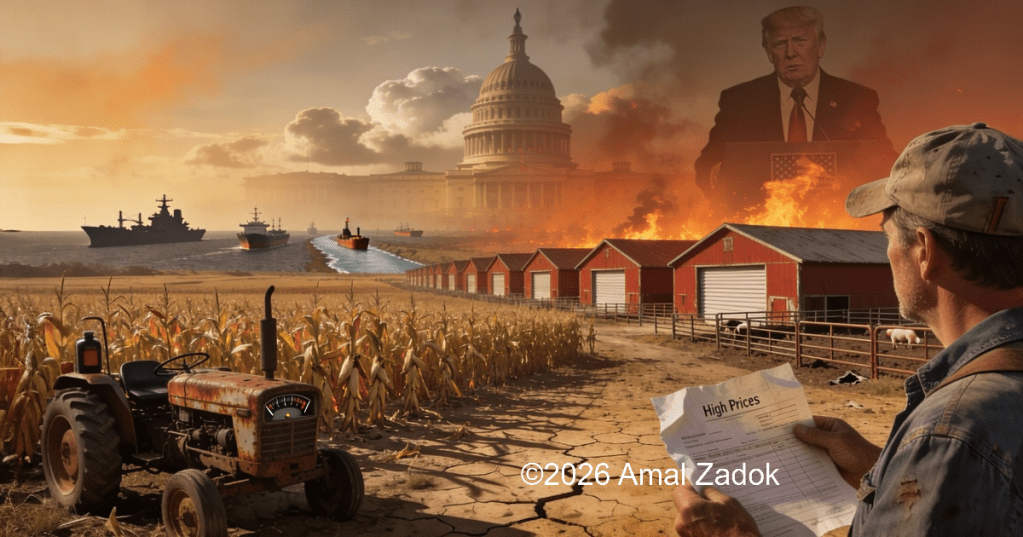
Donald Trump’s Iran war is not just another foreign policy blunder. It is a direct attack on U.S. food security that risks manufactured shortages in the 2027 harvest. By launching a discretionary war that predictably shut the Strait of Hormuz, Donald Trump detonated a fertilizer crisis at the exact moment American farmers need nitrogen in the ground. He has turned the Corn Belt into collateral damage.
A president who fired at Iran and hit American farmers
When Trump ordered military action in Iran, his administration knew—or should have known—that roughly a third of the world’s fertilizer shipments move through the Strait of Hormuz, including a huge share of nitrogen‑rich urea exports. This chokepoint is not just about oil tankers. It is about the lifeblood of modern agriculture, from Iowa corn to Kansas wheat. Yet the White House pushed ahead without any serious contingency plan to keep fertilizer flowing to U.S. farms. It left producers exposed to the most fragile part of the global input chain.
The result is a brutal, man‑made shock. Since the war began and Hormuz effectively closed to normal trade, fertilizer prices for U.S. farmers have surged. Some key nitrogen products have nearly doubled compared with late 2025. For farmers heading into spring planting, this is not an abstract geopolitical story. It is a crisis that rips through their budgets acre by acre. Corn production costs, driven heavily by nitrogen, are exploding. Growers are already cutting application rates and rethinking which crops they dare plant.
This was foreseeable. Experts warned about it. Trump ignored them.
Weaponizing the Strait of Hormuz against U.S. crops
By turning the Persian Gulf into a war zone, Trump has effectively weaponized the Strait of Hormuz against his own country’s food system. Fertilizer cargoes are delayed or cancelled. Shipping insurers are pulling back. Traders are scrambling to reroute limited supplies to the highest bidders. U.S. farmers now find themselves in a bidding war for the basic nutrients their soils require.
You cannot put fertilizer in the ground in June that you failed to apply in March or April and expect the same yields. Once the window closes, the damage is locked into the harvest. This is basic agronomy, not rocket science.
The timing could hardly be worse. Spring is when U.S. corn growers apply heavy nitrogen. This year they are doing it under the shadow of a president‑made supply shock. Instead of securing supply routes before pulling the trigger in Iran, the administration lurched into conflict first. Only afterward did Trump start talking about “supporting American farmers”, with empty promises in cabinet meetings and photo‑op speeches.
Farm groups that once counted themselves as Trump allies are now reduced to pleading. They are warning that his military adventure has disrupted fertilizer shipments and energy markets on the eve of planting. They are calling it what it is: a national security issue.
This is not bad luck. It is strategic incompetence. Trump opened a critical maritime artery to chaos and then acted surprised when the fertilizer stopped arriving.
2027: from fertilizer shock to food shortage
The fertilizer crisis Trump triggered is not just this year’s headache. It is setting up structural damage that will be felt in the 2027 harvest and beyond.
Faced with soaring nitrogen prices and physical shortages, farmers are already signaling they will plant less corn, the most nitrogen‑hungry crop. Some will switch acres to soybeans or other lower‑input crops. That does not magically preserve corn supplies. The world loses grain that underpins feed, ethanol, and export markets.
Others will try to keep their acreage but slash fertilizer rates. That means quietly mining soil fertility and accepting lower yields just to survive one more season. Analysts warn the 2026 fertilizer shock is not a brief price spike. It is a structural disruption likely to persist into 2027. If the Hormuz blockade drags on, the world faces a real yield cliff.
Even if the strait reopens, there is no way to rewind the clock and apply the nutrients that should have gone down at planting. Crops follow biology, not Trump’s talking points.
The downstream consequences are stark. Projections already suggest global food prices will climb sharply by the end of 2026 as the fertilizer crunch cuts harvests. That wave will hit again when the 2027 shortfall fully feeds into world markets. For a U.S. president to willingly trigger a conflict whose predictable side effect is higher food prices and potential shortages is not just reckless. It is economic betrayal.
Collateral damage in the livestock sector: pigs, cattle, and sheep
The damage does not stop at crop fields. It runs straight into the livestock sector, hitting pigs, cattle, and sheep operations that depend on affordable feed grains.
Livestock producers live and die by the cost of corn, soymeal, and forage. When fertilizer prices explode and grain yields are threatened, those inputs become scarcer and more expensive. Every barn, feedlot, and pasture feels the shock.
For pig producers, the situation is especially acute. Intensive hog operations rely on high‑energy, high‑protein rations built on corn and soy. As acres shrink or yields drop because farmers cannot afford full nitrogen applications, feed costs rise. Margins, already thin, are crushed. Smaller family‑scale hog farms, which cannot easily hedge or push costs onto big packers, will be the first casualties. They face ugly choices: cull herds, halt expansion, or shut down.
Cattle and sheep producers are also in the crosshairs. Beef and lamb depend on pasture and supplemental feed, and both are tied to fertilizer. Nitrogen shortfalls do not just hit cornfields. They undercut hay and silage production, lowering forage quality and quantity. Ranchers will face higher prices for purchased feed and lower carrying capacity on their land. Many will be forced to sell animals earlier than planned. That means a short‑term flood of meat, followed by tighter supplies and much higher prices for consumers.
This is how a fertilizer crisis turns into a protein crisis. The comforting belief that meat, milk, and eggs will stay cheap even if grain prices jump is a fantasy. In a system built on high yields and just‑in‑time feed logistics, any sustained disruption in fertilizer flows ricochets through feed markets and into supermarket coolers.
By turning Hormuz into a battlefield without shielding agricultural supply chains, Trump has effectively slapped an Iran war surcharge on every pork chop, burger, and lamb roast American families hope to buy over the next two years.
And it is not only about prices. It is about who survives. As smaller pig, sheep, and cattle producers are squeezed out by rising feed costs, the sector consolidates further. Fewer, larger corporations gain more power while rural communities lose independent farms. A president who claims to stand with “real America” is presiding over policies that hollow it out. The result is a handful of corporate giants, shuttered barns, and auctioned‑off herds.
That is not rural strength. It is rural abandonment.
Farmers, Congress, and allies turn against Trump’s “Iran war tax” on food
The political blowback is already building in farm country. Coverage now openly describes an Iran war‑driven fertilizer shortage that threatens Republicans in farm states as costs soar and margins vanish. Farmers are going on air to say out loud what many feel: Trump’s war has choked off fertilizer and pushed their operations to the edge.
Even in Washington, where Trump long relied on rural lawmakers, patience is fraying. Democrats on the House Agriculture Committee have accused the administration of launching hostilities without considering the obviously foreseeable consequences for agriculture. They warn that farmers will either pay punishing prices or go without and accept lower yields.
The American Farm Bureau Federation, which once gave Trump political cover, is sounding alarm bells too. It has warned that if the administration fails to prioritize fertilizer shipments and ease its own trade barriers, it will cause even more financial turmoil for farmers who were already hanging on by their fingertips.
Trump’s answer has been improvisation and spin. Vague promises of future aid. Hints at bailouts. Scrambling to raid supplies from other countries rather than admitting his policies helped create the crisis. It is crisis management by press release, not by strategy. Farmers can see the difference.
A deliberate choice for chaos over food security
No president can control every global shock. But this disaster was not an act of nature. It came from a chain of deliberate choices.
Trump chose to escalate in the Gulf without securing fertilizer supply routes. He kept in place, and in some cases added to, trade measures that had already inflated input costs. Then he bet that if things went wrong, he could paper it over with subsidies and slogans.
Experts now describe the 2026 fertilizer crisis as a watershed moment for global agriculture. It is forcing a rethink of planting patterns, supply chains, and food prices through 2027 and beyond. The system is lurching away from lean, globalized logistics because political leaders have turned key maritime corridors into war zones. Trump did not just inherit a fragile system. He lit the fuse.
When the 2027 harvest comes in light—when corn yields sag, feed costs explode, pigs and sheep are culled, and families feel another wave of food inflation—the cause will not be some mysterious “market forces”. It will be written in the record: a president who chose war in Iran, closed the Strait of Hormuz, and treated American farmers, livestock producers, and consumers as acceptable collateral damage.
That is not strength. It is sabotage of the country’s own food future.
And when grocery shelves thin and prices spike, the question will not be whether Trump meant to attack America’s food system. The truth is simpler and uglier: he was willing to treat your dinner table as expendable collateral in a war he chose to start.
A president who gambles away fertilizer, grain yields, and livestock herds is gambling away the stability of every family that depends on affordable food—which is all of us. The next time he wraps himself in a flag and shouts about “patriots” and “real Americans,” remember this: he didn’t just turn the Strait of Hormuz into a battlefield, he turned your pantry into one too—and he did it with his eyes open.
References
1. Fortune. (2026, March 11). Fertilizer prices soar as Strait of Hormuz tensions rise—forcing U.S. farmers to rethink spring planting. Fortune Media.
2. Arita, S., Chakravorty, R., Kim, J., Lwin, W. Y., & colleagues. (2026, March 22). Strait of Hormuz closure and fertilizer supply risks for U.S. agriculture. farmdoc daily, University of Illinois at Urbana–Champaign.
3. MarketMinute. (2026, March 17). Fertilizer prices surge as Strait of Hormuz disruption threatens 2026 planting season. Times‑Online / MarketMinute.
4. NDSU Agricultural Trade Monitor. (2026, March 12). The Strait of Hormuz closure and global fertilizer trade disruptions. CAPTS–NDSU.
5. AgFunderNews. (2026, March 25). Persian Gulf fertilizer crisis: Global food prices could rise 12–18% by the end of 2026, warns Helios AI. AgFunderNews.
6. AgroEmpresario. (2026, March 29). Fertilizer crisis may push global food prices up 18%. AgroEmpresario.
7. CNBC. (2026, March 19). Iran war‑induced fertilizer shortage threatens farm‑state Republicans. CNBC.
8. Dow Jones Business Intelligence. (2026, March 24). Strait of Hormuz stoppage will increase food prices. Dow Jones.
9. Al Jazeera English. (2026, March 18). Not just energy: How the Iran war could trigger a global food crisis. Al Jazeera.
10. Atlantic Council. (2026, March 22). The Strait of Hormuz crisis will ripple across plastics and food supply chains. Atlantic Council.
11. Times‑Online / MarketMinute. (2026, March 13). Fertilizer shock: Strait of Hormuz closure sends global nutrient markets reeling.
12. International Food Policy Research Institute. (2026, March 16). The Iran war: Potential food security impacts. IFPRI.
13. Center for Strategic and International Studies. (2026, March 10). Chokepoint: How the war with Iran threatens global food security. CSIS.
14. The Observer. (2026, March 28). It’s not just the oil, it’s fertiliser: Strait closures’ deep global impact on food. The Observer.
15. Investing.com. (2026, March 13). Fertilizer shortage threatens U.S. spring planting season. Investing.com.
16. Fortune. (2026, March 12). Oil and fertilizer prices are climbing. Your grocery bill may follow. Fortune Media.
17. House Committee on Agriculture (Democrats). (2026, March 30). Middle East conflict and U.S. fertilizer supply risks [Press release]. U.S. House of Representatives.
18. American Farm Bureau Federation. (2026, March 10). Farm Bureau calls on administration to protect fertilizer supplies. AFBF.
19. Reuters. (2026, April 1). U.S. farmers to plant less corn as Iran war spikes fertilizer prices. Reuters.
20. FoodNavigator. (2026, March 4). Iran closes Strait of Hormuz: Which foods will get pricier? FoodNavigator.
©️2026 Amal Zadok. All rights reserved.
 Think and be Free!
Leave a comment