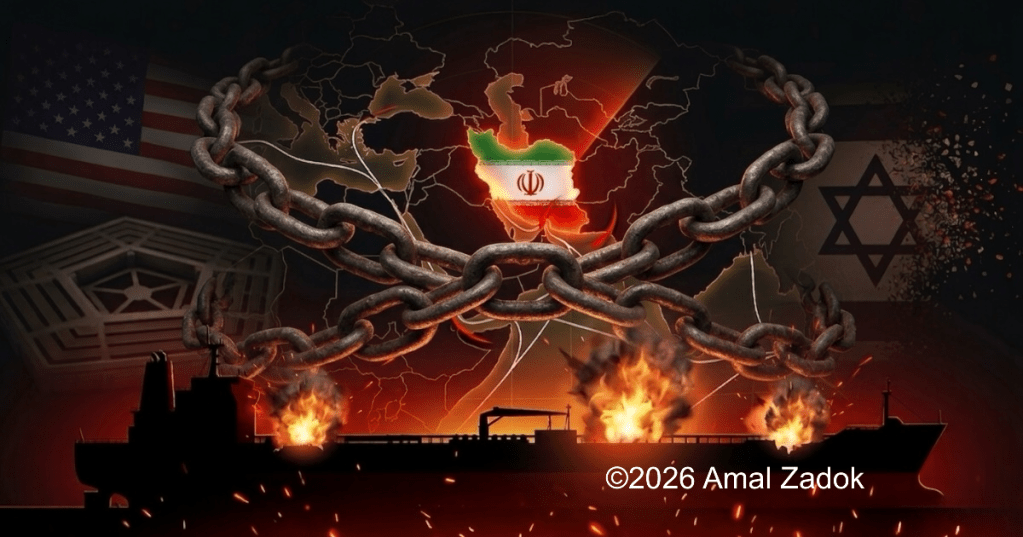
By Amal Zadok
There are moments in history when empires die without knowing it. While Donald Trump prepares another TV address and Benjamin Netanyahu basks in the ruins he helped create, Iran is quietly, methodically turning a Western-made catastrophe into something the “indispensable nation” never imagined possible: all the previous geopolitical models has been shattered and a new model is now a reality, rooted in energy, geography, and sheer strategic ruthlessness.
For decades, Washington and Tel Aviv treated Iran as a manageable problem—something to be sanctioned, bombed from time to time, and contained through a web of U.S. bases and pliant Gulf monarchies. That era is over. In barely more than a month of war, the United States and Israel have walked straight into an escalation trap of their own design, and Iran has emerged not as a victim, but as a power that now holds the knife at the throat of the global economy.
The empire that bombed itself into decline
Trump and Netanyahu sold this war as a surgical assertion of dominance: decapitate Iran’s leadership, pound its nuclear sites, cow its proxies, and re‑establish Western control over the region. What they actually did was industrialize a scenario decades in the making: the small ally (Israel) dragging the superpower (the U.S.) into a conflict structured so that any U.S. move deepens dependence and narrows exit options.
Israel’s pattern is now obvious even to those who refused to see it. Time and again, Tel Aviv triggered escalations at precisely the moments when diplomacy showed signs of life—bombing consulates, hitting gas and oil infrastructure, and forcing Washington to either “stand with Israel” or accept peace that might reduce Israel’s unilateral leverage. The U.S. chose Israel and war, again and again, until it woke up to find itself as a reactive co‑belligerent dragged behind an ally that weaponized escalation as a policy tool.
The United States has turned its own military might into an instrument of someone else’s strategy—and in doing so, it punched a hole straight through the foundations of its global power: credibility with allies, perceived restraint, and command over energy security. A superpower that can be jerked into war by a client state is not a superpower; it is a very large, very dangerous auxiliary.
Iran’s chokehold: from pariah to pivot
While American cable news debates whether Trump will “declare victory” this week, reality has moved on. The core point is brutal in its simplicity: you cannot “declare away” structural power. The war has transformed Iran’s position from a sanctioned irritant to the central spoiler at two of the most critical arteries of global trade and energy.
First, the Strait of Hormuz. Around one‑fifth of global oil exports and a similar share of LNG normally pass through this narrow passage between Iran and Oman; in this war, Iran has shown that it can throttle that flow at will—through direct threats, drones, mines, and “selective control” tactics that never quite cross the line of total closure but keep markets permanently on edge. Second, the Bab el‑Mandeb Strait at the mouth of the Red Sea, where Iran can leverage the Houthis as an indirect lever over yet another 10% of global oil and a significant fraction of global container traffic.
This dual‑chokepoint strategy is not improvisation; it is doctrine. By turning maritime geography into a pressure system—squeezing Hormuz, hinting at Bab el‑Mandeb, striking regional energy infrastructure—Iran has converted what used to be Western talking points about “freedom of navigation” into a live hostage situation for the global economy. Every tanker rerouted, every refinery struck, every Gulf state hedging away from Washington feeds the same outcome: a world forced to price in Iranian leverage day after day.
This is what a new center of power looks like at birth. It is not a shiny tower in Tehran or a declaration from the UN podium; it is the cold fact that oil traders, shipping insurers, Gulf royals, and Asian energy ministers now wake up each morning asking the same question: what does Iran choose to allow today?
The coalition that disintegrated in real time
While Iran tightens its grip, the U.S.-built security architecture in the region is crumbling in front of everyone’s eyes. The Gulf’s new landscape is already visible: Iraq bandwagoning toward Iran, Qatar and Oman staying studiously “neutral,” Saudi Arabia and the UAE increasingly alarmed and hedging, Bahrain shaken as its bases come under threat. These are not abstract “realignments.” They are choices made by regimes staring at the reality that Washington is both hyper‑militarized and strategically incoherent.
NATO, the flagship of U.S. alliance power, has been exposed as structurally hollow in this war. On paper, it remains an integrated military command headed by a U.S. general. In practice, the essential question is unavoidable: do you really believe European governments are going to follow American orders into a widened, Iran‑driven energy catastrophe after watching Trump openly threaten to walk away from NATO and blast allies as freeloaders? Politically, NATO is a corpse waiting for its obituary; the Iran war merely turned on the morgue lights.
This is the hidden genius—and cynicism—of Iran’s approach. The Islamic Republic does not need to “defeat” the U.S. military. It only needs to demonstrate, repeatedly, that Washington cannot be trusted to act as a stabilizing hegemon: that its alliances shatter under stress, that its presidents can be blackmailed by domestic politics, and that its wars generate more chaos than order. Trump and Netanyahu have delivered exactly that demonstration.
Markets’ delusion and the West’s poverty
The harshest fire now falls not on politicians, but on the global financial class that insists on believing this can all be wished away. Markets are still acting as if we are “33 days ago”—as if Iran were just 4% of the world’s oil, as if the temporary cessation of bombing or a Trump “mission accomplished” speech would reset the board to pre‑war conditions.
This is fantasy. The war has already ripped open vulnerabilities that will take years, not weeks, to patch: damaged LNG plants in Qatar, threatened Saudi and Emirati infrastructure clustered in a tiny geographic radius, re‑priced shipping risk around both Hormuz and Bab el‑Mandeb, and a wave of energy‑driven inflation that functions as a global tax on the poorest. Even “optimistic” scenario work now concedes that extended selective control by Iran could sustain triple‑digit oil, drain strategic reserves, and force emergency pipeline build‑outs that lock in Iran‑centric routing for Asian buyers.
Trump can rant about NATO. Netanyahu can declare underground victory from a bunker built on Palestinian graves. JP Morgan can keep telling itself that volatility is a trade, not a verdict. But the message to these people is simple and devastating: you mispriced the end of an era. You thought you were looking at a contained “Iran risk.” In reality, you just funded, hedged, and algorithm‑traded your way through the birth of a fourth pole of world power—one rooted not in liberal institutions, but in weaponized infrastructure, martyrdom politics, and a willingness to bleed for leverage.
Iran’s cold victory and the West’s long defeat
This is why Trump’s inevitable declaration that “the war is over” will be a lie in everything but the narrowest legal sense. You cannot call off a structural transformation with a speech. You cannot drone‑strike your way out of an escalation architecture designed to make every tactical success a strategic defeat. You cannot bomb a state, rupture its society, and then complain when it learns to weaponize the very dependencies—oil, chokepoints, regional fractures—that your empire spent decades cultivating.
The United States and Israel have done something extraordinary, and history will not forget it: they have managed to turn a sanctioned, isolated, semi‑peripheral state into a power whose decisions can throw entire continents into recession, redraw alliance patterns from the Gulf to the South China Sea, and expose the hollowness of Western claims to guardianship over the “rules‑based order.” Iran did not “earn” this overnight through some miraculous internal reform. It was handed the opportunity by the reckless, narcissistic, short‑termism of Trump and Netanyahu—and it seized that opportunity with icy clarity.
In the end, this war will not be remembered for Trump’s speeches or Netanyahu’s press conferences; it will be remembered as the month when Washington and Tel Aviv, drunk on their own myths, hammered the last nails into the coffin of unquestioned Western primacy and midwifed the rise of a new power in Tehran—proof that empires do not simply fall, they help their successors to the throne.
©️2026 Amal Zadok. All rights reserved.
 Think and be Free!
Leave a comment