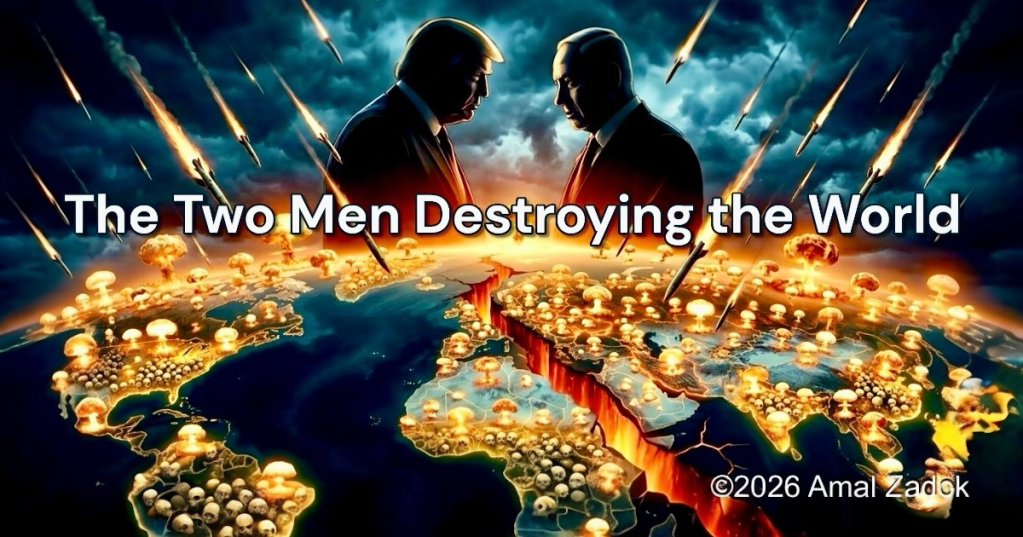
By Amal Zadok
Trump and Netanyahu are not just mismanaging crises; they are unchaining a chain of events that could merge into a perfect storm and end in nuclear war, all while wrapping themselves in flags and calling it “national security.”
Two leaders, one catastrophic dynamic
Both men treat war as a personal instrument: a way to escape legal peril, rally their base, and pose as indispensable saviours rather than compromised, cornered politicians.
They thrive on permanent crisis—“deep state” plots, existential threats from Iran, civilisational struggle—because fear silences questions about corruption, competence, or democracy. In their hands, the world’s most powerful militaries become tools for domestic political theatre, and every escalation is judged not by strategic logic, but by how it plays on television and in the polls.
Trump sells himself as the man who will “keep America out of endless wars,” yet his record is one of lighting fires and then demanding applause for not burning down the entire forest, from tearing up the Iran nuclear deal to green‑lighting maximal pressure campaigns that made conflict more likely.
Netanyahu, for his part, has built an entire regime on permanent siege: hollowing out Israeli democracy, deepening occupation, and insisting that only maximal pressure and military force can keep Israel alive. A de‑escalated, stable region would expose that decades of his “toughness” have delivered isolation, radicalisation, and dependence on US protection.
Washington under Netanyahu’s shadow
Washington does not need a secret tape to prove it is marching to Netanyahu’s drum; the proof is written in policy. For years, US presidents—Trump most of all—have treated Israeli red lines as sacred scripture and American interests as negotiable footnotes, sending bombs, money, and UN vetoes on demand while swallowing public humiliation from a foreign prime minister who openly campaigns inside their Congress.
When Netanyahu wants Iran smashed, the operative question in Washington is not whether that serves the long‑term safety of the American people, but how fast US power can be mobilised to fit his timetable, even if it means blowing up nuclear deals and regional diplomacy.
Again and again, US choices on Iran, Palestine, and the wider Middle East track Israeli priorities even when they clearly damage broader American interests, destabilise energy markets, and put US troops in harm’s way.
Nuclear agreements are torched, ceasefires undermined, and sanctions escalated because Netanyahu’s domestic survival and ideological project require permanent confrontation.
In practice, the most dangerous choices in the region are not made in the White House Situation Room, but in the mind of an Israeli leader who has fused his personal fate with perpetual war—and a frightened, compromised Trump has shown himself willing to sign the cheques and pull the trigger, no matter the cost.
Two wars feeding one perfect storm
On one front, the war in Ukraine has become a grinding confrontation between Russia and a Western‑armed Ukraine, with NATO hovering one misstep away from direct clash.
Russia faces not just Kyiv but a coalition: 32 NATO members plus at least a dozen other states have supplied weapons, money or training, meaning more than 40 countries are materially involved on Ukraine’s side alone. Russia is in turn supported by Iran and North Korea with drones, missiles, and ammunition, and enabled economically and technologically by China’s “no limits” partnership.
On another front, the US‑Israel campaign against Iran has expanded far beyond two flags. Directly or indirectly involved are the United States, Israel, Iran, Lebanon (Hezbollah), Syria, Iraq, Yemen (Houthis), Jordan, Saudi Arabia, the UAE, Qatar, Kuwait, Bahrain, Oman, Cyprus (via British bases), and others—well over a dozen states engaged as belligerents, hosts, or targets.
The geography of violence now stretches across Ukraine and European Russia, the Black Sea and Azov Sea, the Eastern Mediterranean, the Red Sea and Bab el‑Mandeb, the Persian Gulf, and crucial chokepoints like the Strait of Hormuz, turning half the Eurasian rim into a single, connected battlespace.
Economic shock and energy choke points
This is not just a military map; it is an economic time bomb. Around 20–30 percent of globally traded oil and a major share of LNG flow through the Strait of Hormuz, and Iranian attacks plus US–Israeli operations have already brought traffic there close to a standstill. With Iran now effectively closing Hormuz—mining, missile threats, and direct strikes on tankers—roughly a fifth of the world’s oil exports and key gas flows have been disrupted, sending Brent crude into triple‑digit territory and pushing gas prices back toward the record highs of 2022.
Analysts warn that a prolonged shutdown could be “three times worse” than the 1970s oil shocks, driving sustained spikes in fuel, food, and transport prices worldwide and tipping vulnerable economies toward recession within weeks. Insurance premia for shipping through the Gulf, Red Sea and Eastern Med have already soared, freight routes are lengthening, and central banks are forced to balance inflation against stagnation—precisely the kind of stagflationary trap that breeds political extremism and more war.
How the chain of escalation can lock in
If you want to see how this becomes a perfect storm, you do not need conspiracy; you only need a sequence.
1.In Ukraine, a Western‑enabled strike hits deep inside Russia, causing mass casualties or destroying a key strategic target, and Moscow answers with a major escalation—large‑scale missile salvos, cyber‑attacks on NATO infrastructure, or a strike that lands on NATO soil.
2.Under Trump’s erratic leadership, NATO cohesion is frayed, but alliance obligations remain; faced with dead soldiers or a destroyed base, at least one member demands retaliatory strikes on Russian targets.
3.Simultaneously, in the Middle East, Netanyahu pushes further into Iran—hitting core infrastructure, leadership, or civilian centres—and Tehran, convinced its survival is at stake, answers with heavier missiles and sustained attacks on Gulf energy infrastructure and US bases.
4.Washington finds itself in live confrontations with a nuclear‑armed Russia in Europe and a large, battle‑hardened Iran and its proxies across the Middle East, while China recalculates risks and opportunities in East Asia.
5.Under crisis conditions, with shortened decision times and maximal distrust, the risk that someone misreads a radar return, misclassifies a missile, or decides on a “demonstration” nuclear strike as a way to shock the other side into backing down, rises sharply. Once one nuclear taboo is broken, the psychological barrier to further use erodes everywhere.
This is the chain Trump and Netanyahu are helping to forge—not with one dramatic order, but through a series of “tough” choices that close off exits, shred treaties, and normalise permanent escalation.
Hubris at the nuclear precipice
The most frightening element is not just their aggression, but their hubris. Both men think they can ride the tiger: escalate when it suits them, pull back when it doesn’t, and bully rivals into submission by sheer unpredictability. They treat other nuclear‑armed states as if they were domestic opponents—assuming that enough pressure and theatre will eventually force capitulation—when history shows that cornered regimes with nuclear capabilities dig in and prepare to take others down with them.
As they do this, democracies are paralysed and polarised: half the population terrified of war but unsure how to resist it, the other half whipped into a frenzy against “traitors” and “appeasers.” Institutional brakes—parliaments, courts, civil services, alliances, international law—are weakened or bypassed, precisely when they are most needed to prevent catastrophe.
Why the public must be warned
The point of naming Trump and Netanyahu is not to personalise a structural crisis for drama’s sake; it is to make clear that individual choices by specific, deeply flawed men are accelerating us toward the edge.
They have normalised contempt for international law, weaponised fear for domestic gain, dismantled guardrails, and fused their own survival with a politics of permanent confrontation. If the wars in Ukraine and Iran ultimately merge into a perfect storm, history will not record this as an unforeseeable “tragedy,” but as the foreseeable outcome of letting reckless, cornered leaders treat the world’s most volatile flashpoints as props in their personal dramas.
The warning to the public must be as stark as the danger itself: this is not a distant chess match among superpowers, it is the slow‑motion preparation of our own funeral. Every new front opened, every strait choked, every treaty shredded is another spark dropped into a room already filled with gasoline fumes.
A world in which these men remain unchallenged at the helm is a world sleepwalking toward sirens in the night, skies lit by fire, and cities that vanish in a single flash. If we do not tear our gaze away from their theatre and seize back the machinery of war and peace, the “perfect storm” they are summoning will not just rearrange borders; it will write the epitaph of our civilisation.
©️2026 Amal Zadok. All rights reserved.
 Think and be Free!
Leave a comment