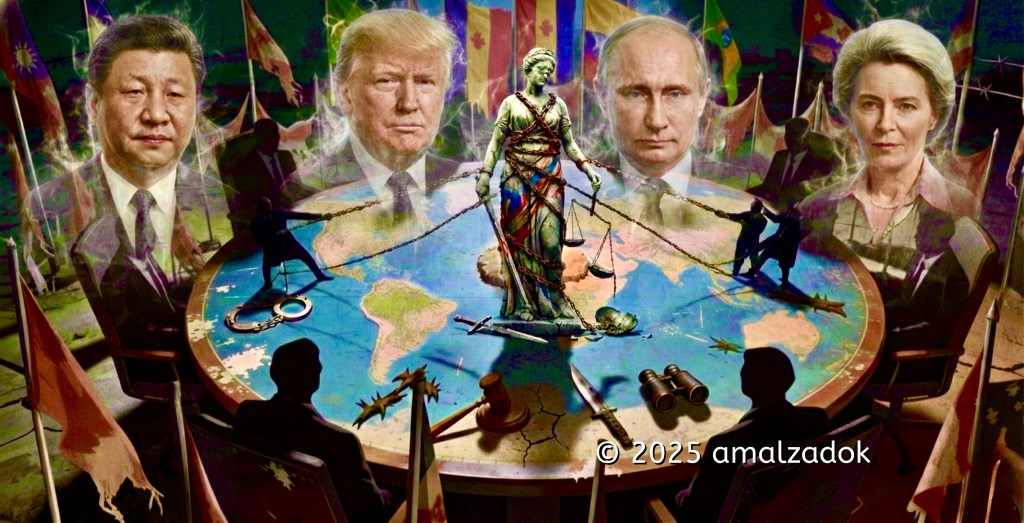
by Amal Zadok
Humanity has witnessed yet another dark milestone with the capture of Maduro, an act carried out in brazen disregard for international law and national sovereignty. Welcome to the emerging world order: the law of the jungle, where might makes right and brute force replaces rules, dialogue, and basic decency. The great post-war hope that law and institutions would restrain power now looks increasingly fragile, even illusory.
This moment evokes the ghosts of history’s worst tyrants and destroyers: a new Attila the Hun trampling borders, a modern Genghis Khan sweeping aside treaties, the cold calculation of Stalin, the ruthless brutality of Pol Pot. Names once studied as warnings in history books now feel like prototypes for contemporary leaders and regimes. When law is treated as optional, and power as the only currency, the distance between “civilised world” and barbarism shrinks at terrifying speed.
Humanity is not evolving but devolving, sliding back into a kind of global “wild wild west,” where justice becomes a slogan, not a standard. In this climate, promises mean little, agreements are discarded when inconvenient, and smaller nations become pawns on a geopolitical chessboard. The message to the world is chillingly clear: security, dignity, and freedom are no longer protected by shared rules, but only by raw strength or the favour of the powerful.
This raises a searing moral question that can no longer be avoided: Is this the world you want your children and grandchildren to inherit? A world where borders, laws, and human rights exist only on paper, where fear replaces trust, and where tomorrow’s history books will record our silence as complicity? If the answer is no, then indignation is not enough. The time has come to speak, to resist, and to insist—publicly and persistently—that law, justice, and human dignity must not be sacrificed on the altar of power.
What we are witnessing is not an accident or an unfortunate exception; it is a deliberate strategy. Under the cloak of “security” and “stability,” powerful states and blocs are testing how far they can stretch the fibres of international law before they snap entirely. Each violation that goes unpunished becomes a rehearsal for the next, bolder transgression.
Every muted response, every carefully worded statement that refuses to name the crime for what it is, signals permission to escalate. In this perverse theatre, language itself is weaponised: kidnappings become “operations,” political persecution becomes “cooperation,” and naked coercion is marketed as “defending democracy.” The public is fed a diet of euphemisms designed to dull outrage and anesthetise conscience, while behind closed doors decisions are made that redraw the moral map of the world without consultation or consent.
Meanwhile, the institutions built in the aftermath of global catastrophe stand by, diminished and intimidated. Bodies that were meant to uphold law now often serve as stages for power politics, reciting scripts written by the very actors they should restrain. Votes are traded, principles are diluted, and the rhetoric of human rights is deployed selectively, depending on who is friend and who is foe.
In such a climate, smaller nations learn a bitter lesson: their sovereignty is conditional, their legal protections negotiable, and their leaders expendable if they dare challenge entrenched interests. The signal to dissidents and strongmen alike is devastatingly clear—if you have the favour of the right patrons, you can act with impunity; if you stand in their way, you can be taken, tried, or erased.
Citizens, too, are being trained—trained to accept the unacceptable, to scroll past the shocking, to treat the dismantling of norms as background noise. Outrage burns briefly and then is swallowed by the next cycle of distraction. Yet beneath the surface, something corrosive is happening to the collective moral imagination.
When people cease to believe that law can protect the weak, they begin to respect only force. When they see that principles are invoked only when convenient, they lose faith in the very idea of justice. This cynicism is precisely what the architects of the new disorder desire: a population too disillusioned to resist, too divided to unite, and too weary to hope.
Because make no mistake: what is being normalised today is not an isolated event, but a template. Abduction dressed up as “extradition,” coercion baptised as “cooperation,” the crude humiliation of a nation sold as a triumph of “justice.” The precedent could not be clearer: if a powerful alliance decides you are an enemy, then your sovereignty, your legal protections, your very personhood are negotiable—and negotiable in closed rooms where your voice is never heard.
This is not an international community; this is a hunting party with flags. Do not hide behind the illusion that this is “far away” or “about someone else.” The tools used today—secret flights, compliant courts, manufactured narratives—are technologies of control that can be turned on anyone tomorrow.
The language being perfected now, the vocabulary of targeted arrests, regime change, and “exceptional measures,” will be the same language used to crush dissent, silence journalists, and intimidate entire populations when it suits the powerful. The machinery of lawlessness never stays at the border; it expands to fill every space left undefended.
Here is the ominous truth: the cage being built is global. Bars of fear, walls of apathy, locks forged from our own cowardice. Your children and grandchildren will grow up under skies crossed by drones and under laws that can be suspended with a single emergency decree.
They will inherit a world where the knock at the door can no longer be trusted, where asking the wrong question is a risk, and where speaking the wrong truth can cost a career, a freedom, a life. And when they turn to the past and ask, “Who let this happen?”, the mirror will be waiting.
Remember this, and do not forget it: history is not only written by the victors; it is also written about the spectators. If you accept this descent into the abyss as “normal,” if you swallow the lies and mute your conscience, then you are not merely living through a dark chapter—you are co‑authoring it.
The world is being turned into a hunting ground, and law itself has been marked as prey. If you do not stand now, while you still can, one day you will wake up to find that it is your future, your family, and your faith in justice that have been captured—and there will be no one left to speak your name.
©️2026 Amal Zadok. All rights reserved.
Subscribe and never miss an article!
 Think and be Free!
Leave a comment