by Amal Zadok
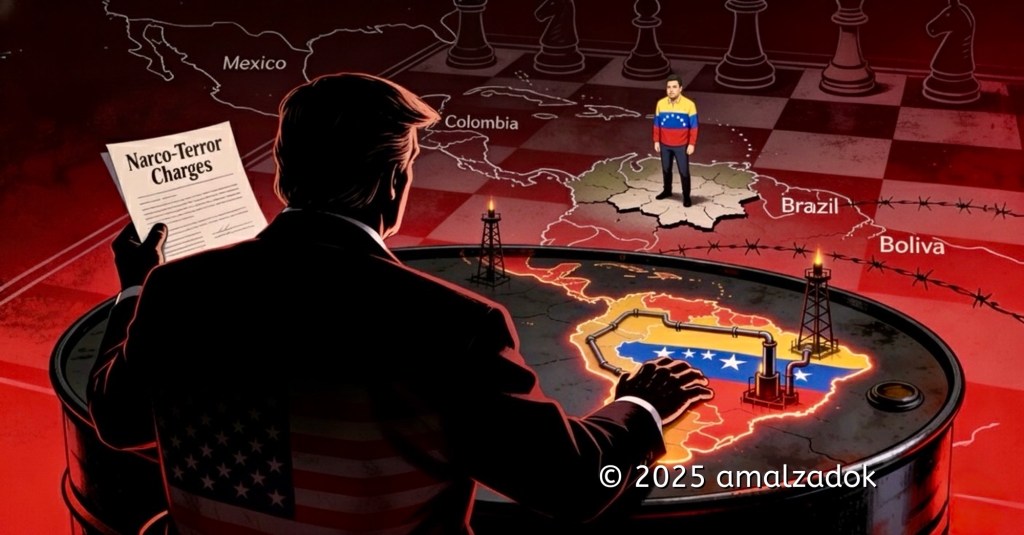
The New York narco‑terror indictment against Nicolás Maduro is not about protecting Americans from cocaine; it is the legal cover for a U.S. bid to seize control of Venezuela’s oil and run the country as a protectorate. Trump has said it plainly: the United States will “run” Venezuela, U.S. corporations will pour in “billions” to rebuild its energy sector, and they will take the wealth “out of the ground” so the operation “costs us nothing.” This is not drug policy. It is looting dressed up as law.
The official story is a familiar Washington thriller: a rogue “narco‑dictator” plotting with guerrillas to flood U.S. streets with cocaine, forcing a reluctant empire to act. Yet U.S. and UN drug‑trade data tell a very different story. Venezuela is, at most, a side corridor in the hemispheric cocaine economy, while the overwhelming flows of narcotics into the United States come through the Eastern Pacific, Central America, and Mexico.
Serious monitoring has long estimated that only around 5–10 percent of Colombian cocaine transits Venezuela in a given year, while roughly 90 percent of U.S.‑bound cocaine uses Western Caribbean and Eastern Pacific routes dominated by Mexico‑based cartels. Some analyses of documented maritime shipments show that in a recent year barely 8 percent of sea‑borne South American cocaine departed via Venezuela and the southern Caribbean, with the rest hugging Pacific and Central American routes north. DEA threat assessments accordingly focus on Mexican cartels and synthetic opioids, often relegating Venezuela to a marginal note, if they mention it at all. The data destroy the U.S. case: the “narco‑state” narrative is not a description of reality but the script for an intervention.
If the real goal were saving American lives from drugs, the targets are obvious. The fentanyl that is killing tens of thousands of Americans is overwhelmingly produced by Mexican organizations using chemical precursors sourced from Asia, not air‑dropped over the Caribbean by Venezuelan generals. Cocaine destined for U.S. cities overwhelmingly travels through Pacific and Central American routes controlled by Mexico‑based cartels, not through a marginal Atlantic detour. Yet Washington chose to bomb Venezuela and abduct its head of state, not to blockade Mexican cartels or meaningfully disrupt precursor supply chains. That choice betrays the truth: this is not a war on drugs. It is a war on a government sitting atop the world’s largest proven oil reserves, and a warning to any state that dares to challenge U.S. energy dominance.
The indictment itself exposes the weakness of the narco‑fable. It relies heavily on cooperating witnesses, sensational claims about a “Cartel of the Suns,” and a few notorious cases, such as the conviction of the “narco‑nephews” related to Maduro’s wife, while glossing over the basic fact that Venezuela neither grows coca nor manufactures synthetic opioids. No serious analyst denies that Venezuelan officers and officials have dipped their hands into trafficking; corruption inside the state is real and corrosive. But scattered corruption does not a hemispheric hub make, and the attempt to inflate every crooked colonel into proof of a unified state conspiracy reveals more about prosecutors’ ambition than about the actual geography of the drug trade. The “narco‑state” label functions less as an empirical category and more as a magic word, unlocking sanctions, military deployments, and—now—regime change.
The military operation against Maduro shows just how convenient that label is. U.S. forces and allied actors executed a near‑perfect decapitation strike: seize the president, fly him to New York, and leave the rest of the machinery standing. If Venezuela were truly an intolerable “narco‑dictatorship,” one would expect the supposed cartel‑state to be dismantled, the institutions “liberated” from their criminal capture, and the security forces re‑founded. Instead, the same authoritarian, corrupt structures remain in place—only now they operate under a new balance of power, with Washington openly boasting that it will oversee the country’s transition and economy. The dictatorship has not fallen; it has changed landlords.
Corruption, far from being eradicated, is the lubricant of this new arrangement. The very fact that elements of the Venezuelan armed forces and political class could be bought or persuaded to hand over Maduro is evidence that the regime’s moral rot is intact. Washington did not come to cleanse that rot; it came to use it. A pliable officer corps, a bureaucracy trained in clientelism, and a security apparatus habituated to repression are not obstacles to a foreign power—they are assets. They allow an outside actor to decapitate a leader, slap the label “transition” on the operation, and continue business as usual with a few new faces at the top and new signatures at the oil ministry.
Trump’s own words remove any remaining doubt about what “business as usual” means. He has bragged that the United States will “run” Venezuela until a satisfactory transition occurs, that U.S. oil majors will invest the “billions” needed to restore production, and that Venezuelan crude will pay for the intervention. Major outlets report officials discussing how American companies will help “restore” output and export Venezuelan oil to global markets, including to rivals like China. In the same breath, Trump has floated the idea that “the hemisphere is in play” and hinted that Washington is reclaiming “what was ours in the past.” This is not the language of partnership or sovereignty. It is the language of empire recovering a lost concession, with oil contracts in one hand and an indictment in the other.
Inside the United States, the way this was done reveals a parallel slide toward authoritarianism. Trump acted without a formal declaration of war, without robust congressional debate, and with legal rationales that stretch the notion of self‑defense to the breaking point. In effect, one man, backed by the permanent national‑security apparatus, decided to overthrow a foreign government, occupy its territory in all but name, and hand its key industry to private corporations—all while presenting this as law enforcement. Washington condemns Maduro as a dictator even as it normalizes the presidential prerogative to wage undeclared wars of regime change. If dictatorship means unchecked executive power fused with militarism and economic plunder, the finger does not point only south.
The media chorus has largely gone along, amplifying the narco‑fable and muting the resource grab. Major outlets have repeated, with minimal scrutiny, claims that Venezuela is a central cocaine menace, even when drug‑trade experts cited in the same stories note that the evidence does not support such a dramatic role. Critical voices and UN‑linked analyses showing Venezuela’s marginal place in the global cocaine map have been pushed to the margins, treated as technical quibbles rather than as the demolition charges they are under the official narrative. When the facts and the story diverge, the story wins—backed by bombs, not by data.
Strip away the propaganda and what remains is brutal simplicity. A superpower has used exaggerated and selectively framed drug charges to remove a hostile leader, keep his authoritarian machinery, and seize practical control over a vast pool of oil. Maduro, an undeniably authoritarian and corrupt figure, has been transformed into the necessary demon for a larger project: the normalization of twenty‑first‑century colonialism under the banner of the “war on drugs” and “democratic transition.” The question is no longer whether Maduro deserved to face justice—Venezuelans themselves had long reasons to oppose him—but whether the United States has any right to turn a country into a protectorate because its president is unpopular in Washington and its oil fields are attractive to Chevron.
A president who boasts that he will “run” Venezuela and reclaim “what was ours in the past” is announcing a doctrine of permanent devouring, one in which Latin America is reduced again to a buffet of oil, gas, minerals, and cheap labor for a power that has been quietly pushed out by the big‑league players in Europe and Asia and now turns back to its “backyard” in search of easy prey. As U.S. influence erodes in Brussels and Beijing, the temptation grows to reassert dominance where the costs seem lower and the resistance more fragmented: will it be Mexico, eternally vilified as a fentanyl factory; Colombia, treated as a forward operating base rather than a sovereign nation; Brazil, with its Amazon and pre‑salt oil; or lithium‑rich Bolivia, already punished once for daring to industrialize its own wealth? A president who bombs first and never bothers to ask Congress has sketched a roadmap in which borderlines are negotiable but corporate concessions are sacred, and at some point the question ceases to be whether one man in Caracas deserved to fall and becomes whether an entire region is prepared to live forever as a colony of a superpower that no longer even pretends to respect its own constitution when it goes to war.
References
1.Evrim Ağacı. (2025, September 2). UN report contradicts US claims on Venezuela drugs.
2.U.S. Drug Enforcement Administration. (2024). National Drug Threat Assessment.
3.Washington Office on Latin America. (2021). Beyond the narcostate narrative: What U.S. drug trade monitoring data says about Venezuela.
4.USA Today. (2025, December 9). Trump says Venezuela traffics lethal drugs into US. Experts disagree.
5.Al Jazeera. (2025, October 24). The US warships off Venezuela aren’t there to fight drugs.
6.NBC News. (2026, January 3). Trump says U.S. will govern Venezuela until there’s a “proper transition”.
7.Al Jazeera. (2026, January 3). Trump says US will “run” Venezuela after Nicolas Maduro seized.
8.Vox. (2026, January 3). Trump says the US is going to “run” Venezuela. What does that mean?
9.Reuters. (2026, January 3). Trump says US oil companies will spend billions to restore Venezuela’s crude output.
10.The Hill. (2026, January 3). Trump says US will “run” Venezuela, control oil production.
11.U.S. Department of Justice. (2025). Nicolás Maduro Moros and 14 current and former Venezuelan officials charged with narco‑terrorism, corruption, drug trafficking, and other criminal offenses.
12.Transparencia Venezuela. (2024). Drug trafficking in Venezuela 2024.
13.Chatham House. (2026, January 2). US to “run” Venezuela after Maduro captured: Early analysis.
14.Al Jazeera. (2025, September 4). Is Venezuela the big cocaine menace Trump claims it to be?
15.FAIR. (2025, November 18). Corporate media parrot dubious drug claims that justify war on Venezuela.
16.Statista / IntelliNews. (2025, November 18). Few cocaine shipments head north from Venezuela.
17.UNODC. (2023–2025). Global and transatlantic cocaine reports.
18.Venezuelanalysis. (2025, September 1). Oil geopolitics disguised as “war on drugs”.
19.Military.com. (2025, November 2). Venezuela in 2025: Realities, drug‑transit claims, and international law dimensions.
20.CodePink. (2025, December 14). Trump’s Venezuela drug war gambit and the militarization of the Caribbean.
21.Al Jazeera. (2025, December 4). Meet the US’s drug‑running friends: A history of narcotics involvement.
22.BBC / CNN and related outlets (2025–2026). Coverage of Trump’s capture announcement and regional strategy.
©️2026 Amal Zadok. All rights reserved.
Subscribe and never miss an article!
 Think and be Free!
Leave a comment