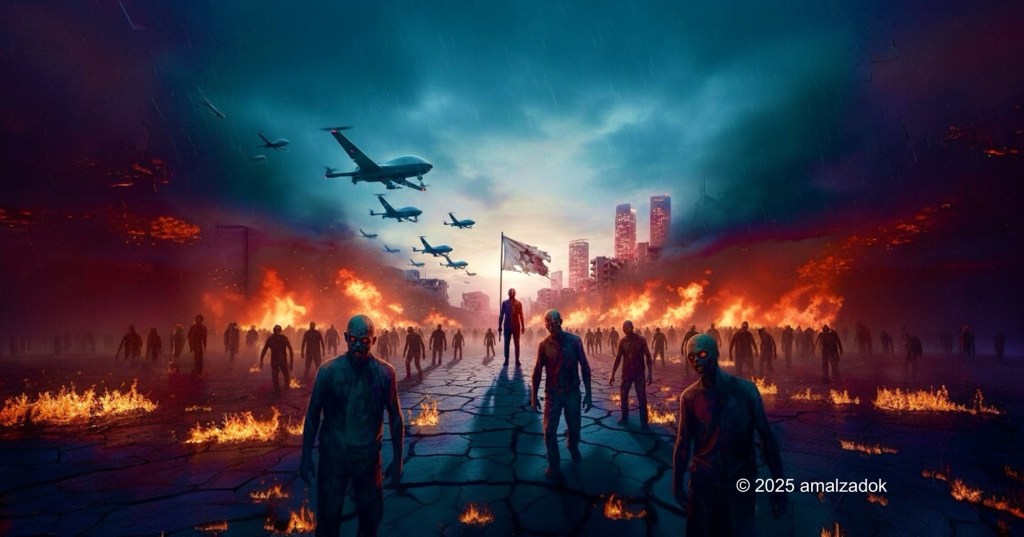
by Amal Zadok
In an age where global crises are engineered and suffering becomes an instrument of policy, Achille Mbembe’s theory of necropolitics offers a piercing lens to decode the moral decay of modern geopolitics. Mbembe (2003) defines necropolitics as the use of power to determine “who may live and who must die,” extending Michel Foucault’s notion of biopolitics into the domain of death.
This framework exposes how democracies manufacture legitimacy through the management of death—structuring societies and global systems around hierarchies of disposability.
Today, the necropolitical project manifests vividly in the United States and Israel: two democracies that proclaim freedom while orchestrating survival and extinction with calculated precision.
Both reveal how death itself has become a resource—economically lucrative, politically stabilizing, and ideologically normalized (Mbembe, 2019; Ribeiro, 2021).
The Necropolitical Economy of the United States
The United States presents necropolitics not as contradiction but as continuity. Its foundations—indigenous genocide, slavery, and imperial conquest—were already necropolitical acts, later institutionalized through systems of racialized policing, mass incarceration, and economic neglect (Mbembe, 2019; Ribeiro, 2021).
Mbembe’s insight that sovereignty manifests most clearly as the capacity to “let live and make die” is reflected in America’s management of racialized death—from police killings of Black citizens to deliberate neglect of healthcare and environmental safety (Mbembe, 2003).
These mechanisms are structural, transforming inequality into ongoing necropolitical governance (Ribeiro, 2021). Death is not an accident of policy; it is its outcome. Tens of thousands perish each year from preventable illness in the wealthiest nation on Earth—a slow death rationalized as “personal responsibility.”
At the border, necropolitics transforms geography into a weapon. The militarization of U.S. immigration strategy turns deserts into lethal deterrents, designed to kill without direct violence (Allinson, 2015).
America’s Global Necropolitics and the Business of War
Globally, American necropolitics thrives through militarism and the arms trade. Mbembe (2003) warned of modern imperialism’s “generalization of death”—a defining feature of the U.S. defense-industrial complex.
This industry profits from endless conflict, ensuring weapons production translates into political legitimacy (Stavrianakis, 2025). Each war fuels corporate dividends while consolidating imperial reach.
From Iraq to Ukraine, the U.S. has institutionalized a war economy that treats human life as expendable for geopolitical gain (Carrigan, 2010; Dillon, 2007).
The nuclear threat reaffirms sovereignty by monopolizing annihilation—an ultimate expression of necropower (Mbembe, 2019).
Israel and the Architecture of Genocide
If the U.S. industrializes death globally, Israel perfects it domestically. Gaza is a case study in necropolitical confinement—a controlled deathworld where life persists only to witness its erasure (Hassan, 2025; Mbembe, 2003).
By withholding Palestinian bodies, Israel governs even grief itself, managing memory as part of occupation.
The ongoing assault on Gaza reveals necropolitics fused with racial ideology. As Israeli leaders publicly dehumanize Palestinians, state policy transforms genocide into an administrative process (Al Jazeera, 2023).
Through blockades and selective bombardment, existence itself becomes contingent—a system of “bio-necro collaboration” that sustains life only to orchestrate its breakdown (Allen, 2024).
Necropolitics in the Caribbean: The United States Turns the Sea into a Grave
The Caribbean has become America’s latest necropolitical frontier. Since September 2025, the U.S. Navy has executed seven deadly strikes against Venezuelan fishing boats, killing over thirty civilians accused without evidence of narcotrafficking (BBC, 2025; Reuters, 2025). These operations, celebrated by President Trump, mark the first officially confirmed U.S. strikes in Latin America since Panama (Wikipedia, 2025).
Human Rights Watch condemned these attacks as “extrajudicial killings,” noting the absence of verified evidence or judicial oversight (Human Rights Watch, 2025). Two survivors were detained at sea—without rights—while Admiral Alvin Holsey, head of SOUTHCOM, resigned abruptly amid growing controversy (CNN, 2025; The Hill, 2025).
The Venezuelan government denounced the operations as “massacres in international waters,” accusing Washington of acting as “jury, judge, and executioner” (UN Press, 2025). This necropolitical act at sea echoes Israel’s strikes on Gaza fishermen—democracies of death erasing both evidence and empathy.
Necropolitics and the Moral Hypocrisy of Democracy
Both nations frame necropolitical violence as moral necessity. Beneath democratic rhetoric, they operate on Mbembe’s paradox of sovereignty—deciding who is disposable while calling it defense (Mbembe, 2019). The same states that brand others genocidal industrialize it in practice.
In Gaza, civilians die in seconds. In Venezuelan waters, they drown unseen. In both, the necropolitical rhythm is constant: death normalized as policy, killing justified through law, and silence sold as order.
Mbembe’s concept thus becomes prophecy—complex bureaucracies, global arms profits, and the spectacle of impunity masking death as democracy.
Conclusion: Life Beyond the Machinery
The necropolitical order will not end through outrage but through reimagining sovereignty as care, not control. The United States and Israel have turned governance into global death management—proving Mbembe’s (2003) thesis that modernity’s violence is not an accident but its structure.
Today, the empire’s ghosts drift across oceans—from the bones of Venezuelan fishermen to the rubble of Gaza—summoning humanity to choose between complicity and conscience. When democracies begin to measure power by the precision of their assassinations, they cease to be democracies and become empires of necropolitics.
Each drone, each blockade, and each strike against the powerless reveals governance through death disguised as justice.
Yet necropolitics, like all tyrannies, carries within it the seed of collapse—for a civilization that defines itself by whom it can kill will one day discover that it has killed its own soul. The waves off Venezuela and the ruins of Gaza are no longer distant tragedies—they are mirrors to humanity’s conscience, reflecting how near we have come to becoming the living dead of our own design.
References
Allen, L. (2024). Sanctions and bio-necro collaboration: Gaza as a deathworld. Yale Journal of International Law, 49(3), 72–95.
Allinson, J. (2015). The necropolitics of migration. Political Studies, 63(3), 134–150.
Al Jazeera. (2023, November 9). ICC receives lawsuit over Israel’s ‘apartheid,’ ‘genocide’ in Gaza. Retrieved from https://www.aljazeera.com/news/2023/11/9/icc-receives-lawsuit-over-israels-apartheid-genocide-in-gaza
BBC. (2025, October 17). US captures two survivors after attack on Venezuela ‘drug’ boat. Retrieved from https://www.bbc.com/news/articles/ce8zd5nylpmo
Bonaiuti, C. (2025). Trade, geopolitics and ethics from the First Gulf War to today. Journal of Global Ethics, 39(1), 65–89.
Brooks, A. (2024). Beyond Apartheid Israel. Critical Middle East Studies, 28(2), 144–166.
Carrigan, M. (2010). Necropolitical power and nuclear sovereignty. Security Dialogue, 41(6), 579–601.
CNN. (2025, October 19). US military build-up in Caribbean as Trump pressures Venezuela. Retrieved from https://www.cnn.com/2025/10/19/world/us-military-build-up-caribbean-trump-pressures-venezuela
Dillon, M. (2007). Sovereignty and the death drive. International Political Sociology, 1(1), 1–12.
Hassan, B. (2025, March 5). Disciplining the dead: Israel’s necropolitics in Palestine. Synergy for Justice.
Human Rights Watch. (2025, September 17). US: Maritime strikes amount to extrajudicial killings. Retrieved from https://www.hrw.org/news/2025/09/18/us-maritime-strikes-amount-to-extrajudicial-killings
Mbembe, A. (2003). Necropolitics. Public Culture, 15(1), 11–40. https://doi.org/10.1215/08992363-15-1-11
Mbembe, A. (2019). Necropolitics. Duke University Press.
Ribeiro, C. J. (2021). Necropolitics and diffuse violence: Critical reflections on the state and structural death. Journal of Postcolonial Studies, 44(2), 145–165.
Reuters. (2025, October 17). How many US strikes on boats near Venezuela have there been? Retrieved from https://www.reuters.com/world/americas/how-many-us-strikes-boats-near-venezuela-have-there-been-2025-10-17/
Stavrianakis, A. (2025). Arms trade and the transformation of global order. International Studies Quarterly, 5(2), 233–261.
UN Press. (2025, October 9). Venezuela calls Caribbean vessel attacks “extrajudicial killings.”Retrieved from https://press.un.org/en/2025/sc16190.doc.htm
Wikipedia. (2025, September 1). 2025 United States strikes on Venezuelan boats. Retrieved from https://en.wikipedia.org/wiki/2025_United_States_strikes_on_Venezuelan_boats
The Hill. (2025, October 19). Holsey’s retirement raises concerns over Caribbean strikes. Retrieved from https://thehill.com/policy/defense/5562049-holsey-departure-raises-alarms/
©️2025 Amal Zadok. All rights reserved.
Subscribe and never miss an article!
 Think and be Free!
Leave a comment