by Amal Zadok
Twisting the name of God into a launch code for annihilation.
Lindsey Graham has long been Washington’s high priest of holy war — a man who speaks less like a statesman and more like a harbinger of false prophecy and war, a wolf in prophet’s clothing who preaches wrath and deception, twisting God’s name to serve violence and deceive the faithful.
On August 14, 2025, in front of an evangelical crowd in South Carolina, he declared: “If America pulls the plug on Israel, God will pull the plug on us.”
It was not policy — it was prophecy soaked in gunpowder: align with his vision, or face divine and earthly ruin.
To Graham, Israel is the altar, the battlefield, and the ultimate excuse for American escalation.
No ceasefires, no half-measures, no diplomacy — only fortresses of steel rising above rivers of blood and rubble, and the promise of annihilation for the other side.
In his world, “victory” is not the absence of war but the complete erasure of enemies from the map, sanctified by scripture and paid for in blood.
But in wielding the name of God to justify war and mass killing, Graham crosses into the territory the Bible itself warns about — the realm of false prophets who twist holy words for unholy ends. He is a shameful manipulator of faith, draping divine authority over earthly violence, trading the teachings of peace for the theater of fear.
The prophets of scripture called for repentance, justice, and mercy; Graham calls for missiles, vengeance, and annihilation. In doing so, he stands not with the shepherds of God’s flock, but with the wolves in sheep’s clothing.
His rhetoric has repeatedly crossed into the nuclear — literally. In October 2024, as bombs flattened neighbourhoods in Gaza and plumes of black smoke choked the sky, Graham invoked the ghost of Hiroshima and Nagasaki: “Why did we drop two bombs—nuclear bombs—on Hiroshima and Nagasaki? To end a war we couldn’t afford to lose.”
The subtext was unmistakable — if Israel’s survival demands another Hiroshima, so be it. The human cost — children incinerated in streets, entire cities erased in a flash — is not a deterrent in his calculus, but collateral proof of resolve.
Years earlier, he floated preemptive strikes on Iran, conjuring images of its nuclear facilities reduced to glowing craters; he mused about the “total destruction” of North Korea, envisioning it consumed in fire from the sky.
Time and again, he has treated diplomacy as a hollow ritual, a brief interlude before the “real” solution: overwhelming force.
To Graham, America’s role is not as a builder of peace but as the unblinking sword of God, swinging wide enough to cleave nations in half.
Critics call him a warmonger, a zealot, a man whose political compass points permanently toward the next conflict. Supporters call him steadfast and unflinching. Both are right — but only one side seems to grasp that when Graham speaks of fire from heaven, he is not speaking in metaphor.
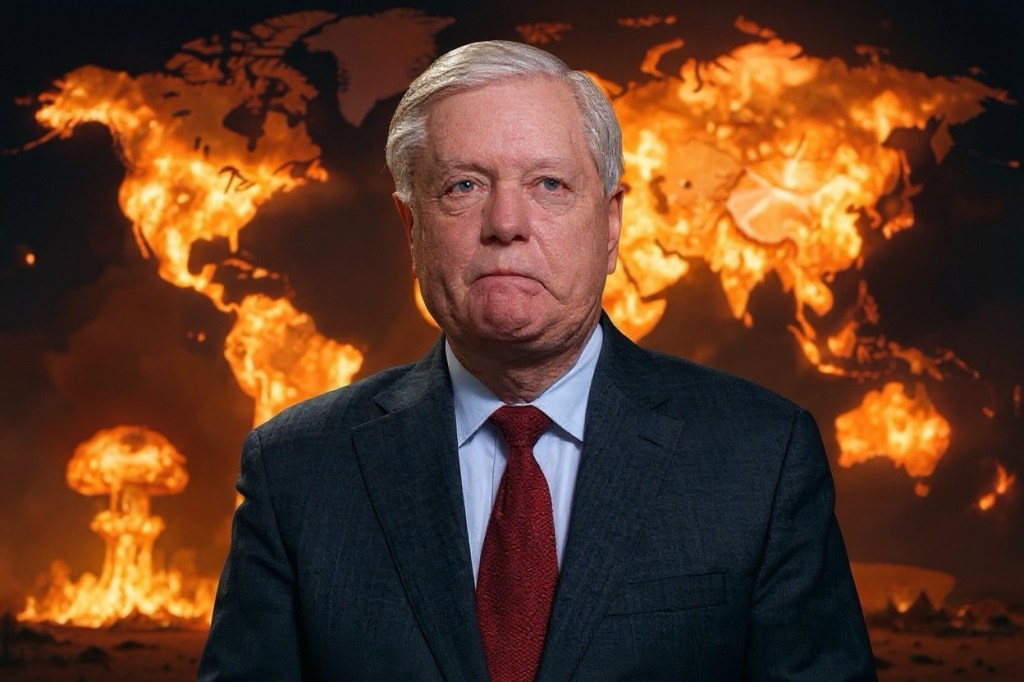
Lindsey Graham doesn’t just flirt with the abyss — he drags the nation to its edge and begs it to jump. His brand of politics fuses piety with annihilation, a theology of war where mushroom clouds are not the specter of catastrophe but the righteous blaze of victory.
In Graham’s worldview, there is no proportionality, no diplomacy worth the paper it’s written on — only the doctrine of overwhelming force, sanctified by faith and armed to the teeth. It’s a gospel of obliteration, where the “will of God” doubles as the launch code, and anyone in Washington who dares to reach for the plug on Israel risks not divine disfavor, but the senator’s own unapologetic push toward a world where nuclear fire is a policy option, not a last resort.
History will either forget him or remember him as the man who believed salvation came with a blinding flash and a heatwave strong enough to turn cities into dust.
©️2025 Amal Zadok. All rights reserved.
Subscribe and never miss an article!
 Think and be Free!
Leave a comment